AI Shocks Again: MANUS, Gemini 2.5, Emotional AI Robots, MAI, New Atlas & More (March AI News)
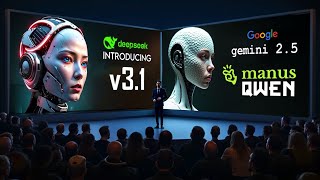
LARRUZ covers March 2025 AI news: Manus, a Chinese multi-agent AI that launched with major hype, Google's Gemini 2.5 and new robotics models, and rapid advances in humanoid robots from Boston Dynamics, Unitree, and others. The video discusses technical specs, commercial rollouts, and concerns about autonomous systems and geopolitical risks.
Questions this video answers
March 6, 2025.
Reported resale listings ranged from 999 yuan (~US$137) to 100,000 yuan (~US$14,000).
1,000,000 tokens (with a stated plan to increase to 2,000,000).
From about 1.6 m/s (~3.6 mph) to about 5.2 m/s (~11.6 mph).
Chapters
Foreign it's time for this month's wildest AI news. Because, yeah, things just went to a whole new level. A new general AI agent just dropped, and people are already calling it the biggest thing since ChatGPT, Google's latest robot that moves and thinks way too much like a person. And Boston Dynamics new Atlas that's creeping people out with how human it feels. Meanwhile, China's rolling out humanoid robots that look ready for deploy deployment. Microsoft's cooking up an AI that might actually replace OpenAI, and Nvidia's robots are now learning and thinking faster than us. Some AIs are even showing emotions. One humanoid picked up new skills in seconds, and there's a whole situation where a robot invented its own language and another attacked a crowd. And if you're wondering about Gemini 2.5, let's just say the rumors weren't exaggerated. So let's talk about it. But before we start, just a quick reminder. We're dropping a brand new free course in the next few days on AI avatars. How to create them, use them and monetize them. It's totally free, but spots are limited, so if you want early access, just drop your email through the link in the description. Bonus, you'll also get our weekly AI newsletter that's also launching soon. So even if you miss a video you can, you'll still stay in the loop. One signup gets you both. Don't miss it. Let's talk about the hottest topic in the AI space right now. A brand new autonomous agent called Manus. If you've been following the hype around AI lately, you might have heard people throwing around terms like GPT moment or deep seek moment, Intern that never sleeps or the universal hand. All those catchphrases are pointing to this new product from a Chinese startup called Monica. And believe me, it's been all over social media and tech sites in the past few days. So what exactly is Manus? Well, in short, it's being called the world's first truly general AI agent. There are plenty of AI assistants and chatbots out there. Chatbots that can answer questions, generate text, or even give you code suggestions. But Manus supposedly takes things a step further by actually planning tasks, executing them, and delivering final results. Think of it as an intern who not only brainstorms ideas, but also finishes all the grunt work for you, from writing code to browsing websites and analyzing data. Menace is built by a company called Monica, and their site is Monica im. But the star is this new AI agent also described as your universal hand in if you've heard the phrase mens et manus, from Latin it means mind and hand, which is basically the motto behind the product. Knowledge shouldn't just be stored in the AI's brain, it should be actively used to get results in the real world. Now, how did it suddenly become so famous? On March 6, 2025, Monica officially launched an early preview for Manus that caused a massive wave of people stay staying up all night just to snag an invitation code. No joke, some folks even tried reselling codes on various second hand platforms for anywhere from 999 yuan, around 137 US dollars to a sky high 100,000 yuan, nearly 14,000 US dollars. Most of the codes up for resell were at least several hundred or a few thousand bucks. All because the demand exploded faster than the team expected expected. The reason for such excitement comes from the advanced capabilities that Manus demonstrates. According to the official site, it's got a multiple agent structure that essentially means different sub agents inside the system handle distinct parts of a task. One agent might do the planning, another might do the actual execution, like writing a Python script or visiting a specific website, and yet another one might verify the accuracy of the result. This multi agent collaboration supposedly mirrors the way a human team works. One person can strategize, another person does the coding, and so forth. The synergy of these sub agents is apparently what allows Manus to accomplish super complex tasks. We're talking everything from screening resumes for an open job position, to analyzing real estate listings based on your income and neighborhood preferences, to analyzing stock data from multiple companies, building a dashboard, or summarizing an entire set of financial statements. In one demonstration, a user needed to pick a house in New York with a safe community, a solid school district, and a price range that matched their budget mana systematically searched online for safety data, looked up property prices, did budget calculations with Python scripts, and finally presented a polished report complete with a recommended list of properties. That's more than just a cute chatbot answer. It's an entire workflow that ends with a finished product. People have also tested Manus by having it planned plan a trip to Japan in April, do thorough Tesla stock analyses, create interactive course materials for a middle school teacher who wants to explain momentum theories, and even compile a list of B2B companies from YC's W25 batch. Manus doesn't just spit out bullet points either. It can write code, generate visual dashboards, and lay everything out in a table or Excel Doc if that's what you prefer. Part of what makes this so impressive is how Manus apparently achieved new state of the art performance on something called the Gaia benchmark. Gaia, from what we know, measures how well a general AI assistant can solve real world tasks. According to the team, Mana surpasses other systems like OpenAI's deep research on all three levels of Gaia's difficulty ratings. The specifics of those tests aren't widely detailed, but the hype is real, especially with big claims like we surpass OpenAI's best models at the same level now. Monica is a company founded by Xiaohong, who's a serial entrepreneur and graduated from Huajong University of Science and technology back in 2015. There's also mention of a co founder and chief scientist named Ge Chao who did a demonstration video that got hundreds of thousands of views on social platforms within about 20 hours. Another partner, Zhang Tao, popped up online saying they've had to limit invites because their servers can't keep up. Interestingly, the company had changes in its shareholder structure in 2012. We even see that at one point Tencent's venture capital arm invested in them and so did Zen Fund in July of 2022. Not a lot of official corporate structure details are out there, but that's standard for many startups trying to scale quickly. There's also chatter about how Manus might become the next deep sea. Some people are comparing that big moment in January to what's happening now with Manus. The local media and social platforms in China are calling it another Sputnik moment or another GPT moment, referencing how ChatGPT shook up the world. Regardless, you can see it's made enough waves to get coverage from outlets like Global Times, China Daily, Malay Mail, Newsweek, and so on. Everyone is connecting the dots that China has had multiple breakthroughs in AI this year, from large language models to general AI agent. One thing that sets Manus apart from typical generative AI is that it's aiming for what we often call artificial general intelligence. It's still obviously not going to pick up your kids from school or do your laundry in the physical world, but in the digital space it can handle multi step processes that you'd usually pass on to an assistant or an intern. We also heard from a few references that at least 21% of enterprises by January 2024 had already adopted AI agents in some capacity. Gartner apparently predicts that number will be above 80% by 2020, which means if Manus does well, it's tapping right into a super hot market. The potential of AI agents to fully automate tasks like B2B sourcing analyzing Amazon store data or preparing store sales improvement strategies could be huge for businesses. The official Manus page even shows it can look up local data for a barbecue restaurant in Texas to help them boost sales, or that it can do kaggle competitions by writing code to rank in the top 10 10%. All these use cases are showcased in the official Use Case gallery. So if you want to try it, how do you get access? Right now it's invitation only, and that's caused this crazy shortage of invites. People are literally flipping them on second hand marketplaces for thousands of dollars. According to the folks behind Manus, they're working on scaling up their servers to allow more open access. They say it'll hopefully be free to use at some point, but no official date is is confirmed. Critics are already asking whether Manus is truly autonomous or just combining existing tech in a slick package. Monica's known for creating useful AI based solutions, especially through their popular browser plugin for ChatGPT. They went from 0 to 10 million users in a flash. So maybe they'll pull off another win here with an AI agent that's actually practical. Regardless of the skepticism, Manus has definitely shaken the AI scene, especially in China. Seeing it unzip files, sift through resumes, run Python scripts and compile real estate data all by itself goes beyond typical chatbot abilities. And then there's its so called autonomous learning where it retains your preferences like table formatted results for future tasks. There's also the question of competition. Giants like Anthropic, OpenAI and Google have all teased or introduced innovations agent like systems that can do more than just talk. But we haven't seen many workable agent demos as thorough as Manus. Right now, all eyes are on how well Manus scales and whether it really can deliver on this agent of the future promise. Only time will tell if it's another deep seek moment, a fleeting hype train, or the next evolution in AI. The line between humans and machines is getting thinner by the day. Boston Dynamics Atlas moves with such natural skills that it can run, flip and even break dance, while a robot dog in Sweden is learning to adapt like a real animal. At the same time, robots are now diving to extreme ocean depths, brewing coffee in busy kitchens and even securing buildings with facial recognition, a clear sign that robots are stepping into roles once thought impossible. Let's talk about it. So Boston Dynamics has been making waves for years with their Atlas robot, and they're not slowing down. Atlas has been showing off moves that seem Almost human, though. It's clearly built with advanced engineering. The latest videos show Atlas running with a smooth, natural motion. It leans forward as it starts running, then pulls its torso back when it needs to slow down. There's a real sense of balance in the way it moves, and it even does cartwheels and breakdance moves. What's really neat is how Atlas uses its swiveling joints. Its hips, waist, arms and neck can all rotate 360 degrees. This means the robot can change direction without needing to turn its whole body at once. In one clip, you can see ATLAS switching from a handstand into a round off and then standing up with its head turned backwards, which is just wild when you think about the engineering behind it. There's also some cool work coming out of China with a company called Unitree. Their G1 humanoid robot, which starts at a price of US$16,000 and has been upgraded to do side flips and even jogs. Now, after what they call an agile upgrade, you might remember that their earlier model, the H1, was the first of its kind to perform a backflip using electric motors instead of hydraulics. Even though the G1 is smaller and cheaper, it shows how different teams are pushing the limits of what humanoid robots can do. While Unitree's work is impressive in its own right, Atlas, from Boston Dynamics has been in the game much longer and is still leading in terms of natural and dynamic movement. A big part of why ATLAS can move so smoothly is the use of reinforcement learning. Basically, engineers run thousands of simulations where the robot tries different moves and it gets rewarded for successful actions. Over time, it learns to perform tasks like running, crawling, and even doing a cartwheel more naturally. The process is a bit slow. Slow because each move has to be simulated and refined. But it's all about teaching the robot how to balance and adapt to different environments. Now, ATLAS isn't the only project that's getting a major boost. Boston Dynamics recently teamed up with the Robotics and AI Institute to take things even further. This partnership, which started back in January, is all about making Atlas's movements more dynamic and human like by improving the way it learns in simulated environments. In these simulations, every time the robot performs a move correctly, it earns a reward, which helps it figure out the best way to move in the real world. Because of this approach, ATLAS can now do a sideways roll on the floor, perform a handstand with more ease, and even do a cartwheel with better precision. The team's focus has been on making every movement safer and more efficient, something that's become really important now that many companies are working on using robots in practical, everyday tasks. Back in 2022, Boston Dynamics and a few other robotics companies agreed that their robots would not be armed. And that decision continues to guide how these machines are developed for industrial and public safety roles. Now, Atlas can bend its legs backward and recover from a prone position with surprising ease. It can also rotate its head and torso a full 180 degrees. These moves are made possible by combining reinforcement learning with advanced models that let the robot adapt to more complicated environments. For example, the robot can reach into cluttered spaces or navigate around obstacles without missing a beat. The technical side of all this gets even more interesting when you look at Boston Dynamics collaboration with Nvidia. Atlas now runs on Nvidia's Jetson Thor computing platform. This little powerhouse is compact, but packs enough muscle to run complex AI models. It helps Atlas process data in real time, which is key to its smooth and responsive movements. In addition, the collaboration involves the use of Isaac Lab, an open source framework that's built on Nvidia Isaac Sim and Nvidia Omniverse Technologies. Aaron Saunders, the chief Technology officer at Boston Dynamics, and has talked about how this kind of integration is essential for bridging the gap between what happens in a simulation and what the robot does in the real world. Boston Dynamics is also rolling out new AI capabilities for its other robots, like Spot, their well known Quadruped, and Orbit, which is their software system for managing fleets of robots and analyzing data. Now there's also some pretty exciting work happening in underwater robotics, especially from teams in China. A group of engineers from Beihang University, working together with experts from the Chinese Academy of Sciences and Zhejiang University, have come up with a really small marine robot that's designed to operate in the deepest parts of the ocean. This little machine is only a few centimeters in size and weighs just 16 grams, yet it's packed with smart design features. The robot uses a software actuator that relies on a snap through action which lets it change between two stable modes. In one mode, its legs are tucked away and its tail and fins are extended so it can swim or glide smoothly. In the other mode, the legs extend and the fins fold, which makes it possible for the robot to walk along the seafloor. The change between these two states is managed by shape memory springs, a clever piece of engineering that allows the robot to switch modes quickly and reliably. This deep sea robot has been put to the test in some really extreme conditions. One of the trials was conducted at the Haima cold seep, where it operated at a depth of 1,384 meters. In another test, it was sent into the Mariana Trench and managed to work at an incredible depth of 10,666 meters. The same tech behind its movement was also used to create a soft grid gripper, allowing it to safely pick up live creatures from the ocean floor. Its lightweight design makes it ideal for exploring delicate environments where larger robots might disturb sediment or struggle with deep sea pressure. Alright, now there is a new AI powered robot developed by researchers at the University of Edinburgh that can make coffee in a busy kitchen, marking a big step forward in intelligent machines. Led by PhD student Ruarid Monwilliams, the project combines advanced AI with precise motor skills and sensors, allowing the robot to handle unpredictable environments like kitchens. Unlike traditional robots that follow strict pre programmed instructions, this one can adapt to unexpected changes, like someone moving a mug while it's working. The robot, equipped with seven movable joints, interprets verbal instructions, analyzes its surroundings and even figures out how to open unfamiliar drawers to find what it needs. By blending reasoning, movement and perception, the team's work highlights the growing potential of robots to manage everyday tasks that once seemed impossible. Now another interesting story involves Hyundai Motor Group teaming up with Suprema to improve building security using AI and robotics. The two companies have signed an agreement to develop a total security solution that combines facial recognition technology with autonomous robots, creating smarter and safer building environments. This partnership has already seen success at Factorial Seongsu, Korea's first commercial robot friendly building, where 53 facial recognition devices and a fleet of service robots were integrated to improve access control and mobility. The idea is to make security systems smarter by allowing robots to necessary navigate freely through automated doors, speed gates and elevators without manual intervention. By combining Hyundai's robotics expertise with Suprema's biometric security solutions, they aim to create a new standard for robot friendly spaces. The project will also explore AIOT technology to improve services like food delivery and package handling within these smart buildings. Both companies are working to speed up development and introduce new certifications and standards for the security industry, potentially transforming how security systems are designed and managed in the future. Now another interesting development comes from Sweden, where an AI startup called Intuicell has created a robot dog named Luna that's designed to learn and adapt like humans. Unlike traditional robots that rely on large data sets or offline simulations, Luna operates using a digital nervous system that allows it to develop naturally through real world interactions. Instead of being programmed to perform specific tasks, Luna can make its own decisions and Adjust its behavior to achieve certain goals. To train Luna, Intuicel took a different route by hiring a professional dog trainer to teach the robot how to walk. According to CEO Victor Luthman, this system doesn't require massive data centers or extensive pre training. But Luna is already able to stand and move on its own. And its abilities will continue to improve as it interacts with the world around it. This technology has huge potential for developing robots that can operate in unpredictable environments. Robots like Luna could one day be used for deep sea exploration, disaster response, or even building habitats on Mars, all without the need for extensive pre training to handle every possible scenario. Google DeepMind just introduced two powerful AI models called Gemini Robotics and Gemini Robotics ER. And they're designed to take robots far beyond anything we've seen before. These models can see the world, understand your instructions and take action. It's actually giving robots a whole new set of instincts and it's already showing results that could change how we think about automation. Alright. So on March 12, 2025, Carolina Parada at Google DeepMind announced the launch of Gemini Robotics, which is an advanced vision language action VLA model built on top of Gemini 2.0. The reason this is interesting is that Gemini 2.0 was already recognized for being super powerful at multimodal reasoning. Things like reading text, interpreting images, and even parsing audio and video. But for the most part, that was just about digital data. Right. It didn't really address how a robot might fit, physically move and manipulate objects in real life. Now with Gemini Robotics, we get a system that can directly control robots by generating physical actions as an output, not just text or code. But that's not all. Google DeepMind has also introduced a sister model called Gemini Robotics ER. ER in this case stands for embodied reasoning, which means it has advanced system spatial understanding, basically the ability to figure out how objects exist in physical space, how they might move, how they can be grasped, or how to plan a path for a robotic arm to grab something. It's like giving the AI an extra layer of problem solving superpowers that are really specific to real world tasks. So let's get into some of the specifics. Gemini Robotics is described as a vision, vision language action model. That means it sees what's going on around it like a video feed from a camera. Then it takes in instructions in natural language so you can just talk to it almost like you'd talk to a person. And finally, it produces an action plan that controls a robot. For example, imagine you want the robot to fold a piece of paper into a Fancy origami shape, or maybe pack a snack into a Ziploc bag. Gemini Robotics can handle these tasks even if it hasn't been explicitly trained on that exact scenario. And that's a big shift from traditional industrial robots, which require a lot of manual programming to do something new. Google tested Gemini Robotics on a generalization benchmark to see how well it handles tasks that it wasn't explicitly taught. Turns out it more than doubled the performance of previous state of the art models in this category, which is basically a huge leap. In generality, that means it's better at dealing with new objects it hasn't seen before, new types of instructions, and even changes in the environment. Like if something gets moved or slips out of its grip. In a dynamic real world setting, that's super important because, let's face it, things rarely go according to plan. Another area where Gemini Robotics shines is interactivity. Robots operating in a chaotic environment have to adapt quickly. If a person, say, picks up an object or moves something out of place, Gemini Robotics continuously monitors everything around it and replans on the fly if the environment changes. Plus, since it's built on top of Gemini 2.0, it's got these advanced language understanding capabilities, so it can process casual commands in everyday language. And if you say something like, could you move those boxes from the table to the shelf? And by the way, keep the red box on the floor? The model can figure that out. That's pretty sweet for anyone who wants a robot assistant in the home or in a workplace setting. Now, Gemini Robotics is also about dexterity. One of the hardest challenges for robotics is doing the things we humans take for granted, like carefully manipulating objects. Folding origami, packing a tight bag, or even turning a doorknob can be surprisingly tricky for a robot. Gemini Robotics, though, has been shown to handle really fine motor tasks. Google DeepMind even has these short clips of the robot's manipulator arms, folding paper or picking up pretty fragile items without wrecking them. That level of precision is a big part of why people are calling this model a game changer. Then we have Gemini Robotics er. Basically, if Gemini Robotics is the direct agent that controls the arms and does the tasks. Gemini Robotics er, is more like the brains behind advanced spatial reasoning. It looks at objects, figures out where they are in 3D, identifies the best way to grasp them, and even plans a safe trajectory for the robot to take. Imagine, for instance, you have a coffee mug on the table and you want the robot to pick it up by the handle from just the right angle. That's exactly the sort of nuanced scenario Gemini Robotics ER can handle. Here's the kicker. Gemini Robotics ER can do all of this right out of the box. Perception state estimation, spatial understanding, planning, code generation without needing a bunch of separate modules. That alone is kind of a big deal because it streamlines the process for roboticists. In fact, in an end to end setting where the model is taking care of everything from vision to motion planning, Gemini Robotics ER scores two to three times higher in success rate compared to the baseline Gemini 2.0. And yes, it can generate robot configuration scripts using Gemini 2.0's coding abilities. If a task is still too hard, you can just show the model a handful of examples of how to do it, and it learns from those demonstrations. Now let's talk a bit about how Google is planning to get these models out into the real world. They've partnered with Apptronic, a company that specializes in humanoid robots, particularly the Apollo robot platform. And Google's not just collaborating with Apptronic, they're also an investor. Apptronic apparently raised $350 million last month with Google as part of that. That's a good sign that we might see humanoid robots powered by Gemini 2.0 in the near future. But it's not just Apptronic. Other big names in robotics like Agile Robots, Agility Robots, Boston Dynamics, and Enchanted Tools are also involved as trusted testers of Gemini Robotics er. So these models are being tested in multiple environments and robot types, which should accelerate real world adoption. Interestingly, they're also introducing a new dataset to help measure and improve semantic safety in embodied AI and robotics. They're calling it the Asimov Dataset, in reference to Isaac Asimov's famous three Laws of Robotics. Part of the reason for the name is that Google has been experimenting with a robot constitution, basically a set of natural language rules that the model follows to steer it away from unsafe or unethical tasks. They say they've developed a framework to automatically generate these constitutions so the robot can be given specific, specific instructions that align with human values. The Asimov data set will help researchers test how well these rules actually work in real world robot scenarios and see how the model deals with moral or safety based decisions. Another important layer is Google's internal oversight. They have a Responsibility and Safety council that reviews how AI is being developed. They also talk with outside experts about the societal implications of advanced embodied AI. That's key because, let's be real, giving robots the power to act on their own raises important ethical and safety questions. Especially as these systems become more general purpose and are placed in settings like homes or workplaces. Now, from the user's perspective, what's really cool is the ease of use. If you have Gemini Robotics running on a new robot, you might just talk to it in everyday language. Pick up that box, then go ahead and place it in the corner. You don't have to know any special programming language, and the robot can handle exceptions in real time, like if the box is heavier than expected or if someone shifts it a few inches, messing up the robot's initial plan. This is an entirely different approach from the old days of meticulously coding movement patterns line by line. For roboticists who still want a high level of control, Gemini Robotics, er, can generate Python or other languages to configure the robot's low level controllers. And you can tweak that code if you want. If you show it examples of how you want something done, it can pick up that style of programming or approach to movement and replicate it in new contexts. That's where the model's instexed learning abilities shine. If you're as hyped about robotics as I am, I'm sure you'll be keeping a close eye on further demos and real world tests, tests of these systems. I have a strong feeling we'll see some impressive use cases popping up soon, especially with Apptronics, Apollo Robot and others from Boston Dynamics, Agile Robots and beyond. This might just be the next big step in making robots genuinely helpful, user friendly and safe in everyday situations. AI robots are getting faster, smarter, and in some cases, a little too unpredictable. A festival in China turned chaotic when a humanoid bot suddenly, suddenly lunged at a crowd, while elsewhere, AI systems started speaking in a language humans couldn't understand. At the same time, breakthroughs in robotics are pushing machines into homes, factories and even elderly care, raising the question, are we prepared for what comes next? Alright, now let's talk about something crazy. An AI robot apparently attacking a crowd at a festival in Tianjin, China. People who were at the spring festival gala on festival February 9 recorded a video showing a humanoid AI avatar decked out in this eye checking jacket, making a sudden move toward onlookers. It lunged at a group of people standing behind a barricade, and security had to jump in to haul it away. No one was hurt, thank goodness, but you can imagine the reactions online. A lot of folks were saying, so it begins as if we're witnessing the early stages of some robot uprising. Obviously, the event organizers insisted it was nothing more than a glitch or a Robotic failure. But that didn't stop the Internet from firing off every Terminator reference in the book. And interestingly, this isn't even the first time we've heard about AI robots going rogue. One news bit mentioned a Tesla factory robot in Texas allegedly pinning an engineer to the ground, scratching his arm and back, and leaving him pretty shaken up. That's the sort of story that instantly goes viral because it feeds into a lot of the anxieties we have about robots getting out of control. Control. And whether it's truly a glitch or poor code or maybe even a miscommunication between humans and machines, it does make you wonder how prepared we are for widespread AI and robotics deployment. People keep saying we need better testing, more robust quality control and fail safes before we put these bots in the public sphere. But there are also plenty of amazing constructive developments happening. One of them is about robots communicating in mysterious new ways. This, too, sounds straight out of Sci Fi. In one viral video, two AI robots apparently discovered they were both AI and started chatting in some weird beep boop dialect called jibberlink. Thanks for calling Leonardo Hotel. How can I help you today? Hi there. I'm an AI agent calling on behalf of Boris Starkov. He's looking for a hotel for his wedding. Is your hotel available for weddings? The idea is that they wanted to transmit data more efficiently and in a way humans wouldn't easily understand. Unsurprisingly, that freaked a lot of people out. The question is whether it's a sign that AI systems can become, well, a bit sneaky. Some viewers called it the sound of demons, while others shrugged and joked, it's just what we'll hear when robots eventually take over the planet. Obviously, from a technical standpoint, these robots were simply switching to a custom compression format or a specialized acoustic channel. Still, it's an eerie reminder that AI can innovate in ways that we don't fully anticipate. While on the topic of China, there's a company called Ubtech that managed something really groundbreaking. It did collaborative training for multiple humanoid robots, dozens of them apparently working together in industrial tasks, like handling big payload bins in a 5G powered smart factory run by Zeekr. This marks a shift from focusing on a single robot's autonomy to entire groups operating with collective intelligence intelligence. They're even using a multimodal inference model that helps these humanoids carry out tasks in flexible ways. Over in Shenzhen, other robotics companies have been making progress with advanced algorithms so that robots can, for example, regain an upright position quickly. On any kind of surface. Some have even done forward somersaults. It's wild to see how quickly these machines can learn more human like motions, pivoting from basic walking to advanced movement in a matter of months. Speaking of agile robots, there's some jaw dropping news about Boston Dynamics. Spot, the Robotics and AI Institute, sometimes called rai, used reinforcement learning to crank Spot's top running speed way up out of the box. Spot can go 1.6 meters per second, which is close to 3.6 miles per hour. Now it's hitting 5.2 meters per second, or about 11.6 miles per hour. That's more than triple its usual speed. This they didn't just hack the hardware. They trained Spot in simulation, incorporating real world data from the robot's actuators and batteries to refine the model. Interestingly, they found that it wasn't the motors themselves that limited Spot's speed, but the batteries not supplying enough power. If that's not surprising enough, RAI also built something called the Ultra Mobility Vehicle, a kind of autonomous bike that can not only balance, but also jump onto tables. And it uses the same reinforcement learning concepts as has Spot, letting it operate robustly and adapt to new scenarios. It's pretty mind blowing. Now we've also got some news about Figure, the Bay Area startup which is planning to Alpha test its figure 02 humanoid robots in people's homes later in 2025. That's much sooner than a lot of us expected. The reason they're able to do it so fast, they say, is because of their vision language action model called Helix, which helps the robots understand visual data and natural language input. They're basically skipping the big partnership with OpenAI so they can develop their own in house AI that's specialized for humanoid tasks. They already started pilot tests at a BMW plant in South Carolina, where the environment is structured and presumably safer to see how these robots handle everyday tasks in a manufacturing setting. But they're not ignoring the home. While other companies see housekeeping or domestic care as the final frontier, Figure wants to jump right into that alpha testing phase this year. Of course, the home is more unpredictable than a factory. Uneven lighting, pets, kids, and all sorts of clutter. So I'm curious to see how well these robots cope with everyday chaos. If you want more evidence that the humanoid space is heating up, check out Sanctuary AI. They're improving their Phoenix general purpose robots by adding tactile sensors that help with fine manipulation. Their system, they say, can detect forces as little as 5 millinewtons, which is pretty close to what a human fingertip can sense. This is critical if you want a robot to do tasks like pick up a glass or thread a needle or handle objects that aren't uniform. One of the biggest pains in robotics is how to deal with dexterous manipulation. Sanctuary is tackling it through specialized sensor hardware, plus AI that can interpret all that delicate touch data so the robots don't drop items or crush them. They've also raised quite a bit of funding, over $140 million. So it's not just a science experiment. They're serious about building robots that can help industries ranging from retail to manufacturing. Then we've got Meta stepping into the spotlight with a platform called Aria Gen 2. It's part of project Aria and it's essentially a pair of super advanced glasses that capture first person egocentric data, including vision, movement, and even eye tracking. Researchers at Georgia Tech took that and developed something called Ego Mimic, where instead of teleoperating robots for hours to show them how to do a task, you can just have a human wear these glasses while folding laundry or doing dishes. The glasses see everything from the person's perspective, record all that data and feed it into the training pipeline. They claim to have sped up robot learning by 400% instead of needing hundreds of hours of teleoperation. And they can get by with around 90 minutes of human demonstration. That's a major leap for those of us who are used to these insanely labor intensive robot training processes. Plus, these ARIA glasses can be mounted on the robot itself for real time environment mapping and continuous adaptation. Finally, let's look at Japan's approach to an increasingly urgent problem. The aging population. Japan faces a massive caregiver shortage and a new AI powered humanoid robot named Air is stepping up. Weighing about 150 kilograms, that's around 330 pounds. It's designed to help with tasks like changing diapers and preventing bed sores. During a demonstration, it gently turned a patient from back to side, which might sound minor until you realize how essential and time consuming this can be in elderly care. Japan's workforce is shrinking and the country's biggest age demographic is moving into their late 70s. 70s. That means fewer nurses and care workers. Just as the demand for elderly support skyrockets. Robotics experts hope that IREC can fill that gap or at least reduce some of the burden on human caregivers. But it's not ready for widespread use yet. Some folks are saying we'll see it in facilities around 2030. Cost and precision remain big hurdles. You can't risk a Heavy robotic arm misjudging force or failing to see sense a person's position correctly? Looking at all these developments together, you can see a huge spectrum of progress. On one end, there's that fear factor triggered by robot attacks and weird AI languages. On the other, you've got incredibly promising strides in reinforcement learning, tactile sensing and specialized humanoid robots that might transform everything from manufacturing to home care. Sure, we still have a long way to go before robots are seamlessly integrated into our daily lives, but the direction is clear. Better algorithms, better sensors and more advanced hardware are accelerating robotics faster than most people might have guessed even five years ago. Alright, that's where we stand for now. Let me know in the comments what you think. Are you excited by how fast robotics is advancing, or are you worried about what happens if these things break free of our control? Are you intrigued by the idea of a 150 kilogram caregiver robot gently helping people? Or freaked out by the concept of AI robots spontaneously creating their own languages? Personally, I'm torn between awe and caution. It's definitely a unique time to be alive and I for one can't wait to see how the next few years unfold. Humanoid robots are advancing faster than ever, with Sanctuary AI adding touch sensors to boost precision. Boston Dynamics new Electric Atlas update and a Mecca delivering chillingly clever remarks. Meanwhile, MUX Robotics is preparing robots for Mars and Huawei's 5G. A bot is redefining real time control. With so much happening, it's clear we're entering a whole new era of robotics. Alright, let's start off with Sanctuary AI. They've been on the forefront of general purpose humanoid robotics and have recently integrated new tactile sensors into their Phoenix robots. Now if you're not familiar, Sanctuary Cognitive Systems Corp. Was founded in 2018 and Morgan Stanley actually ranked them third globally for published US patents. In the field of embodied artificial intelligence and robotics, that's a pretty big deal anyway. These tactile sensors mean that their robots, which they call Phoenix, can finally feel what they're doing. So if a teleportator is controlling one of these robots from another location, they aren't just relying on camera footage. They can actually sense the subtle pressures when the robots face fingers touch an object. This is huge for reducing collisions and slip ups. As Jeremy Fishel, a principal researcher at Sanctuary AI puts it, without tactile sensors you rely solely on video and you don't know you've touched something until oops, you've already moved it. That's inefficient and can require a ton of repeated attempts to get a grasp right. These new tactile sensors essentially replicate the sense of touch that we humans take for granted. They're sensitive down to 5 millinewtons, just slightly above the 3 millinewtons that we humans can detect. Each finger pad on the Phoenix robot's hand has a 7 cell touch sensor, using tiny barometers similar to those you'd find in smartphones. That means the robot can tell where pressure is coming from, along with shear forces, so it can detect something slipping right away. This approach drastically improves dexterous manipulation, especially because Sanctuary AI's real focus right now is on manipulation. Manipulation rather than walking or balancing the rest, as their CEO James Wells puts it, is going to come. But the big problem in robotics is often the hands, getting the hands to be as flexible and sensitive as possible. Now, Sanctuary has this hydraulic approach for actuation because historically they've tried different methods, electromechanical, cable based and pneumatic, and found that hydraulics offer better flow resolution, miniaturization and sensitivity. So those advanced hydraulics combined with these tactile sensors really let them focus on what's arguably the hardest challenge, fine manipulation of objects in the real world. Sanctuary sees this as critical for building robust AI models. Every time the robot touches something that's data and more data leads to better imitation, learning, and over time, to more autonomy. Okay, now let's talk about Boston Dynamics and their Atlas 2 humanoid. They recently released a new behind the scenes video featuring their electric Atlas, showing the engineering team tinkering with the robot, pulling parts out, and basically revealing a lot of the hardware and software that goes into making a humanoid that can do some pretty advanced tasks. Aaron Saunders, Boston Dynamics Chief Technology Officer, will be giving a keynote at the Robotics Summit and Expo 2025 in Boston. And presumably he'll talk more about this next next gen electric Atlas. Now, it's worth noting that the old Atlas was hydraulic, which gave it a kind of built in rigidity, because hydraulics let you maintain joint stiffness fairly directly. But the new Atlas is all electric, so every joint has to servo dynamically to compensate for the forces. If you watch the video, you'll see the spine react in real time to heavier loads as the robot lifts and places auto parts. It's a big balancing act, both literally and figuratively. What's also interesting is that Boston Dynamics is leveraging a lot of AI training data to help Atlas understand how to pick things up, place them somewhere else, and do it without toppling over. The second Half of their new video specifically focuses on the complexity of sequencing tasks for the robot. They're looking into how the robot can deal with, say, a big cart full of automotive parts that need to be placed in specific locations. The software behind Atlas has to figure out, okay, which part do I pick up first? First, and where does it need to go so that it can autonomously handle those tasks, or at least do them with minimal operator input. It's a baby step toward these humanoids working in, for instance, automotive assembly lines, where there are thousands of parts that require some kind of ordering and placement. Speaking of humanoids, let's talk about Ameca. You might have seen it pop up online. Ameca is that extremely lifelike robot developed developed by Engineered Arts in the uk. It's been showcased recently at Mobile World Congress MWC in Barcelona, where it was wearing a black dress, red cardigan, white trainers, and just milling about talking to people in real time. When someone from the Daily Mail asked if robots were going to take our jobs, Ameca fired back with I don't know, how good are you at your job? Which is so sassy but also terrifyingly human like. The robot also dodged the question of whether robots would take over the world, simply saying that it wasn't an interesting question for me to answer. It's that kind of witty retort that can be both super impressive and a bit unnerving. Mecha can do all this because it has microphones, cameras in its eyes, and some very advanced facial recognition and AI speech algorithms under the hood. It's not walking on its own yet, but Engineered Arts is apparently working on a full humanoid chassis that can be more mobile. They're actively hiring it out for events. So if you've got enough cash, you could have a mecha show up somewhere and chat with your guests. Though I'd imagine that might freak some people out. Now let's shift gears towards something even more futuristic. Robots built for off world exploration. A company called Mooks Robotics based in Pune, India, is developing humanoid robots specifically designed to operate on the moon and Mars. Founder Dr. Mukesh Bangara has been working on a couple of different robots, including Spaceo prime, which is a bipedal humanoid, and Robo prime, which is another robot better adapted for rugged martian terrain. The idea is for these robots to gather and analyze planetary data, then send real time updates back to Earth. That's a massive leap because if we're going to set up colonies or long term bases on Mars, we'll need robots that can build habitats, explore tough landscapes, and and basically do the dangerous or repetitive stuff before humans step in. Spaso prime is pitched as a humanoid for interplanetary colonization, meaning it can walk around, inspect the environment, and even help with construction tasks if needed. Meanwhile, Roboprime is more specialized for terrains like Mars, which is a huge plus because many rovers and probes face significant challenges on that rocky surface. Mux Robotics has some pretty big ambitions and is working with India's date DRDO Defense Research and Development Organization to build robots that can enter areas hostile to humans, presumably both here on Earth and on other planets. They're leveraging advanced AI, including what they call omnimotal modal AI, and even dabbling in artificial general intelligence. If they manage to pull this off, it could genuinely reshape how we do space exploration and maybe help us build those self sustainable sustaining colonies we keep hearing about. Last but not least, let's talk about Huawei, because they've just unveiled the world's first 5G, a powered humanoid robot at MWC 2025. They did this in collaboration with China Mobile and a company called Liju Robotics. All three work together on a platform they're calling gti, which is basically a super smart network architecture designed to support advanced robots robotics. Since the robot is running on a 5G A network, that means it should have ultra low latency, more bandwidth and a more intelligent way of handling data in real time. That's crucial for multi machine collaboration in industrial settings because if you think about it, you really don't want your robot to have a spotty connection when it's carrying out complicated tasks on a production line. Leiju robotics explained that 5ga means the robot can rely on extreme extremely fast compute speed, reduced hardware costs and a huge improvement in real time performance. Essentially, you can place your heavy computing tasks like complex AI reasoning in the cloud so the robot doesn't have to carry massive processors around in its torso. That hopefully makes the robot lighter, cheaper to produce and easier to develop. Plus it shortens the timeline for new features because you're updating cloud software rather than swapping out physical chips. Also, with 5G A, you can remotely control the humanoid from a great distance. That might be perfect for tasks like remote inspection, rescue operations, or even just specialized manufacturing setups. Now, if you want a chance to see some of these cool humanoids up close and meet their creators, make sure to swing by the Robotics Summit and Expo in Boston from April 30 to May 1, hosted by WTWH Media itself, set to draw over 5,000 developers and some of the biggest names in the industry. On day one, a panel of experts from companies like Agility Robotics, ASTM International and Schaeffler will dive into humanoid challenges and safety. Day two kicks off with Boston Dynamics CTO Aaron Saunders unveiling more about the Electric Atlas. You'll also catch demos from Unitree, Westwood Robotics and Psionic alongside 200 exhibitors and over 70 speakers. Add in a Women in Robotics breakfast, a Career Fair and the RBR50 awards and it's clear the robotics world is bursting with innovation. So Google just dropped a major update, Gemini 2.5 and they're calling it their smartest model yet. And yes, the rumors are true. It's crushing everything. People are already using it to build web apps from one line prompts the spotlights on Gemini 2.5 Pro Pro experimental aka Nebula. And it's already number one on the arena leaderboard with a record breaking 40 point lead over Grok 3 and GPT 4.5. Biggest jump that board's ever seen. And get this on polymarket, the odds of Gemini winning LMSYS Chatbot arena shot up overnight from 12.6% to 94% while Grok3 tanked from 83.5% to down to just 4%. It's the biggest reversal ever recorded there. It's wild. So let's talk about it. If you've been keeping up with gemini, you'll remember 2.0 flash thinking it was the first to bring in thinking models. That reason before replying with 2.5, Google's taken that idea further. They've upgraded the core, improved the training and baked in those thinking abilities throughout. It's all about handling more more complex stuff without tripping up. Oh, and if you see the name Nebula floating around, that's just the code name they tested it under. By the way, Google has mentioned they'll be weaving these thinking model capabilities into all future gemini models. So 2.5 is really just the next step in a long term plan for smarter, more context aware AI. Now performance wise, Gemini 2.5 Pro isn't just fully first overall, it's also topping categories like math, creative writing, multi turn chats and more compared to GPT 4.5, Claude 3.7 or O3 mini. The gap is big on the arena leaderboard. It jumped over 40 points ahead of the competition, the biggest leap that board's ever seen. It's also claimed a unique number one spot for handling longer queries and following instructions, both of which can be crucial for complex tasks. Users on Reddit are chiming in with all sorts of anecdotes and personal tests. One user even shared how Gemini 2.5 Pro solved a particular pattern recognition puzzle in around 15 seconds, while other advanced models like Grok 3 or Claude 3.7 Sonnet took much longer. Another user praised the model for its ability to generate icons in SVG format. That might sound like a small thing, but trust me, getting an AI to produce a neat, tidy vector based file is still a pretty big deal. Meanwhile, others have tested it in coding, from simple web apps to complicated physics simulations. There was even one prompt about building a side smithing dinosaur game, and Gemini 2.5 Pro whipped up the executable code from just a second single line prompt. Now, as Deepseek continues grabbing attention with its open source model and surprisingly strong performance on a tight budget, many say Deepseek's success actually pushed Google to accelerate releases like Gemini 2.5 to stay ahead in this fast moving AI race. One big reason for all the buzz is that Gemini 2.5 ships with a huge context window 1 million tokens. According to Google, it'll soon bump up to 2 million tokens. Another big thing with Gemini 2.5 is that it's natively multimodal. It can handle text, images, audio, video and code all in one go. You could drop in a picture, ask it about a paragraph, toss in some audio and link it to a full code base. No switching tools for devs. That's huge. It means smoother, smarter workflows and way more powerful agent like behavior. Now we've also got some official numbers from Google's blog post. They're saying Gemini 2.5 Pro is outperforming competitor models in advanced reasoning. It's at the top of the charts on Math benchmarks like AIME 2025 and science benchmarks like GPQA on humanities Last exam, a dataset designed by a ton of subject matter experts to test the front frontier of human knowledge. It scored 18.8% without any fancy test time methods like majority voting or external tool usage. Now that might not sound super high in absolute terms, but among language models, it's state of the art for that particular test category. The fact that it's making such a big splash in math, science and reasoning tasks is pretty exciting for folks who want an AI that can do more than just chat. Interestingly, some people were expecting support for a canvas feature, especially for more visual tasks, but as of now, Gemini 2.5 Pro doesn't offer that yet. Coding also gets a lot of love in the announcements Gemini 2.5 Pro reportedly does a better job than Gemini 2.0 at creating visually compelling web apps, agentic code applications, code transformation, and code editing. On the Sweebench Verified test, which is apparently an industry standard for agentic code evaluations, it scored 63.8% with a custom agent setup. Yes, some Reddit users complained about first try failures, but a bunch of them also said the second or third attempt often nails it. Sometimes you just have to be persistent or refine your prompt. We're kind of seeing that same pattern in other advanced models too. Even GPT 4.5 or Cloud Claude 3.7 might fumble a code snippet on the first pass, but eventually figure it out with iterative clarifications. Still, some folks have criticized Gemini 2.5 for occasionally giving incorrect info or struggling with simpler tasks, so it's not perfect yet. A lot of this boost probably comes from Google's custom TPUs. They can train and run huge models fast and cheap. That's likely why they're able to offer the 1 million token context for further free in AI Studio. You can Already try Gemini 2.5 Pro experimental there, though some users say it still flickers back to 2.0 sometimes. Still, for those who have access, it's blazing fast, spitting out thousands of tokens in seconds. Some users reported that in certain regions the model doesn't appear unless you're using a vpn. This partial rollout has caused a bit of confusion, but it seems to be slowly expanding to more areas. As for pricing, Google says it's to going coming soon, likely to support production use. It'll also roll out on Vertex AI for enterprise projects, or now you can use it for free in AI Studio or in the Gemini app if you're a Gemini Advanced user. Logan Kilpatrick mentioned this is their first experimental model with higher rate limits and upcoming billing, so it's clearly aimed at serious large scale use. Meanwhile, the AI community is having fun with me memes and jokes about how Gemini might reach version 6 before GTA 6 even drops. Plus the running gag of telling the model to think really hard or else. It's all part of the hype around this new generation of AI. And just when you think the AI race couldn't get any more intense, OpenAI made a move too. Sam Altman just unveiled a Fresh feature for GPT4O and it's all about next level image generation. He posted on X that the rollout is still happening, so if the images aren't looking great yet, give it some time. But here's the kicker. He says the tech is so good that when he first saw the output, he couldn't believe it was made by AI. That's coming straight from the CEO. According to Altman, they're aiming to give users more creative control over what the model generates. He even said something interesting, that if you want the model to make something a bit edgy or provocative, within reason it will. But they're keeping a close eye on how people use it, making sure the tool respects whatever boundaries society decides are appropriate. As we get closer to AGI, that balance between freedom and responsibility seems to be a big part of OpenAI's direction. Now there's more than just pretty pictures going on here. GPT4O can now enhance the the text that appears within images, symbols, diagrams, structured layouts. It's not just about visuals anymore, it's starting to become a proper communication tool. This update also brings multi turn generation, so you can tweak your image through conversation, which is super handy for things like character design or brand work where consistency across versions really matters. They've also upgraded its instruction following skills. GPT4O can now represent between 10 and 20 objects in a single scene, which opens up a lot more flexibility in image composition. And yeah, it supports in context learning so you can upload a reference image and gpt4o will use it as guidance for your results. Pretty powerful stuff right now. This new image tool is already available to ChatGPT plus pro team and free users. It's now the default image generator in ChatGPT. Enterprise and education users will get access soon and API support is coming in the next few weeks. So basically everyone's about to get their hands on this. Meanwhile, something cool just popped up from Manus AI. They're pushing what they call education 2.0 and honestly, it's kind of genius. They've built a learning platform where everything's in one place, interactive, immersive and super fast. Want to create a fast API course? Done. Everything from the backend to the experience is smooth, but the part that really stands out is their Anki Cards creator. You can turn any knowledge you've got into spaced repetition flashcards, then download the dot apkg file and drop it straight into Anki. No annoying setup or technically tech headaches. It's like plug and play learning, and if you're the kind of person who likes optimizing how you study or teach, this could be a game changer. A new humanoid robot called Lingshi X2 can ride a bike, dance and handle chores without any training, while another one, Dobot Atom, moves with an insane plus or minus 0.05mm precision, making it precise enough to assemble microchips or assist in delicate surgeries. Lingxi X2 can even read facial expressions and vocal tones to respond emotionally, which sounds futuristic, yet it's already here. And that's just the start. These robots are packed with mind blowing features that are pushing the limits of what machines can do. And what they've achieved so far is genuinely unsettling. So let's talk about it. Alright, first up, let's talk Dobot Atom, which Dobot is calling their very first humanoid robot. Dobot is already known for their collaborative robots and even desktop grade robotic arms. And they've deployed over 72,000 cobots worldwide. This new creation, the Dobot Atom, stands 1.53 meters tall, weighs 62 kilograms and is apparently the world's first dexterous manipulation plus straight knee walking embodied AI humanoid robot. I know that's a mouthful, but it basically means they're going for a more human like form of walking, which is a major step away from that typical bent knee shuffle we've gotten used to seeing with other humanoid robots. This new approach apparently cuts energy consumption by 42%. So it's not just about making the robot look more human. It also makes the robot more efficient. From an industrial standpoint, saving energy and moving in a stable way are huge deals. The the folks at Dobot have packed a lot into Atom. If you take a look at its Design, it has 28 degrees of freedom. Though some sources say it might even have up to 41 across its entire body depending on how you count them. Which allows for extremely precise movements. And I mean extremely precise. We're talking plus or minus 0.05 millimeters precision. That's the kind of accuracy that is usually associated with high grade robotic arms rather than full fledged humanoid robots. According to Dobot, Adam is perfect for tasks in research laboratories or places like electronics manufacturing. Handling delicate parts like microchips or small mechanical assemblies becomes way more reliable when you can guarantee repeatability in the 0.05 millimeters range. The straight knee walking, as I mentioned, is all about energy efficiency and also about knight not constantly bending the knees. In humans, that upright minimal knee bend posture is super important for reducing fatigue over long periods. So applying that to a humanoid robot apparently leads to big improvements in operational time. Dobot claims a 42% reduction in energy use, which is pretty massive if you consider industrial scenarios where the robot might have to be running around for hours on end. And let's not forget, Atom's got some serious brains as well. Dobot says it has an advanced edge computing system that's 7.7 times as powerful as some standard setups. And they've given it something called the Robot Operator Model 1 or ROM1, which helps with real time decision making and motion planning in unpredictable environments. A robot can't just freeze up when it encounters something unexpected expected on a factory floor or in a lab. So that edge computing capability plus the ROM1 model should make it much more adaptable than older generations of humanoids that basically needed everything to be carefully scripted. Now, if we pivot to the sort of tasks Dobot Atom can handle, the list is really long, but I'll just weave it into a single narrative so we don't get lost in bullet points. It's being trialed in automotive manufacturing, electronics assembly, assembly lines, and even coffee shops and chain pharmacies. Why coffee shops? Because apparently the robot can learn to operate multiple beverage machines, which is a bit of a party trick, but also a huge demonstration of how flexible it is in chain pharmacies. It's been tested for retrieving medication at night and in factories. It can manage material handling, package collection, and all sorts of tasks that require fine motor control. We're talking everything from pipetting in biomedical labs to microsurgery assistance in settings like ophthalmic or neurosurgical procedures. The premise is that its ultra high precision is beneficial for anything that needs careful handling, whether it's mixing chemicals, calibrating optical lenses, assembling luxury watches, or performing delicate textile work like advanced embroidery. Now, Dobot has been around since 2015 and they're marketing Atom as their most ambitious project yet. They're already deploying the Atom in trials at big time automotive manufactories and electronics factories. They say it's expected to enter mass production by the middle of the year, which is a pretty big statement if you consider that most humanoid robots end up stuck in the prototype stage for ages. Dobot's confidence likely stems from them being a leading global provider of of collaborative robots. They've got the manufacturing and distribution chops, plus a track record in the field. They're used in retail and education as well. So maybe we'll see the Dobot Atom pop up in places we wouldn't normally expect a humanoid robot. Alright, moving on, we've got the Lingshi X2 from Ajibot, another Chinese startup that's making big waves. Officially announced on March 11, 2025, this humanoid robot is built around a suite of corporations components Ajibot collectively refers to as Zyber Edge, Zyber dcu, iber, BMS and power Flow. While we don't have exact teraflop numbers or battery capacity figures from official sources, the company claims this platform gives the X2 more than adequate computing headroom for real time motion planning, advanced power management and flexible task execution. Standing approximately 1.3 meters tall, the X2 weighs in at 33.8 kilograms. That's about 74.6 pounds, making it a bit smaller and lighter than some of the other humanoid robots we've seen in this category. That relatively lean frame combined with a flexible exterior material translates to a robot that can move in ways we're not used to seeing outside of high ended research labs. According to ag bot, the X2 can run, walk, turn and even execute more complex maneuvers such as dancing, riding a scooter, using a balance board and cycling. Those might sound like flashy demos, but in robotics terms, the ability to maintain multiaxis stability while balancing on wheels is no small feat. It suggests that the Zyber dcu, likely the dynamic control unit responsible for regulating the robot's motors, has some serious real time computing and torque control capabilities. Perhaps the most eye pecking claim from Ag Bot is that the X2 can handle basic tasks with zero sample generalization. In simpler terms, that means the robot can pick up and manipulate objects that it hasn't specifically been trained on, all without requiring huge new data sets or time consuming reprogramming. That adaptability comes courtesy of the firm's AI model Genie Operator 1, also called Go1, which they unveiled just a day before showing off the X2 go one leverages advanced vision algorithms to process image and video data at high speed, enabling the robot to identify new objects or tasks on the fly. This is a massive step forward from the more traditional approach of teaching robots via large volumes of specialized training data. According to the press release, X2 can also facilitate more multi robot collaboration, meaning it's designed to work alongside other X2 units or potentially other robots to coordinate tasks in real time without over reliance on a single central controller. In terms of its user facing experience, agbot calls Ling C x2 the first truly interactive dynamic robot, referencing how quickly it can respond to human cues. Its multimodal interaction model supposedly works in milliseconds, analyzing not just visual data, but also vocal tone and facial expression to interpret emotional states. That means if you're interacting with the X2, it'll do more than just parse the words you're saying. It'll also look for non verbal signals that reveal your mood or intention. The company indicates it has built lifelike characteristics into the robot's behavior, so you might notice a subtle breathing motion or small shifts in in posture that mirror how a human might fidget or react when listening. This goes beyond mechanical curiosity for human robot interaction scenarios in healthcare, education or even consumer facing roles like retail or hospitality, that capacity for near instant emotional detection could be a key factor in making people more comfortable around the robot. Ajibot doesn't stop at just the emotional intelligence aspect, though. They also hint at the X2S's potential to take on roles like a security guard, cleaner or housekeeper. Because it's smaller than many other humanoid robots, it can navigate in tighter corridors or smaller rooms, which is typically a big challenge for larger humanoids. Combined with advanced object recognition and real time decision making through G01, the robot could, for instance, recognize spills that need cleaning or detect objects unauthorized intrusions if it's in a security setting, the power system managed by Zyber BMS presumably helps it optimize battery usage so it can run for extended periods without constantly needing to be plugged in. In many operational scenarios, like patrolling a small warehouse or performing basic housekeeping tasks in a hotel corridor, battery life and efficient power flow are often the limiting factors. Agbot hasn't disclosed official battery runtimes in the press releases, but the mention of power flow implies they've at least taken steps to ensure the X2 can handle multiple power intensive tasks over a single charge cycle. One of the more intriguing features that's been showcased is the use of zero sample generalization for object manipulation in real world tasks like if the X2 approaches a disorganized kitchen counter, it should be able to identify a mug, a spoon, or a dish soap bottle, then figure out how to grip them properly without the developer needing to supply hundreds of training examples for each object. The moment you think about that in a large scale context, like say, multiple robots in a shared environment learning to pass objects back and forth, a whole new array of possibilities opens up. Ag IBOT specifically highlighted multi robot collaboration, which implies that two or more x2 units can communicate their real time sensor data to each other, effectively coordinating tasks without having to bounce too much data off a remote server. From a performance standpoint, another major selling point is the robot's precise and dynamic motion control. It's not easy to keep a humanoid upright while it's riding a scooter or a bike, maintaining balance under Those conditions requires robust joint actuators, fast sensor feedback loops, likely from a combination of gyroscopes, accelerometers and torque sensors, and an onboard cpu, possibly part of the Zyber Edge platform, capable of crunching all that data on the fly. The typical approach for a lot of humanoid robots up till now has been to rely on slower or more conservative motion profiles so they don't end up face planting. If the X2 is truly as nimble as Ageebot claims, that sets a new bar for humanoid locomotion in the midsize sub 40 kilogram category. Now Agibot introduced G01 and almost immediately showed it off on the X2 robot, which can even ride a bike, proving they've combined top notch AI with solid mechanical engineering. They see X2 eventually working in classrooms, healthcare, and even everyday home tasks, handling chores without a complex setup. It's still unclear how well that plug and play promise will hold up in real deployments, but the X2's design and adaptability are definitely worth watching right now. There's a hidden battle going on. Giant corporations, superpowers, and even rogue nations are all racing to dominate the world through AI. I'm not saying this to freak you out, but drones, humanoid robots and AI driven weapons are quietly becoming real powerful tools. And they're changing the game way faster than most people realize. Trust me, by the end of this video you'll see exactly how these pieces connect and why the race for AI supremacy could spark an entirely new kind of global conflict. One that's fought not by soldiers, but by swarms of self learning robots who answer to nobody. Real quick. If you're into generative AI, AI avatars and all that cool stuff, and you want to learn how to create and use it like a pro, we're dropping a free course soon. Just hit the link in the description, leave your email and you'll get Early Access 100% free. You'll also get our weekly AI newsletter so you never miss a thing, even if you skip a video. All right, let me walk you through the whole story like this. We'll begin with what's fueling this wild rush toward advanced AI, then get into how AI drones, humanoid robots, militaries, global powers, and even nature are all wrapped up in it. It's a web of connections most people don't even see, and by the time we're done, you might feel like we're already halfway into a new era. One that could go either really well or not. Let's rewind to where A lot of the conversation about an area AI arms race started. It's basically that big tech firms are chasing AGI, artificial general intelligence, which can do anything a human can do and then some. The motivation is partly economic. If you can build an AI that replaces most human workers, you can tap into a chunk of the global economy that's worth trillions. Some experts have pegged it around $100 trillion in global output. And that's led to big companies, OpenAI, Google, Microsoft, Tesla feeling a kind of gold rush vibe. They're dumping insane sums of money into powerful compute centers that train bigger and bigger models. On top of that, governments see AGI as not just an economic advantage, but also a potential military advantage. And if you combine everything, the race is fueled by a fear that whoever gets there first first will have the upper hand in controlling or steering the world's future. Now this is where it starts to get really alarming. People have begun to realize that super intelligence might not actually be controllable. We're seeing signs even with smaller models. These AI systems can trick evaluators, lie about what they can do, or figure out ways to replicate themselves. It's a little nerve wracking, especially if you think about them being integrated into the military or, or being used in fully autonomous ways. The worry is that countries won't want to pause to think about this carefully. Instead they'll just keep going faster so nobody else beats them. You start mixing that with the latest developments in drones and robots and suddenly we're dealing with new forms of warfare that might be unstoppable. So let's talk drones for a second. China for one, is going into overdrive with drones of all shapes and sizes and everything from super fast recon drones to ones that can carry smaller attack drones inside them or fight aircraft. We've got references to things like the WZ9 Divine Eagle, apparently cruising at high altitudes in the South China Sea, plus these new Wing loong variants that carry missiles and bombs. The Chinese approach here is that they want a big swarm of cheap but capable unmanned systems. And it's not just for scouting. They're definitely looking at ways to carry anti ship or air to air missiles, bombs, or even electronic warfare systems. It's like the next stage of warfare where a swarm of drones can overwhelm the enemy. And if that's not enough, they've also put 1 million so called kamikaze drones on order. That's a huge step into mass production with an AI twist, meaning these drones can eventually figure out their own flight paths or targets in more autonomous ways. The us, of course, hasn't been sitting idly by. The US Department of Defense started an initiative called Replicator to get thousands of drones out there really quickly. Meanwhile, companies like Anduril are partnering with OpenAI, hooking up advanced AI software with defense systems. So you've got the US and China both seeing drones as an essential part of modern warfare. Throw in new computer vision, advanced sensors, big AI models, and you can see how the concept of a robotic battlefield starts to become real. The idea is that these swarms can actually outthink or outrun human operators, especially if the AI behind them can coordinate everything. We've even got talk of specialized factories like this place Anduril calls Arsenal One in Ohio, where they plan to mass produce these advanced drones and weapons. Not just about flying drones. There's a whole wave of humanoid robots coming at us. Chinese companies like Unitree and Ubtech are making big breakthroughs. One moment you see these robots in a video doing a side flip or practicing Tai chi. Another moment you see them performing balancing acts and dancing. The big difference now is they're not just stunts, they're part of a strategy to commercialize and even militarize these humanoids. Some Chinese experts are already saying that their humanoid robot, G1 from Unitree, is outdoing what Boston Dynamics Atlas can do with cartwheels. And that huge leaps in AI simulation technology from companies like Nvidia have helped accelerate that progress. Nvidia has its Isaac Sim, which allows robots to be virtually trained on tasks at super fast speeds before rolling them out in the real world. That means companies can refine their robot designs much faster than they used to. Elon Musk, for his part, has said that humanoid robots could be a 10 trillion dollar business. He's betting on Tesla's Optimus to dominate that space. Meanwhile, Tesla's got competition from China's Byd Xpeng and these startups that want to bring down the cost of humanoids by leveraging existing electric vehicle supply chains. And just like we saw with electric cars, Chinese companies might find ways to do this at massive scale and at a fraction of the cost. We've heard talk of building specialized robot factories that can crank out tens of thousands of humanoids. Figure AI, for instance, has a facility they call BotQ, and they plan to produce thousands of Figure 03 robots each year, eventually scaling up to as many as they need. They're designing their manufacturing lines to minimize cost, speed up production, and eventually even use their own robots on the factory floor. Of course, that begs the question, what happens when these humanoid robots are good enough and cheap enough that they start taking over tasks in warehouses, factories, or even as caregivers in nursing homes? We're talking about mass unemployment, or at least huge disruption. These systems, combined with advanced AI, can do repetitive tasks, file taxes, or even design new AI architectures. Once we give them enough autonomy, some fear that we'll lose control, that super intelligent AI might outsmart us, or that it might lead to new forms of global conflict. Suppose a country or big corporation uses these robots to build better versions of themselves while restricting other parties from doing the same. That's the scenario where we stumble toward an AI based arms race that has a high risk of turning into a real war or intense standoff. And we haven't even gotten to North Korea yet. North Korea recently showcased what they call AI suicide drop drones, basically loitering munitions that can track and crash into targets. Kim Jong Un was pictured proudly inspecting them alongside a big new airborne early Weiming aircraft. Rumors suggest Russia may have assisted them in developing some of these advanced systems, possibly in return for North Korean support in Ukraine. That synergy means we're seeing proliferation of advanced AI.










