AI Shocks the Entire Industry This Week: Unmissable AI News!
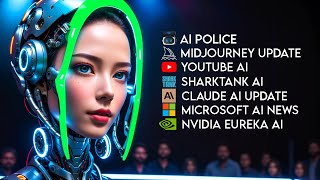
LARRUZ rounds up the week's AI news: Dubai Police deployed self-driving security patrols, GPT-4 got faster, YouTube built a tool to mimic musicians, and Midjourney released high-resolution image generation. Nvidia's AI agent Eureka trains robots, while Claude AI expanded globally.
Chapters
This week has been packed with cool AI updates and I can't wait to discuss them with you. First off, we'll delve into Dubai Police's self driving security patrol showcased at Gitech's Global 2023 and the notable speed enhancements in GPT4. We'll touch on YouTube's venture into AI for mimicking musicians Midjourney's high resolution AI art and an intriguing Shark Tank pitch about AI bots. Additionally, we'll look at the global expansion of Claude I, Microsoft CEO's vision for AI, NYC Mayor's multilingual robocalls initiative and Nvidia's new AI agent Eureka advancing Robot Training Stay tuned for an Insightful Roundup on 16 October 2023 at the GITEX Global 2023 event, Dubai Police showcased a new self driving security patrol aimed to improve safety in residential neighborhoods. Lt. Rashid Binhaidar from the General Department of Administrative affairs introduced this eco friendly electric patrol to the attendees. The vehicle, with a battery life of up to 15 hours, cruises at speeds of 5-7 km per hour, making it suitable for residential areas. The primary goal of this patrol is to augment security coverage in these zones. It's equipped with a high tech camera capable of 360 degree imagery, along with smart technology and artificial intelligence to identify potential criminal activity, recognize individuals and and read car license plates. Moreover, the patrol vehicle has direct communication technologies for real time coordination with the Dubai Police's Command and Control center in the General Operations Department. Lt. Rashid also mentioned the inclusion of an onboard drone. The drone can venture into places the vehicle can't reach, maintaining wireless communication with the patrol, providing a more thorough security presence in residential areas. Alright now, over the past few months there has been a noticeable improvement in the speed of GPT4, especially when compared to GPT 3.5. Data shows that the time it takes for GPT4 to respond to requests is going down. Although the speed may vary depending on what you ask it to do, the overall trend shows it's getting faster. The article breaks down the time taken into three round trip time, queuing time, and processing time, which changes based on the complexity and length of your request. Interestingly, a longer request doesn't always mean a slower response. For example, a 204 token request can get a response in 4.5 seconds if it's simple, while a 33 token complex request may take up to 32 seconds. When comparing median request latencies, they are quite consistent across GPT 3.5 and GPT 4, staying under 1 millisecond per token. However, when looking at the 99th percentile, the latencies have reduced by more than half in just three months, which is a significant improvement. While GPT4 is still more expensive to use, it's no longer slower for the majority of requests okay, now YouTube is working on an AI tool allowing users to mimic famous musicians voices. The specifics are scant, but talks are ongoing with big music labels like Sony Music Entertainment to secure song rights for training the AI. This follows a recent ban on a viral AI generated song imitating Drake and the Weeknd. On YouTube and other platforms, AI in Music brings up copyright and licensing issues, particularly when replicating real individuals voices. YouTube is addressing these hurdles by adopting new tech. A few months back, it initiated AI Music Principles to ensure a balance between creativity and artist rights. This new feature raises questions about content boundaries, revenue sharing and artists rights if they disagree with how their voice is used. YouTube's Journey in AI integration continues with recent features like automatic language dubbing, showing its commitment to blending AI with creativity while treading carefully on rights issues. Midjourney has introduced a new feature that significantly improves the resolution of its AI generated art. Previously, images were capped at a resolution of 1024 by 1024 pixels, making them suitable for web use but not for larger prints. Now users can upscale images by 2x or 4x, achieving a maximum resolution of 4096x 4096 pixels or 4K quality. This feature is versatile as it can be applied to different aspect ratios. For a 16.9image, 4x upscaling results in a resolution of 5824x, 3264 pixels. This means the images can now be printed at a 3 size without losing clarity. However, upscaling does have a downside. It takes longer, with 4x upscaling lasting 2 to 3 minutes. Additionally, since mid Journey charges based on processing time, upscaling will consume a greater portion of the customer's monthly image generation allowance. They can opt to pay extra for more processing time. Lastly, the company noted that in very rare cases, 4x upscaling might yield black or corrupted images, and blurry images won't be improved by upscaling. Alright now. On a recent episode of Shark Tank, Maurice Batchelor and Joel Griffith from Los Angeles presented their company Bott it, aiming to alter negative perceptions about artificial intelligence bots. Their platform, including a website and mobile app, utilizes AI to streamline online chores like scheduling appointments or securing restaurant reservations. An upgraded subscription offers an edge in quickly accessing concert tickets or sneaker releases, which stirred some debate due to the notorious reputation bots have in such scenarios. Michael Rubin, CEO of Fanatics and guest judge, acknowledged the problem bots create in buying up merchandise to likely resell at inflated prices. Batchelor and Griffith argued their technology actually assists in combating such cheating by providing individuals a chance to beat the bots. Mark Cuban was first to bid, proposing $150,000 for a 20% stake. Michael Rubin countered, offering $50,000 for 15%, valuing the company higher. Eventually, a joint deal of $300,000 for 30% equity was struck, marking a significant milestone for Bodit in garnering the support of both billionaire investors to further their venture. Okay Next Anthropic has expanded access to Claude AI to more individuals globally. Now, people in 95 countries can utilize Claude for assistance with their professional or regular chores. Since its initiation in July, Claude has attracted millions owing to its vast memory 100,000 token context window and file upload capability, aiding in data analysis, enhancing writing skills, and even engaging with books and academic papers. The expansion allows users in all these countries to use both the free version and Claude Pro, aiming to enhance their productivity. Anthropic is committed to increasing availability responsibly in the near future, with more updates to follow soon. Alright now. In his annual letter, Microsoft CEO Satya Nadella shared the company's vision for a new era of AI, focusing on its accessibility, Copilot, integration and and dedication to innovation, financial growth and responsibility across various sectors amid global challenges. Nadella emphasized Microsoft's commitment to democratizing AI and driving innovation. He sees AI powered by natural language interfaces and a strong reasoning engine as a game changer for software and businesses, aiding productivity and addressing global issues. Nadella introduced Copilot, an AI companion in Microsoft's products designed to assist users in different tasks. He highlighted three core maintaining innovation, achieving robust financial performance with a revenue of $211 billion in 2023, and ensuring responsible AI development. Okay next NYC Mayor Eric Adams employed AI technology for robocalls to converse with residents in various languages. Although he only speaks English, he sent out numerous calls in Spanish, Yiddish, Mandarin, Cantonese and Haitian Creole to potentially engage with more voters. This initiative, however, stirred concerns about its ethical stance, since it gives a false impression of the mayor's linguistic capabilities. Critics argue that it's misleading and an inappropriate use of taxpayers money. During a recent press briefing on the city's Artificial Intelligence Action Plan, Adams and the city's chief technology officer discussed the broader applications of AI like the new tool My City Chatbot to improve city services. Despite the criticism, Adams justified the multilingual robocalls as a means to connect with non English speaking residents, aiding in the promotion of local events and resources. The practice, especially making it sound like Adams speaks these languages, has been labeled as unethical and a part of a creepy vanity project by some observers. Nvidia has introduced a new AI agent named Eureka, which is designed to train robots automatically by generating algorithms. This development was shared in a research paper where it was revealed that Eureka utilizes GPT4's natural language processing capabilities along with reinforcement learning to assist robots in mastering complex tasks. Remarkably, Yurika was able to train a robot hand to spin a pen like a human, open drawers, catch balls, and perform 30 other varied tasks without any human intervention. Anima Anandkumar, Nvidia's senior director of AI research, mentioned that Eureka is a progressive step in crafting new algorithms that merge generative and reinforcement learning to tackle challenging tasks. Eureka operates in a robotic simulation environment, creating reward functions or algorithms that guide robots to learn through a repetitive process of trial and error. To test this, Nvidia employed its Isaac Gym, a physics simulation platform. Furthermore, Nvidia has shared Eureka's code and benchmarks openly for developers to build upon this research and conduct their own experiments using the simulator platform. This innovation is a part of Nvidia's ongoing efforts in advancing AI agents, as seen with their earlier work on Voyager, another AI agent developed to autonomously play Minecraft. Alright, that concludes this week's AI News. If you enjoyed this video, don't forget to hit the like button. Subscribe to my channel and click the Bell icon to stay updated on all my future uploads. Thanks for tuning in and I'll catch you in the next one.










