AI Shocks The Tech World This Week: Major News Breakthroughs!
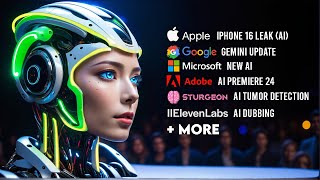
Google's rolling out Gemini and multimodal Bard, Adobe Premiere Pro 24 adds AI editing tools, and ElevenLabs launched AI dubbing in 20+ languages. iPhone 16 leaks show an A17 Pro chip with 8GB RAM and Wi-Fi 7. Sturgeon, an AI tool using nanopore sequencing, diagnoses CNS tumors with 90% accuracy in 40 minutes.
Questions this video answers
Premiere Pro 24
Over 20 languages
Approximately 90% accuracy and diagnoses within about 40 minutes in most cases
Blocked 99% of harmful attacks with a false alarm rate under 2%
Tetraprism zoom lenses (Pro/Pro Max), Wi‑Fi 7 support, A17 Pro chipset and 8GB RAM (iPhone 16/16 Plus), and improved Siri via AI
Chapters
This week is buzzing with exciting updates in the world of AI, and in this video I'll cover all the crucial AI news. Firstly, Google is close to unveiling a new model Gemini, and the open source community progresses with Lava 1.5. Adobe's new Premiere Pro version uses AI for easier editing, while eleven Labs is launching an AI dubbing feature for a natural dubbed content experience. Leaks about iPhone 16 hint at advanced features and improved Siri through AI. A study presents an AI model sturgeon for quicker diagnosis of central nervous system tumors. A smart algorithm is developed to safeguard military robots from cyber threats. Lastly, Google and Microsoft are stepping into healthcare with AI projects to better manage patient data, aiming to improve the experience for both patients and healthcare providers. There's a lot happening in the AI sphere, so let's dive into the details of these intriguing updates. Alright? First, Google is gearing up to unveil Gemini, a highly awaited new AI model that's expected to significantly outshine current models like OpenAI's GPT4 Cissy. Xiao, a lead figure at Google for Bard and Google Assistant, shared her excitement about Gemini, even though she's not directly involved in its creation. She revealed Gemini's ability to create entirely new images based on user requests, like illustrating steps to ice a cake, demonstrating a leap from text to visual interactions. The success of Gemini is crucial for Google, especially when rivals like Microsoft and OpenAI are making strides with visual and interactive AI technologies. There's a narrative to change, considering some critics argue Google has lagged behind. Meanwhile, Xiao's team is tirelessly working to enhance Bard, integrating it with Google Assistant to make it more helpful and less prone to spreading misinformation. This move signifies a shift from voice to a multimodal interaction approach covering text, voice and images. Xiao likens the rapid advancements in AI at Google to a new magic ingredient that's arrived, offering endless possibilities to explore and integrate into existing popular apps apps to make them smarter and more useful. Okay, next the world of generative artificial intelligence is expanding with large multimodal models like OpenAI's GPT4 Vision, which let us interact with AI using text and images. However, its closed source nature limits its usage. The open source community is stepping up with Lava 1.5, showcasing a promising path for open source alternatives. Lava 1.5 blends various generative AI elements, showing high accuracy in tasks, setting a potential new direction for LMM research. The training of such models involves two initially aligning visual features with the language model's word embedding space using image text pairs, then fine tuning the model to respond to visual prompts, a phase known for being compute intensive. Lava 1.5 uses a clip model for visual encoding and Vicuna for instruction following, making it stand out it's not yet a rival to GPT4 Vision, but its cost effectiveness and the scalability in generating training data make it a noteworthy contender in the open Source Arena. With Lava 1.5, we're seeing just a glimpse of what's coming in open source LMMS as more efficient and accessible models are on the horizon, ready to democratize generative AI technologies further Next Adobe has launched the new version of its editing software, Premiere Pro 24, bringing in several exciting features. This update emphasizes making editing quicker and more straightforward thanks to new AI functionalities. A notable change is a speedier editing experience, which is five times faster than before, making the workflow smooth even with complex projects. The software now handles tedious tasks more efficiently, allowing users to focus on the creative part of their work. Text editing has become smarter with tools that can automatically transcribe audio from a specific channel or a mix, making it easier to edit interviews. A new Transcript tab has been added to simplify dialog editing. Adobe has also refined color settings by organizing them under a single tab, making them easier to find and adjust. The audio department sees some smart upgrades too. The new Audio Auto Tag feature categorizes audio clips into dialogue, music, SFX or ambience automatically, saving time and effort. Another AI feature, Enhanced Speech, has been introduced to better the sound quality. Although it's still in beta, it seems very promising. Adobe has borrowed a recovery feature from Photoshop to ensure that in case of a crash, your project can be reopened right where you left off, keeping your hard work safe. An effects manager has been introduced to handle third party plugins better, and now there's support for creating templates from projects, providing a structured way to manage and reuse assets. Lastly, there's new hardware acceleration support and other technical enhancements to make the software more robust and user friendly. This update, now available on Adobe's website and cloud app, certainly aims at making the editing experience more pleasant and efficient. Alright, Next ElevenLabs has rolled out a new feature called AI dubbing, making the experience of watching dubbed content feel more natural. Unlike traditional dubbing that often sounds off, AI dubbing retains the original speaker's voice, speech patterns and emotional tone, while translating the audio into a different language. This innovation aims to allow audiences worldwide to enjoy their favorite shows and movies in their own language without losing the essence of the original audio. The technology behind AI Dubbing involves a blend of multilingual speech synthesis, voice cloning and audio processing to ensure the translated content remains true to the original in terms of voice and emotion. Behold this magnificent blue jewel. Foreign. Labs CEO Mati Staniski expressed how watching dubbed movies with a single narrator during his childhood in Poland took away the magic and how AI dubbing could be a game changer in overcoming language barriers. This feature supports translations in over 20 languages, making content more accessible regardless of the language you speak. Starting from today, anyone can use AI dubbing with the cost based on the number of characters you need dubbed. This step by elevenlabs is a leap towards making content enjoyable across different languages while keeping the unique voice and emotion intact. Okay now the California based tech giant is back in the spotlight due to leaks about the iPhone 16. First off, the iPhone 16 Pro and Pro Max are set to have special lenses called Tetraprism zoom lenses which will make zooming in on photos a breeze, so expect clearer pictures of faraway objects. Next up, faster Wi Fi is coming with the iPhone 16 Pro. With Wi Fi 7 technology, your Internet on the phone will run quicker, making everything from browsing to using apps more smooth. This faster Wi Fi might also help with new AI and ML applications, making your phone smarter and more responsive. There's also talk about Apple working on new AI tech to make Siri better. This could mean that Siri will understand you easier and help out more efficiently, and it's likely that the iPhone 16 Pro will have this upgrade. Lastly, the iPhone 16 and 16 plus are said to come with a stronger engine under the hood. With a new A17 Pro chipset and 8GB RAM, these phones will have the muscle to run AI and ML applications better, making them smart and quick in responding to your commands. All in all, the leaks suggest the iPhone 16 series is shaping up to be a big step forward with better photos, the faster Internet, a smarter Siri and stronger engine to make everything run smoothly. Next, a recent study highlighted a new AI model named Sturgeon, designed to speed up the diagnosis of central nervous system tumors. This AI uses nanopore sequencing, a method that reads DNA, to identify the tumor type, which is critical for deciding the treatment plan. Sturgeon showed a promising 90% accuracy in early tests, providing accurate diagnoses within 40 minutes in most cases, a significant reduction from the traditional hours long process. This innovation aims to equip surgeons with real time information during surgery, aiding in crucial decisions like whether to remove a tumor entirely or just obtain a biopsy, potentially reducing further complications and additional surgeries. Dr. Gabriel Zeta sees a bright future for such AI models in medicine, especially in aiding the identification of tumor subtypes, which is becoming increasingly important for surgical strategies. While AI models like Sturgeon are not set to replace human expertise soon, they are stepping stones towards more informed and safer surgical procedures, offering a supportive role in the complex world of medical diagnoses and treatments. Alright, next. Robots are popping up everywhere in hospitals, farms and even the military. But they can be a security nightmare if not handled correctly. So experts from Charles Sturt University and the University of South Australia got creative. They devised a clever algorithm to catch and stop a tricky cyber attack known as a man in the middle attack on military robots quickly. This new algorithm uses something called deep learning neural networks to think like a human brain and spot when a MITM attack is happening. The tech gurus tested it using a model of a US army vehicle and the results were promising. It blocked 99% of harmful attacks with a minuscule false alarm rate of under 2%. This could be a game changer for boosting security in military settings. The algorithm is smarter than other global tech used for spotting cyber attacks. Professor Anthony Finn and Dr. Fendi Santoso, the brains behind this project, worked alongside the US Army Futures Command to simulate an attack on a GVT bot ground vehicle. They trained its operating system to sense an attack, showing the potential to shield our robots against digital threats. The good news doesn't stop there. Finn and Santoso are planning to test this algorithm on other robotic devices like drones, which are faster and trickier to manage compared to ground robots. And lastly, Google and Microsoft are stepping into healthcare with new AI initiatives aiming to tackle the problem of scattered and hard to access patient data. Microsoft has come up with Microsoft Fabric, a platform that gathers all the medical data in one spot, making it easier for doctors to get a complete picture of a patient's health and consequently make better informed decisions. On the other side, Google is creating a smart search tool for doctors to effortlessly find and pull together patient data from various sources. This tool is expected to save doctors time, making the healthcare process smoother. Both companies are also working on additional AI tools to help both patients and healthcare providers with tasks like a appointment scheduling, understanding medical reports, and more. These projects are in their early stages, but the potential is huge. They could lead to more personalized care, less paperwork and more time for doctors to focus on patients. However, as these tech giants venture into healthcare, handling sensitive data with utmost care is crucial. While competition might spark innovation, collaboration between such giants could lead to faster and more significant breakthroughs in healthcare making the journey easier for both patients and medical professionals. Alright, that concludes this week's AI News. If you enjoyed this video, don't forget to hit the like button. Subscribe to my channel and click the Bell icon to stay updated on all my future uploads. Thanks for tuning in and I'll catch you in the next one.










