AI Shocks the World This Week: Insane News That Will Change Everything!
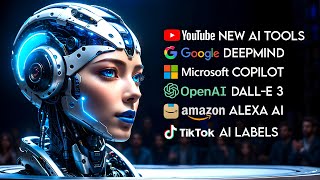
LARRUZ covers this week's AI news: Amazon upgraded Alexa's conversations, Microsoft launched Copilot, Google DeepMind's AlphaFold won the Lasker Prize, YouTube added creator AI tools like DreamScreen, and OpenAI released DALL·E 3 amid copyright questions.
Questions this video answers
2023-09-25
September 26 (year implied 2023 in the video)
Over 200 million predicted protein structures
170,000 protein sequences and their known structures
80 chickens
Chapters
The AI realm is exploding with breakthroughs this week, and we're diving deep into the epicenter of all the action. First up, Amazon's Alexa has gotten a major upgrade and now sounds more human than ever. TikTok's rolling out new AI labels. Microsoft is launching an AI helper called Copilot. And Google DeepMind's AlphaFold has won a prestigious prize for its work in predicting protein shapes. YouTube creators get ready for some cool AI tools, including the DreamScreen feature. Meanwhile, Google's AI chatbot Bard got a massive update, and OpenAI's Dall E3 is changing the game in image generation. In the world of cryptocurrency, an AI created digital coin named Astro Pepex has made a splash. Researchers in Japan have developed AI that understands chicken emotions. Yes, chicken emotions. And a recent survey by edX reveals some surprising views on AI from CEOs. And before we dive in, remember to subscribe to my channel to stay updated with all the latest AI news and developments. Alright, starting with big news from Amazon this week, they've just given Alexa their voice assistant, a cool makeover. If you've got an Amazon smart device at home, you're in for a treat with this update. Alexa sounds more like humans, it chats more naturally, understands better, and even sounds a bit emotional at times. No more awkward pauses or robotic replies. This change is Amazon's way of stepping up its game, especially with so many chatbots out there. Everyone's talking about the power of AI these days, and Amazon wants Alexa to be at the forefront. The experts at Wired had a chat with the folks at Amazon and they're pretty excited about where things are headed with this tech. So if you're into gadgets or just love a good chat with your voice assistant, keep an eye on Alexa if you getting smarter and more conversational by the day. Alright, now Microsoft's launching a cool new AI buddy called Copilot, making your tech life way easier. It's like a friendly helper on your computer, helping you find stuff, learn and even create cool content. This AI is coming to Windows 11, Microsoft 365, Edge and Bing, so you can chat with it pretty much anywhere. So Copilot makes Windows 11 super powerful. It can find files, set reminders, send emails and help with homework. Plus it brings fun features to apps like paint and photos, letting you create and edit pictures like a pro. And it also makes Bing and Edge smarter too. It remembers your chats and makes searching way more convenient, helps with online shopping, and even lets you create awesome images with the integration of DALL E3 by OpenAI and for those who create, there's a watermark feature to show it's your work in Microsoft. The 365 copilot brings the AI chat, making apps like Word, Excel and PowerPoint even better, helping with documents, data slides and emails. Lastly for the designers, there's a special tool called Designer, and for those who love visuals, a new gallery feature in File Explorer. And if you're into teamwork, check out Surface Hub 3 with Copilot making Brainstorming a piece of cake. So get ready to welcome Copilot on September 26th with a free update. Whether you're on a PC, mobile or web, it's gonna be a game changer. Next Google DeepMind's AI program AlphaFold, led by Demise Hassabis and John Jumper, has won the Lasker Science Prize for its groundbreaking work in predicting 3D protein shapes. This big win hints at a possible Nobel Prize in the future for AI research, as many Lasker winners have previously received the Nobel. Protein folding is essential because proteins, which are life's building blocks, rely on their shapes to function correctly. While traditional methods take years to figure out these shapes, AlphaFold does it in minutes. Last year the team shared over 200 million predicted protein structures, boosting various scientific research areas. AlphaFold was trained using 170,000 protein sequences and their known structures. In 2018, it entered the CASP competition, an event where programs predict protein structures. Although it initially faced challenges, the By 2020, AlphaFold won the competition. Experts believe AlphaFold's impact on science is massive. Looking ahead, the team aims to tackle more significant challenges that can lead to large scale advancements in science. Alright now. YouTube has introduced five new tools for video creators. One of the coolest features is DreamScreen. With this you can type in a description like Panda drinking coffee and YouTube's AI will create a background video or image for you. This is great for YouTube shorts where you can then add your own video on top. They're also using AI to give creators ideas on what videos to make. This new AI Insights feature looks at what your audience likes and suggests video topics searching for the perfect song for your video. YouTube's new assistive search will use AI to help you find the right music quickly. For those who watch videos in different languages, there's an automatic dubbing tool. This lets viewers switch between the video's original language and and AI created translations in their own language. Lastly, there's a new app called YouTube Create. It's like TikTok, allowing you to edit videos on your phone with fun options like text stickers and voiceovers. Overall, YouTube is making it easier for creators to make and edit content with the help of AI. If you're into making videos, these tools might be worth checking out. Okay, next Google's AI chatbot Bard recently got a big update and seems to be outpacing OpenAI's ChatGPT. So what's the buzz about? Firstly, Bard can now connect with Google apps like gmail, Drive and YouTube. Imagine asking Bard to pull an email or suggest a trip route without hopping between apps. It's your new digital buddy that can read your emails, help draft responses, or even find documents in your drive. Planning a trip Bard can pull flight info, show maps, and even suggest travel videos. If you're stressing over getting the wrong info, Bard has this cool new Google it feature. Just give it a click and it will double check its answers straight from the web. And hey, you can even customize how Bard chats with you. Whether you like it short and sweet, long and detailed, funny or straight to the point. The best part? It isn't just for English speakers anymore. It NOW speaks over 40 languages and is available in more than 230 places worldwide, so more people can use it for learning, translations and exploring global topics. Comparing Bard with ChatGPT Bard's integration with Google Tools, its fact checking feature and multi language support give it a strong edge. Next OpenAI's new tool, Dall E3 is a game changer in turning words into images. It's the latest version and much better than its Previous 1, Dall E2. It even beats other popular tools like Midjourney and Stable Diffusion XL in quality and design. What's cool is it works with ChatGPT, so you can easily ask for tweaks in your images. But Dalle3's journey started back in 2021, improving with each version. It uses a method called latent diffusion to make these images. Yet there are concerns. Artists worry about AI copying their styles, leading to copyright issues. Big names like John Grisham are even suing OpenAI. So OpenAI has set some rules for Dall E3. It can't make certain types of content or copy a living artist's style. They're also building a tool to see if Dalle 3 made a picture. However, it's not all smooth sailing. There are still debates on who owns AI made images and how to protect original art. Okay, next A developer used AI to create and launch a digital coin named Astro pipex in just one day. It brought in $12 million. This wasn't a random name. Actually ChatGPT picked it. After studying popular coin names, the developer known as Croissant Eth on Twitter combined ChatGPT with a script to make digital coins automatically. The AI used information from top tokens on Uniswap and data from CoinMarketCap and CoinGecko. Some test coin names included Inuverse and QuantumPepe, similar to famous coins like Dogecoin. After Naming the coin, ChatGPT teamed up with Dall? E to design the coin's image. The cool part? Once the coin is made, the AI doesn't own it all. The coin's supply is put on Uniswap, a trading platform with some Ethereum added. This idea was inspired by a digital artist named Ret Mankind who made a coin called Turbo, which became worth over $50 million. But the new method uses even less human help. Croissant Eth said the AI wrote the contract code and plans to make an easy to use platform so others can make coins. Many have already tried it and it's expected to become even more popular. Alright, next Researchers in Japan led by Professor Adrian David Chalk from the University of Tokyo have developed an AI system that they say can understand the emotions of chickens by listening to their clucks. This technology, named Deep Emotional Analysis Learning, uses advanced algorithms to interpret emotions like hunger, fear and excitement in chickens. The more it listens, the better it gets at understanding the birds. To test the AI, scientists studied sounds from 80 chickens. With the help of animal experts, they linked these sounds to specific emotions. The results were promising, but the team notes that different chicken breeds and environments might affect the AI's accuracy. Also, chickens communicate in other ways, like body language. Although the research is yet to be reviewed by other experts, an exciting step in understanding animals better. Cheok believes that knowing how animals feel can help create a better world for them. This AI breakthrough might soon be used for other animals too. And finally, a recent survey by online education platform EDX reveals that 49% of CEOs believe AI could take over most of their tasks, and 47% think it might be beneficial. The poll involved 1,600 US workers, including top executives and non executive employees. Anant Aggarwal, the founder of EDX and a professor at mit, says many executives see AI as a game changer, potentially even bigger than the Internet. While AI could manage routine tasks, certain essential CEO qualities like creativity, teamwork and vision can't be easily replaced by machines. However, AI's impact isn't limited to CEOs. The survey indicates that by 2025, nearly half of the current workforce's skills might become irrelevant and many aren't ready for this shift. While only 20% of non executives feel AI could replace their roles, top executives are actively seeking employees proficient in AI. A significant 87% of them find it hard to hire AI skilled workers. Interestingly, only 24% of employees are learning AI skills at their present jobs, and 39% are considering leaving their job for better AI training opportunities. Especially among Gen Z, 62% are acquiring AI skills to outperform peers. Agarwal's advice? Worry less about AI replacing your job and more about colleagues with better AI skills outpacing you. Alright, that concludes this week's AI News. If you enjoyed this video, don't forget to hit the like button. Subscribe to my channel and click the Bell icon to stay updated on all my future uploads. Thanks for tuning in and I'll catch you in the next one.










