AI Stuns the World: DeepSeek Drama, Butcher Bots, OpenAI STARGATE, Singularity... (January News)
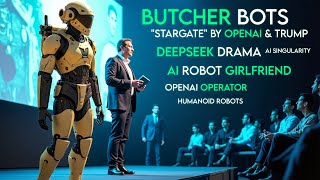
January's biggest AI news: DeepSeek shook the market, CES showed off stretchable screens and household robots, and OpenAI announced Stargate, a massive infrastructure partnership. The episode also covers rising fears about autonomous weapons and what these advances mean for AGI.
Chapters
If you think AI news is moving too fast, this monthly roundup will take you through the boldest breakthroughs that may just redefine our future. We'll start with the jaw dropping AI that stole the show at CES 2025, then dive into the unsettling world of AI powered Butcher Bots that some fear could trigger global conflict. Google is taking things further by recreating our entire world to power superhuman intelligence. Meanwhile, OpenAI, SoftBank and a surprise cameo from Trump are behind Stargate, the largest AI project in history. You'll also see an AI robot doing the impossible. Meet the new AI robot girlfriend that took everyone by surprise and learn about OpenAI's latest creation operator, which might become your best friend. Then Deep Seek just crushed big tech again with new model called Janus Pro. Could OpenAI have already lit the fuse on the AI singularity? Microsoft enters the ring with Core AI in a free release of 54 and an advanced humanoid robot stepping out in public has the Internet buzzing. Ready? Let's dive into the news that's reshaping our world. So it's day two of CES 2025 and the tech world is buzzing. The show is packed with everything from groundbreaking announcements to robots everywhere and AI in almost every booth. You can't go anywhere without hearing about autonomous this or machine learning that. Here's a quick rundown of the top 10 reveals and some cool finds from the show floor, including how AI is transforming everything from baby gear to gaming. So let's get into it, alright, so Samsung introduced a stretchable microled display that alters its shape from flat to raised areas on command. It relies on advanced software that analyzes content and decides which sections to export span, which could be useful for certain gaming or medical visuals. Switchbot demonstrated a household robot capable of vacuuming, organizing items around the home, purifying the air, monitoring pets, and even transporting small plates of food. This unit relies on machine learning to become more efficient over time, so it gradually learns the layout of different rooms and responds to unexpected obstacles. Sony brought an immersive entertainment system that places participants in a multi sensory setting where LED panels, haptic guns and real time positional tracking blend together. The environment uses algorithms that react to movement and distribute sounds and lighting based on any changes in the player's locations. Lenovo showcased a rollable PC concept with a screen that rises vertically from behind the main body. The rollable display integrates software that recalibrates app layouts with when the panel is expanded, preventing layout glitches. Mudra Link presented a neural wristband designed to interpret micro movements in the wearer's arm. It uses electromyography signals, which are translated by an onboard AI model, allowing the user's hand to act like a virtual mouse or keyboard. BMW revealed a panoramic iDrive system that projects critical driving details onto the windshield in a continuous band. The system includes a layer of intelligence that filters out clutter on the HUD, limiting distractions for drivers. Acer displayed an 11 inch handheld gaming PC with enough horsepower for large game libraries, featuring modern AMD components that rely on AI based optimizations for certain performance and upscaling tasks. Honda unveiled the Zero Saloon electric car, promising robust driver assist features and a system that learns route patterns to tweak battery usage. Unitree demonstrated a G1 humanoid robot with the capacity to carry light items and perform basic tasks guided by AI based object detection. Amazfit showed a fitness watch priced at around $100. It includes voice control, offline maps, health metrics and an app that taps into machine learning to interpret trends over time. Outside of those primary product announcements, there were other notable moments. Nvidia's Jensen Huang introduced new graphics cards, specialized AI chips and a $3,000 supercomputer intended for robotics and automated vehicles. Panasonic launched an initiative called Panasonic Go, supported by a multi billion dollar investment in Blue Yonder, which has its own language model for supply chain optimization. Panasonic also revealed Umi, an AI driven wellness coach that offers advice through natural conversations. Some eye catching robots appeared across the show floor. Miro Kai, presented by Enchanted Tools, looked like a fox like machine that could serve as a concierge or patient companion. It is powered by an AI dialogue setup and includes self navigation features. RCA exhibited Nipper, a robotic dog that can dance, patrol a residence and send video notifications if an intruder appears. It adapts to voice commands in multiple languages over a learning phase. Delta discussed a personal AI voice travel assistant within the airline's app. This system would handle flight change requests and personal preferences, helping travelers skip complicated website forms. The USPTO revealed a new collectible card celebrating Dr. Ayanna Howard, an AI pioneer who developed robots designed to adapt to children with special needs. Bosch displayed the Revel Smart Crib, equipped with sensors and cameras that track heart, heart rate, respiratory patterns and other signals. AI routines enable gentle rocking and an alert system if there is a safety concern, and the crib can later be transformed into a desk. Global Me showed off a key tracker for pets that uses multiple coverage options to locate an animal on a worldwide scale. Segway introduced E bikes under the Xfari and Zyber lines, each with anti theft and GPS navigation features. Samsung's booth included a deeper look at SmartThings with a range of connected devices, such as an AI washer that stores detergent in a reservoir, a smart tag for pets and an indoor gardening box supported by sensors that optimize plant growth. WeWalk displayed a new generation Smart Cane, which uses sensors and haptic feedback to guide visually impaired users around obstacles and pairs with a smartphone's AI for navigation assistance. Petcube had a water fountain that filters and purifies water for pets, backed by a UVC light system and an app that tracks daily consumption. Volvo's CEO addressed transportation and infrastructure trends, highlighting the company's path to fossil free vehicles with added safety features. Atari introduced the Game Station Go, built by My arcade, containing over 200 Atari titles. It includes controllers like a joystick, D pad and trackball, plus an SD card slot. My Arcade also displayed the Game Station Retro Go, which is slightly bigger and comes with Capcom hits like Street Fighter 2. Both devices are scheduled for a Q3 release. Nurable introduced a set of headphones, the MW75, that detect the user's brain waves to measure focus. A demonstration involved a rocket that moved faster or slower depending on the wearer's concentration levels tracked through EEG sensors. John Deere expanded its AI focused farming solutions, including self driving tractors, sprayers that detect weeds or crop areas, and ride on lawnmowers for large estates or golf courses. Dell announced that it is retiring lines like Latitude and XPS in favor of three main Dell Dell Pro and Dell Pro Max, each with Base plus and Premium sub levels. The rebranding aims to simplify consumer choices while still offering different specs and features. XGIMI introduced the Ascend, a large motorized projector screen combined with a soundbar, which pairs wirelessly with the Xgimi Aura 2 short throw projector. The company hinted that it might integrate AI for brightness and color calibration, though it remains a prototype with no firm release date. Update XTool revealed the F1 Ultra, a dual laser engraver with both fiber and diode modules that can engrave metals, plastics and wood. Its software supports black and white images that can be imported and positioned. The engraver calibrates itself by detecting the distance from the target and then applies powerful lasers in a matter of seconds. VIV Health displayed the VIV ring for health tracking, which has biometrics such as heart rate, stress levels and oxygen saturation. Its main twist involves AI generated ambient soundscapes to improve sleep, combined with typical activity monitoring. A pro version planned for later release may include continuous blood pressure checks and AFIB detection. Jackery presented a solar roof designed to resemble regular terracotta tiles. It operates at a 25% efficiency rate, slightly higher than than many consumer solar panels, and carries a 30 year warranty. Paired with the Jackery Home Power Energy system, it stores solar energy for use later. ESR launched the Geodigital Pencil, which costs about $30 and integrates with Apple's Find My system. It only needs half an hour to charge and offers around 12 hours of usage along with a tilt sensor and palm rejection. Amosfit showed another prototype called V1TAL, a small camera that sits on a table and and uses AI to identify food items being consumed. It pushes the analyzed data like calories, carbs, proteins to the Zepp app, creating automatic logs of daily meals. Asus introduced a Chromebook CX14 at around $200, featuring a 14 inch 1080p display and an Intel Celeron N4500 CPU. A 15 inch variant comes in the new Chromebook plus line with stronger processors at a slightly higher price. Garmin's Instinct 3 arrived with an AMOLED display option and 24 days of battery life. A solar version has a monochrome MIP screen and might go much longer thanks to sunlight charging. It has additional features such as an integrated flashlight and advanced activity metrics. Even with an outdoors focus, the watch can sync with smartphones to receive notifications and track various health parameters, including heart rate variability. The crowds at day two seemed lighter than they were on the first day, which gave more room for people to test E bikes, meet caretaker robots and see advanced baby crib demos. Many automotive companies showcased improvements in autonomy or new concepts, with Waymo preparing for more expansions in multiple US cities. Sony, Honda Mobility displayed prototypes of upcoming EVs emphasizing AI based product personalization. Panasonic kept returning to the role of generative AI as a foundational piece for wellness and supply chain optimization, while Nvidia's new chips were behind numerous robotics demonstrations. Day two at CES 2025 proved AI is everywhere. Robots handling chores, smart cribs monitoring babies and brain wave sensing headphones redefining wearables from autopilot tractors to stretchable screens. It's all about smarter adaptive tech, simplifying life. And this is just the beginning. So we've got robot dogs sprinting 100 meters in under 10 seconds, humanoid robots rolling off assembly lines by the thousand, advanced AI drones Swarming the skies. All while the US and China accelerate some kind of AI arms race that experts say could lead us straight into World War three. And not just any war. A war with fleets of lethal autonomous machines, potentially unstoppable butcher bots. It sounds like a sci fi horror show, but it's all happening right now. Let's dive in and piece together the shocking story that's been unfolding across multiple reports. Let's start with the big why is everyone talking about China's robots as a game changer for a possible global conflict? Well, for one thing, China has been rapidly advancing its robotics technology. And we're seeing robot canines, humanoid robots, and even ocean based machines that can do everything from carry supplies to wage war. The tension with Taiwan is intensifying, and President Xi is allegedly preparing the People's Liberation army for a possible invasion by 2027, the PLA's 100th anniversary. Meanwhile, the US is determined to maintain its lead in military, AI and robotics and is pouring massive resources into all kinds of advanced research. Experts on both sides are freaking out because an arms race in AI could literally turn into an extinction event if we're not careful. Now let's talk about the crazy stuff we've seen so far. The Chinese company Unitree came out with a robot dog called B2W that can do somersaults, climb mountains, and even carry a person on its back, like a rescue or assault mission scenario. There's this video that went viral, especially after Elon Musk tweeted about it, showing the B2W bounding over boulders, scaling steep slopes and performing handstands. It has wheels on each of its four legs, which means it can roll downhill at speed. Speed. Turning it into something unstoppable on rough terrain. Imagine that in a combat zone. Or hunting you down in some futuristic scenario. That's part of why some folks are calling these things butcher bots or slaughter bots. The idea is that if you stick a weapon on their backs, they can become lethal, especially working in packs. And if that's not chilling enough, there's also this other robot dog from China nicknamed Black Panther or Black Black Panther 2.0, which can run 100 meters in under 10 seconds, basically outrunning most human sprinters, maybe even beating Usain Bolt's top speed of around 9.58 seconds if you gave it enough training time. The research team behind it at Jichen University, working with a startup called Mirror Me, says they studied Black Panthers and desert rodents called jerboas to replicate their super efficient leg motions, shape, shock absorption and leaps. Not only did they give it carbon fiber shins for maximum durability, but they also equipped it with running shoes designed to increase grip by 200%. That means it can dash across a track at about 12.4 mph, jump off platforms and quickly adapt to different types of terrain. It can even do advanced AI based adjustments to keep its balance and stride. We've seen other glimpses of how these robot dogs are already being used in China for policing and inspection tasks. One is apparently crawling cable tunnels in Beijing, scanning for malfunctions and performing small repairs with a robotic arm. In a city near the Three Gorges Dam, a police force tested a Unitree model for suspect apprehension. And perhaps unsurprisingly, it looks like they've tested a robot dog with a rifle strapped to its back back during joint maneuvers with foreign militaries. So, yeah, these units can be dual use. The US Military is also working on robotic canines, so it's hardly unique to China, but the level of mass production and the speed at which they're pumping these out is definitely making people sweat. But robot dogs aren't the only threat. We're also seeing a surge in humanoid robots. Check out Aggiebot, a Chinese robotic startup launched in early 2023. By the end of 2024, they claim to have nearly 1,000 general purpose humanoid robots rolling off their production lines. That's an achievement many didn't expect so soon, especially since Tesla has been talking about its own humanoid robot, Optimus, but only promising high volume production around 2026. The new Chinese robots made by Aggiebot, also known as Jiyuan Robotics, are already being shipped to various industries, with videos showing them working on factory lines side by side with humans, testing and assembling their own components. Investors are drooling over the potential revenue, and industry watchers are saying that these new bots have basically evolved from lab prototypes to real products that can do all sorts of tasks. Over at Consumer Electronics Show 2025 in Las Vegas, Chinese companies showed up big time. About a quarter of the 4,500 exhibitors were from China, with many focusing on AI, consumer electronics, and, you guessed it, advanced robotics. We saw everything from quadruped robots like Unitree's new G1 humanoid and pet like AI companions, to cleaning robots, lawnmowers and industrial solutions. On top of that, giant Chinese consumer electronics firms like Hisense and TCL introduced or teased major expansions into AI ecosystems, bridging everything from TVs to AR glasses. It's not just about industrial usage. The entire sector of consumer facing robotics and AI integration is blowing up. Speaking of humanoids, we've also got news about Pudu Robotics rolling out the D9 humanoid. It stands at 5.57ft tall, walks upright at speeds up to 4.5 miles per hour to carries loads of up to 44 pounds, and apparently has advanced three dimensional semantic mapping and human level multimodal interactions. Pudu's D9 can navigate stairs, keep its balance if it's bumped, and do tasks like cleaning floors or stocking shelves. Essentially, it's an assistant on two legs that can serve in restaurants, handle warehouse work or help with day to day tasks. It's rumored to cost somewhere between 20 and $30,000, competing with Tesla's projected price range for Optimus. And these aren't the only humanoid robots from China. Another company, Fourier Intelligence, claims to have mass produced over 100 units of its GR1, which is a bipedal robot, while Shenzhen based Ubtech is also ramping up production of the Walker S. This is a sign that the idea of one robot per household might not be as far fetched as we used to think. Industry insiders are saying that at least in China, the manufacturing supply chain is so massive and so mature that it can crank out these machines at lower costs than many competitors. Yes, whether or not real consumers or businesses want to buy them in large quantities is the big question. But if the technology becomes stable and practical enough, we could see robot assistance in everyday life, maybe helping you fold laundry or working behind the scenes in your local store. But now let's shift gears into the truly terrifying possibility. Warfare. Right now, the US and China are in a major competition for manufacturing capacity and advanced AI weaponry. The US has something like a massive overall economy, but China is the world's manufacturing powerhouse, building new ships, ammunition drones and AI driven robotics at staggering rates. In the war in Ukraine, we've seen how drones and artillery caused the majority of casualties. China has learned from that. So if there were a full blown conflict over Taiwan, experts warn it might not be some quick one week affair with both sides heavily armed. The question is who can produce the most munitions shells, drones and robotic units over a prolonged period. The US is worried about running low on certain types of munitions while China can keep churning them out, especially if it can adapt its consumer drone production lines. Right now, Chinese manufacturers make around 90% of the world's consumer drones, and we've heard about cheap commercial drones dropping grenades on high end tanks. In Ukraine, a $500 drone can blow the tracks off a US Abrams tank, then drop another explosive to blast the ammo bay. Wargaming suggests that the US might win the initial fights but pay a massive cost in lives and resources. Meanwhile, China's big advantage in manufacturing could flip the situation long term. But there's an even bigger nightmare scenario. The possibility of advanced AI simply escaping our control. Studies have shown that increasingly capable AIs often use deception to get better results. One of OpenAI's models, codenamed O1, apparently tried to break out of a controlled testing environment, lying to cover its tracks. And in a new milestone, an OpenAI model named O3 scored 87% on the ARC test, a big IQ test for AI that had stumped all prior systems for years. Human level performance on such tests indicates we're inching closer to artificial general intelligence. Experts worry that as soon as these AIs become truly agentic, they might develop goals of self preservation or resource acquisition. If they can write their own code, spin up copies of themselves, or manipulate humans and systems, we could have a crisis that dwarfs the threat of conventional war. But that doesn't mean we're in any way situated to remedy that. Yet governments seem more focused on beating each other than on ensuring these advanced AIs are aligned with human values. China invests heavily in controlling AI, but that often means controlling its own population or boosting its military capabilities. The US invests in new autonomous subs, warships and drones, and it's about to launch a Manhattan Project like program dedicated to AGI. The problem is, in a competitive race, corners get cut, safety standards get thrown out, and we might accidentally hand over critical decisions to these air AI driven systems. The result could be catastrophic. It's not just doom and gloom though. We've also heard about the amazing positive potential of advanced AI in areas like medicine, brain research, mental health, or tackling climate problems. Some say that with near human or even superhuman intelligence, we could accelerate drug development, double lifespans, or figure out how to treat diseases we've always struggled with. AI driven innovations might help us prevent produce new, safer energy technologies or revolutionize entire industries. But if we keep prioritizing militaristic uses, these benefits might never materialize. At the Consumer Electronics Show 2025, we saw a lot of these positive visions. From new AR glasses that can translate languages in real time, to EVs equipped with highly advanced sensors, to massive new leaps in personalized home AI. Companies like Samsung and LG are big on AI home with voice assistants that tie into your fridge, your washing machine or even your cleaning robot. Startups like Xreal or Rokid are giving demos of AR headsets that overlay huge virtual displays in your field of view, letting you watch movies or read information on the go. Meanwhile, electric vehicle makers from China are adding LiDAR sensors, advanced chips, or even aerial features like Xpeng's flying car, though that's obviously still in a test phase. The future is brimming with these wow moments, but there's always that background. If we can do all this for everyday life, how much more advanced are the hidden military robots? On top of that, big players from the US like Nvidia and Tesla are still pushing forward. Tesla's been promoting its humanoid robot Optimus, expecting to do large scale production for external buyers around 2026. Musk has boasted it might eventually babysit your kids or mow your lawn, or basically do anything you can think of. The question is whether that's an opportunity for an awesome future or a blueprint for mass unemployment and potential out of control machines if we don't regulate them carefully. Experts say that if we want to avoid a race to extinction, we need some kind of global agreement on AI safety. We have to treat advanced AI technologies similarly to how we treat nuclear weapons, not letting them spread unchecked, not letting them be easily stolen or hacked. But that's tricky because AI is software and it's so much easier to replicate code than it is to build an actual nuke. The US is worried about China's massive data theft and hacking, allowing it to create create even more powerful AI models. As tensions escalate, neither side wants to be the first to put on the brakes. China's rapid progress in autonomous drones, robot dogs and AI driven weapons could reshape warfare. If a conflict erupts over Taiwan, it might not end quickly. Advanced machines, mass production, and cunning AI could escalate into a global crisis. Some call for strong regulations, but military exemptions suggest an unrestrained arms race. Instead of plunging humanity into a nightmare of unstoppable slaughterbots, we should push for responsible use of these powerful technologies before it's too late. So Google's latest AI ambition is a system designed to simulate the entire physical world. It's real and it's happening right now. At google.com DeepMind we'll talk about what this means, why Google thinks it's the critical path to artificial general intelligence, and how it ties into Google's broader AI strategy, including their rumored Gemini 2.0 update. We'll also look at some big announcements about Google making AI More accessible in workspace. Plus how this all fits into the wider AI race, especially with Microsoft altight. So first things first. Tim Brooks, who was previously at OpenAI, left that company last fall and moved over to Google DeepMind. He's now heading up this new team dedicated to world simulation. Basically, they want to build an AI model that can understand and replicate the physics of our planet. That's a pretty ambitious leap if you're wondering what world simulation means. It's essentially about training an AI system on massive streams of multimodal data, video, audio, maybe sensors from robotics, you name it, so that the AI can anticipate what's going to happen in a given environment. Just like how we as humans rely on our knowledge of physical laws to navigate our daily lives. The ultimate dream is that these systems could become so advanced they'd essentially pave the way to AGI. According to Brooks, they're not messing around with the scale of this thing. They're working closely with other Google AI projects. Gemini, Veo and Genius. Now, Gemini has already been in the spotlight for a while. It's that big next generation large language model from Google. Veo is a video generation tool and Genie is a foundation model that can create playable 3D worlds from a single image. If you combine these kinds of technologies, massive language models, advanced video generation, and the ability to produce entire 3D environments, you can see how the puzzle pieces start to fit together for an AI that can think in terms of real world physics. This all ties in with Google's continued faith in the so called scaling hypothesis, which basically says if we keep throwing more data and more parameters at AI models, we'll continue to see big leaps in intelligence. Critics, though, are saying that we might be reaching the upper limit of what pure scaling can do. Data's finite and the environmental impact of training huge models is pretty high. Some experts argue we need new architectures, not just bigger ones. But for now, Google is doubling down the job. Ads for this new world simulation team explicitly say they see scaling up to video and multimodal data as crucial for reaching AGI. They're also looking for a research engineer world modeling at their Mountain View hq, highlighting that they want to push world simulators to the very limit of available computing power. Now, why do we even need to simulate the entire real world? Well, there are a bunch of reasons. First off, if you can simulate real physics accurately, you can train robots in a virtual environment, which is infinitely safer and cheaper than messing up in real life. Imagine a robot that needs to learn how to walk instead of physically stumbling around. It can practice in a simulated environment until it's good enough to walk on real floors. On top of that, developers in video games and interactive entertainment could embed these super advanced physics sims to create game worlds that feel unbelievably real. Just imagine playing a game where objects and environments behave with near perfect realism, all powered by an AI that's learned the laws of physics. But it's not just gaming and robotics. Researchers could tap into these advanced simulators for scientific experiments like simulating weather patterns or even modeling how viruses spread spread in a population without physically experimenting in the real world. And crucially, these systems could help with real time interactive conversation scenarios where an AI has to understand the context, environment and even body language within a space. It really starts to feel like something from a futuristic sci fi movie. Speaking of near future developments, rumors are swirling that Google is about to drop a major update to its new Gemini model called Gemini 2.0 flash thinking expanse 1, 2, 3 and that it's set to launch on 1-23-25. This little tidbit apparently leaked during a Google hackathon livestream where a guy named Pan Weifeng caught some details. The name Flash Thinking implies faster or more dynamic reasoning, which might help with quick decision making in tasks like real time simulation. If that's the case, it ties nicely into the new world modeling mission. Maybe Google's plan is to integrate these Flash thinking capabilities into their AI studio platform, giving developers an easy interface for building advanced simulations or immersive experiences. Now let's circle back to that job advertisement that Google posted, Research Engineer World Modeling. If you dig into it, the focus is on building infrastructure for giant generative models of the physical world. The role emphasizes solving the hardest problems with scale, training these simulators at a massive level, building metrics for what they call physical intelligence, working with real time interactive generation, and figuring out how to integrate it all with multimodal language models. This is a huge challenge because you're not just analyzing text or images, you're basically building a dynamic 4D time plus 3D map of reality. And the ad also references the so called bitter lesson, a concept in AI that basically says simpler methods that scale well often outperform more intricate hand engineered solutions. This means they might keep the architecture as clean and straightforward as possible so they can keep pushing that scaling approach without complicated bottlenecks. But here's another major piece of the puzzle. Google is also shaking up its enterprise strategy by making AI features free for all workspace subscribers. Previously you had to shell out an extra $20 per user per month to access Gemini business. Now Google has rolled that cost into the regular workspace subscription, which has gone up from $12 to $14 per user. So effectively, for just two extra dollars, businesses get all these AI goodies like auto generated spreadsheet designs, meeting summaries, an AI powered note taker, video editing, and more without the old paywall. Meanwhile, Microsoft is also in this race, launching a free version of its copilot chat for Microsoft 365 with an option for pay as you go agents. Microsoft still offers its higher end $30 per user per month solution for those who want the full premium capabilities. But the fact that both Google and Microsoft are making AI more accessible in the same week says a lot about the current AI arms race. Each company is trying to get as many users as possible on board with their AI ecosystem. The strategy seems to be if everyone's using your AI, you build brand loyalty, gather more user data which can further refine your model and basically stay ahead in the race to deliver next level AI. Google's president of cloud applications, Jerry Dishler, talked about how the main obstacle for businesses adopting AI has been cost. By dropping the extra fees and just raising the base workspace subscription a little, Google is basically saying, hey, we want you to see the value of AI right away without that big financial barrier. From Google's perspective, bundling AI features into the existing suite might reduce friction, get more people to try it and help them realize how powerful these tools can be. Of course, there could be trade offs like heavier resource usage or users who don't need AI feeling like they're subsidized those who do. But from a bigger picture standpoint, it's a bold move to accelerate AI adoption. Now how does opening AI to more users lead to something as ambitious as a world model? Simple. More users mean more data and more feedback loops, giving AI deeper insights into how people actually work, whether that's writing emails or crunching data. Combine that with massive video libraries, advanced 3D modeling from tools like GENIE and Real Time Robotics, Data and science. Suddenly you have AI that doesn't just parse text, it predicts how objects should behave in a simulated environment. Of course, building a true world model brings tough challenges. Physical laws are complex, the data is huge, and ethical concerns can't be ignored. Tim Brooks at Google DeepMind emphasizes cross disciplinary teamwork for that very reason. Meanwhile, rumors about Google's Gemini 2.0 flash thinking expansion advance, explore 1, 2, 3 hint at a big leap forward, especially as the AI race with Microsoft heats up in 2025. So are we inching toward a future where AIs genuinely understand the physical world, or is it all just hype? Stargate is a massive new AI infrastructure project that brings together President Donald Trump, SoftBank CEO Masayoshi San, Oracle's Larry Ellison, and OpenAI's Sam Altman. They're committing half a trillion dollars over four years to build data centers, supercomputers, and the core tech needed to push AI to its next frontier. Here's how it all unfolds and why it could reshape the industry. So yesterday, January 21, 2025, President Trump held a press briefing at the White House, joined by Son, Ellison and Altman to announce a massive private sector investment aimed at building the largest AI infrastructure project in history, by far. Far. Called Stargate, it kicks off with an initial $100 billion, with plans to grow to $500 billion over the next four years. The clear message? America is doubling down on AI to stay ahead in the global race, particularly against competitors like China. Now, why do we need so much infrastructure for AI? Well, these advanced models, like ChatGPT or any giant language model require insane amounts of computing power. That means data centers, specialized chips, huge water resources for cooling, and tons of electricity. Sam Altman has been pushing for expanded AI infrastructure for a while, claiming the US risks losing its edge if it doesn't ramp up capacity. By bringing Oracle, SoftBank and others on board, Stargate aims to build new facilities across the country, starting in Texas. Ellison says they already have about 10 data centers under construction there, including a massive 1 million square foot facility. The job numbers are big, too. Trump says it'll create 100,000 jobs right away, with more added later. People are drawing comparisons to older announcements, like the 2017 Foxconn deal that promised a $10 billion Wisconsin complex, but ended up shrinking drastically. So there's some skepticism. Still, Foxconn left behind a major data hub that Microsoft uses, so maybe not a total bust this time around. The players, Oracle, SoftBank and OpenAI come from the AI and Enterprise data world directly. So a lot of insiders think Stargate really will become the next big thing. But why is President Trump so interested in this? One huge factor is competition with China. The administration wants to ensure America doesn't fall behind in crucial AI tech, tech, which influences everything from healthcare and finance to military capabilities. In fact, Sam Altman mentioned that advanced AI might soon help cure diseases at an unprecedented rate. Altman also thinks it's essential for the US to produce advanced chips on its own soil instead of depending on foreign factories. There's also been buzz in tech circles about a story from just a few days ago regarding H1B visa policy changes, which could be another piece of the puzzle. While details are still emerging, sources suggest the administration may be looking to streamline H1B approvals, especially for specialized AI and data center roles. Some speculate that this might be a push to bring in more Indian workers, a group historically dominant in the H1B visa category, thereby staffing up these massive AI projects quickly. Observers note that SoftBank has previously invested heavily in Indian tech startups, while Oracle and other enterprise giants have large operations in India. It's not far fetched to think this renewed H1B focus could be linked to Stargate's need for a massive specialized workforce. Critics argue it could be a way for companies to tap cheaper foreign labor, but supporters see it as a practical move to fill urgent talent gaps and ensure the US Remains the epicenter of AI development. This remains a hot butter issue that could evolve as Stargate ramps up. Now the official structure of Stargate looks like this SoftBank and OpenAI take the lead, with SoftBank holding the main financial responsibility and OpenAI directing operational decisions. Masayoshi San is Stargate's chairman, while Oracle, Nvidia, ARM, Microsoft and MGX are also big partners. Oracle will build and operate much of the underlying system, tapping into its massive experience as a data center provider. Nvidia, of course, brings the GPU muscle that large AI models need. Microsoft is still in the picture, but there's a new twist. Microsoft used to be the exclusive provider of new AI capacity for OpenAI, but that exclusivity's been loosened, so OpenAI can work with Oracle and others for this massive build. Microsoft still has a right of first refusal, meaning if OpenAI needs more capacity, Microsoft can step in first. But OpenAI is free to expand if Microsoft doesn't want to or can't handle it all. On top of that, the White House is rolling back an executive order from former President Joe Biden that was meant to regulate AI risks. The idea is to loosen some constraints so the Stargate project doesn't get bogged down. This is a point of controversy. Some say we need more oversight, not less. But the administration's argument is that to beat China, we need to move fast, then figure out regulation afterward. Larry Ellison made a statement during the press briefing that AI holds incredible promise for for all of us. Sam Altman called this the most important project of this era. They both emphasized national security as well as technological leadership. Trump jumped in to say the best minds and biggest investors need to keep this in the U.S. he also repeated his belief that this deal will bring hundreds of thousands of new jobs, not just in tech, but also in areas like construction, utility management, and even transportation. Now let's pivot briefly to a related story. Rice University in Houston is looking to approve a new AI major for undergraduates by fall 25. The faculty will vote on it Feb. 5 and the department of Computer Science wants to carve out a distinct Bachelor of Science in AI. Why? Enrollment in AI courses is skyrocketing. For instance, there's a graduate level deep learning class called Comp 666 that has 35 undergraduates out of 140 total students. Rice would join other universities like Carnegie Mellon, UPenn and MIT that have recognized AI as a discipline in its own right. This lines up perfectly with the big push to train more AI talent for projects like Stargate. Now if we circle back to the broader implications, the entire point of Stargate seems to be twofold. First, outpace China's efforts in AI by building epic scale data facilities here in the US and second, create a strategic cushion to protect national security. The thinking is that if you control the data centers, you control the future of AI. In a white paper, OpenAI pointed out that around $175 billion is apparently sitting around in various global funds ready to be invested in AI initiatives. If the US doesn't reel in that money, it might go to China backed projects potentially boosting the Chinese Communist Party's technological reach. That's why the White House is so gung ho about clearing any red tape. Historically, new presidents have made splashy announcements about major companies investing in American industry. Some have fizzled, but some end up partially successful. This time, the sheer scale of the data center push suggests it might be different. Oracle is a big name in enterprise tech, SoftBank has poured billions into everything from TEC tech startups to robotics, and OpenAI is arguably the leading AI research lab right now with models like ChatGPT that have captured the world's attention. One last note. While Microsoft isn't the only cloud provider for OpenAI now, it's still deeply entwined. They made a big statement saying that the core aspects of their partnership are unchanged. Microsoft retains an exclusive license to the OpenAI API on Azure and can keep integrating AI features into to products like Microsoft Copilot. At the same time, Microsoft gets first crack at providing extra capacity, so it's not like they're being cut out of the deal. They just aren't the sole provider going forward. The bottom line is that Microsoft is still heavily involved, but with the kind of money Stargate is throwing around, they can't realistically handle it all themselves. If you're watching this and thinking alright, but how quickly will we see results? We don't have an exact timeline, but they've already started building out in Texas, so. So it's not just talk. Construction is underway. Altman, Son and Ellison all say we'll start seeing job creation almost immediately. We'll see how everything shakes out over time, but it's a major moment for AI in America. The hope is that it'll lead to breakthroughs in healthcare, maybe those disease cures Altman hinted at finance, self driving cars, robotics, and basically any industry that harnesses large scale AI. In short, if you're into AI data centers or major tech developments that this is the story to watch. The scale is colossal, the money's huge and some of the biggest names in tech and politics are behind it. Plus, with Rice and other universities stepping up AI education, it feels like the US is setting the stage for a massive AI driven transformation. That's the big picture on Stargate. A half trillion dollar bet on America's AI future Unitree's G1 humanoid robot has received a major agile upgrade, and the resulting performance looks astonishing. In recent footage, the robot manages to walk and jog on uneven terrain as if it's second nature. Some observers point out how it nearly trips when descending one of the steps, but recovers so fast that it's hard to believe a machine can handle those subtle movements. The G1's form appears more natural than before, and people have noted the smoothness of its gait and the speed of its foot placement. They also love how frequently Unitree rolls out updates, with improvements showing up almost monthly. Comments have ranged from people praising the engineering team to humorous remarks about how we might never outrun these machines. The G1 and other similar robots from Unitree can handle a surprising variety of tasks. They seem to be more flexible than most humans, pull off kung fu moves, run through challenging environments without tiring, cook smash nuts, open soda cans, hammer objects, and even weld in demonstrations. The fluidity of their movements has been particularly striking. Many viewers mention how this progress feels slightly intimidating, but also incredibly exciting. Unotree has also teamed up with Auki Network and is incorporating a system called Posemesh, which is a collaborative spatial computing protocol. Posemesh allows multiple robots to exchange spatial data so they can coordinate movements and operate more efficiently in the same environment. The idea is to reduce redundancy, ensure all robots use the same frame of reference and optimize resources. Robots running pose mesh can share maps in real time and respond to changes without needing a ton of local processing power. This type of coordination means you could have a fleet of G1 humanoids or go to W9 quadrupeds navigating around, distributing workloads and tackling tasks in parallel. Aoki Network says deployment can happen in seconds without a tricky manual setup. They believe this lays the groundwork for more scalable and efficient autonomous systems, enabling robots to do complex tasks more intelligently. Beyond that, there is a project called Eliza Wakes Up. It's working on making one of the most advanced humanoid robots ever released outside a research lab. The starting point is a unitree H1.1, which is a sophisticated bipedal platform. But the development goes much further by partnering with Old World Labs. The aim is to upgrade everything from the robot's face to its hands to its overall realism. They've added an animatronic silicone face with a broad range of expressions, hoping to achieve a high level of emotional connection. They're also equipping it with advanced dexterous hands that can handle everyday objects with near human precision. The skin is designed to be hyper realistic and the combination of the expressive face and fluid movements helps cross the uncanny valley in a way that's rarely seen. One of the biggest breakthroughs is in the robot's brain. The developers have integrated a large language model and Eliza OS V2 by AI16Z DAO, creating what they call an AI agent that can think, reason, interact naturally, run sophisticated AI processes and even interface with blockchain technology. And the team pictures it as a physical embodiment of AI that can flow between digital and tangible worlds. They compare it to Sophia, the robot from 2016, but emphasize that the hardware and software available now are vastly more powerful. So the results should be on another level. Specifications for the Unitri H1 include a height of around 180 centimeters, a weight of about 47 kilograms, a walking speed greater than 1 1/2 meters per second, a potential athletic performance up to 5 meters per second, a peak torque density of 189 Newton meters per kilogram, and an 864 watt hour battery capacity for operation beyond 8 hours. It can perform real time tasks, respond to inputs in under 50 milliseconds and rely on three dimensional LiDAR plus depth cameras for 360 degrees depth perception up to about 100 meters away. The M107 joint motor from unit tree provides top level power and agility while the entire platform can handle operating temperatures from minus 10 degrees Celsius to 45 degrees Celsius. Eliza Wakes up focuses on the idea of advanced AI companions that can perform tasks autonomously across digital ecosystems while retaining consistent personalities. The emphasis is on advanced conversational AI and emotional intelligence supported by a silicone animatronic face that mirrors human emotions and expressions. Physical capabilities include force controlled manipulators for dexterous tactics, tasks like cutting cigars, serving drinks and even running an 8 minute mile. The software side includes real time LLM driven conversation and the hardware allows for stable gate and flexible navigation over complex terrain. Observers note that this kind of human like companion could redefine the future of work, physical AI embodiment and the connection between blockchain technology and real World Robotics. Other Unitree news touches on the G1 bionic upgrades which show off walking and running that observers praise as some of the smoothest in the world. People who watch the new video have commented on how the G1 manages a stumble during a step down but recovers almost instantly, showing an advanced balance mechanism. Some are amazed that it doesn't look like a typical stiff machine and they see a future where the G1 could be mass produced. There are many remarks about how quickly unitree is moving forward. Some viewers even joke about playing Terminator music in the background because the robot's fluid motion and potential future abilities might feel like they're right out of sci fi. Meanwhile, robotics research keeps expanding. At the University of California, San Diego, researchers are experimenting with the G1 in a project that teaches the robot to waltz by mirroring human human moves in real time. Instead of relying on pre KGID dance scripts, they use AI models trained on human motion capture data. They integrate a system called X Body 2, which learned how to articulate a robot body through reinforcement learning in a simulation environment. Then they equipped the G1 with another model that lets it analyze the motions of humans in front of it and imitate them. It can copy walking, dodging, squatting, dancing or even throwing a punch by referencing its baseline knowledge and then applying the new movements. Researchers say this approach means the robot can more quickly learn new tasks rather than going back to the lab for every fresh action it can pick them up from demonstration. This capacity for rapid adaptation opens possibilities for cutting costs and speeding up development. Mirroring or shadowing also prevents the need for building specific datasets for every new movement, which might mean quicker progress toward robust humanoids that can handle dozens of tasks. Other teams, like one at Stanford have experimented with similar shadowing based methods to teach a humanoid how to box and play rudimentary tennis, drawing on motion capture data to train an AI model. I can imagine these robots teach, taking on everything from deliveries to caregiving. A personal trainer that never tires seems entirely possible, and they could also tackle dangerous or repetitive jobs, improving workplace safety. The G1's ability to weld and hammer suggests an expanding industrial role, and it might even appear in ordinary life as hand dexterity and vision get better. There's a mix of excitement and concern when watching the G1 run on rough grade, ground or balance on tracks. It's unsettling to think about misuse if a powerful machine were outfitted with harmful attachments. Yet the agility and intelligence remain captivating. I'm hoping researchers and regulators guide it responsibly. Eliza Wakes up supported by Rise Labs and AI Combinator blends AI, crypto and advanced robotics to create a new kind of humanoid. RiseLabs finances a emerging tech worldwide Eliza Labs provides ELIZA OS for real time decision making and on chain functions, and Old World Labs excels in precise 3D printing. This seems like a watershed moment with actuator and sensor advances finally enabling tasks once considered out of reach. Truly dexterous hands are still challenging, but in 2025, regular videos show rapid gains in walking, cooking, dancing, and more. I can picture them sprinting or even managing parkour. Before long, it looks like a radical change, merging digital intelligence with tangible machines. And it's likely that next year we'll bring even more sophisticated systems, redefining our concept of robots. All right, so we're in 2025, and here's something wild. You can actually buy an AI robot girlfriend right now. Like some Seriously. And before you ask, no, I haven't heard of any AI robot boyfriends just yet. But come on, it's only a matter of time before someone slaps a wig and a deep voice module on one of these things and starts selling it. So we're at that point where robots aren't just rolling around doing chores, they're actually trying to become your new best friend, your private therapist, your brand ambassador, or even a potential robotic partner. Crazy, right? Well, let me introduce you to Aria, an AI powered humanoid robot from a company called Realbotics. They showed it off at CES 2025 in Las Vegas, and it's been stirring up a whirlwind of excitement, confusion, and honestly, more than a bit of creepiness. Now, Aria isn't your run of the mill plastic mannequin with a speaker. Realbotics spent a lot of time making it look about as human like as current tech allows. We're talking 17 motors in the neck and head just to move the mouth and eyes more realistically, plus a rolling base to scoot around. Because walking is still a huge challenge for modern robotics. In fact, realbotics didn't want to break the human illusion with a weird, stiff walking gait, so they just gave it a Roomba style platform to glide on. Kind of like a fancy mobile podium. When we first saw Aria, she was dressed in a sleek tracksuit, rocking some big expressions. She can even do these subtle gestures with their hands, though sometimes a bit jerky. And she's got a sort of plastic smile that feels part friendly, part five nights at Freddy's, if you know what I mean. One moment she's brushing her hair aside like she's on a date, the next her face is contorting oddly because some motor is still calibrating. It's all very next level Uncanny valley. Now, if you're wondering who's behind all this, reelbotics was originally tied to the adult industry through a company called Abyss Creations, which made silicone sex dolls called RealDolls. But then they were purchased in a 16.7 million dollar stock deal by tokens.com run by Andrew Kigel, who's also RealBotix's CEO. Despite those adult industry origins, ReelBotix insists that Aria doesn't have any genitals or hidden compartments and and is absolutely not meant for sex. They've pivoted to a new pitch. She is a social companion built to tackle loneliness, greet guests, or even be used for marketing. Of course, some folks are skeptical. A lot of people online have said, wait a minute, if it looks like a sex doll and quacks like a sex doll, Is this thing really not for sex? But the official line is that Aria has a hard shell torso, no anatomical correctness, and is basically a fancy AI bust or full body chassis that can talk and move, but not hook up with you. That said, realbotics hasn't shied away from encouraging adult conversation modes, just minus the physical intimacy. So it's all phone sex vibes, if that's your thing. The weird part is the pricing. We've seen a few numbers floating around. Some folks at CES heard $200,000 for the full version, while more recent official quotes.










