AI Takes No Breaks: Crazy Week with AI News!
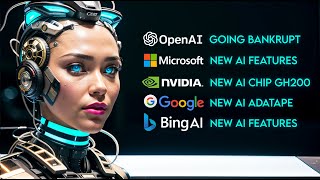
Nvidia's new GH200 chip arrives next year with 141 GB memory. OpenAI faces $700k daily ChatGPT costs and potential bankruptcy by 2024. Google launches Project IDX for cloud coding, while Microsoft and Bing roll out new AI tools and China develops Recycle GPT for faster inference.
Chapters
The AI world has been on fire this week with some truly fascinating news and innovations. In this video we'll explore the most compelling AI stories of the week, like Nvidia's new AI chip that claims to be hotter than the Sun, OpenAI's financial crisis that could lead to bankruptcy by 2024 and Google AI's new project Adatape that enables adaptive computation and dynamic read and write. We'll also dive into Project IDX, Google's new AI integrated coding environment, Microsoft 365's new AI capabilities, Bing AI's six month anniversary with new features, and finally a new AI research from China that introduces Recycle GPT, a language model with recyclable module alright, the first topic is about Nvidia, the leading company in providing high end processors for generative AI applications. Nvidia has unveiled a new AI chip, the GH200, which is designed to enhance the efficiency of running large artificial intelligence models. The chip pairs 141 gigabytes of advanced memory with the same GPU as Nvidia's top end AI chip, the H100. This edition is targeted at improving the inference phase of AI, where the model continuously makes predictions or generates content. The new chip will allow larger AI models to run on a single system and is expected to considerably reduce the costs of this process. Nvidia's CEO Jensen Huang highlighted that the GH200 is built for expanding data centers globally. It's set to be available next year, although the price has not been disclosed. The release comes as Nvidia faces growing competition from companies like amd, Google and Amazon, all of whom are working on their own AI oriented chips for inference. The next topic is about OpenAI, known for its groundbreaking technologies that have brought AI to non technical audiences. However, recent reports suggest that OpenAI is facing potential financial difficulties due to the high cost of maintaining ChatGPT and other projects. According to these reports, ChatGPT alone costs $700,000 per day to run, which amounts to over $250 million per year. This is a huge financial strain for OpenAI, which relies on a $10 billion investment from Microsoft and as its main source of funding. However, this investment may not be enough to sustain OpenAI in the long run, especially if its user engagement continues to decline. The Reports indicate that ChatGPT's website usage has dropped significantly in recent months, partly due to the cannibalization effect of its API service and partly due to the competition from other open source language models. As a result, OpenAI may struggle to generate enough revenue to cover its expenses and achieve its ambitious goals. If the company does not secure additional funding or find other ways to reduce its costs or increase its income, it may face bankruptcy by the end of 2024. This would be a huge loss for the AI community and the world at large. As OpenAI has made many valuable contributions to advancing AI research and democratizing AI access, we hope that they can overcome their financial challenges and continue to pursue their vision of creating artificial general intelligence. Now the third topic is of course about Google AI's latest project, Adatape, which is a new AI approach with a transformer based architecture that allows for dynamic computation in neural networks through adaptive tape tokens. Traditional neural networks use the same amount of effort for every task, whether it's easy or hard. It's like using a sledgehammer to crack a nut and then using the same sledgehammer to break a rock. It's not very practical. ADA Tape changes this by being adaptable. It uses something called adaptive tape tokens, which are like helpful hints or tools that the computer can use. These tokens allow the computer to understand how complex a problem is and adjust its effort accordingly. If the task is easy, it uses fewer resources. If it's harder, it uses more. Imagine you have a big article and you want a short summary. Adatape can read it, pick out the important parts using its special tokens and create a neat summary for you. Or if you want to write an email or a poem, it can help with that too by understanding what you need and adjusting its effort. Okay, another news from Google Labs is about Project idx, Google's new AI integrated coding environment that aims to revolutionize software development. Project IDX is a new tool from Google that helps developers create web and multiplatform applications easily. It works in the cloud, so you can use it anywhere and on any device, just like you would on your own computer. You can import your existing projects from GitHub, or start new ones with popular coding languages and frameworks. One of the standout features of Project IDX is Cody, an AI that helps with all sorts of coding tasks like finding errors, suggesting improvements, and even learning your personal style to make personalized suggestions. Project IDX also connects with various Google Cloud services, so deploying and scaling your apps is a breeze. It's still in the testing phase, but will be available to the public soon. If you're interested, you can join the waitlist on the official website to try it out. The fifth topic is about Microsoft 365 new AI capabilities so Microsoft has introduced new AI powered tools to help frontline workers like retail staff, healthcare professionals and delivery drivers. These essential employees often deal with issues like lack of information, communication barriers and security risks. Microsoft 365 aims to make their work more manageable and secure. One new tool is Copilot, a virtual assistant that can do things like schedule appointments, check inventory and answer customer questions. It can even provide reminders and suggestions tailored to the worker's needs. Another feature is announcements, allowing managers to send out important messages to workers through teams or Outlook. These can include images, videos or audio and can be translated into different languages or sent at specific times. Finally, Windows 365 frontline is a cloud based service that gives frontline workers a secure and personalized Windows experience from any device. It includes all the apps and data they need and protects their identity with things like multi factor authentication and encryption. These new tools are part of Microsoft 365's commitment to to make the lives of frontline workers easier and more efficient. Alright, Next up, Bing AI celebrated its six month anniversary with new features and impressive achievements. Bing AI was launched six months ago as an experimental feature that showcases Bing's capabilities in natural language, understanding and generation. Since then, they added some exciting new features. Now users can ask Bing AI to draw pictures like animals or landscapes, and it will create an image to match the description. It also remembers past conversations so users can look back at what they've talked about before. For those who like a darker screen, Bing AI introduced a dark mode. In addition to these updates, Bing AI has reached some big milestones. It's had over 10 million conversations with users from more than 100 countries. It has exchanged over 100 million messages and drawn over 1 million images. Users seem to love it, with a 90% satisfaction rate and 80% of them coming back for more chats. These numbers show that Bing AI is not only popular, but also continually improving to make chatting with it a fun and useful experience. The final news of the week is about a fresh AI idea from China called Recycle GPT, which is an exciting method to make language models faster. Language models are computer systems that create text similar to how humans write. They are used in many areas like creating summaries, translating languages and more. One big problem with language models is that they can be slow and use a lot of computer power. They take time to produce text, especially if the model is large or the text is complex. Recycle GPT helps solve this problem by reusing some of the work from earlier steps. It has two main parts, a small neural network called a recyclable module and a process called a recycling mechanism. The recyclable module can be added to any layer of a language model like GPT3. The recycling mechanism saves and uses earlier results to help with later steps. By using Recycle GPT, a language model doesn't have to repeat the entire process every time, saving time and effort. It can also make the text it creates better by making it more coherent and varied. This method can be used with any language model and for different tasks. It is actually a very clever way to make language models more efficient and shows China's growing role in AI research and it's a step forward in making these powerful tools even better. Alright, that concludes this week's AI News. If you enjoyed this video, don't forget to hit the like button. Subscribe to my channel and click the Bell icon to stay updated on all my future uploads. Thanks for tuning in and I'll catch you in the next one.










