AI Takes No Rest: This Week's News That Shook the AI World!
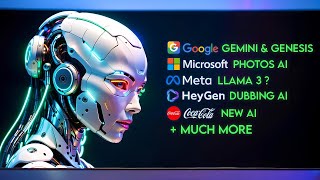
Google launched Genesis, a journalism tool, and positioned Gemini against GPT-4. Heygen's Video Translate mimics voices and lip movements across languages. The UK invested in Isambard 3 supercomputer ahead of the AI Safety Summit, while top tech leaders met in Washington about regulation.
Chapters
There's a lot going on in the AI world this week and we've got all the details ready for you today. Google is in the spotlight with its Genesis and Gemini projects. While Windows 11 enhances its photos app, Meta is also introducing its own counter to OpenAI with an open source perspective. Meanwhile, Hagen from Los Angeles has unveiled a fascinating video translation tool. The UK is heavily investing in AI research and top technology leaders recently discussed the direction of AI in a significant meeting. Additionally, North Carolina is adopting new AI technology for road safety, and Coca Cola has innovatively combined AI with their newest beverage offering. Ready with your snack? Let's break down this week's AI highlights, alright? Google is working on a new AI tool, Genesis, that can draft news articles by gathering data from various sources. Back in 2023, they discussed this with big shots like Wall Street Journal and New York Times. Google's representative, Jen Kreider, said they're considering how AI can assist journalists, especially at smaller outlets. The aim isn't to replace them, but to help in tasks like creating headlines. However, some people are wary. Certain executives felt Google might undervalue the effort behind quality journalism. Plus, there's buzz about OpenAI's ChatGPT, which used countless news stories from Associated Press to train and refine its text writing skills. The specifics of their deal, especially the financial details, are still private. Expert Angela Misri believes AI tools like Genesis can handle the daily grind for journalists. But Boris Babik, a university professor, feels journalists should tread carefully. He suggests that over relying on AI could compromise their core values. There's a broader ethical debate, too. Misri pointed to a survey where a majority of Canadians expressed they want clarity on how newsrooms deploy AI. Many worry about potential inaccuracies or misinformation resulting from AI use. In light of these concerns, Misri emphasizes that media outlets need to establish transparent guidelines about AI's role. Now Google is also prepping to unveil its new AI model called Gemini. The company recently let a few businesses test an early version. According to a report from the Information, Gemini is Google's answer to OpenAI's GPT4. After OpenAI, supported by Microsoft, shook the tech scene with ChatGPT, Google ramped up its AI game with Gemini. They aim to tap into a range of uses, from chatbots to generating texts like emails, song lyrics and news stories. It's also designed to assist software pros in writing code and even in creating images and videos based on user requests. For now, developers are working with a version of Gemini that's big but not their biggest. Their larger model will be closer to the capability capabilities of GPT4. Google's planning to offer Gemini via their Google Cloud Vertex AI service. While they introduced AI to their search tool in India and Japan last month, they've also been selling AI tools to businesses for $30 per user monthly. Google hasn't officially commented on this yet. Next Windows 11 Photos app is stepping up its game with cool AI features, making Microsoft's multimedia apps even better. Microsoft announced on Thursday that their Photos app will now have a background bl. Think of it like the portrait mode you see on phones. On top of that, the OneDrive app has upgraded its photo search. Now you can look for photos by what's in them, like beach or snow. Earlier, we weren't thrilled with the new Photos app because the old one felt better in some ways. For instance, in the old app you could search for content like beach pictures. But now, if you link photos to OneDrive, the regular Photos app lets you search for OneDrive pictures. Remember in May when Microsoft added Spotfix to Photos? It lets you focus on a small bit of a photo and uses AI to clean it up. Imagine removing dust specks on a computer. The new Background Blur is a bit like Paint 3D's Magic select, which was added to Paint. Both identify the main subject and play with the background. Magic select removes it while Background Blur blurs it. But there's a catch. A past attempt by Microsoft at this feature wasn't impressive. We hope the new Photos app does it better. The good news? You can tweak the blur level. These new tools are in the testing phase in Microsoft Photos, so they might not be available to all. Still, it's cool to see the Photos app evolving alright. Next Meta is challenging OpenAI's ChatGPT with a new AI. Right after launching Llama 2, they're crafting another model set for training in 2024. This model, per the Wall Street Journal, might surpass ChatGPT in features. The twist? Unlike ChatGPT, Meta's AI will be open source, letting companies freely use it to craft their AI solutions. Since the year's start, Meta has formed a team of AI specialists. While they once relied on Microsoft's Azure, they're now keen on using their own infrastructure. They're investing in Nvidia's H100 chips designed for big AI models. Although the exact amount isn't clear, it's believed to be in the millions. But Meta has ground to cover. They're racing to catch up with giants like OpenAI and Google. They introduced Llama 2 for free, trying to attract users. Upcoming tools might assist developers in coding tasks, an insider mentioned Meta knew they were behind making it open source looks like a community move. However, open source models raise concerns. Detractors highlight risks like misinformation. Meta's also dealing with a lawsuit about using personal data for AI training, showing the tech's complexities Now Hagen, an AI video company from la, released a tool, Video Translate, which can mimic your voice in a video and translate your words into seven different languages. And it doesn't just stop there, it adjusts your lip movement so it appears like you're genuinely speaking that language. You can upload a video where you're speaking one of these languages English, Spanish, French, Chinese, German, Italian, Portuguese, Dutch, Hindi or Japanese. No need for any high tech equipment, just make sure the clip is about 30 seconds and preferably features just you Once uploaded, Haegen works its magic. Welcome to the definitive iPhone versus Android video. One user, John Finger, tried the tool and shared his English video with French and German translations on Twitter. It went big, gaining over 6 million views. Mostly positive. Some said it sounded a bit robotic, but still impressive. After its launch on September 7, Heygen's tool became a hit. It's so popular that there's a huge waitlist to use it for faster service. Heygen offers a paid version, which processes videos in about 10 minutes. It's priced at $29 per month, but there's a discount if you subscribe annually. They're also planning to add more languages by the end of the month. Okay, next the UK government is investing in AI research with the introduction of a $1.1 billion supercomputer named Isambard 3. This supercomputer, inspired by 19th century British engineer Isambard Kingdom Brunel, will be located at the National Composite center in Bristol. In addition to the supercomputer, the University of Bristol, which is already a hub for AI studies, will also be the location for the new AI Research resource. This facility will provide support for AI research and promote its secure application. Funding for both the supercomputer and AIRR stems from a government AI investment initiative announced earlier in the year. According to the Department for Science, Innovation and technology, the Isambard 3 is composed of cutting edge GPUs, positioning it among Europe's most potent supercomputers. Michelle Donilon, the Secretary of State for Science, Innovation and technology, emphasized the UK's commitment to staying at the pinnacle of AI development through such projects, while specific details about Isambard3's specs remain undisclosed. The University of Bristol currently operates several supercomputing clusters primarily utilizing Nvidia GPUs and Intel CPUs. Coinciding with these AI advancements, the UK is preparing for the AI Safety Summit on November 1st and 2nd at Bletchley Park. Initiated by Prime Minister Rishi Sunak and designed to foster international collaboration on AI safety, the summit will gather global AI experts, government representatives and researchers. Alright next. Top tech figures including Elon Musk, Sundar Pichai, Mark Zuckerberg and others recently convened with Washington lawmakers to discuss the future of artificial intelligence and its regulation. Musk warned about AI's potential dangers. Pichai emphasized AI's solutions to current problems, while Zuckerberg underscored the need for open source AI systems. The AI Insight Forum, organized by Senate leader Chuck Schumer, was a proactive effort by tech leaders to influence and guide potential AI regulations. The dialogue was attended by industry giants like Bill Gates, Sam Altman of OpenAI, Satya Nadella of Microsoft and Jensen Huang of Nvidia. The emphasis throughout was the joint aim of getting this right in the evolving landscape of AI. The US has been slow in setting AI regulations compared to Europe, but has recently started to move. The White House is expected to issue an AI Executive order and has announced safety agreements with 15 companies. The meeting was one in a series planned to educate Congress on the technology. While the tech leaders saw it as an opportunity to voice their perspectives, there were differences of opinion. For instance, Zuckerberg advocated for open source AI, while others expressed concerns about its potential security risks. In the meeting, Musk was especially vocal about AI's existential threats. However, some criticized the event for being closed door and not open to the public. Senate leader Schumer mentioned that future meetings would likely be public to ensure a broader discourse. Now, North Carolina is adopting Accucensis AI technology for monitoring violations among commercial truck drivers. This Australian based road safety tech firm, which recently established its U.S. headquarters in Las Vegas, developed the Heads up system to detect issues like seatbelt neglect and hands free law breaches. In 2020, large truck collisions accounted for over 10% of the 1,658 traffic fatalities in North Carolina. Elon University's Professor Scott Spurlock highlights the revolutionary nature of such AI advancements. The Heads up technology employs deep learning to understand truck drivers behaviors from high definition images. These AI models can escalate from recognizing simple shapes to identifying detailed objects and actions such as a person using a phone. However, Spurlock warns of potential biases due to the human involvement in initial data labeling. Despite such concerns, the system's success is noteworthy. Since its 2019 introduction in New South Wales, Australia, there's been an 85% decline in phone use while driving. Yet some, like truck owner Clarence Brownlee, find these surveillance measures redundant, while others, like campus safety officer Jennifer Collington, suggest that monitoring decisions should be company specific. And finally Coca Cola Introduces AI Inspired Beverage for the Future the brand introduces Coca Cola Y3000 Zero Sugar, a flavor crafted by blending insights from fans and AI. This drink embodies people's global perceptions of the future using their emotions, colors, aspirations and more. Oana Vlad from Coca Cola reflects on the inspiration, saying, as we look forward to the year 3000, we ponder what Coca Cola might be like. Then, using the real magic brand essence, we merge human and AI creativity, emphasizing unexpected, joyous connections. The futuristic drink will briefly be available in regions like the us, Canada, China, Europe and Africa. Also, the US and Canada get to try an original taste variant of Y3000. By scanning the QR code on the package, customers can access the Coca Cola Creations hub. Here they can see their current surroundings through the Y3000AI CAM. Giving a peek into the future. A collaboration with the fashion brand Ambush further extends the futuristic journey with a collection set to drop this fall. As Vlad puts it, after diving into augmented reality, embracing AI helps the brand connect deeper with its audience and tap into newer ones. Alright, that concludes this week's AI News. If you enjoyed this video, don't forget to hit the like button. Subscribe to my channel and click the Bell icon to stay updated on all my future uploads. Thanks for tuning in and I'll catch you in the next one.










