AI+X: AI Innovation in Healthcare
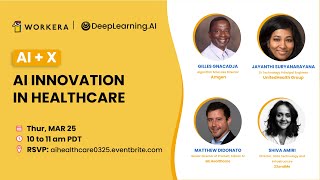
YouTube panel (AI+X: AI Innovation in Healthcare) moderated by Sandhya Simhan with panelists from Amgen, Optum, GE Healthcare, and 23andMe. Opening frames AI as a horizontal skill that must be combined with domain expertise (“AI X”). Panelists introduce themselves and discuss concrete projects (notably 23andMe’s polygenic risk score platform serving ~12M customers and scoring at-scale over ~10M genotypes), sector-specific differences vs. other industries (regulation, privacy laws, data fragmentation), challenges (data quality, heterogeneity, high dimensional/longitudinal data, model interpretability, deployment and post-deployment monitoring), differences in scale/engineering between B2B and B2C deployments, and sources for staying current (conferences, webinars, blogs like Towards Data Science, NeurIPS talks).
Chapters
Sam.
Hi everyone and welcome. My name is Kian Ketanforouche and I'm the CEO and co Founder of workera and a Lecturer of Computer Science at Stanford University. I'm excited to welcome you to AI AI Innovation in Healthcare. This event is presented to you by workera in partnership with Deep Learning AI and before introducing our panelists, I would like to set the context by recalling and sharing thoughts around the topic of AI and skills. It turns out that the direction AI as a skill is taking is similar in many ways to the one coding took around 30 years ago. From a highly specialized skill that only software engineers or developers may have had, coding became widespread. Today you have anywhere from mechanical engineers to electrical engineers, chemical engineers, data analysts, IT professionals and roboticists who all code and despite using different frameworks, we're now experiencing a similar evolution with data and AI skills. And with the rise of data tools and higher level frameworks, you can now do a lot more with data and machine learning models than you could 10 years ago and you could do it a lot faster. This makes it easier for people to start using AI to tackle problems and make AI and data a horizontal skill. Although there is an important difference between AI and many other skill categories in that solving real world problems with AI requires subject matter expertise, I would usually say that AI without subject matter expertise is like electricity without a light bulb. And while a front end engineer could apply their skills almost seamlessly from one industry to another, for example, they can build a web interface with JavaScript, HTML and CSS for a healthcare product, but also for a financial product. An AI practitioner may not be able to seamlessly build and deploy models in both healthcare and finance. The data is different, the metrics are different, the deployment environment is also different, among other things. And this is a reason why companies are investing millions to train their subject matter experts in AI and or sometimes even higher individuals who can combine their subject matter expertise with AI skills and we call these emerging careers AI X and companies who can embrace AI X or manage to combine AI skills with domain expertise are going to be well equipped to become leaders in their industries. Today's panelists are prime examples of leaders who focus on AI applications in a specific vertical, in this case healthcare. They themselves are AI practitioners, but also subject matter experts in healthcare related topics. So I'm very excited to hear them share their thoughts on the latest trends, applications, opportunities and challenges at the intersection of AI and healthcare. You can find the list of topics that we'll be covering in the description under the video and after the panel discussion, we will be taking questions from from you via Slido. If you have signed up for the Slido ticket, check your email for the access link to post an upvote question there. Now, without further ado, I'd like to welcome our panel, starting with Gilles Nyakaja, who's Algorithm Sciences Director at Amgen Jayanti Suryana Rayana, who's a Senior Technology principal engineer at Optum Matthew DiDonato, senior director of products working on Edison AI at GE Healthcare. And Shiva Amiri, who's the Director of Data Technology and infrastructure at 23andMe. And last but not least, Sandhya Simhan, the Director of Marketing at deepprint AI, who will be moderating the discussion. Welcome everyone.
Thank you, Kian, for that introduction. As you said, my name is Sandhya Simhan. I'm the Director of marketing here at DeepLearning AI. I'm very excited to be here today facilitating this discussion. So for the next 40 minutes or so, I'll be asking some questions to our panelists. And while I'll direct questions to a specific person, I'd also like to encourage any of you on our panel to jump in and offer your input in the conversation. Maybe we can start off with a brief introduction from everyone. Jenpee, do you want to go first?
Sure.
So my name is Jayanti Sureenarana. I have about nine years of experience in healthcare. Prior to that I have experience in retail and as well as legal industry prior to this. And I have the great opportunity to work on variety of platforms, transactional data platforms and now advanced analytics as well. I am a continuous learner as well as continuous unlearner as well, so that I can reinvent myself to, you know, to understand the changes happening both in the industry as well as in specifically in technology as well. And I'm so glad to be in this panel and looking forward to share and learn from all of you.
Awesome.
Welcome.
Matt, how about you?
Absolutely. First, I want to start off by thanking worker and DeepLearning AI for hosting the panel. I'm excited about the conversation today. My name is Matt Dean Nutto at GE Healthcare. I lead the product team building out GE's AI platform, which is branded as Edison and that encompasses everything from data curation and data collection upfront, all the way through model development and deployment. So really the full AI lifecycle and it's really just an interesting time to be working in AI and health care. Prior to ge, I actually worked at a startup artist and that's really where I started to invest in deploying AI in healthcare. And I think it's from what I've seen in both a small and large company, it is really the path forward for health care. And I think it's just unbelievably exciting and will pave the way for a lot of what we expect as norms in the future here. So, like I said, excited to be here.
Awesome, Shiva.
Sure. Everyone, I'm Shiva Amiri, I'm at 23andMe. And thank you for the invitation to be on this panel. This is an exciting topic, no doubt. And thanks for bringing this group together. I've been in the space of digital biology, or computational biology, health care for a long time. I started out wanting to be a doctor around the turn of the century and realized quickly that there was a lot of genetic data and we were going to need computers and humans were not going to be able to think about all the possibilities and all the things and all the letters and its permutations. So I thought computer science was going to be an important combination here. So I've done both. Past 20 years, I've had an opportunity to be involved with organizations, companies that are involved with both on the technical side of biology. And so I've had the opportunity to lead a small startup in New York and that continues to be there. It's called Biosymmetrics, that's expanding machine learning for biological data. I've also headed up the data science team at Zymergen, the computational chemistry team there as well. And that's really on the molecular and microbial side of machine learning. And then more recently, the past couple years or so, I've been at 23andMe, building infrastructure, machine learning platforms for the different types of data that we have. I think with COVID 19 things have been expedited in this space. And I think it's a very exciting time not just for the biotech technologies that have come along in the past decade or so, but also now with more openness to digital biology and healthcare and AI by necessity. So yeah, I'll stop there. Thank you.
Sounds good. And last but not least, Gilles.
Hi, Gilles Yakag. I am algorithm Sciences director at Amgen and where I co lead the data science team in digital health and innovation. Digital Scrap Innovation is an organization at Amgen that is tasked with bringing in the new digital technologies to Amgen and to facilitate the philosophy that our CEO has called beyond the Molecule, where we want to supplement our molecule, our drugs, with digital products. That's what I do. I am a mathematician by training and in fact I serve as a resident mathematician across the country, so I actually serve cross functions wherever there is math problems around. In fact, I started my career at Atam Gen as an applied mathematician. I was part of a group that did mathematical modeling for the company. So before data science became what it is now, I used to work on mechanistic modeling in discovery research. So I am very excited to be here and share my experience and perspective about AI in healthcare. Thank you for the invitation.
Awesome. Thank you all for joining us today. I would love to start us off with, shall we say, getting into the specifics. So if one of you could tell us about a specific AI for healthcare project that you've worked on recently, perhaps it's genesis, some hurdles, maybe some eventual learning. Shiva, you had mentioned something earlier.
Sure, sure. I'm happy to start. You know, there's a lot of great things to do in the, in the bio and health and AI space. There's a spectrum of things, obviously, from diagnostics to preventative, you know, products and technologies, all the way to drug discovery and using AI for molecular design and all these things. I'll focus on a project that's much more relevant to this panel and something we did at 23andMe that is in our product, and that is we want to put a lot of focus on health and prevention. So how do we use the genotype data that we have and the surveys that we collect to give our customers more information about what they're at risk for? So are they at risk for high cholesterol or heart disease, or are they at higher risk for migraines, for example? There's a lot of indications where there are genetic markers that give you a higher chance of developing certain things. There's a lot of genetic indications that are very clearly marked by certain genes in our genome. But some of these indications are much more complicated. So there's a combination of genes that are involved, or variants, we call them, which are parts of genes. So how do we use this combination of genetic information to give our customers more insight into what they're at risk for? So there's a bunch, there's a type of models called polygenic risk score models or PRS models. And polygenic just means multiple genes. So multiple genes are involved. So we were able to build a machine learning platform that uses the genetic data in combination with other data, if we're interested, to include that to make a prediction on your health predispositions. In our subscription product, actually, we have one of these. We produce one of these per month. We say okay, we need to build models, be able to track these models. These models need to be scalable. And our customers, which are around 12 million people now, all should have access to some of these. But some people will have access to a lot more of these. We built a machine learning, a production machine learning platform that surfaces these models to a large audience. This was different in that we have a lot of science that goes on locally as well. And we don't publish that it's not a customer facing product, but this was a customer facing product and we needed to make sure that it met performance requirements. We were able to run models on a very large scale of data, and this is real big data data, over 10 million people, and make sure it was accurate. It stood up to our compliance requirements, security, privacy, the science stood up all of this. So there's a lot of considerations here. But the team really collaborated and we're multifunctional, came together and we were able to build this production platform for predicting polygenic risk scores. And it's in our product today. And that was one of the, I think one of the funnest things I've done in my career, being part of a team like that. Very collaborative, but also seeing it be used by so many people in a relatively short time. So it's called our PRS machine, our PRS platform.
Very cool. Staying on the scene. There are definitely specificities, if you will, in AI and healthcare projects compared to, say, something in AI banking or AI plus manufacturing, and there's these differentiations. Matt, could you tell us a little bit about where you feel like the most important lines of health care versus other sectors, if you will?
Absolutely. I think that it's a really interesting lens to look at things from. And my first take is actually sort of where I started with how exciting working on healthcare problems really are and bringing AI to that. I think one of the things that jumps out as a differentiator to start is sort of the direct impact that you can have on people's health and in their real moments of need. And I find that to be just really motivating and something that is intrinsically interesting. On top of that, I think there's also a ton of complexities that come along with working on AI and healthcare. And health care is a regulated industry you mentioned. Banking and finance are also regulated in industries which bring their own complexities. One in healthcare in particular is the regulatory bodies that exist in the us. Everybody jumps to the fda. And I think as you start to think about that, you start to think about do you have the right information and have you collected up front to make sure that not only you believe that the model is robust and should be shipped, but also is something that can go through a very regimented process and get the seal of approval of the fda? And then you start to layer on complexity with looking at global distribution. And every country has its own regulatory body and its own process. And so there's a huge complexity there which starts to also point at having the right amount of data. And data in healthcare is intrinsically something that we want to keep private. There are laws, regulations, GDPR, HIPAA, etc. And that also starts to create a complexity around how do we effectively source the right amount of data that is really representative of a population that you're going to then use a particular model to predict on? And it's not always easy. And I think it's a real complexity. Certainly data access is difficult in many verticals. I think it's particularly something complex in health care to go after. On top of that, healthcare is an industry that in particular has lagged other industries as far as technology adoption goes. And that results in a bunch of fragmented systems that create data silos. I think we're getting better and better in healthcare and sort of moving the adoption curve forward. And this conversation of AI is one example of us moving forward. But currently data exists in a bunch of different systems and that makes it difficult to collect information for training. But also when you go to deploy a model, if you're using data from multiple systems, that means your deployment mechanism also needs to sort of be a fabric that pulls that information as you need it. And so a ton of complexities. But at the end of the day, like I said, the return is really potentially impacting someone at their moment of need, which is really, really great. So worth going after.
For.
Sure.
It's definitely, what you're describing is really, I think, is that probably unique to healthcare in the nature of the protections that are available legally for the data versus you know, even other really well regulated industries like finance or insurance or others? No. Really interesting. Now obviously you guys come from a range of companies that are of various sizes and so, you know, are there differences in how AI or data science is different? You know, that you feel like fundamental differences and how it's deployed at an enterprise versus say a smaller company.
I'm happy to take that one or at least jump into start. Prior to ge, I worked at Arteris, as I mentioned in my intro, which is a startup where we sort of paved the way on Some early FDA clearances. And so I've got some small company experience on AI development as well as GE Healthcare, which is a larger company sort of by any means. And I think the first thing that pops up is not the differences actually, but the similarities across development teams. I've seen in many different places. Everybody's using the same tools that are all open source, which is like a great aspect of the AI community. So TensorFlow, PyTorch, everything that I'm sure people on this call are very familiar with. Then on top of that, there seems to be a culture within AI of looking at the latest research. I mean, the underpinnings of this technology are changing every three to six months as we learn more and more. And I think there's a commonality in small companies and large of making sure that we're up to date and connected to Arxiv and some of the publications that are out there and finding ways to apply that to work in any product line that you're on. Some quick differences, though. I do think that in a small company, a large company within healthcare, there are some market dynamics and the fact that you may have an existing install base at a large company that sort of drive AI development differences. I think from a market dynamic perspective, healthcare is tough. It's got long sales cycles and if you've got a finite Runway, that means a shorter amount of time for collecting data, doing development and then eventually launching a product. And I think that forces smaller companies to be creative to solve those problems. And if you're on the large side of the equation there, you may have a little bit more time, but the creative solution may beat you out. So it's not always as competitive as I'm making it. I think there's a lot of synergies and I don't think that any one company is going to build all of the AI for healthcare.
So.
Complimentary solutions exist. But I do think it's an interesting dynamic. And the other one I mentioned, which is an existing install base, I think that creates a ton of opportunities and that's generally larger companies that have an existing install base to apply AI. And it's not just the killer app, but it's also integrating into workflows and the existing devices and software that you potentially have out there. How can you apply AI to any way that's being used? Not just, you know, the big sexy thing that people want to market, but how do you make AI powered workflows something that just make your products easier to use? On the other side of That I think you're starting with a legacy install base and small companies are able to bring in modern tech stacks without debt. And so again, I think it becomes an interesting dynamic and how that plays out is very dependent on each context. But it's generally my take. I'm sure others have one as well.
No, it's interesting when you say like, you know, you're mentioning earlier, there's this nature of fragmented solutions that are sort of kind of piecing together and if you've been around for long enough, you at least benefit from being able to integrate into majority of them because they, you know, you've all been in the same playground for a while. That's really interesting. You had mentioned something earlier about scale, if you could go into that a little bit.
Sure. You know, a couple of things I've noticed between how you deploy AI or machine learning at different types of companies, I think also depends on the type of business you have. So if you're deploying to customers that are, you know, the hundred thousand million that's a B2, almost like a B2C set up, then the things you have to think about are different. It needs to scale a lot more, there's a lot more compliance issues you need to think about, performance issues you need to think about. And I think that there's probably more involved engineering, software engineering there. Whereas if you are B2B or maybe you're more of a research oriented organization, you don't have to worry about hundreds of thousands of customers, then your type of engineering may be very different. You may not have to worry about scale as much as you won't have millions of customers viewing what you've built. Performance may not be as much of an issue, your models may not diverge as much and so on. So I think there's different types of considerations depending on what you're actually doing. And so I've seen that at 23andMe, the platforms, AI platforms we put in front of our customers are very different than what I was doing at Biosymmetrics. For example, when we were a small shop, we were working with big customers, it was B2B and so we didn't have the same types of, you could argue, maybe worries around scale, performance and things like that.
Now, you know, sometimes what happens is that we're really looking for something. You know, it's not just about the specificities and sort of getting into the details, but sometimes we come across AI, healthcare products or projects that are, you know, exceptionally inspiring or exciting. Gilles, we haven't heard from you yet. I'd love to hear about something that you found, you know, exceptionally interesting over the last few years.
Yeah, sure. I actually came across something recently, a couple of weeks ago, that I felt very excited about. But to set the stage for that, let me say first that I care a lot about explainability, interpretability and reproducibility. In fact, data science is very exciting. The term data science makes people excited. But I believe until this three tenets of science become mainstream, data science has not fully earned the right to be called a science. And it is a tall order. It is a big ask for AI model to be interpretable as they are now. But it is, I think, a worthy thing to aspire to. And I actually believe there are many aspects that are slowing down the adoption or the full success of AI in healthcare, but I believe this is one of them. Models have to be interpretable, especially in the clinical decision support area. Physicians have to understand what they are getting as answers, and it has to be simple. Getting there will not be simple, but the outcome has to be simple. One of the things I like to say is that simplicity is the ultimate form of sophistication. So with that said, what made me excited recently is I learned it from a seminar I follow a webinar. Everything is online now. I followed recently about interpretable machine learning and a solution that was developed for clinical decision support, specifically to score the risk for brain damage in critically ill patients and many other applications. That model was important in its outcome, in how it was fully interpretable, and its performance was compared with more complex models. And it was about the same. In fact, the theme for that work was, you don't need to use black box models to get the same level of performance. It was very exciting for me because at Amgen, in the work we do, we do a lot of risk assessment projects. Risk of developing a certain disease or risk of developing adverse events from certain medications. In fact, a big theme that our CEO has put across the company is predict and prevent. But to predict and prevent, we have to make that also explainable and interpretable and accessible to those who are supposed to consume the outcome of those predictions. So that was very exciting. And it's going to be again, as I said, a big act for all AI to become that way. I was very excited to see a very tangible progress in that direction.
Very cool.
Now, if we can shift to a more industry point of view. You know, there are, I'm sure there are things about, you know, the challenges of machine learning or data science in your industry. That, you know, keep you guys up at night, you know, it's like, what do you, what, what worries you and why? Jayanthi, we haven't heard from you yet. I'd love to hear about your perspective on this.
Definitely. As far as the key challenges, if you kind of think about it in three dimensions, you can think about first, let's talk technical. If you take AI, it's basically AI or deep learning, all terms. Interchangeability is essentially you have code and data. Many times industry, the research is focusing on the code part or the model part. But actually in healthcare I would say data part is very, very significant. Focus needs to happen there. The reasons are as follows. First and foremost, the data is pretty sparse data. Second, it's heterogeneous data, meaning structured, unstructured audio, X rays, imag, everything, right? So we have variety of heterogeneous data. That's another. And then the third is like it's high dimensional data and it's longitudinal data as well. So these are the data characteristics within the healthcare system itself. And the last but not the least is the data quality aspect of things. As Matt mentioned, data comes from variety of systems and you really don't know the quality of the data coming for which you're building the model. And you need to pay attention and kind of look at that more. And as we all know, the data, ensuring data, what you put in is what you get. So ensuring data quality is very important. And I think in healthcare that's one of the biggest challenges, I would say, like managing the data processing part before even you getting into the modeling part. I would say that's, that's the technical part of the code and the detail. And the second part is of course it's a highly regulated industry and many of the panelists have talked about it. So you really need to pay attention for building the systems for protection against data breaches, exposure, how do you manage the PI phi and those aspect of things. So that is a dimension number two. The regulatory aspect of that is additional. I would say in a good sense it's a challenge so that you can protect people's data. And then the third one is when you embed the AI within the workflows. Essentially healthcare is a kind of an interaction between the patient, the provider and the, so the workflows can get pretty complicated. And so the post model means once you deploy the model, the monitoring of that, you really need to make sure both the tech and the, I mean the whole team kind of understand upstream downstream effect and then able to make Decisions based on where your model is deployed in the workflow, if you have embedded in the workflow because workflows keep changing as well as the industry is progressing or you know, so many other factors will come into picture, your systems are your modernizing or you're acquiring or so many different things are coming into play but then knowing and knowing how your upstream downstream things are affected. The post deployment monitoring for both the data and the model draft is pretty important. I mean it's important in general, but then in healthcare it's lot more important because it's a dialogue. Not a dialogue, but conversation across the three parties in general. Right.
In healthcare.
So that adds lot more complexity I'd say. So those are some of the challenges in the industry and I think of course Covid has accelerated the adoption, et cetera. But I think post deployment monitoring I would say is very, very important in our industry.
For sure.
I want to jump in and just echo. I agree with Giant Feag completely. I think that generalizability and data drift are the things that keep me up at night. How do we make sure that what we've launched is consistently producing robust results? That definitely keeps me up and I think it's so important to keep track of. So I just wanted to echo that. I see it as well. I think other things keep me up at night not for worry, but out of excitement. To be honest with you. I think that GDP3 from OpenAI, federated learning, synthetic data, all these really interesting technologies or like paradigms that as they come out, I think there's a ton of promise. There's. Like I said, it keeps me up from excitement. How do you translate that to something that is usable and useful in to giantly your point, like clinical workflows or into like a healthcare setting where risks are high if you get it wrong or like, you know, you need to be more sensitive to having accurate predictions at all times. I think there's a ton to stay up at night worrying about, but there's also a ton to stay up at night being excited to solve. So agree to faulty.
Yeah, no, definitely things to keep us up. Both good and positive or sorry, both, you know, worrisome and positive. I guess this sort of leads me to the next question, which is how do you keep yourself updated so you know, where do you go to consume news? Any references on the application of AI in healthcare? Gilles, you were mentioning some of the resources that you particularly enjoy when we were chatting earlier.
Yes, I think everybody knows Medium and especially this blog called Towards Data Science. I occasionally Find good articles there. But in general I like conferences and webinars, especially now under the pandemic conditions. Everything is online, so I consume a lot of those. Recently I subscribed to a data science series from the Neo Jews Institute of Technology. That's where I learned about the project I mentioned earlier. I also follow seminars from myla, the Montreal Institute of Artificial Intelligence and a few others. So there are, and of course conferences, especially the big one. Now you can subscribe, you know, register for conferences for quite cheap and have access to presentations at your own convenience. So there is that big conference that happened in December that was supposed to be in Vancouver, the Neural Information Systems Conference. And so I followed a lot of good talks and acquired new knowledge. So conferences, webinars and a few good blogs.
Awesome. Is there anyone else that has particular resources that they'd love to share with our audience?
Oh, I like to kind of add some more things. Like I kind of have this core extended and industries like that. So for core, ongoing learning is must and you, you kind of have to go back to your basics. Taking the high deep technical courses along the way. That's really the core part. And then I'll say for the next level, academic papers, I go and subscribe to some of the newsletters and of course batch newsletter I subscribe to as well and also subscribe to academic institutions focusing on the, focusing on this part, this area. I go attend webinars, events, newspaper, newsletter subscription, etc. And thirdly, Minneapolis, I'm from Minnesota and we are kind of medtech hub. So I kind of keep track of, or not keep track. Listen, about a lot of great institutions are there in Minnesota as far as medical area is concerned. So we have Medical Alley which kinds of gives a comprehensive view and news of that. And also whenever time permits, I just kind of add in as many events as possible locally. Our academic institution, Minnesota University and things like that as well.
No, yeah, definitely important to stay in touch with like the institutions. I think a lot of progress comes when you both have both educational institutions as well as, you know, private or even public companies kind of working hand in hand. That private public partnership is, has been key in a lot of growth in AI in general, but especially in the healthcare space.
I totally agree. The amount of collaboration across industry and academic institutions has been tremendous and each of us are benefiting from each other as well.
Yeah, for sure. It sort of mimics what Matt was saying earlier. You know, enterprises or small companies alone won't be able to do it. You need that sort of inherent combination of a lot of different players in order to really make progress. So definitely, I mean, obviously we've been chatting a little bit about healthcare and you mentioned this earlier, Jamie, about, you know, the need for data capabilities. And so I'd love to hear from some of you guys on, you know, what's your take on the growing market need for data capabilities in clinical development, especially Gilles, do you want to kick us off?
The need is huge. We have a lot of data from clinical trials, from real world, evidence world. Data is essentially data from drugs that are on the market. Every drug that is on the market is being followed very closely. And this data has always been analyzed. When there is clinical data, clinical trial, the data is analyzed. But there is a growing realization that even we can learn more, we can gather more insight from what is there already. And plus more is coming and there are methods in place, they have been placed to do that. But there's an opportunity to apply the new methods of data science to gather more insight. So the need is huge. That's just a fact. And it's not just Amgen. Everybody in the industry realizes that.
I'm happy to jump in as well. I think that like data capabilities are like such an underpinning of like the current form of AI and like deep learning, like paradigms in general right now and going back to like the fragmented systems I was talking about before. I actually think that connecting the worlds and standards are actually really, really important here for, for everything from clinical pharma development all the way through my world in radiology and others as well. And ihe just came out with standards around communicating AI results. And I think bodies like that are really important to make sure that we get the advance that I think you're talking about in many different.
Sorry.










