AI + X: Don’t Switch Careers, Add AI
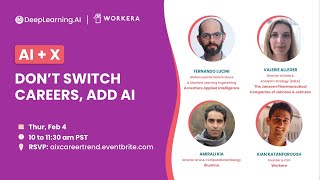
Kian Katan Forouche and panelists argue that combining AI skills with domain expertise matters more than switching careers entirely. AI projects need industry-specific knowledge to move fast, so companies should build career paths and data literacy across teams rather than just hiring pure AI specialists.
Chapters
And upvote questions there. Now, without further ado, I'd love to welcome Kian Khattan Farouche, Founder and CEO of Workera to help us dive deeper into AI X. Welcome Kian hi everyone.
Excited about this and thank you Sandhya. I'm going to share my screen to introduce everyone to AI X. So as Sandhya said, I'm Kian Katan Forouche. I'm the CEO of Workera and the lecturer of Computer Science at Stanford University where I I teach the deep Learning classes. In this short presentation I will introduce you to AI X and I'd like to start by recalling that there are record levels of investments and anxiety in developing data and AI skills. Companies today are spending a lot of money to train their workforce. Global spending on AI specifically is expected to double over the next four years to grow to $110 billion in 2024, according to IDC. The skill shortage in AI is cited by CIOs as the single most significant challenge for their organization. According to Gartner, 79% of CEOs are concerned that a lack of essential workforce skill is a threat to the future growth of their organization. This leads companies to think deeply, and even more deeply than before on how to structure and grow successful AI organizations. This is happening in all sectors. The 2019 AI survey globally from McKinsey shows in AI adoption in nearly every industry, although certain industries like retail, tech, telco and automotive are leading the way through workera and deep learning. I've had the chance and been fortunate to meet and work with AI leaders from large organizations in multiple industries and I learned that most companies look for individuals with dual competencies. For example, Toyota and Hyundai are looking for people with AI and polymer electrolyte membrane expertise to build fuel cells that backup data centers that backup power laptops, chargers and wearables. Biotech companies like Illumina and I think Amir Ali will touch up on that. Seek talent with AI and DNA sequencing expertise to develop novel algorithm for genome interpretation and unlock new treatments and medicine. Medical device manufacturers like Medtronic sick employees who have a combination of AI and robotics expertise to create new types of surgical procedures. And even agricultural giants like John Deere wants applicants with AI and agricultural or agronomic expertise to help farmers customize and automate how they manage their field operations. And you can see examples of job titles who are up right now on the market. This is a unique phenomenon in AI and because AI projects are centered around data which varies significantly from industry to industry, the subject matter expertise piece is critical. Take a front end engineer that is very talented and they will be able to build elegant visual interfaces for industries like music, applications in logistics or bioscience. But a data scientist without domain expertise is likely to struggle to successfully complete projects across all those industries. Industries. And in other words, we could say that AI without a subject matter expertise is like electricity without a light bulb. And so companies need individuals with these dual competencies, AI and subject matter expertise. So we'll refer to those as AI X individuals, where X stands for subject matter expertise. AI plus X individuals can hit the ground running, enabling companies to tackle new business opportunities more rapidly. And you can think about it this way. Training a biotech engineer in AI could take several months, but training an AI practitioner to understand biotechnologies deeply could take years before meaningful output. So a subject matter expertise in that sense who comes with or is able to develop new capabilities in AI is an incredible investment for companies. Andrew and I at Stanford have already seen this desire for obtaining an AI toolbox to complement existing knowledge. And in our deep learning class CS 2/3 students learn both about the theory and also apply their deep learning knowledge to projects while being mentored by industry leaders and teaching staff members. Two thirds of those students are not from the computer science department. They're from everything from chemical engineering to mechanical engineering to astrophysics to business and law. And in fact these non CS students perform oftentimes at par and sometimes even better than those pursuing a computer science degree. Many of them win project awards and take their projects and publish their results in leading industry journals. And you know what our teaching staff really understood and tried to understand is why are non CS students so effective at delivering high quality AI project? And we realized that domain expertise can help at literally every stage of the AI project development life cycle presented in Worker's AI Career Pathway Report. So let's look at a few examples together. Let's start with data engineering. Pre processing a data set for a musical application requires an understanding of encoding types and musical notation. Here you have an example of a sample encoding which combines pitch, volume and instruments. And the author of this project, Christine Payne, is actually a trained pianist on top of being an AI practitioner. This is knowledge that takes years to acquire. An example of modeling tasks that require subject matter expertise would be performing error analysis on a chest X ray for a pneumonia detector. This requires heavy domain expertise. And the fourth author of this paper, Pranav Rajpurkyar, is an AI plus healthcare expert and has worked with many radiologists over the years to understand their thought process and the decision making. As you know, machine learning does not operate in a vacuum. Deploying an intelligent robotic arm in a factory requires knowledge of the environment. What's the pace of the manufacturing line or the workflow inside the factory? What's the type of object that the robot would need to grab? Where do we position the robot in the factory? Would a suction head or a gripper be more effective for the robot to move objects? And how often should we carry out maintenance on such a robot? Finally, to picture how domain expertise impacts business analysis, imagine analyzing the results of an A B test for a marketing campaign. It requires understanding a load of marketing metrics such as CTR, MQLs, CAC, LTV and so on. And you can even imagine if you were to evaluate the performance of a text to speech synthesizer from English to Hindi without speaking Hindi. It's very complicated. So in that note, I hope the introduction on AI X was helpful. I'm very excited to talk about AI career trends and AI X with incredible leaders like Fernando, Valerie and Amirelli. Thank you for your attention everyone.
Thank you Kian, for that wonderful speech. I really love how your microcosm of your class at Stanford really reinforces that an individual with that interdisciplinary background can really be more creative in really unexpected ways. So I thank you for sharing that. Really awesome. So now let's welcome the other panelists to join us for the discussion. They are Fernando Luccini, Global Lead for Data Science and Machine Learning Engineering at Accenture Applied Intelligence Valerie Elijah, Director of Data and Analytics Strategy, EMEA at the Janssen Pharmaceutical Companies of Johnson Johnson and Amir Ali kiya, director of AI and computational biology at Illumina. So for the next 50 minutes or so, I'll be asking some questions to our panelists. While I'll direct questions to a specific person, I'd love to encourage all of you to jump in and offer your input on any of the questions that you're interested in. So let's start off with a brief introduction from everyone. Fernando.
Hi everybody. Lovely to be here. You've already done a very good introduction, but I'm Fernando Luccini. I'm the Chief Data Scientist at Accenture. So my role is to hopefully, in this particular setting, tell you about what we do to serve our customers. May be different to maybe being a customer. So what does it take for you to be an AI X in the world of consulting, serving customers every day and doing interesting things with data and AI?
Awesome, Valerie.
Sure. As you said, Sandhya, I'm currently the Director of Data Analytics Strategy at Janssen Emea and before that I held several roles at another pharma company spanning from commercial marketing and sales functions all the way to descriptive analytics and also trained myself in data science a few years ago. So maybe as a disclaimer, my area of expertise is more into mostly into marketing analytics, which is for me the science of producing insights and recommendations to make data driven decisions for commercial purpose.
Totally. You're impacting business strategy from the ground up.
Amira Lee hi everyone, this is a pleasure to be here. I'm Iradi Kia, Director of Computational Biology and AI at Illumina. A quick note that I wanted to mention that resonates with this area is that my background is also mechanical engineering, not necessarily computer science or data science. So I came from that path and then joined Illumina doing data science and eventually expanding that to applying AI to different aspects of technology at Illumina. So it has been a very wonderful path and I hope that I can share some of my experience here with the rest of the people.
Awesome. Thank you all so very much for being here. So to kick us off, I'm going to put out a potentially controversial statement. So we have a thesis that, you know, if AI is the new electricity, that electricity without a light bulb is a bit useless. And I'd love to hear from you guys about whether you agree or disagree with that.
Amir. Sure. So there are two aspects to this that I want to mention. One is how do you look at AI? Do you look at AI as a tool and then you want to force it to solve a problem? Sometimes there is non existing problem or it's an overkill tool to solve a certain problem. That's one way of looking at it. If we look at it that way, I would always suggest that no, you have to go back the other way. You have to find the problem and find the right tool. And AI in many cases could be the right tool for solving that problem. The other way of looking at it is the way that I was having a brief discussion before this meeting with Kian that does AI without subject expertise matter can solve the problems? Ideally, yes. With the new AI techniques that you can go end to end, you can get the raw data and if you have the right labels, you can train a model and everything works fine. But the truth is that if the problem is that clean that you can ideally apply it. Usually you don't need to apply AI, you already know the answer. So in practice what happens is that you get into so many problems in terms of noise, other things that can happen, problems that can happen and immediately have the right understanding of the problem that you're dealing with. And it brings the fact that if you don't have the subject expertise or the right input for the subject expertise, you will have a hard time solving the problem.
Makes total sense. Valerie.
Sure. So I mean, in my view, first of all, I agree also coming from my background, I guess from a life science engineer background, and having trained further along the way on data science, I cannot agree more that we need both, let's say, to make it really relevant for the organization in general. But what I can say maybe on this is that beyond the hype on AI, I mean we hear a lot of buzzwords. Maybe I can tease Fernando a little bit on this because we have a lot of consultants trying to sell us, let's say a lot of hype. Maybe not Fernando, I imagine, of course. But in general, what I can say, what I have seen in the past is that not necessarily connected to actual business questions. Right. And very often we hear about AI use cases, but we don't know exactly if they are solving the main business problem. I think what's critical here is really not to jump when we have a business question is not to jump immediately on Using a machine learning technique, for example, is rather to do some descriptive analytics first, you know, to look at KPIs and all that and to have, as Kian said before, To really look at what would be the best technique to be used to solve the question.
Awesome. Fernando, would you like to add to that?
I don't mind being teased. It's okay. We have a very healthy debate about this in the firm because as you can imagine, there's many of us. But here's the two sides. And I always joke it's like Duran Duran with two tribes go to war. On one side we have the super expert. These are the AI plus X. These are folks that have PhDs in mechanical engineering and are data scientists and are working in a gas and oil company trying to figure something out. And on the other hand, what we have is the super AI experts. So people that have been peers of key and professors of AI who think that if you look at a problem as first principles, you may not use AI, but it helps you think of the problems and this remove them as first principles and go back to the bottom of the problem and figure out. And we have a funny example that we use to demonstrate this, which is the old paradigm. If you have say a turbine and the turbine is leaking and in the morning, every morning Somebody comes in and cleans the leak, right? In the meantime, all this telemetry is going out of the machine. And a clever person that understands the machine and knows thermodynamics and all these things and is thinking, well, I don't understand it. And the person with the first principles comes and says, if you think a little bit outside the box, you'll think that somebody's wiping the oil at the beginning of the day, filling the machine back up, and we don't know why it's wearing down to destruction during the day. And we use that example to try and figure out if you are the super expert and you're just thinking about how the machine works mechanically, would you miss that because you're not thinking a little bit further out? And would the generalists come in? Nobody's won this debate so keen, and I have this debate as well. I'm on the side of the experts. Very rarely do you go to the CEO of a bank or your CEO of your company and you say, I'm going to go and hire a data scientist that knows nothing about our business and it doesn't pass the common sense sort of test. Right? So I think that works for me. And I said, I played with the story of the turbine and the leaking all day to test this theory with people and I dare say 50. 50.
Fair enough. So all of you work at places that really have embraced the use of both domain experts and, and AI experts really working in concert. I'd love to hear about how domain expertise drives AI usage in your respective roles. Shall we start with Valerie this time?
Yes, of course. So, yeah, maybe building on what we said before, I mean, the way I see it is that it's more of a composite role, right? As we said, AI +X, I mean, by definition, but it's also about a composite and a complementary team. I don't think one single individual can do these. Whatever we call it, however we call it analytics, translation, or even AI plus X, we can call it different ways, but I don't think it's very easy to do it with one single individual in any way, in any case. So I think, you know, it's more about finding the best combination of people within the team who can bring both things. I mean, the subject, Including, you know, AI, machine learning techniques, but also statistics. And. As the, let's say for me, the skill set of the data scientist alone, without even thinking about subject matter expertise is already quite broad and. Without even talking about, you know, subject matter expertise. So now when you add in Subject matter expertise, it becomes really not difficult, but it becomes really, you need to think how you compose that team per se, so that you can really deliver value to the company. That's how I see it.
Makes sense. Amir Ali.
Sure. Let me give you one example or a couple of examples at how subject expert matter can play a role here. In genomics. You draw blood from a patient and that's the starting point, right? And then what else? If you're a data scientist, do you know what sort of information you can extract from that blood that you drew from a patient? If you're a pure data scientist, you're clueless, you don't know what can be done with that, right? So that's how the subject segment matter comes in place and can identify what you can do. And now trying to look at it in a more abstract way, to be able to do AI, you need, first of all, you need data. If you don't have data, AI doesn't really mean anything. And when it comes to data, the subject expertise help you first know how to generate data, right? And then the second thing is that how to extract information from that data. The third thing is that what is orthogonal information that you can access if you don't have subject expertise, you don't understand what orthogonal information you can add or what redundant information you have in the data that you have. And we all know that redundant information can quickly put you in a bad situation in terms of the modeling that you're doing. Then the next level comes, which is application. Okay, I have my data, I have my model, what sort of applications can I do and what are the specifications of those applications? What are the characteristics of those applications? One of the better applications that is around is, for example, translation, right? For using AI is very, very powerful in translation. We have apps in almost all mobile phones that does a translation. If it makes a mistake, is it a matter of life and death? Not really. Nobody relies on that translator to do their day in, day out job. But what if you want to report a test on a certain patient? What happens then if you make a mistake? So what is the level of accuracy, what is the level of reliability that you want in the application that you want to put out there, combining the data that you have and the model that you have? And then the third layer comes, which are the expectations in many cases, for example, if you're reporting something, you have to be able to trace it back, you have to be able to explain it. In some other cases, there is no need to be able to explain that and all of that comes out of subject matter expertise. How you do it comes from a data science expertise. But what you need comes from subject matter expertise.
No, really, really. Well said, Fernando.
I have more pedestrian view. Amy is way too, way too much more advanced than I am. My simplicity in this is, as you'll see, it's a question of density. So if the density of the problem is in the, let's say in genomics, for example, then you'll have to balance that way. If the density is the problem, isn't the mechanics of the science, the data science, then you have to go the other way. I'll give you a good example.
Can you explain a little bit what you mean about density?
I'll give you an example. We've become clear. So if you go to any of our customers, normally you go into a supply chain in a gas and oil company, there's no chance you walk in there and understand a conversation. If you've never heard it before, you will walk in and they'll be speaking, they might as well speak in Japanese or Spanish. And you're not a speaker, you won't even know where you're doing in the first. So that's super dense. It's a very dense space, right? In terms of knowledge, right? So then within that you have somebody who actually understands the, you know, how you deal with wear and tear in a turbine. So you have context within context, it becomes more and more dense. For that we need the super expert in the topic. And to be honest, a data scientist can come in and help and they can work side by side and you can try and make that work. But in some cases you can lose so much time to explain that if you have somebody that understands the both topics to a certain degree, that's great if the density is on the other side. So if you're creating a synthetic data set using variational onto encoders and you spend your life studying physics and the physics of a turbine, it's unlikely you've sat there and really understand really deeply. Variational to encoder works. It's very dense on the data science side. So at that point the pairing becomes very, very good. And I have a philosophy, again, you guys can disagree with me, which is the whole point of AI is to do more with less, to do much more with less. Right? With less of everything, less human. You don't need thousands of data scientists to solve problems. As a matter of fact, you need very few to do very, very spectacular things. Right? So the pairing is fine. And it depends on that, whether a topic is super dense, that it just the barrier to entry, to understand it and create an algorithm is just beyond you, or the science that you're trying to apply is beyond that expert. At which point you start pairing and you get the best of both worlds and there's a balance in between where you can get it, you can make it work, notwithstanding what my colleagues say, which is totally correct as well. Right.
That's really interesting. It's almost like, shall we say, if we treat density as really like a language comprehension, like you might speak marketing, you might speak AI, you need people who are relatively fluent, conversationally fluent in the other to be able to have that true pairing of expertise. Really interesting. Now, I guess we've talked a lot about, like, how this can be applied. Where do we find these natural unicorns? Where do we find these candidates with dual competencies? And do you honestly, do you see a lack of that talent in your current markets? Fernando, we'll start with you.
So this is a source of constant conversation between Kian and I. As a matter of fact, that's where we use workera to help us out together. I think in the next two or three years this is going to be more and more difficult. And a very nice professor in the UK said to me, it's all about unicorn farming. No, unicorn hunting. Right. So for a company like ours, which employs, there's half a million of us, 550,000, but we're looking for, you know, it's all, we have a massive scale. We also have the ability to create a lot of these careers. So for us it's about creating those careers. So it's about bringing in experts, say my example with somebody who's done mechanical engineering, PhD, and actually giving them the opportunity to create a career through assessments, through benchmarking, through training, through application in their customers to create these unicorns, if you will. Because my view is that whilst the knowledge of AI is going to be more easily accessible to everybody, thanks to Kian and Andrew and yourselves in deep learning and others, that raises the water level for all, but it doesn't necessarily raise the depth for all. Right? So I need a bit of. I need a bit of both. I need the PhD in mechanical engineering or whatever, and I need them to be super deep. So the only way for me to get there, I think, is to. Is to create a career that allows them to get there.
I really like the phrase unicorn. For me, it makes a ton of sense. Amir?
Sure. I agree with Fernando a lot on this and I really like the way that he mentioned the density in the answer to the previous question that actually relates to this one as well. In a way, I think that things are getting a little better because many of people who are finishing up in different degrees, they go into places like workera deep learning AI inside data sciences other places and they try to train and add a layer of data science to their work and they're sort of training themselves. But for a company who's going to hire them, you have to look at the situation. In many cases, common sense can play a huge role. You're playing with the data that common sense can take care of majority of the work for you. In some cases, the expertise is the thing that you need. So there is no other way around it. And we had a philosophy at Illumina and I was trying to follow a philosophy that should I go with a person who knows biology and teach them AI, or should I go with a person who knows AI and teach them biology in case I cannot find the person who knows both of them? And ideally you want to find a person who knows both of them. I think in the later questions we're going to touch upon this and I'm not going to get into this more, but my understanding is that hunting for these people is getting easier just because the trend. Because people are trying to learn data science as part of their program. Like it's a matter of taking a few courses. As a matter of adding a quick like program at the end of your PhD or whatever other degree that you have or you are at work, join one of these programs. So the future looks bright on this end.
Makes sense. Valerie, anything else to add?
Yeah. To find, you know, these unicorns that we've talked about, especially in Europe, I think it's even more difficult. And if you reduce it even further to the pharmaceutical domain into pharma commercial, it's even harder to. So yes, I mean, definitely it is difficult. And it's even a small community of people in Europe, you know, I'm also involved in pmsa, which is the Pharma Management Science association, which is an American nonprofit organization actually for sharing insights, best practices on insights and data science for commercial in pharma. And I'm the European lead for this. So in Europe I can say we're just starting. It's a very small community. So I wouldn't say that we all know each other, but a lot of people know each other in this area. I am, you know, personally quite extreme in the way I look for these profiles because I go Massively technical in a sense, meaning that I really like to have. It's always a combination, as I said. So not everyone the same, but some people in the team for me must have been doing, you know, have been a data scientist in the past and doing really hands on, you know, playing with data, cleaning the data. Not saying that they must be, you know, deep learning experts, but at least they should have not. Also, they should have got their hands dirty with preparing data and things like that at some point. Right? And I think this is an essential part of a team for me to have people like that. So that's kind of the AI plus x technical, a bit more technical people. Right.
And then.
Why am I thinking this way? It's because I have observed in the past, in my previous company, I have observed that even at a leadership level, People who were having this technical background in both topics, leading data science teams as well as commercial data science teams, let's say it started to change, it started to really take off and we started to really build a roadmap and deliver value. So that's why I am biased and that's why I go quite technical. I need to explain that to my colleagues because some people don't understand why this is needed in the combination, but I truly believe this is a key.
Success factor that makes a ton of sense. So, Kian, we haven't heard from you in a little bit, but I think it's really clear that employees with AI skills are in really high demand and provide great value. Can you tell us more about why a career shift like this is really useful to someone who's already pretty successful as a subject matter expert? How is it beneficial to them?
Well, I think it's all about making people more productive and better at their job. And I think AI and data skills are making their way to nearly every job category. The easiest analogy that I can think of is programming skills. Today you'll find so many mechanical engineers that code, so many material scientists, aeronautics engineer, chemical engineer, that code. And that was not the case a long time ago. And the reason they learned how to code is because it makes them much more productive and better at their job. And so similarly, I think that the ability to work with data and models will make those job categories much more productive. And besides, oftentimes these subject matter experts have the strong scientific and engineering foundations to pick up data and AI fairly quickly. This would include linear algebra, functional analysis, calculus, probabilities and statistics, data structures and algorithms that are very useful when picking up AI skills. And I agree with What Fernando and Amir Ali said regarding it really depends on the density of how much you need to be technical in AI. But I think in a few years from now everybody would benefit from having foundational AI skills to become more productive on their job.
No, that makes a ton of sense. I'd actually take your statement and go one step further. My background is actually in psychology and at first glance you think social science has absolutely no need, but there's a ton of research that's done in psychology that requires quantitative analysis. And so freshmen at my alma mater are now encouraged to take Python courses because they, you know, it either helps you when you hit industry or it helps you if you're pursuing like, you know, higher academia. So really glad to see that there's that sort of understanding of, you know, programming has sort of become a base skill. But I love what you're saying that AI is going to become one of those base skills that everyone needs as well. So I'm gonna, I'm gonna send a question to all of you now. So for all. So there are a lot of audience members in, in our chat today that who may be in HR or learning and Development or part of a data AI academy within an organization. What advice do you have for them on how to bring AI+X to their organization at scale? Can we start maybe. Amir Ali, could we start with you?
Sure, sure. Actually for this question I had taken a lot of notes like details on what to share because it's such a broad topic. But I just think that there is one important factor that we benefited at this at alumni. I've seen this in other places which is bringing the fundamental understanding of how AI works to almost everyone. Not only to people who are quote unquote data scientists and AI team, but also bring that understanding to people who are in case of Illumina and other genomics companies or working in the lab. And then even more importantly bring that understanding to the higher up management. And what is that level of understanding? That level of understanding is that what can be done with what? Right. So if you know that level, then doors starts to open. If a person who is working in the lab, they know that, oh, if I can collect this type of data, maybe I can do something with it and then take that and share it with a data scientist that by the way, I can collect this type of data. Do you think you can do something with it? That is the start of something great in a company. And if that person in the lab doesn't know this.
Sorry, we're getting a Little bit of an echo.
They would generate that data, but it would never go anywhere or they would never even think of generating that data. And now it is even more important on the management level because if a company wants to include AI plus X, which is a very, very important factor if you're a data, if you're a scientist deep down in a company, yes, you can do AI plus X, you can do something here, something middle there. But in a more grand scheme of things, you want something happen at the company level. And for that the management should get engaged. The management should provide you with the tools that you need. And the management should have that understanding that, oh, I can go into this direction, I can collect this type of data, I can collect that type of data, I can invest in this and then good things happen. So if HR can initiate that sort of training, which is not deep training, it is just conveying the basic fundamentals of how AI can benefit, I think that that goes a long way for any company.
Awesome. Fernando.
I'm gonna follow in my line of giving you pedestrian views. We create immense amounts of factories within Accenture. So we have a lot of experience. But the way I would simplify it is create careers. If you're in hr, everybody's hungry for a career. So create careers. Create careers. And to do that, think about them. If you think about the professionalization of AI, another one of Kian and Fernando's favorite topics, the professionalization of this space. And I don't mean that everybody has to be certified by the government. I mean, no, no, if you think about the way software worked, it's entirely professionalized. But there's no certification to professionalize it. It's not like being a doctor or being an engineer or an architect, but it's, I mean, it's totally professionalized. I always joke, you know, you put five software engineers in a room for five hours and you open the door after five hours and they've self organized the source control. Everything is compiled the right way. They haven't written any code, but they've done all that right. AI needs to go through the same kind of process. And if you're in HR and you want to create AI +X, create the careers so people know what they have to do, they have learning available. I have a theory that assessment and benchmarking is going to be the new currency to make sure value is clear and understood. Because again, AI is not one thing. As we all know, the science of it is endless and it'll continue to be endless. So you have to Start thinking really making it very clear what success looks like. So create a career. Make it very clear what success looks like. And people want to join great companies to have a career. So make it easy for them to know that there is a career path called AI X or just AI up to you that makes sure that you come in with a skill and you progress a long time creating another set of wonderful skills and test it. Give them the ability to be clear of what it is they know and don't know. Don't leave it to the wind. Right. That'd be my two cents.
No, no, that makes a lot of sense. At deep Learning AI, we spend a lot of time thinking about how are we creating equitable access to world class education. And I think what you're saying is it's not just the education part that matters, it's the ability to translate that into job prospects into careers. And having those industry benchmarks is really critical. I know. Kian, you spent a lot of time thinking about it. You were on the founding team at DLAI and now you've created workera. Could you speak a little bit more about sort of that approach?
Yeah, it echoes what Fernando just said. I think HR folks are drowning in content. Content is not anymore the limiting factor. You have so many courses out there of great quality. So the question is really how do you get started and who do you send through what curriculum? Creating careers is one step, but even understanding what the organization looks like oftentimes in order to be a high functioning AI organization, you need this set of highly technical AI folks, which people would call machine learning engineers and data scientists and software engineers who are here to make sure that the AI projects are deployed into production, made available to users and scales properly. But there's also also another aspect to look at. It echoes what Amir Ali also talked about, which is data literacy, company wide, all functions. I'm actually curious if any of the leaders around the table have an idea of how many times the word supervised learning is being said every day within the company. And it's probably much more than before. And so what does that mean? It means when you're a recruiter in a company that suddenly is using so much vocabulary around AI, you need to start getting to know these vocabulary. If you're starting to recruit data scientists and machine learning engineers, you need to be speaking their language. If you're a product manager who was used to working with backend and front end and infra and now you're working with AI systems, it's a completely different deal. And similarly, if you're an executive, you're asked today to identify new business models that rely on AI models. All of that is part of a company wide data literacy that HR folks are trying to drive.
Can I make a quick point on that one before I forget it because I'm a bit of a dummy. Here's one of my pet hates and I don't know if you guys share it as well, which is a lot of our leaders are illiterate in AI. It's okay, we're gentle to our leaders, we love our leaders. But when they learn, they learn by examples. And this is a problem we need to in HR push your leaders. And I think Amirali, I think you said it as well. Our leaders need to understand enough about this the science to really, really understand their own problems, not take even more examples from the industry. And Valerie, to your point on the hype and listen to the hype of another CEO that stolen they should be doing that thing. I don't know if it's useful to you or not, but they need to be doing it. It's really important that our leaders also become well educated to the point where they understand enough to understand the concepts and come up with their own use.










