AI's Wildest Week Ever: Mind-Blowing News You Almost Overlooked!
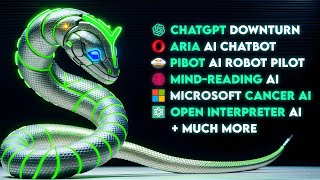
A roundup of major AI news from September 2023: Falcon 180B, a new 180-billion-parameter open-source model; MindViz research that translates brain scans into images; Microsoft training cancer-detection AI on 4 million pathology slides; and Pibot, a humanoid robot that can operate vehicles including airplanes.
Questions this video answers
180 billion parameters.
About 3.5 trillion tokens (Refined Web dataset).
Around 7 million hours on Amazon (reported).
Visits fell by 3.2% in August to a reported total of 1.43 billion visits.
Average session duration dropped from about 8.7 minutes (March) to about 7 minutes (August).
Chapters
AI headlines have been off the charts this week and we've got a jam packed episode for you today covering all the greatest news in AI. First, we'll dive into the unveiling of Falcon 180B, the new large language model that's shaking up the AI scene and see how ChatGPT's website traffic has been faring. Then we'll explore Opera's new AI chatbot for gamers Aria and marvel at Mindviz, the the system that's bringing our sci fi dreams to life by turning brain scans into visuals. Ever dreamt of a digital sidekick for your techie endeavors? We'll introduce you to Open Interpreter. Meanwhile, Microsoft Teams up with Page for a game changing move in cancer detection and Snapchat unveils its imaginative AI feature named Dreams. Stay tuned as we also discuss the AI creator Ghostwriter's new song and dive into Dubai's latest AI campus, a potential new department of AI in the US Zoom's AI companion rollout IBM's Granite series. And last but not least, meet Pibot, the world's first humanoid pilot robot. So sit tight, grab your snacks and let's dive into this week's AI whirlwind. Alright, let's start with New Large language model so TII released a new large language model called Falcon 180B on hugging face and it's a big deal in the AI world. It's it's the biggest open source model available with 180 billion parameters. It's even better than other models like Llama 270B and OpenAI's GPT 3.5 in some tests and is as good as Google's Palm 2 in others. Training Falcon 180B was a huge job. They used 3.5 trillion tokens from a data set called Refined Web and it took around 7 million hours on Amazon's powerful computers. Most of the data came from the web, but they also added in things like conversations and technical papers, which helps the model understand a lot of different topics. Falcon 180B isn't just a bigger version of the older Falcon 40B. It uses some of the same smart techniques, but it's also been specially trained to chat and give instructions. It's really good at what it does, even when compared to models that companies keep private. You can try out it on the Hugging Face website. However, if you want to use it for business, there are rules to follow. They want to make sure people use it the right way and for good reasons. Overall, Falcon 180B is a big step forward in AI and it could change a lot in the field of language models, but it's important to use it responsibly. Okay, next OpenAI's ChatGPT has seen fewer people visiting its website for the third month in a row in August, the number of people visiting the ChatGPT website went down by 3.2%, with a total of 1.43 billion visits. This comes after two months where visits dropped by around 10%. People are also spending less time on the site. Back in March, visitors stayed for about 8.7 minutes, but in August they stayed for only 7 minutes. There's some good news though. The number of different people visiting the site went up a bit in August from 180 million to 180.5 million. With schools starting again in September might be more visits to ChatGPT. Some schools are starting to use this chatbot and this has increased visits, especially in the US David F. Carr from Similar Web who studies ChatGPT and other similar platforms, mentioned that students looking for homework help might be a reason for the increase. The number of younger people using the website went down in the summer, but is now going up again. In May, OpenAI launched a ChatGPT app for iOS. This might be one reason why fewer people are visiting the website, but we'll be watching closely to see how ChatGPT does in the next few months. Now Opera has introduced a new AI chatbot named Aria in its Opera GX browser. Designed mainly for gamers, this chatbot uses Opera's Composer technology and is built on OpenAI's ChatGPT. In the future, it might be connected to other AI models to improve its features. Aria can provide answers to various questions related to gaming. For instance, users can ask if a game like Starfield has launched or seek advice on starting a streaming career. Gamers can also request ARIA to create custom character bios or get information on the latest updates for their favorite games. This AI feature is offered in the main Opera browser and the gaming specific Opera GX for Windows and macOS. It's also available in the Opera app for Android and iOS, reaching over 180 countries. However, Aria isn't automatically activated for users. Those interested in using Aria need to choose to use it. They can activate it by selecting the Early Bird option in Opera's settings. After that, they should turn on the ARIA extension and ARIA command line. To start chatting with Aria, users need to open it from the browser's side panel and sign in to their Opera account. Moreover, the Opera GX browser now has a new command line feature. This allows users to communicate with Aria using the Control Shortcut on Windows or Command on Mac. Additionally, Aria works with Opera's AI Prompts feature, which was introduced earlier. Next in Singapore, researchers have developed a new AI system called MindViz that can interpret brain scans and convert them into visuals. The system works by scanning a person's brain while they view certain images. The brain's response to these images is then translated by the AI into a unique language. This information is processed to recreate the images the person was seeing, essentially reading their thoughts. The success of this project is attributed to the large amounts of MRI data available and the increased computational power. Nowadays, however, this AI isn't yet capable of understanding the general public's thoughts. There are significant variations in brain structures and functions between individuals, making this a challenging endeavor. The team estimates that achieving a more generalized mind reading capability might take another five to 10 years. The researchers are aware of the potential risks associated with this technology. A primary concern is privacy. There's apprehension about whether the data collected might be accessed or shared. Without the participants consent. To address these concerns, the team emphasizes the need for strict ethical guidelines and legal regulations. Yet amidst the challenges, there's optimism about the potential benefits of this technology. For instance, researcher Zhao believes it could be transformative for those with disabilities. People who can't move or speak might be able to control devices or communicate using their thoughts alone. This innovation could provide them with a newfound sense of independence and connection. Okay Open Interpreter is a new, groundbreaking tool that bridges the gap between powerful AI models and our everyday computing needs. This tool is particularly intriguing for those who are enamored by the advancements in AI technology. The magic behind Open Interpreter is its ability to let language models like OpenAI's ChatGPT run code on your computer. Not just any code, mind you. It can execute Python, JavaScript, shell commands, and much more. Imagine having a conversation with your computer where you ask it to create or edit photos, videos, and PDFs, or even controlling a Chrome browser to gather research. It's like having a digital assistant that understands tech jargon and simplifies it for you. While there are other platforms like OpenAI's code interpreter that offer similar capabilities, Open Interpreter stands out. Many of the cloud hosted services come with limitations such as no Internet access, restrictions on package installations and constraints on file sizes and runtimes. Open Interpreter sidesteps these hurdles by operating in your local environment. This means it has full Internet access, no time or size restrictions, and the flexibility to use any software package or library you Fancy safety is paramount, especially when running code on personal machines. Recognizing this open interpreter has a built in feature that seeks user confirmation before executing any code. However, for the daring souls the there's an option to bypass this safeguard, but with a word of caution. Always be vigilant, especially when executing commands that might change system settings or files. So if you've ever dreamt of having an AI powered sidekick for your tech adventures, Open Interpreter might just be the answer. Alright. Next Microsoft is working with Page, a company that specializes in digital pathology, to create the world's biggest AI model for spotting cancer. This AI is being trained on billions of images and can detect both common and rare cancers. The goal is to help doctors who are facing more patients and fewer staff right now. Pathologists look at tissue samples under a microscope. This method works, but if they miss something it can be harmful to the patient. But Page wants to improve this process. They've made a tool called Full Focus that lets pathologists view these samples on a screen. They've also made an AI that can spot certain types of cancer on these screens. But turning these tissue samples into digital images needs a lot of storage, which is expensive. That's why only big, wealthy centers have been using this digital approach. Paige has a lot of data, even more than Netflix. But they wanted to make an even better AI, so they partnered with Microsoft. With Microsoft's help, they're building an AI that uses images from 4 million slides. It's the biggest of its kind. Andy Moy from Page said this project is a big deal for cancer care, similar to how ChatGPT changed how we think about AI in the future. They also want to provide more information about patients health details. Now Snapchat is launching a new AI feature named Dreams. This tool was recently tested in Australia and New Zealand and will soon be available worldwide. It lets users modify selfies to create imaginative images that change their appearance. Users can edit up to eight photos for free, after which they need to pay. Jessica Melugin from the center for Technology and Innovation commented on this new feature, noting that it's an innovative step for Snapchat. She believes most users will find it fun, especially younger people, and will use it for entertainment rather than harmful purposes. However, she acknowledged the potential risks of generative AI, especially its ability to spread misinformation quickly, especially during elections. Snapchat has been a pioneer in offering AI tools to its users, while other social media platforms like Instagram, Facebook and TikTok haven't yet provided similar tools. Melligun believes it's only a matter of time before they do. She emphasized the importance of innovation and progress for the economy and quality of life. Melligan also noted that unlike some other tech companies, Snapchat isn't currently facing any major legal issues in Washington. Alright, the AI creator known as Ghostwriter, who previously made a song in Drake's AI generated voice, has now created a new song called Whiplash. This Track features the AI generated voices of Travis Scott and 21 Savage. Speaking of rap. After the song was shared on TikTok, Ghostwriter added a note for the two artists. He mentioned that the future of music could be where singers don't need to sing but can have their voices generated by AI. Ghostwriter is willing to give the song's earnings to Travis Scott and 21 Savage if they agree to its release. If not, he's open to deleting the post. Earlier, Ghostwriter had copyright issues with his AI generated song Heart on My Sleeve, which was a Drake song. This song became popular on platforms like Spotify and Apple Music, but was later removed. Such AI created music is causing legal concerns. Platforms like YouTube are finding it hard to decide what is allowed and what isn't. Additionally, there's news from the New York Times that Ghostwriter wants to get a Grammy Award for Heart on My Sleeve. He is trying to get it nominated for two categories, Best Rap Song and Song of the year. Harvey Mason Jr. The CEO of the recording Academy, which manages the Grammys, said the song could be considered because a human created it. Yet, for the song to be eligible, it has to be widely available like in stores or online. With its copyright issues, this might be challenging. Okay, Dubai is building a new campus for cutting edge technologies like artificial intelligence and Web3 by 2028. This campus aims to house over 500 companies and offer more than 3,000 jobs. Mohamed Alblushi, the head of Dubai International Financial Center Innovation Hub, shared this news with Khalid Times. He mentioned that the campus, named the Dubai AI and Web3 campus is part of Dubai's plan to be a world leader in AI and Web3 technologies. The campus will be located in the DIFC Innovation 1 space will cover a vast 100,000 square feet area. It will have modern research and development facilities, programs to speed up business growth and shared workspaces to help companies grow in the region. The DIFC is a major financial hub in Dubai. It operates under English Common Law and is home to a big professional community with more than 39,000 people working in over 4,900 companies. This makes it a hotspot for industry talent. The DIFC Innovation Hub has a history of supporting new tech companies, including those focused on the Metaverse and AI. Just recently, the DIFC announced that it has chosen 10 startups for its DIFC Metaverse accelerator program. In line with Dubai's goal to be a top business spot for tech companies. The new AI and Web3 campus is already starting its operations. Companies are being given licenses to operate there and the campus will be ready for them in the next few months. The difc, which already has a strong tech community, will be handling these licenses. Next, AI specialists from top US Universities suggest forming a federal Department of AI to oversee artificial intelligence instead of leaving it to Congress, the White House or businesses. This recommendation comes from a survey by Axios Generation Lab and Syracuse University involving leading computer science professors. Opinions about AI's future control were varied. Most believe AI needs oversight, few trust the private sector to self regulate, and President Biden was the top individual trusted with AI issues. These insights arrive just before key AI discussions on Capitol Hill involving tech leaders. Experts are particularly concerned about AI increasing discrimination and disparities. They foresee AI causing job reductions in areas like customer service, but boosting sectors like technology and healthcare. Many experts back a dedicated federal agency to regulate AI, with fewer supporting global organizations or Congress. The White House has proposed an AI Bill of Rights. It's worth noting these views represent experts, not the general public. The survey's main takeaway is the strong support for a specific AI department. Alright now. Zoom is rolling out a new feature, the Zoom AI Companion. It's a smart assistant designed to make your work on Zoom easier and more efficient. This tool is included for free if you're on a paid Zoom plan. The AI Companion assists users by catching them up on missed meeting details, aiding in chat responses and summarizing recordings with highlights and actionable steps. Later on, it'll even help with emails, summing up chat messages and aiding in quick replies. If you're discussing a meeting in chat, it will spot that and offer to schedule it for you. And for brainstorming sessions, the AI Companion can help jot down ideas on a digital whiteboard and sort them. In the future, Zoom plans to make the AI Companion even smarter. You'll be able to chat with it like a personal assistant, asking for meeting summaries, finding documents and more. During a call, it can help with real time tasks like filing a support ticket or looking up info. After calls, it will sum up the discussion and suggest actions to take. With Zoom Phone, it'll analyze recorded calls and summarize SMS messages and voicemails plus it'll offer feedback on your communication style during meetings. Helping you improve privacy is a priority for Zoom. They've assured that they won't use your data to train their AI models. Also, companies can choose which AI features they want. Active and meeting hosts have control over in meeting AI tools. To start using the Zoom AI companion, you need to have a paid Zoom plan. More updates about the feature will be shared in Zoom's upcoming event. Zoomtopia 2023 IBM has unveiled new generative AI models, the Granite series, on its WatsonX platform. These models, similar to OpenAI's GPT4 and ChatGPT, use enterprise data and can be specialized for tasks like finance. IBM plans to share more about Granite's training data by Q3 2023. Tarun Chopra from IBM mentioned that these models use curated enterprise data and can manage tasks like content generation. IBM's WatsonX has also introduced the Tuning Studio, allowing users to customize AI models. There's a new synthetic data generator in WatsonX aiming to reduce risks in AI training. WatsonX data will soon offer AI tools for users to access Data through a chatbot interface and will support retrieval augmented generation by Q4 2023 IBM is also working on WatsonX governance to protect customer privacy and detect model biases. Despite some revenue challenges, IBM's CEO Arvind Krishna remains optimistic about AI, with many businesses including Samsung and Citi, using their services. And finally world's first humanoid pilot robot, Pibot can fully operate an airplane based on the instructions from a human language manual. Unlike other systems that can only control speed, altitude or bearings, Pibot can manage all aspects of an airplane, from starting the engines to landing. While human pilots excel in contextual understanding and handling complex situations, they might not always recall every detail from flight manuals, especially in emergencies. Pibot, on the other hand, can instantly access and remember everything from the manual, ensuring it responds precisely and without emotion even in critical situations. Designed in a humanoid form, Hibot can fit into spaces made for humans, such as car seats, driver seats, cockpits, and other operator positions. This means it can operate not just airplanes, but also cars, tents, excavators and submarines. Its ability to recall detailed instructions and act without panic makes it a valuable tool for many operations. Alright, that concludes this week's AI News. If you enjoyed this video, don't forget to hit the like button. Subscribe to my channel and click the Bell icon to stay updated on all my future uploads. Thanks for tuning in and I'll catch you in the next one.










