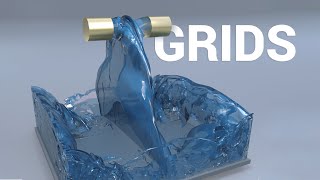
Dr. Zsolnai explains the adaptive staggered tilted grid, a method that rotates and refines simulation tiles where turbulence happens. Four experiments show it handling vortex streets, smoke through nets, boat wakes, and water sheets with only 1% extra computation cost.
Chapters
Dear fellow scholars, this is Two Minute Papers with Dr. Zsolnai. Today we are going to concoct some absolutely insane fluid and smoke simulations. A common property of these simulation programs is that they subdivide the simulation domain into a grid and they compute important quantities like velocity and pressure in these grid points. Normally, a regular grid looks something like this, but this crazy new technique throws away the idea of using this as a grid and uses this instead. This is called an adaptive staggered tilted grid, an AST grid, in short. So what does that really mean? The tilted part means that cells can be rotated by 45 degrees like this. And interestingly, they typically appear only where needed. And I'll show you in a moment. The adaptive part means that the size of the grid cells is not fixed and can be all over the place. And even better, this concept can be easily generalized to 3D grids as well. Now, when I first read this paper, two things came to my mind. One, that is an insane idea. I kinda like it. And two, it cannot possibly work. It turns out only one of these is true. And I was also wondering, why? Why do all this? And the answer is because this way we get better fluid and smoke simulations. Oh yeah. Let's demonstrate it through four beautiful experiments. Experiment number one, Karman vortex treats. We noted that the tilted grid points only appear where they are needed. And these are places where there is a great deal of vorticity. Let's test that. This phenomenon showcases repeated vortex patterns and the algorithm is hard at work here. How do we know? Well, of course we don't know that yet. So let's look under the hood together and see what is going on. Oh wow. Look at that. The algorithm knows where the vorticity is, and as a result, these tilted cells are flowing through the simulation beautifully. Experiment number two, smoke plumes and porous nets. This technique refines the grids with these tilted grid cells in areas where there is a great deal of turbulence. And. Wait a second, what is this? The net is also covered with tilted cells. Why is that? The reason for this is that the tilted cells not only cover turbulent regions, but other regions of interest as well. In this case, it enables us to capture this narrow flow around the obstacle. Without this new AST grid, some of these smoke plumes wouldn't make it through the net. Experiment three, the boat ride. Note that the surface of the pool is completely covered with the new tilted cells, making sure that the wake of the boat is as detailed as it can possibly be. But in the meantime, the algorithm is not wasteful look, the volume itself is free of them. And now hold on to your papers for experiment number four. Thin water sheets. You can see the final simulation here and if we look under the hood, my goodness, just look at how much work this algorithm is doing. And what is even better, it only does so where it is really needed. It doesn't do any extra work in these regions. I am so far very impressed with this technique. We saw that it does a ton of work for us and increases the detail in our simulations and helps things flow through where they should really flow through. Now with that said, there is only one question. What does this cost us? How much more expensive is this AST grid simulation than a regular grid? Plus 100% computation time plus 50% how much is it worth to you? Please stop the video and leave a comment with your guess it costs almost nothing and adds 10 typically an additional 1% of computation time and in return for that almost nothing, we get all of these beautiful fluid and smoke simulations. What a time to be alive. This episode has been supported by Lambda GPU Cloud. If you're looking for inexpensive cloud GPUs for AI, check out Lamda GPU Cloud. They've recently launched Quadro RTX 6000, RTX 8000 and V100 instances and hold on to your papers because Lambda GPU Cloud can cost less than half of AWS and Azure plus they are the only cloud service with 48 gigabyte RTX 8000. Join researchers at organizations like Apple, MIT and Caltech in using Lambda Cloud instances, workstations or servers. Make sure to go to lambdalabs.compapers to sign up for one of their amazing GPU instances today. Our thanks to Lamda for their long standing support and for helping us make better videos for you. Thanks for watching and for your generous support and I'll see you next time.