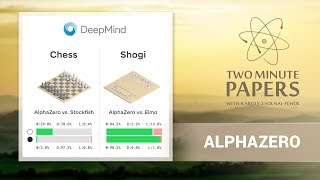
A short YouTube explainer by Károly Zsolnai-Fehér (Two Minute Papers) about DeepMind’s AlphaZero. The video emphasizes AlphaZero’s main contribution: a general algorithm that reaches superhuman play in multiple games (chess, go, shogi) using self-play and relatively little training time. It contrasts AlphaZero with Stockfish — noting Stockfish’s high Elo (>3200) and long development history — and highlights AlphaZero’s efficiency (fewer positions evaluated per second) and rapid training (4–7 hours). The speaker points viewers to the paper’s evaluation and related editorials for deeper details.
Questions this video answers
Over 3200.
Four to seven hours.
More than 10 years.
Chapters
Dear fellow scholars, this is two minute papers with. Finally, I have been waiting for quite a while to cover this amazing paper which is about AlphaZero. We have talked about AlphaZero before. This is an AI that is able to play chess, go and shogi, or in other words, Japanese chess on a remarkably high level. I will immediately start out by uttering the main point of this work. The point of AlphaZero is not to solve chess or any of these games. Its main point is to show that a general AI can be created that can perform on a superhuman level on not one, but several different tasks at the same time. Let's have a look at this image where you see a small part of the evaluation of AlphaZero versus Stockfish, an amazing open source chess engine which has been consistently at or or around the top computer chess players for many years now. Stockfish has an Elo rating of over 3200, which means that it has a win rate of over 90% against the best human players in the world. Now interestingly, comparing these algorithms is nowhere near as easy as it sounds. This sounds curious. So why is that? For instance, it is not enough to pit the two algorithms against each other and see who ends up winning. It matters what version of Stockfish is used. How many positions are the machines allowed to evaluate, how much thinking time they are allowed, the size of hash tables, the hardware being used, the number of threads being used, and so on. From the side of the chess community, these are the details that matter. However, from the side of the AI researcher, what matters most is to create a general algorithm that can play several different games on a superhuman level. With this constraint, it would really be a miracle if AlphaZero were able to even put up a good fight against Dogfish. So what happened? AlphaZero played a lot of games that ended up as draws against Dogfish. And not only that, but whenever there was a winner, it was almost always AlphaZero insanity. And what is quite remarkable is that AlphaZero has only trained for four to seven hours only through self play. Comparatively, the development of the current version of Stockfish took more than 10 years. You can see how reliably this AI can be trained. The blue lines show the results of several training runs and they all converge to the same result with only a tiny bit of deviation. AlphaZero is also not a brute force algorithm as it evaluates fewer positions per second than Stockfish. Kasparov put it really well in his article where he said that AlphaZero works smarter and not harder than previous techniques. Even Magnus Carlsen, Chessmaster extraordinaire, said in an interview that during his games he often THINKS what would AlphaZero do? In this case, which I found to be quite remarkable. Kasparov also had many good things to say about the new AlphaZero in a, let's say, very Kasparov esque manner. And also note that the key point is not whether the current version of Stockfish or the one from two months ago was used. The key point is that Stockfish is a brilliant chess engine, but it is not able to play Go or any game other than chess. This is the main contribution that DeepMind was looking for. With this work this AI can master three games at once and a few more papers down the line. It may be able to master any perfect information game oh my goodness, what a time to be alive. We have only scratched the surface in this video. This was only a taste of the paper. The evaluation section in the paper is out of this world, so make sure to have a look in the video description and I am convinced that nearly any questions one can possibly think of is addressed there. I also linked to Kasparov's editorial on this topic. It is short and very readable. Give it a go. I hope this little taste of AlphaZero inspires you to go out there and explore yourself. This is the main message of this series. Let me know in the comments what you think or if you found some cool other things related to AlphaZero. Thanks for watching and for your generous support and I'll see you next time.