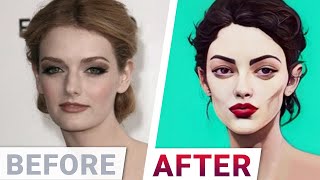
This YouTube video (Two Minute Papers, hosted by Dr. Zsolnai) demonstrates a new AI technique that converts photos into stylized images — caricatures, cartoons, and anime — and argues it outperforms recent prior methods. Caricatures retain identity well (passing an "identity test"), cartoons perform well but sometimes lose identity, and anime results sometimes prioritize consistent character design over individual features. The host compares outputs to previous methods (including a paper humorously named "Gans N Roses" and StarGAN2), cites a user study from the paper showing a clear win for the new method, and ends with a sponsored Lambda GPU Cloud ad highlighting competitive pricing.
Chapters
Dear fellow scholars, this is Two Minute Papers with Dr. Zsolnai. Today we are going to create these cartoon style deepfakes and find out how much better this new AI is than previous techniques. I think you will be very surprised when you see the results. So what is exactly happening here? Well, in goes a photo of us and we also provide the target style. And bam. We become a cartoon, an anime character, or a caricature of ourselves. That sounds absolutely amazing. So let's have a look at all three of these one by one. Now, hold on to your papers, fellow scholars, and let's start with my favorite first caricatures. These are meant to exaggerate the facial features of the test subject, and we can also provide the style here. Mr. Bean has a funny face. And to my delight, all of the caricatures also have a funny feel to them. That is absolutely amazing. A work right there, Little AI. Most of these also pass the identity test. That is, if we were to cover the photo of the real person and just look at the AI's interpretation, in almost all cases, we could tell exactly who it is. That is absolutely incredible. Just think about how difficult it is to retain the identity of the input photo while transforming it according to this style. Also, glasses work. A variety of hairstyles also work. Finally, an AI that creates amazing caricatures. This is incredible. Loving it. Two. Next up, cartoons. The results are still high quality images. I like that glasses and hairstyles are still supported. The identity test is still kind of okay here. Harry Potter is definitely recognizable in some cases. Mr. Bean too. Traces of the stubble of Mr. DiCaprio are visible on some of the results, but. But they are gone from most of the rest and hence it would be difficult to tell exactly who this is. Three, if we are looking to become some anime characters, we see an even more powerful demonstration of this effect here. Sometimes it feels like our input photos are only taken into consideration to get the exact position of the face. And hence I feel like we are seeing the same one character in different poses. Now, this will make a very interesting case study. Why? Well, perhaps the reason for this is that these example images contain too few detailed facial features to be able to redo a real person into an anime version. Remember, caricatures were extremely recognizable and passed the identity test easily. So here I feel that we ran not into the limitations of this AI, but into the limitations of the concept itself. Hmm. Actually, we can find out about that ourselves. How? Well, let's compare this to what previous techniques were capable of and see if this One is better. First we can inspect these images ourselves. These are three previous techniques and this is the no method. Hmm. This one is called gnr. Are you thinking what I am thinking? Yes, this paper is called Gans N Roses. Yes, that just happened. I am not kidding. This did not perform well at all. But Stargan 2, this is actually not so bad. In some cases the quality of these images seems higher than the new technique until we realize that it is not doing exactly what we asked for. Remember, this is the input photo and this is the target. The input photo is meant to be reimagined in the style of the target. And oh yes, there we are. Sometimes this just keeps giving us images that are good, but good is not good enough here. These would have to be close to the target style and often they aren't. Hence, I am really happy to see the comparisons against the unsupervised image to image translation technique because it is doing something very similar to this technique. But the quality differences are quite striking. The new one is so much better. Now let's see the user study from the paper and see if others agree too. What? Is that really true? Goodness. That is one of the cleanest wins for a follow up paper I have seen in a while. Wow. Just look at that. And the incredible thing here is that all of these techniques were published in research papers from the last two to three years. These are from not so long ago at all. You see, the pace of progress in AI research is nothing short of incredible. These amazing new papers are popping up every year and in some fields, almost every week. So with that we can soon become any character when playing in a virtual world. And we can also choose how much of our identity we wish to reveal. What a time to be alive. So what do you think? What kind of character would you like to become? Let me know in the comments below. If you're looking for inexpensive cloud GPUs for AI, Lambda now offers the best prices in the world for GPU Cloud compute. No commitments or negotiation required. Just sign up and launch an instance and hold on to your papers. Because with Lambda GPU Cloud you can get on demand a 100 instances for $1.10 per hour versus $4.10 per hour with AWS. That's 73% savings. Did I mention they also offer persistent storage? So join researchers at organizations like Apple, MIT and Caltech in using Lambda Cloud instances, workstations or servers. Make sure to go to lambdalabs.compapers to sign up for one of their amazing GPU instances today. Thanks for watching and for your generous support, and I'll see you next time.