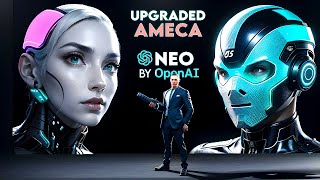
A narrated YouTube explainer (LARRUZ, uploaded 2023-07-13) comparing two humanoid robots: Ameca (Engineered Arts) and Neo (OpenAI/1X). It details Ameca’s human-like appearance, motor counts (face/arms/hands), sensors, and new drawing capability built using a pipeline of GANs, style transfer, inverse kinematics and PID controllers — a project developed with University of Bristol and University of Bath and funded by EPSRC, presented at ICRA in May 2023. It then describes Neo as OpenAI/1X’s modular humanoid integrating GPT-4, DALL·E, Codex and CLIP, unveiled at the Neo Accelerator in July 2023; Neo is framed as an AGI testbed with swap-in hardware modules. The video contrasts Ameca’s creativity-focused human expressiveness with Neo’s versatility and discusses societal and ethical implications before closing with a viewer call-to-action.
Questions this video answers
At the International Conference on Robotics and Automation in May 2023.
Engineered Arts, University of Bristol, and University of Bath.
The Engineering and Physical Sciences Research Council (EPSRC).
Unveiled in July 2023 at the Neo Accelerator event (associated with Ali Partovi and partners).
Chapters
So Ameca, a groundbreaking robot from Engineered Arts that talks and mimics human expressions and movements, now draws two, making it a fascinating blend of tech and art. This AI robot looks like a human, but doesn't have a specific gender or race. With a gray rubber face and hands, it can move its arms, fingers, neck and face, letting it show emotions and even talk. With microphones, cameras and facial recognition software, it can interact with people just like a human. Now, recently, OpenAI and a Norwegian startup called 1X made an exciting announcement about the launch of their first physical robot named Neo, which looks like a futuristic astronaut, can move around, handle things, talk and sense its surroundings thanks to its arms, legs, cameras, speakers, microphones and sensors. Ameca and Neo are excellent examples of AI in human like forms. They don't just respond to commands, they can also show their intelligence and creativity, like when they draw. Let's examine how they managed to do this. So first let's talk about Ameca, one of the most advanced human shaped robots in the world. Representing the forefront of human robotics technology, it is designed specifically as a platform for development into future robotics technologies such as artificial intelligence and machine learning. One of the most impressive features of Ameca is its realistic human like appearance and motion. Ameca can mimic human expressions such as smiling, frowning or winking using 24 motors in its face. It can also move its head, eyes and mouth to follow and engage with people. It can speak in different languages and accents using text to speech synthesis or pre recorded audio. It can also gesture with its arms and hands using 20 motors in each arm and 12 motors in each hand. It can even play rock, paper, scissors or give a thumbs up. But Ameca is not just a pretty face. It also has a high degree of dexterity and fine motor skills which enable it to perform tasks that require precision and coordination. For example, Ameca can write with a pen, type on a keyboard, play the piano or solve a Rubik's Cube. It can also draw with a pencil, which is one of its newest and most amazing skills. Ameca's drawing ability was developed by Engineered Arts in collaboration with researchers from the University of Bristol and the University of Bath. The project was funded by the Engineering and Physical Sciences Research Council and was presented at the International Conference on Robotics and automation in May 2023. The project aimed to use artificial intelligence to make drawing more imaginative and accurate. The researchers used a combination of techniques to achieve this goal, such as generative adversarial networks, style transfer, a method that can change the style of one picture to match another, like making a Photo seem like a painting. Inverse Kinematics A technique for determining the movements of a robot arm based on its intended final position. Like holding a pencil. Proportional integral derivative controllers. These adjust a motor's speed and force to get a specific result, like drawing a line. Using these methods, Ameca can draw different types of images like portraits, landscapes, animals and even abstract art. It can also draw pictures based on text descriptions such as a cat with sunglasses or a fire breathing dragon. It can even make drawings from its own thoughts by using random data as its input to draw an image. Ameca first uses a GAN to generate an image from a text prompt or noise. Then it uses style transfer to apply a desired style to the image, such as sketch, watercolor or oil painting. Next, it uses IK to calculate the joint angles of its arm and hand to trace the contours of the image. Finally, it uses PID controllers to control the motors of its arm and and hand to draw the image on paper. The result is stunning. Ameca can draw images that are not only realistic, but also expressive, diverse and original. Now, most of us are familiar with OpenAI because of ChatGPT. However, OpenAI isn't just about making software. They also focus on hardware and that's why they have developed neo, their first physical robot. NEO is a human like robot powered by OpenAI systems such as GPT4, Dall? E, Codex and Clip. It can learn, understand command commands and even create images or code. Designed to look like a future astronaut, it can move, handle objects and communicate. OpenAI plans to use NEO as a testbed for their vision of artificial general Intelligence AGI, which is the ultimate goal of creating AI that can perform any task that a human can. It was unveiled in July 2023 at the Neo Accelerator, a startup accelerator founded by Silicon Valley investor Ali Partovi, which partnered with OpenAI and Microsoft to provide free software and mentorship for budding AI companies. And it was one of the highlights of the event where it demonstrated some of its abilities and tasks. NEO is one of the most innovative and ambitious robots in the world, representing OpenAI's vision for the future of AI and robotics. It has a customizable design and latest tech features. Its parts can be changed based on the task or place. For instance, it can swap its legs for wheels or its gripping tools depending on what's needed. It can also interact with its parts wirelessly through Bluetooth or WI Fi. Furthermore, Neo uses OpenAI's AI systems like GPT4, Dall? E, Codex and Clip that enable it to understand and respond to spoken Commands, create realistic images from text, write functional code from spoken prompts, and learn from text based guidance to identify objects, faces and feelings. With these abilities, Neo can perform a variety of tasks such as drawing, playing games and solving puzzles. For instance, it can draw pictures, learn and play games like chess, and solve logical puzzles like Sudoku. Ameca and Neo are both humanoid robots that can draw and do amazing things using artificial intelligence. But they are also very different in many ways. They represent different approaches and possibilities in the field of robotics and AI. Ameca is designed to be human like and interacts with people using normal language and movements. Its art comes from turning words or noise into images which it then draws on paper. Although Ameca's artwork is unique and expressive, the quality depends on how well the images are generated and traced. On the other hand, Neo is designed to be versatile, able to do any human task using artificial intelligence. It makes art by transforming words or noise into code, which it then runs on its internal computer or screen. While Neo's drawings are accurate and realistic, they're limited by the complexity of the code and the display resolution. Both robots are remarkable, but have different goals. Ameca aims to express itself through art, valuing creativity and diversity. Meanwhile, Neo wants to learn and improve its abilities, prioritizing intelligence and efficiency. While both robots are impressive, they bring up societal questions and challenges. AI robots like Ameca and Neo can bring lots of changes to society, some good and some bad. They can make learning and entertainment more exciting, help us with tough or boring jobs, and spark new creative ideas. But they also have their downsides. They might take over some people's jobs, question the importance of human values, or even harm us if they malfunction or are used wrongly. It's important that we design and use these robots properly so they benefit us and don't cause harm. AI and robotics have an exciting yet unpredictable future. These future AI robots will be smarter and more human, like impacting how we live, work and view ourselves. We're committed to guiding this future, ensuring ethical and responsible use of these technologies. Our goal is a world where humans and AI robots harmoniously coexist. We hope you liked this video and learned something about AI and robotics. If you did, please like share, subscribe and leave a comment about what you think of Ameca and NEO and what kind of AI robots you want to see in the future.