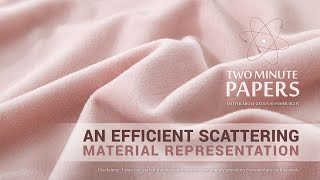
Researchers compressed 25 GB of volumetric material data down to 45 MB, a 500-fold reduction, while keeping rendering over twice as fast with barely noticeable quality loss. The technique handles anisotropic scattering, where light bounces through volumes with directional bias.
Chapters
Dear fellow scholars, this is two minute papers with zsolnai. Have a look at these beautiful images representing these materials that you see here. Takes more than 25 gigabytes of storage. You could store several feature length movies on your hard drive using the same amount of storage. And this technique is able to compress all these 25 gigabytes into 45 megabytes without introducing any significant perceptible difference. That is close to a whopping 500 times more efficient representation. Hmm. This improved representation not only helps easing the storage requirements of these assets, but it also makes the rendering times, or in other words, the process of creating these images via light simulation programs, typically more than twice as fast to process. That is a ton of money and time saved for the artists. An important keyword in this piece of work is anisotropic scattering. So what does this mean exactly? The scattering part means that we have to imagine these materials not as a surface, but as a volume in which rays of light bounce around and get absorbed. If we render a piece of cloth made of velvet twill or a similar material, there are lots of microscopic differences in the surface. So much so that it is insufficient to treat them as a solid surface, such such as wood or metals. We have to think about them as volumes. This is the scattering part. The anisotropy means that light can scatter unevenly in this medium. These rays don't bounce around in all directions with equal probability. This means that there is significant forward and backward scattering in these media, making it even more difficult to create more optimized algorithms that simplify these scattering equations. If you look below here, you'll see these colorful images that researchers like to call difference images. It basically means that we create one image with the perfectly accurate technique as a reference. As expected, this reference image probably takes forever to compute, but is important to have as a yardstick. Then we compute one image with the proposed technique that is usually significantly faster. So we have these two images, and sometimes the differences are so difficult to see, we have no way of knowing where the inaccuracies are. So what we do is subtract the two images from each other and assign a color coding for the differences, as the error may be spatially varying. This is super useful because we can recognize exactly where the information is lost. The angrier the colors are, the higher the error is in a given region. As you can see, the proposed technique is significantly more accurate in representing this medium than a naive method using the same amount of storage. This paper is extraordinarily well written. It is one of the finest pieces of craftsmanship. I've come along in a long while and yes, it is a crime not having a look at it. Also, if you liked this episode, make sure to subscribe to the series and check out our other videos. We have more than 150 episodes for you ready to go right now. You'll love it and there will be lots of fun to be had. Thanks for watching and for your generous support and I'll see you next time.