Anthropic CEO : AGI is Closer Than You Think! (machines of loving grace)
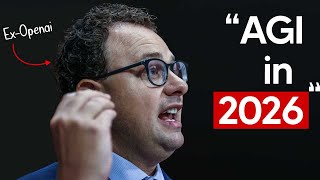
YouTube commentary (LARRUZ) summarizing Dario Amodei's essay "Machines of Loving Grace." The video outlines a definition of "powerful AI" and a near-term timeline (Amodei suggests it could arrive as early as 2026), describes expected capabilities (multimodal interfaces, agentic long-running tasks, millions of parallel instances), and emphasizes limits (physics, experiment times, data scarcity, regulation). It frames impacts via "marginal returns to intelligence" and examines five high-impact domains: (1) biology & health (claims of a "compressed 21st century" where decades of biomedical progress could occur in 5–10 years), (2) neuroscience & mental health (measurement, interventions, potential cures), (3) economic development & poverty (possibility of rapid catch-up and distributional risks), (4) peace & governance (coalitions, supply-chain controls, interpretability), and (5) work & meaning (comparative advantage, possible need for new economic institutions). Tone is explanatory with speaker interjections and speculation; the video primarily paraphrases and comments on Amodei's optimistic-but-cautious vision.
Questions this video answers
2024-10-13 (video titled/artifact dated in metadata)
Could come as early as 2026 (claim attributed to Dario Amodei)
AI could compress 50–100 years of biological and medical progress into 5–10 years after powerful AI is developed
Chapters
So Dario Amodei, the CEO of Anthropic, recently released a huge essay in which he titles it Machines of Loving Grace How AI Could Transform the World for the Better. So essentially, this is basically talking about how AGI super intelligence could transform the next 100 years. And in this, it's pretty insightful because it doesn't focus on the majority of things that other individuals are focusing on, like the AI risks. Not that Anthropic is not focusing on safety, but it purely seeks to look at how good can the future get if we manage to get super intelligent AI right along with artificial general intelligence. So in this video I'll be diving into absolutely everything that this talks about, as well as looking at the future with as to what the predictions are for the future onwards, like the 2000 and 30s, 2000 and 40s, and any subsequent years after that. So you can see here that he starts out this essay by stating that in this essay I try to sketch out what the upside might look like with a powerful AI if everything goes right. Of course, no one, okay, and this is absolutely no one, even those at these top frontier labs can know the future with any certainty or precision. And the effects of powerful AI are likely to even be more unpredictable than past and previous technological changes. So if all of this is unavoidably going to consist of guesses. So he's basically facing this with stating that, look, these are his best guesses, but considering the fact that this is fundamentally new technology, an entire new paradigm, the accuracy could vary slightly. He also says that I'm aiming for at least educated and useful guesses which will capture the the flavor of what will happen, even if most details end up being wrong. And he also says that I'm including lots of details, mainly because I think a concrete vision does more to advance discussion than a highly hedged abstract one. So this is where he actually discusses exactly what's going on. And there are five key things that this video is going to be broken down into that we will discuss. So essentially we can see it says the list of positive applications of AI is extremely long, and some of them he won't even cover in this essay. This includes, of course, robotics, manufacturing, energy and much more. But he's going to focus on the small number of areas that seem to me have the greatest potential to directly improve the quality of your human life. And there are five categories that he's most excited about, which is first, biology and physical health. Second, neuroscience and mental health. Third, economic development and poverty. Fourth, being the peace and governance Third, five being the work and meaning. So all five of these are going to be covered in this video. So that's where this thing is headed. Now, some of the basic assumptions for this framework, because like I said before, this is based on the fact that AI is going to be increasingly powerful. But he says to make this whole essay more precise and grounded, it's helpful to specify clearly what we mean by powerful AI. And this is, for example, the threshold at which the 5 to 10 year clock starts counting, as well as laying out a framework for thinking about the effects of AI once it's present. So Dario Amadei, the CEO anthropic CEO of Claude 3.5 Sonnet company behind Claude 3.5 Sonnet, says that you know what powerful AI will look like, and he actually dislikes the term. AGI or when it will arrive is a huge topic in itself. I've discussed publicly and could write a completely separate essay on I will at some point. And obviously many people are skeptical that powerful AI will be built soon, and some are skeptical that it will be built at all. But here's one of the biggest things that he recently said is that he thinks that it could come as early as 2026, though there are ways that it could take much longer. But for the purpose of this essay, I'd like to put these issues aside and assume it will come reasonably soon. So basically from this, he's basically stating that powerful AI is AI that can start to directly impact your life in a very positive way, could come as early as 2026. Now, as of the date that I'm recording and potentially publishing this video, it is 12-10-2024, which means that that is.
Just around two years, which isn't that long if you think about it, stating.
That maybe not God level AI, but powerful AI is going to be coming rather soon. And he explains exactly what he means by powerful AI. It's going to be coming, you know, in two years is quite surprising. And basically this is focusing on the five to ten years after that. And right now he's going to get into exactly what such a system will look like, what its capabilities are and how it interacts, even though there is room for disagreement on this. So by powerful AI, I have in mind an AI model similar to LLMs in today's form, though it might be based on a different architecture and it might involve several interacting models and it might be trained differently with the following properties. So here's where you want to pay attention, because this is where they're Giving.
The first kind of predictions to how AGI is. And of course he dislikes the term AGI, but I'm still going to use that in this video because I think it's a pretty useful term for quickly describing how AI is going to be in terms of pure intelligence, which is essentially how smart the model is. It is smarter than a Nobel Prize winner across the most relevant fields, biology, programming, math, engineering, writing, etc. This, this means it can prove unsolved mathematical theorems, write extremely good novels and write difficult code bases from abstract, et cetera. That is insane. I'm not going to lie to you guys. That is absolutely insane. Stating that in terms of pure intelligence in 2026 we can have an AI that is smarter than a Nobel Prize winner across the most relevant fields. Okay, that's pretty crazy. And an AI that could prove unsolved mathematical theorems could. The implications for that. Outstanding. Which is of course what we're going to get into later, but I just think that is pretty crazy. Now, quickly, I do want to say that even if this doesn't happen in 2026, this is still an AI model that could happen in the future. But I think it's important to understand the timelines for which individuals are discussing this stuff. So it also says that in addition to just being a smart thing that you talk to, apologies for that. It has all the interfaces available to a human working virtually, including text, audio, video and keyboard control, and of course, Internet access. It can engage in any actions, any communications or remote operations enabled by this interface, including taking actions on the Internet or taking or giving direction to humans, ordering materials, directing experiments, watching videos, making videos, and so on. It does all of these tasks, again, with a skill exceedingly the most capable humans in the world. That is, I'm saying, again, okay, it does all of these tasks, again, with a skill exceeding most of the most capable humans in the world, which is pretty insane when you actually start to think about the implications for this. So we're going to have an AI that is going to be able to use all of these modalities, but exceed some of the most capable humans in the world. Now, it also says here that it does not just passively answer questions. Instead, it can be given tasks that take hours to days or even weeks to complete, and then goes off and does those tasks autonomously in a way that a smart employee would, asking for clarification as necessary. So this is where we get into the agentic behavior, where we see that in 2026 onwards that these models are going to be doing tasks. And the thing about this, that most people might not understand is that some of these models, whilst, yes, they're going to be smarter than a Nobel Prize winner, which is crazy to think, this doesn't necessarily mean that these models are going to be able to instantly respond to exactly what you're doing, because there are physical limitations such as time. And the physical world is bound by, of course, physical constraints like the laws of physics, which essentially means that even if we do have really smart AI, things can't happen in a split second, as some may presume. So some tasks might take days or weeks to complete as certain experiments are conducted and as data is fed back into the system. It also includes that it doesn't have a physical embodiment other than living on a computer screen, but it can control existing physical tools, robots, or laboratory equipment through a computer. And in theory, it could even design robots or equipment for itself to use, which is pretty incredible. I mean, imagine a AI designing robots for itself to use. That's pretty. I mean, the implications for that are just outstanding. Then it says here that the resources used to train the model can be repurposed to run millions of instances of this model. And if this matches the projected cluster sizes by 2077, and the model can absorb information and generate actions at roughly 10 to 100 times human speed. Of course, this is what I was already saying before. It might be limited by the physical response time of the physical world or the software it interacts with. So, yeah, this is some pretty insane stuff. And I think the crazy thing about this is that when we actually start to see how autonomous agents are working, I think it's going to be the biggest mind warp that most people can't wrap their head around. Because right now you're seeing me move around the page, okay, Things are going to get really weird. I'm going to move around the page. But you can see me move around the page. Let's say if you wanted me to highlight resources, I could highlight that. I could highlight this text. But an AI model, okay, as long as the Internet is working and the computer isn't laggy and the limits of any software are being maintained, an AI is going to be able to highlight every single piece of word, summarize things in split seconds, okay? Of course, there are certain physical limitations which it does talk about, but this is going to be 10 times the human speed. I mean, sometimes you're tired, sometimes, sometimes you're fatigued, sometimes humans get distracted. Imagine an AI who has one goal, one focus that is working that quickly on a single problem, you can imagine how quickly that is going to be. And I can't imagine that some websites and services are going to be AI agent friendly. I think some are going to be completely not AI agent friendly. Because I think when we have bots and stuff that already exist, there are already bots out there that, for example, if you're trying to buy something, sometimes you'll see that this product is completely sold out the moment everything goes on, because bots can instantly buy and sell those things. But I think when we start to think about bots that can do that, but with real intelligence, real problem solving and moving forward on the goals that could actually benefit humanity, we can start to realize why things are going to be absolutely incredible. And of course, when we have millions of instances of this AI doing the same thing, it's going to be absolutely insane. So it says that each of these millions of copies can act independently on unrelated tasks, or if needed, can all work together in the same way that humans would collaborate, perhaps with different subpopulations, fine tuned especially to be good at particular tasks. So this is what he's stating that in 2026, these kind of models that we're going to have, they're going to be not like general models, for example, with the O1 models, those models are reasoners. But I think even within those reasoners, we're probably going to have a model that's just focused on math, probably going to have a model that's just focusing on reasoning for AI research. We're one that's just focusing on conducting experiments and is fine tuned to just be specific at those tasks. And this is essentially like what OpenAI had as their goal, which is where they say that they want to get to the final goal, which is of course organizations where you're going to be able to essentially have organizations that are just completely AI run. So he says here that we could summarize this as a country of geniuses in a data center. Clearly such an entity, which is an interesting way to describe it, would, would be capable of solving very difficult problems very fast. Okay, which is crazy, but it is not trivial to figure out how fast. Two extreme positions, both seem false to me. First, you might think that the world would be instantly transformed on the scale of seconds, quite like the Singularity, which is where people think that the AI just builds upon itself and upon itself and just continues until it's so smart that it's able to just become a God, basically. But of course he talks about the problem with this is there are real physical and practical limits, for example, around building hardware or conducting biological experiments. Even a new country of geniuses would hit up against these limits. And of course intelligence might be powerful, but it isn't magic fairy dust. Like for example, let's say it managed to even solve cancer. Let's say, for example, it would take a while to get up the factories to build the drug, to distribute the drug. There are still physical limitations just based on the physical laws of reality. Like there is a speed limit, the speed limit is the speed of light. So there are those things like there is literally physical limits, which is by even if we have rapid technological advancement, it's not going to happen like all within a day, as some of these sci fi novels may suggest. And it says here that secondly, you might believe that technological progress is saturated or rate limited by real world data or social factors and that better than human intelligence will add very little. That this also on the flip side seems implausible to me as there are hundreds or even thousands of scientific or social problems where a large group of really smart people would drastically speed up progress, especially if they aren't limited to analysis and can make things happen in the real world, which our postulated country of geniuses can included being directed by or assisting teams of humans. And it says, I think that the truth is likely to be some messy mixture of these two extreme pictures, something that varies by task in the field and is very subtle in the details. And I believe we need new frameworks to think about these details in a productive way. So of course the economists often talk about factors of production, things like labor, land and capital. And the phrase marginal returns to labor, land and capital captures the idea that in a given situation a given factor may or may not be the limiting one. For example, an air force needs both planes and pilots, and hiring more pilots doesn't help much if you're out of planes. And and I believe that in the AI age we should be talking about the marginal returns to intelligence and trying to figure out what other factors are that complementary to intelligence and that becoming limiting factors when intelligence is very high. And we're also not used to thinking in this way. And of course we need to ask how much does being smarter help with this task and on what timescale. But it seems like the right way to conceptualize the world with a very powerful AI. Basically what he's saying here is that the plain example is a really good example. He's basically saying that, look, let's say you were a country that wanted to go to war, but. But you only have three planes, but you've trained a million pilots. It doesn't really matter if you have the world's best fighter pilots if you only have three planes. So it's like, you know, once we have unlimited geniuses, or maybe not unlimited because, you know, physical limitations of data centers, but once we have thousands and millions of agents that are really, really smart, what's going to be the actual physical bottleneck that we cannot solve? Which is, I think it's a really important question that I genuinely didn't even think about. Of course, you can see right here, these are the factors which limit intelligence. So it says intelligent areas need to operate interactively in the world in order to accomplish things and also to learn. But the world only moves so fast. Cells and animals run at a fixed speed, so experiments on them take a certain amount of time, which may be irreducible. The same is true of hardware, material science, anything involving communicating with people, and even our existing software infrastructure. Furthermore, in science, many experiments are often needed in sequence and learning from or building on from the last. And all of this means that with the speed at which a major project, for example, developing a cancer cure, can be completed, have an irreducible minimum that cannot be decreased further even as intelligence continues to rise, which basically means that as the future, yes, things are going to move faster. However, there are certain limits to systems with how things move, which means that even if you have everything moving at 100% and there is a base rate at which things move at which cannot be improved upon. Which is why when you think about the speed of these things happening, you have to understand that things are going to happen, but they're not going to happen as quickly as you might think. But they're also not going to happen as slowly as you think, and they will happen faster than you think. Which is why he said it's going to be quite a balance. Now, of course, he said the need for data, sometimes raw data is lacking. In its absence, more intelligence does not help. So today's particle physicists are very ingenious and have developed a wide range of theories, but they lack the data to choose between them because the particle accelerator data is so limited and it's not clear what they would do drastically better if they were super intelligent, other than perhaps speeding up the construction of a bigger accelerator. Yeah, this is a crazy point, because when we think about the particle accelerator and the kinds of data that's there, there's just not enough data to go around. Because it's like, even if we had the geniuses to develop, let's say they developed the most incredible theories, let's say we had, for example, a million particle accelerator theories, someone developed asi, and we had a million theories to test. The is that the particle accelerator is so expensive it's costly to build. Like, you have people that are trying to all test their theories and there's the physical limits and slots and stuff. So it's not as easy even if we have a lot more intelligence, okay? And that's something that wouldn't help. The only thing that it could really help with is of course, speeding up the construction of a bigger accelerator to conduct more tests. Of course we've got intrinsic complexity. Some things are inherently unpredictable and chaotic, and even the most powerful AI cannot predict or entangle them substantially better than a human or computer. Today, for example, even incredibly powerful AI could not predict only marginally, only marginally further ahead in a chaotic system such as the three body problem in the general case as compared to today's humans and computers. And basically this is a largely unsolvable problem. I believe in physics, I should probably include a video of this. But this is just something where they're basically saying that there are limits to how smart a system can get and the kinds of problems it can solve. But the point of this problem is, is that it's just chaos. Like there is just pure chaos. So even if a system is super intelligent, it's only going to be marginally ahead in some areas due to the chaotic nature of the universe. Of course, constraints in humans. Many things cannot be done today without breaking laws, harming humans or messing up society. An aligned AI would not want to do those things. And if we have an unaligned AI, of course we're back to talking about those risks. Many human societal structures are inefficient or even actively harmful, but are hard to change while respecting. Constraints like legal requirements on clinical trials, people willingness to change their habits or the behavior of governments. And for example, what they're trying to say is that even if, let's say, for example, a super intelligent AI managed to figure out all of these faster ways to travel, faster ways to build houses, you know, there's legal, there's going to be zoning requirements, there's going to be building requirements. You've got like, you know, certain bodies that are just slow. You've got like, you know, all of these regulatory issues and hurdles because of humans essentially. And these systems are just genuinely quite slow because there are rules and regulations. None of this shouldn't be rules and regulations. There always should be. But it's just like, you know, when we actually think about how things move in the real world, I mean, some countries are going to move fast with this stuff, but. But some countries and overall we have laws and rules and regulations for what individuals can do. And I'm sure there are governing bodies for the world. You can't develop certain levels of nuclear weapons and things like that. For example, examples of these advances that work well in a technical sense, but the impact have been reduced by regulations or misplaced fears, which basically means that humans are essentially fearing this greater than it actually is, include nuclear power, supersonic flight, and even elevators, which is pretty trivial. So of course we've got the physical laws, A starker version of the point. There are certain physical laws that appear to be unbreakable. It's not possible to travel faster than light. As I said before, you know, the physical light limit, I'm not sure what the exact number is, but you can't travel faster than that. It seems like the limit. If you're someone who believes we live in a frigging simulation, you could say that that's the like game speed, whatever, engine speed. And of course, chips can only have so many transistors per square centimeter before they actually become unreliable. And computation requires a certain minimum energy per bit erased, limiting the density computation in the world. There's a further distinction between timescales. Things that are hard constraints in the short run may become more malleable to intelligence in the long run. For example, intelligence might be used to develop a new experimental paradigm that allows us to learn in vitro what used to require live animal experiments, or to build the tools needed to collect new data, for example, the bigger particle accelerator, or to, within ethical limits, find ways around human based constraints, for example, helping to improve the clinical trial system, helping to create new jurisdictions where clinical trials have less bureaucracy, or improving the science itself to make human clinical trials less necessary or cheaper. And he says all of this to basically say that we should now imagine a picture where intelligence is initially heavily bottlenecked by the other factors of production. But over time, intelligence increasingly routes itself around these other factors, even if they never fully dissolve. Like some things, like the absolute physical laws of the universe are absolute, which means that they cannot physically be changed, but they can be worked around and lived with. And the key question is how fast it all happens and in what order. Now, with that framework in mind, this is where we get into the first area.
Biology and Health biology is probably the first area where scientific progress has the greatest potential to directly and unambiguously improve the quality of human life. In the last century, some of the most ancient human afflictions, such as smallpox, have finally been vanquished, but many more still remain. And defeating them would be an enormous humanitarian accomplishment beyond even curing disease. Biological science can in principle improve the baseline quality of human health by extending the healthy human lifespan, increasing control and freedom over our own biological processes, and, and addressing everyday problems that we currently think of as immutable parts of the human condition. So now here's where he's talking about how super intelligent AI could work with the limiting factors of the physical world. Of course, one of the things that you use to do in order to increase the rate of scientific discovery is that you conduct experiments. And you conduct these experiments in certain ways. And some of these, you know, take certain times, of course, you know, you've got clinical trials, you've got human trials, you've got, you know, the FDA for certain things. And of course this is where we talk about experiments on cells, animals and even chemical progresses and even chemical processes are limited by the speed of the physical world. Many biological protocols involves culturing bacteria or other cells or simply waiting for chemical reactions to occur. And this process sometimes can take days or even weeks with no obvious way to speed it up. For example, animal experiments can take months and human experiments can often take years or even decades. For long term outcomes on studies and somewhat related to this data is often lacking, not so much in quantity, but in quality. There's always a dearth of clear, unambiguous data that isolates a biological effect of interest from 10,000 confounding things that are going on or that intervenes casually in a given process. And I think this is really true because we have to think about the fact that, for example, one of the things that, you know, people are getting into today is the fact that what is going to be today's cigarettes? Because previously I'm not going to get into any of the policies or rules and regulations around what was going on at that time. But if we look back at how cigarettes were marketed, for example, in the 1930s to 1950s, tobacco companies used doctors and advertisement to show that cigarettes were not harmful. They were claiming that, you know, Lucky Strike in their ads used to basically say that cigarettes must be medically better for your throat. Or what I'm trying to get at here guys, is that some things that we look back at, we genuinely did believe that they were Good for us. But over time, some things only happen over 20 years, 10 years, 5 years, which means that these physical limits, it's quite hard to test these theories in a short amount of time, even if we have super intelligent AI, which means that the cycles upon which the iterations can improve is going to be a little longer than we think in some instances. For example, if you wanted to test what happens every five years on something and, and if you had four iterations.
To improve, you could only improve four.
Times in 20 years. Because five times four is 20. And that's something that most people are not missing. And for example, you know, people are, you know, stating that, you know, sugar used to be marketed as a healthy substance. We now know that this is something that is pretty awful, okay? Like it feeds cancer, you know, it just does. Diabetes, skin, acne, just a million different things are wrong with sugar. I'm not going to get into personal dieting and stuff like that. But the point is, is that, you know, there are certain things that, you know, arguably happening in today's society that will only recognize 60 to 40 years from now, because certain things just happen over a really long process of time that we just can't see right now. Not saying that AI couldn't simulate humans and do those kinds of things, but it's important to understand the physical limits of the world. And of course, this is where he talks about there's a million different factors that could intervene as well. Of course, he says, in part for these problems with data is intrinsic complexity. If you've ever seen a diagram showing the biochemistry of a human metabolism, you'll know that it's very hard to isolate the effect of any part of this complex system, and even harder to intervene on the system in a precise and predictable way. Finally, beyond just the intrinsic time that it takes to run an experiment on humans, actual clinical trials involve a lot of bureaucracy and regulatory requirements that are unnecessary and delay progress. Which is why I think that there's going to be probably some societies that are just moving at light speed, whereas others that are quite regulated are going to slow down. And we've even seen this with the EU where, you know, the regulation there has slowed down so much. And I think in the future it's going to become more apparent. And I think, yes, it is kind of good that you have areas that are quite slow and not going to be impacting all the stuff, because of course, we don't know what super intelligent AI is going to do. We don't know if it's going to kill us. We don't know if it's going to be great for us. There are certain areas and of course certain experiments have to follow a certain guideline in order to remain safe. But I do think that certain small pockets are going to just race ahead with this technology, regardless if we like it or not. So here's where we talk about where the specific acceleration is going to come from, he says here to get more specific on where I think acceleration is likely to come from. A surprisingly large fraction of the process in biology has come from a tiny number of discoveries, often related to broad measurement tools or techniques that allow precise but generalized or programmable intervention in biological system. There's perhaps one of these major discoveries per year, and collectively they arguably drive around 50% of all progress in biologies. These discoveries are so powerful precisely because they cut through intrinsic complexity and data limitations, directly increasing our understanding and control over biological processes. A few discoveries per decade have enabled both the bulk of our scientific base of understanding of biology and driven many of the most powerful medical treatments. And this is where we get into some of the examples of what happens. Of course, crispr, a technique that allows a live editing of any gene in living organisms. Since the original. Since the original technique was developed, there have been constant improvements to target specific cell types. We've also got various kinds of microscopy for watching what is going on at a precise level. Advanced light microscopes, fluorescent techniques, special optics, electron microscopes, genome sequencing and synthesis, which has dropped in cost by several orders of magnitude in the last couple of decades. We've got MRNA vaccines that in principle allow us to design a vaccine against anything, then quickly adapt it. And of course these became famous during COVID And of course we've got cell therapies such as CAR T that allow immune cells to be taken out of the body and reprogrammed to attack, in principle, anything. Why did Dario Amadei recently talk about those discoveries?
Because he thinks that their rate of.
Discovery could be increased by 10x or.
More if there were a lot more.
Talented or creative researchers. Basically, to put this another way, I think the returns to intelligence are high for these discoveries and that everything else in biology and medicine mostly follows from them. And why do I think this? Because of the answers to some of the questions that we should get in the habit of asking when we're trying to determine returns to intelligence. First, these discoveries are generally made by a tiny number of researchers, often the same people repeatedly suggesting a skill and not so random such. Second, they often could have been made years earlier than they were. For example, CRISPR was a naturally occurring component of the immune system in bacteria. That's been known since the 80s, but it took another 25 years for people to realize it could be repurposed for general gene editing. They are also often delayed by many years by lack of support from the scientific community for promising directions. And you can see this profile of the inventor of MRNA vaccines and similar stories abound. Third, successful projects are often scrappy or were afterthoughts that people didn't initially think were promising rather than massively funded efforts. And it's not suggesting that it's not just massive resource concentration that drives discoveries, but ingenuity and and although some of these discoveries have a serial dependence, basically you need to have discovery A in order to have the tools and knowledge to make discovery B, which again might create experimental delays. Many, perhaps most, are independent, meaning that they can be worked on in parallel. And basically what he's saying, that there are hundreds of these discoveries waiting to be made if the scientists were smarter and better at making connections between the vast amounts of biological knowledge humanity possesses. Again, consider the CRISPR example, which we knew about since the 80s. And of course the success of alphafod alphaproteo at solving important problems much more effectively than humans, despite decades of carefully designed fixes. Modeling provides a proof of principle, albeit a narrow in a narrow domain should point the way forward. So basically what he's saying here, that my guess is that powerful AI could at least 10x the rate of these discoveries, giving us the next 50 to 100 years of biological progress in 5 to 10 years. And you might think why not 100x? Well, it is possible. But here are both serial dependence and experiment times become important. Getting 100 years of progress in one year requires a lot of things to go right in the first time, including animal experiments, things like designing microscopes or expensive lab facilities. But he does think that we could get a thousand years of progress in five to 10 years, but he's quite skeptical that we could get 100 years in simply one year. Basically, certain design and experiments have certain latency which need to be iterated upon a certain irreducible number of times in order to learn things that can't be deduced logically. Basically saying that, look, no matter which way you slice it, we're going to have to spend some time figuring out the problem, because there's no way to figuring out what happens after this occurs. Basically, he goes on to talk about clinical trials and stuff like that, but he says to summarize the above. My basic prediction is that AI enabled biology and medicine will allow us to compress the progress that a human biologist would have achieved over the next five to 100 years into five to 10 years. And I refer to this as the compressed 21st century. The idea that after a powerful AI is developed, we will in a few years make all progress in biology and medicine that we would have made in the whole 21st century. A truly remarkable statement, but I do think that based on what he's saying here is that it is pretty possible because there's only a few small discoveries that you do need to make that's going to account for the majority of discoveries that exist within the field. And although predicting what powerful AI can do in a few years remains inherently difficult and speculative, and there is some concreteness to asking what could humans do unaided in the next 100 years and simply looking at from what we've accomplished in the 20th century, or extrapolating from the first two decades of the 21st, or asking what 10 crisprs and 50 car ts would get us, we all can see how the level of progress might happen if we get powerful AI. So here's where we stating exactly what could happen in the future years. We could get reliable prevention and treatment of nearly all natural infectious disease. Given the enormous advances against infectious disease in the 20th century, it's not radical to imagine that we could more or less finish the job in a compressed 21st.
Then we also have the elimination of most cancer.
I think this one would largely be one of the best things to ever happen. I think cancer is awful and currently when individuals do get that diagnosis, it can be like a death sentence. It talks about how death rates from cancer have been dropping 2% per year for the last decades. Thus we are on track to eliminate most cancer in the 21st century at the current rate of human science. And some types have been largely cured, for example some types of leukemia with CAR T therapy. And I'm perhaps even more excited for very selective drugs that will target cancer in its infancy and prevent it from ever growing. And AI will make it possible for treatment regimes very finely adapted to the individualized genome of the cancer. And these are possible today, but hugely expensive in time and human expertise, which AI should allow us to scale. We also have very effective prevention and.
Effective cures for genetic disease.
Greatly improved embryo screening will likely make it possible to prevent most genetic disease. And some safer, more reliable descendant of CRISPR may cure most genetic disease in existing people. Which is going to be pretty crazy of course, the prevention of Alzheimer's. We've had a very hard time figuring out what causes Alzheimer's. It's somehow related to the beta amyloid protein. But the details seem to be very complex. It seems like the exact type of problem that can be solved with better measurement tools that isolate biological effects. Thus, I am bullish about AI's ability to absolutely solve it. The improved treatment of most other ailments. This is a catch all category for most other ailments, including diabetes, obesity, heart disease, autoimmune diseases, and much more. Most of these seem easier to solve than cancer and Alzheimer's. And in many cases they are already in steep decline. For example, deaths from heart disease have already declined over 50%. And interventions like GLP1 agonists have already made huge progress against obesity and diabetes. Of course we've got biological freedom. The last 70 years featured advances in birth control, fertility, the management of weight and much more. But AI accelerated biology will greatly expand what is possible. Weight, physical appearance, reproduction and other biological processes will be fully under people's control. We will refer to these under the heading of biological freedom. The idea that everyone should be empowered to choose what they want to become and live their lives in the way that most appeals to them. There will of course be important questions about global equality of access, but I think the biological freedom one is going to be pretty insane. Are people just going to choose to be tall, smart, muscular individuals? I mean, it's going to be interesting. They're going to be like nine foot humans walking around. I don't know. And that's referring to some other stuff as well. And one of these things that he says here is that doubling of the human lifespan. He says this might seem radical, but life expectancy almost creased two times in the 20th century, from 40 years to 75. So it's on trend that the compressed 21st would double it again to 150. Obviously, the interventions involved in slowing the actual aging process will be those that were needed in the late century to prevent mostly childhood premature deaths from the disease. But the magnitude of change is not unprecedented.
So he's saying that concrete.
There already exists drugs that increase the maximum lifespan in rats by 20 to 50% with limited side effects. And some animals, like turtles, already live to 200 years. So humans are manifestly not at all some theoretical upper limit.
I guess the most important thing that is needed might be reliable, non good.
Heartable biomarkers of human aging that will allow fast iteration on experiment and clinical trials. Once the human lifespan is 150, we might be able to reach escape velocity, buying enough time that most of those currently alive today will be able to.
Live as long as they want.
Although there's no guarantee that this biological.
Biologically impossible.
I couldn't even speak properly while saying that because I couldn't even believe it. My brain just got melted. That's insane.
Okay.
He said that once human lifespan is 150, we might be able to reach escape velocity.
So that basically those who are alive.
Today might be able to live as long as they want. Which is crazy.
I mean that is truly a crazy statement. But I don't think he's talking about.
Individuals that are maybe like 70 or 80 right now. I think maybe he's talking about people that are just growing up now. Maybe those 10 and under. I'm not sure exactly what age range that is, but I think this is something that is true.
Because for example, if you look at.
People like Brian Johnson, if you haven't paid attention to this, if you want to know about life expectancy, because this is something that people talk about quite a lot with AI, There's a common phrase right now in AI which is just don't die. And I think it's rather fascinating and thought provoking that some people are stating that if technology continues to advance in.
The way it does, if AI too continues to advance the way it does.
Maybe we might get to a stage where people just don't die. Because we manage to keep extending life by 25%, you know, every couple or so years. And so life extension just. It just keeps on going on basically.
And I guess in theory that does.
Make sense, but of course it's not no guarantee that it's biologically possible. But I am talking about Brian Johnson.
Because this is someone that if you.
Are intrigued in about. I can't even speak properly because it's.
Just so mind blowing. If you are intrigued about how longevity works and all those kinds of things.
This is the channel that I would recommend. You can see in his channel he says don't die.
He's basically sold his company. And all this guy is trying to focus on is just not dying. He literally just focuses on all of these different things. And it's kind of interesting. Like he's his internal body clock, I think.
Is that like of an 18 year.
Old or 24 year old and he's like 40. So it's pretty crazy to see how long this guy is going to live for. And yeah, I think this is going to be one of the channels that explodes as well. Because he's basically the most measured human they've got like all his biomarkers and.
There'S a team of scientists running around.
The clock just basically seeing how long this guy lives for. So I mean, it's going to be a really interesting future to see if other people also adopt this kind of thing too. Now, of course he says it is worth looking at this lick. Of course he says here that it is worth looking at this list and seeing how different the world will be if all of this is achieved 7.
To 12 years and now, which would.
Be in line with an aggressive AI timeline. It goes without saying that this would be unimaginable humanitarian trump. The elimination all at once of most of these scourges that have haunted humanity for the millennia. I mean, pretty crazy, like that thing happening in seven to 12 years from now. I mean, can I fathom that happening? Yes and no. I mean, it's kind of hard to imagine a society where people can live to 150. The average life expectancy is no cancer, there's Alzheimer's, there's a lot of gene editing things that you can just do. I mean, it's going to be pretty crazy. Like trying to, you know, make this video and do that at the same.
Time is pretty hard.
And of course we do have this, that as the ratio of the working age to the retired population will change drastically. So this is going to be changing how the population structures as well. Then of course this point number two, I do apologize for this long video, but there is just a lot of content here and I do want to get through it all. We've got the neuroscience in mind. In the previous section I focused on.
Physical diseases and biology in general and didn't cover neuroscience or mental health, which.
Is a good thing because not a lot of people cover mental health just.
Because it isn't something you can directly see, but it is something that is real and does exist.
But neuroscience is a subdiscipline of biology and mental health is just important as physical health. And in fact, if anything, mental health.
Affects human well being even more directly.
Than your physical health.
Hundreds of millions of people live very low quality of life problems due to.
Addiction, depression, schizophrenia, low functioning, autism, ptsd, psychopathy or intellectual disabilities.
And I know that many of these.
Issues are pretty sure I've spoke to some people with these issues. It's a problem that's quite unfortunate because it's not like, okay, I cut my.
Leg, I go, I fix my leg.
Or you know, I get stitches.
It's like it's quite hard to fix and diagnose, which is.
It's awful. It's really awful. He says that I expect AI to accelerate neuroscientific process along four distinct routes.
All of which can hopefully work together to cure mental illness and improve function.
Traditional molecular biology, chemistry and genetics.
This is essentially the same story as general biology in section one, and AI can likely speed it up via these same mechanisms. There are many drugs that modulate neurotransmitters in order to alter brain function, affect.
Alertness or perception and change mood, et cetera.
And AI can help us invent many, many more. AI can also probably accelerate research on the genetic basis of mental illness, which would be amazing.
Fine grained neural measurement and intervention.
This is the ability to measure what a lot of individual neurons or neuronal.
Circuits are doing and intervene and change their behavior.
Optogenetics and neural probes are technologies capable of both measurement and intervention in live organisms. And a number of very advanced methods, such as molecular ticker tapes to read out firing patterns of individual neurons have also been proposed and seem possible in principle.
Advanced computational neuroscience AI can probably be applied fruitfully to questions in systems neuroscience, including perhaps uncovering the real causes and dynamic of complex diseases like psychosis or mood disorders, which is really true, and it stands to reason that AI could accelerate these as well. Both the development of new methods and helping patients to adhere to existing methods. More broadly, the idea of an AI coach who always helps you to be the best version of yourself, who studies your interactions and helps you learn to be more effective, seems very promising. So in five to 10 years, he basically says that my guess what will happen is like most mental illnesses can probably be cured. I'm not an expert in psychiatric disease, but my guess is that diseases like ptsd, depression, schizophrenia can be figured out and effectively treated via some combination of the four directions above. And the answer is likely to be some combination of something went wrong biochemically and something went wrong with the neural network at a high level. And that is a systems neuroscience question that can be solved. Conditions that are very structural may be difficult, but not impossible. Basically stating that, you know, certain conditions.
Are going to be harder than others.
Effective genetic prevention of mental illnesses seems possible. Most mental illness is partially heritable and genome wide association studies are starting to gain traction on identifying the relevant factors, which are often many in number, and it's probably going to be able to.
Prevent those via embryo screening.
Similarly, with the physical disease, everyday problems that we don't think of as clinical disease will also be solved. So most of us will have everyday psychological problems that are not ordinarily thought of as rising to the level of clinical disease. Some people are quick to anger, others have trouble focusing, they're often drowsy, some are fearful, some are anxious. And these are going to be things that AI are going to be able to solve. So it's going to be interesting to see how many different new areas are going to solve these kinds of issues. And this is crazy, okay? This is futuristic, okay? He says that, you know, one topic that often comes up in sci fi depictions or AI that I haven't intentionally discussed here is mind uploading, which is the idea of capturing the pattern of dynamics of a human brain and instantiating them in software. This topic could be the subject of an essay of itself, but I think that uploading is almost certainly possible in principle. In practice, it faces significant and technological and societal challenges, even with powerful AI.
That likely put it outside the five to ten year window that we are discussing, which is essentially 2030 to 2035. So in summary for part two, he says that AI accelerated neuroscience is likely to vastly improve treatments for or even cure most mental illnesses, as well as greatly expand cognitive and mental freedom and human cognitive and emotional abilities. It will be every bit as radical as the improvements in physical health as described in the previous section. Perhaps the world will not be visibly different from the outside, but the world as experienced will. Humans will be a much better and more humane place, as well as a place that offers greater opportunities for self actualization. And I think, of course, the improved mental health will of course solve a lot of other societal problems, including ones that seem political or economic. And I think this is one of the things that a lot of people don't understand is that, you know, mental health is something that isn't taken seriously by many systems. And I think that once there is something that can maybe not blanketly address the problem, but severely help with how humans are functioning on an individual basis, a lot of the other issues are going to be solved. Like I think most people don't understand that like so many people who are, you know, criminals and so many people who people think are bad people like those, those are some of the people who've had literally some of the worst upbringings and they've had like, they just, you know, have like mental health problems. They're more susceptible to depression, schizophrenia, and all of these issues. And it's just like, okay, this person committed a crime, you know, put them in the jail cell for 20 years, they're awful, yada yada yada. I'm not saying you shouldn't be punished for your crimes, but it's like, you know, we're just surface level tackling these problems. So I think that is also something to take into account. Now this is where we get into something which is pretty dystopian because this is economic development, poverty. And basically it talks about how the development needs to happen for everyone because there is a large disparity in different worlds. It says more broadly, many existing health interventions have not been applied everywhere in the world. Apologies for that. And that matter is the same for non health technological improvements in general. Another way to say this is that living standards in many parts of the world are still desperately poor. GDP per capita is $2,000 in Sub Saharan Africa compared to $75,000 in the United States. And if AI further increases the economic growth and the quality of life in the developed world while doing little to help the developing world, we should view that as a terrible moral failure and a blemish on the genuine humanitarian victories in the previous two sections. Ideally, powerful AI should help the developing world catch up to the developable world as it revolutionizes the latter. And I think this is so true. You can't just leave parts of the world behind. I know that yes, there are certain regulations and all of these kind of things of how things get implemented, but I think it would be awful if only certain parts of the world accelerate further than others. And I think that the baseline, of course, while it is improving, we need to ensure that there is just simply a base level that humanity functions at. Like there shouldn't be certain instances where $2,000 is, you know, the GDP of a country and like, you know, people are living on less than a dollar a day. Like these things are just, you know, it shouldn't be happening. Of course this is where Dario Amade talks about, you know, the challenges faces, you know, in the private public sectors, of course, by pervasive corruption. Like I said before, even if you try and help some of these countries, unfortunately sometimes people are corrupt, they spend the money elsewhere, they don't implement things that are going on. It's quite hard to do that. But of course he says, you know, I see significant reasons for optimism. Diseases have been eradicated. Many countries have gone from poor to rich. And it's clear decisions involved in these tasks exhibit high returns to intelligence despite humans contrary and complexity. So here are the guesses that he makes. For the next five to 10 years after powerful AI is developed on the economy of course you've got the distribution of health interventions. This is the area where he's most optimistic for the future is that diseases have been eradicated top down in campaigns. For example, smallpox was fully eliminated in the 1970s and polio and guinea worm were nearly eradicated with the less than 100 cases per year. The logistics of the distribution can be also greatly optimized and that AI accelerated efforts are going to become more effective. Of course we've got economic growth. Can the developing world quickly catch up to the developed world? Not just in health, but across the board economically? There is some precedent for this. In the final decades of the 20th century, several East Africa Asian agents sustained 10% annual real GDP rates, allowing them to catch up with the developed world. Now here's what's crazy, okay? He says that human economic planners made the decision that led to the success of not by directly controlling entire economies, but by pulling a few levers, such as an industrial policy of export led growth and resisting the temptation to rely on natural resource wealth. And here's where we're getting into some real interesting territory. He says that AI finance ministers and central bankers could replicate or exceed this 10% accomplishment. How do we get developing world governments to adopt them while respecting the principle of self determination? Some are going to be enthusiastic about it, but others are going to be skeptical.
So they're basically saying that, look, previously we've seen that some leaders can develop policies that do work well and do advance the economy, but how on earth do we get that to be implemented if some of them are going to be focused on self determination? I think this is of course one of the most interesting things because I'm not sure people are ever going to relinquish power to AI or even use AI suggested policies. I don't know if that is going to change over the future. I think if certain economies have an AI suggesting policies and their economy is just racing ahead, I think some other nations are also going to potentially use that as well.
And I think that's going to be.
Really, I wouldn't say dystopian, but I think it's going to be interesting. I mean, if this thing is smarter than this, why wouldn't it make the.
Decisions that control where our society goes?
Of course it says finally, non health AI accelerated technology such as energy technology.
Transport, drones, improved building materials, all of those are going to permeate the world naturally. For example, even cell phones quickly permeated sub Saharan Africa via market mechanisms without needed philanthropic efforts. Of course, we have to talk about.
Food security, advances in crop technology, all of that stuff. Of course we do need food security for people.
It's kind of insane that we have some areas where people just waste food. In some areas where people are not.
Getting enough food, of course we've got mitigating climate change. Climate change is going to be felt much more strongly in the developing world, hampering its development.
We expect that AI will lead to improvements in the technologies that slow or prevent climate change from atmospheric carbon removal and clean energy technolog analogy to lab.
Grown meat that reduces our reliance on.
Carbon intensive factory farming. I wonder what people think about lab grown meat.
I mean, it sounds pretty dystopian, but I don't know, I mean, it's kind of interesting.
Some people say that, like, why not? Because it's like if it's just exactly the same and it's grown from a cow, like, what difference does it make? I mean, they have a point there.
And of course the inequality within the countries, there is a ridiculous level of.
Wealth inequality within the United States. And I'm not saying that, you know, like tax the rich or do any of that stuff. I'm just saying that like in certain.
Societies there is a baseline of living.
That some people just don't have. And I think that that's really awful. I still think, of course, that you should be able to work hard and, you know, achieve things, but it's just like the system needs to be designed so that people just don't fall through the cracks. Of course there's also a dystopian problem which is where the opt out problem. So this is, this is one that's like kind of cyberpunkish, but it's like one concern in both developed and developing world alike is people opting out of AI enabled benefits. So I mean, people are going to be skeptical of the technology when it does come here. Like some people, like just nobody's gonna, like, no technology is 100% adopted. You know, of course you've got phones and computers which are pretty much universal, but it's like AI is something that's kind of like anthropomorphosized in the sense that people are going to think that, okay, it's a being, so they might not take its advice. But Dario says here that there could end up being bad feedback cycles where the people who are least able to make good decisions opt out of the very technologies that improve their decision making abilities, leading to an ever increasing gap and creating a dystopian underclass. And some researchers have argued that this will undermine democracy and this would once again place a moral blemish on AI's positive advances. Basically stating that look, if you don't adopt some of the AIs and you lead to worse decisions, you're going to be basically screwed because you're never going to be able to catch up. I mean it's crazy. But he does say that one hopeful sign is that historically anti technology movements have been more bark than bite. Most people adopt it in the end.
Next we're of course going to talk.
About peace and governance. And he basically says suppose that goes well, we get disease hampered down, we get poverty and we get inequality significantly reduced. And the baseline of human experience is raised substantially. Humans are still a threat to each other, of course we need peace. Currently there are just numerous wars going on in the world. I don't really want to talk about them. But this is something that is unfortunate. Humans are a big issue with one another. And of course one of the things we actually need to do is to maintain the fact that AI powered authoritarianism seems too terrible to contemplate, which is basically where you have no personal freedom. And I would argue that this is kind of happening in some societies. Not going to mention any names, but I think we know some societies. It is becoming a little bit dystopian where people can track your every movements, you know, social credit scores, that kind of thing. It's not really going to be pretty good. And especially when like in 10 to 12 years when you have super advanced AI, this is going to be something that we need to have, avoid being overpowered by authoritarianism and present. I can't even say that word right, I'm sorry, prevent human rights abuses within these countries. Here's where he talks about his best guess that the way to do this is via this kind of strategy, which is where a coalition of democracy seeks to gain a clear advantage, even just a temporary one, on powerful AI by securing its supply chain and scaling quickly and blocking or delaying adversaries access to key resources like chips or semiconductor equipment. And this coalition would on one hand use AI to achieve robust military superiority, while at the same time offering to distribute the benefits of powerful AI to a wider group of countries in exchange for supporting the coalition strategy to promote democracy. Basically stating that they're going to be in a better position taking the same bargain as the rest of the world. Which is pretty interesting. I mean, I didn't really think of that one. And of course those of you who are thinking that AI is going to be making the decisions for lawyers in terms of sentencing and all that kind of crazy stuff. He says, I'm not suggesting that we literally replace judges with AI systems, but that we have the combination of impartiality with the ability to understand and process messy real world scenarios feels like it should have some positive application to justice. At the very least, such systems could work alongside humans as an aid to decision making. And basically this would allow the system to be more transparent and transparency would be important in any such system and a mature science of AI could conceivably provide it. And basically they're saying that advanced interpretability, which is where they look inside the model and see what's going on, is where they are going to be able to see inside the final model and assess it for any hidden biases. And the crazy thing about this is that that is actually so true. If you do get advanced interpretability and you're able to see inside the model, you can actually see any hidden biases in a way that is simply not possible with humans. The crazy thing about this is that even you now watching the video, you have your own hidden biases. With how you're raised, where you are, the data that's been put into you.
The TV shows you watch, all of.
These things create hidden biases, meaning that you can't see them yourself. And I know this for myself, I have my own biases, I try to always remain objective, but it's completely impossible to see those biases. But if you can actually look inside of an AI and see what's going on, you can see those hidden biases and try and remove them, which is pretty crazy, which would mean it would be more fair. One example of this, I want to show you guys something really quick. There was this one that was like about judges. There's some gray areas about this research, but it basically said that the authors of this peer reviewed paper looked into more than a thousand rulings made in 2009 by eight judges. They found that the likelihood of a favorable ruling peaked at the beginning of the day, steadily declining over time from a probability of about 65% to near zero before spiking back up to about 65% after a break for a meal or a snack. Basically stating that looks the judges were more lenient once they've had a snack or a break.
And maybe they get more agitated as.
The day goes on, which is pretty.
Crazy because that could mean that we have a situation where, you know, AI judges aren't going to do that because.
They don't need a break, they don't need a snack.
They're always going to remain in the same complete state.
You know, it's pretty crazy. It says how, in a similar vein, AI could be used to both aggregate opinions and drive consensus among citizens, resolving conflicts, finding common ground, and seeking compromise. Some early ideas in this direction have been undertaken by the Computational Democracy Project, including collaborations with Manthropic and a more informed and thoughtful citizensry. Would Ortho strengthen democratic institutions? Of course, the last one that we have here is of course, work and meaning. Even if the four previous sections go well, not only do we alleviate disease, poverty and inequality, but liberal democracy becomes a dominant form of government, and existing liberal democracies become better versions of themselves. At least one important question remains. It's great we live in such a technologically advanced world, as well as a fair and decent one, but some might object with AI doing everything, how will humans have meaning? And for that matter, how will humans survive economically? And this is one of the questions that I've been trying to solve because I think this is coming sooner than most people realize and people are not paying attention. And what's crazy is that Dario Amade says that I think this question is more difficult than the others. I don't mean that I'm more pessimistic about it than I am the other questions. I just means that it's fuzzier and quite harder to predict in advance because it relates to a macroscopic questions about how society is organized that tends to resolve themselves only over time in a decentralized manner. And he gives a great example here. He says, he gives an example right here where he says, for example, hunter gatherer societies might have imagined that life is meaningless without hunting in various kinds of hunting related religious rituals, and would have imagined that our well fed technological society is devout of purpose. Basically saying that look back in the, you know, in the olden days, the really olden days, like you know, areas when we just had sticks and running around hunting, we might have thought that okay, if people aren't hunting all day, what on earth are we going to do? But we can now see that with technology we still have a lot of purpose. And of course they might not understand how our economy can provide for everyone or what function people can usefully serve in a mechanized society. Which is really true. Okay, it's quite hard to look forward and think how things are going to work, but looking back, we usually understand. Basically he's stating that there is a sign that there is clearly a lack of clear answers. And this is one of the things that I've constantly seen while researching this is that there isn't any clear answer to what people are going to do. And I think it's something that needs answering. Genuinely like, this is pretty crazy. Of course, this is where he does talk about the fact that I spend my time playing video games, swimming, walking around outside. All of these generate zero economic value. Of course, it doesn't really matter that someone is better at those things. He's basically saying that just because AI is better than those things, it doesn't really mean that there's no value to you. You're still going to enjoy them. And of course, he's basically talking about there's an economic piece, which is, can you generate economic value in an economy versus the meaning piece, which is like, do you still have meaning in the AI economy? Which is, where are your tasks meaningful to yourself? There's two separate issues. Here's where he gives us predictions on this, which I think is rather fascinating. He says, first of all, in the short term, I agree with arguments that comparative advantage will continue to keep humans relevant and in fact increase their productivity and in some way level the playing field between humans. As long as AI is only better at 90% of a given job, the other 10% will cause humans to become highly leveraged, increasing compensation and in fact creating a bunch of new jobs complementing and amplifying what AI is good at, such that the 10% continues to expand and employ almost everyone, which is crazy. And in fact, even if AI can do 100% of the things better than humans, but it remains inefficient or expensive at some tasks, or the resource inputs to humans and AIs are meaningfully different, then the logic of comparative advantage continues to imply. One area humans are likely to maintain a relative or even absolute advantage for a significant time is the physical world. Thus, I think that the human economy may continue to make sense even a little past the point where we reach a country of geniuses in a data center. And I think this is really true because there are certain things that humans in the physical world just simply do better than AIs just running around a computer. I think it's important to understand that things on a computer are going to become increasingly economically hard to generate value. But I think that if you're doing something that exists in the physical world, I think that's going to become increasingly valuable. Which is why Sam Altman said a while ago that the jobs of plumbers and electricians and those kind of people might actually be going up in the future. Not saying you should quit your career and become a plumber, but it's just funny how these things are starting to change. He does say here that. However, I do think that in the long run, AI will become so broadly effective and so cheap that this will no longer apply. At the point our current economic setup will no longer make sense. There's going to be a broader societal conversation about how the economy should be organized, which is rather true. Okay, Dario Amade, the CEO of this multi billion dollar AI conglomerate, not really a conglomerate, actually is stating that, you know, it's no longer going to make sense. Like the economy is going to break at some point, which is really important for those of you thinking about the future, because, I mean, I do hope that policymakers are really starting to take into account that there is going to be some point at which the economy breaks, because at that point, what are people going to do? Because there's going to be not a lot for humans to do. And I think once AI becomes so cheap, it's going to really throw things off the rail, which, I mean, I don't know, it's going to be fascinating. There really aren't any answers right now. But of course he says the solutions of this could be simple as a large universal basic income for everyone. Although I suspect that there will be only a small part of the solution. And it could be a capitalist economy of AI systems which then give out resources to humans based on some secondary economy of what the AI systems make sense to reward in humans based on some judgment ultimately derived from human values, which is completely crazy. Or perhaps humans continue to be economically valuable after all, in some way not anticipated by the usual economical modules or models. Jesus, I can't even speak properly. I've been speaking for an hour, so forgive me. And the crazy thing about this is, okay, and this is what I want to leave you guys with, is that he says that as with some of the other challenges, we will likely have to fight to get a good outcome here. Exploitative or dystopian directions are clearly possible and have to be prevented. Much more could be written about these questions, and I hope to do so at a later time. But he's basically saying, look, dystopian outcomes can happen. This is why I keep telling people, okay, like, I'm not trying to be an AI doomer. I'm just saying that if we look back at how much technology has advanced society, the fact that there are still dystopian elements of our society where you've got these billion dollar condos and there's like homeless people walking around. You have to understand that just because technology advances in one area, it doesn't mean that it lifts everyone up. It does to an extent. But some people fall through the cracks. And if we get to a society where the economic model breaks, dystopian outcomes are clearly possible. Which means that we have to make sure that as a society, we fight to ensure that we don't end up in a dystopian hellscape. Because it truly is possible. And the world isn't as bad as you think and isn't as good as you think. It's somewhere in between. So I mean, let me know what you guys think about this. I really didn't make to make this video that long. I do have a bunch of timestamps but please do leave a like for this because this is. I don't know if this is my longest video, but hopefully you guys have enjoyed my thoughts and comments and stuff like that. But let me know what you guys think about the future of AI. I think this is going to be an interesting thing for the next five to 10 years. It will be interesting to see if there are slowdowns if these things are going to happen. But at the end of the day, he does say that this is basically when we do get an AI system that is pretty crazy in terms of basically geniuses in a data center which might not be as far away as people think.










