Apollos NEW HUMANOID Robot DEMO STUNS Everyone! (Apptronik Upgrade!)
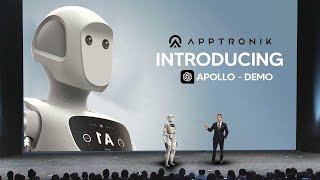
Apptronik's humanoid robot Apollo performed on stage with CEO Jeff Cardenas explaining the company's vision. Apollo will cost under $50,000 and target supply-chain and healthcare jobs, marking what Cardenas calls a shift from expensive industrial robots to a consumer PC-era for humanoids.
Chapters
Ladies and gentlemen, please welcome Apollo the Robot.
Hello, people.
How.
How is Austin treating you? Are you digging south by.
So this is going to be a video on the new Apollo robot. This is Apptronic, a company focused on developing humanoid robotics for a variety of industries. Use case. And this was something that I found to be absolutely incredible because they recently did a video, very, very impressive demo in which they showcased exactly what this robot can do. Now, I think you should all take a look at this because there is a lot of information on the future of humanoid robotics, not just from the CEO getting up on stage to give talk, which I'm going to break down in the next 20 minutes, but there was also a really cool demo in which they showcase just how crazy this robot is and exactly what it could do in terms of its multimodal understanding. Being able to speak. Now, one of the things you're going to see at the start is that this robot demo did actually seem quite similar to Figure's recent demo. But I'm going to let the presenter take it away for the next two minutes and then I'm going to break down some of the key features of Apptronic as well as some of the CEO's new statements.
Good job. Yes, amazing. Thank you. That was.
That's a.
That's a good one.
So.
So also Apollo has his own hero and he picked two that he's going to try to do with. So, Apple, are you ready in case.
There are any directors in the room? This is my first public acting performance.
Hello, I am Baymac, your personal healthcare companion. I was alerted to the need for medical attention when you said robotic nurse. On a scale of 1 to 10, how would you rate your pain?
15.
Physical or emotional?
I will scan you now. Scan complete. You have a slight epidermal abrasion on your forearm. I suggest an antibacterial spray.
Whoa, whoa, whoa, whoa, whoa. What's in it exactly?
The primary ingredient is bacitracin.
Oh, I'm allergic to that. It's a bummer.
You are not allergic to bacitracin. You do have a mild allergy to peanuts.
What makes you think there are settlements over there? Don't get technical with me.
What permission?
What are you talking about? I've just about had enough. I'm saved over here.
Hey.
Hey. Help. Please help.
Good job.
Was I good? Was I good? Did you like it?
Great job. You were amazing.
Super fun. Yemi.
Good job. Good job.
You enjoyed my performance.
All right, so this is Apollo the robot.
So essentially, if you aren't familiar with what you just watched there, the robot was actually imitating a few famous movie scenes from popular culture. Now I think that this was really, really cool because we got to see the adaptation of really, really interesting characters onto our new humanoid robot figure. And I guess that Apollo's new robot form is really, really fascinating in terms of what he's able to do. Now one of the things I really, really liked about this robot was of course the way how the mouth moved and just the humanness that this robot seems to have. I don't know whether it's the voice, the way it moves, the way its face is just so simple and inviting, but I do think that this robot is a little more pleasing than some of the other ones that just have simply a complete glass head. Because although I might be anthropomorphizing this robot, I do think that it does actually play into how people will perceive your humanoid robots and thus how they will perceive your company. I think it is rather fascinating because whilst robots might not have emotions in their current state due to RLHF or whatever fine tuning they that some of these companies may have opted to do, I think like I said before, it will be important for some of them to look and act in a certain way, whatever their target market may be. Now of course, if this just is just, you know, a robot for the warehouse, which it's just going to be completely dark, there's just going to be no walls or whatever, I guess these robots don't really need faces. But I think in public demos like this where they are going to be in human places, giving them a face like this one isn't that much of a disadvantage. Now this super, super, really cool demo here, it does seem as if it was rehearsed. In fact, the robot actually does say that they've been practicing this demo for quite some time. So I'm not entirely sure if it was some, you know, tele operated demo that was previously done before. And even if this is the case, and even if that was, I, I still think that it is a very, very impressive feat on what we have here because a lot of the robots that we do have, they do lack the capabilities of this robot. And I do think that the fluidity of this robot and once it's able to start moving as it can do, as shown in other demos, it's going to give us a really, really good look into the future of what is capable with AI systems. I mean, one of the things that I was, you know, asking myself after watching this demo Was that if this robot was fully autonomous and responding so quickly, within real time, then we would have a very, very shocking demo that I'm sure people around the world would start to realize that, whoa, we are moving into a very, very interesting era. So what I'm now about to show you is the moment that the actual CEO managed to get up on stage and, and the CEO is called Jeff Cardenas. And he actually makes a lot of fascinating points about robotics that I think you should all know, because there is a lot coming that most people haven't also realized. So take a look at this first point. The first point that he makes here is that he thinks that everyone will have a humanoid robot in the future. Quite like how people have phones.
The question will be, you know, what that robot looks like. I think there will be a Cambrian explosion of robots in the future. And you know, in the 90s, I think Microsoft was saying, you know, there will be a computer on every desk in every home. I think in the future there's going to be a robot in every home. Our target for Apollo is the price of a car. So sub $50,000 is sort of the price point that we're targeting. The company that I was most inspired by growing up was Apple. You talked about this in your talk, sort of leading in, but this idea of the connection of technology and humanity. I want to create products that make people feel excited to be alive and make people feel hopeful for the future.
Now, whilst future predictions are very hard to do, especially considering that according to some, we might be moving towards many, what many would call a technological singularity, I think his claim of everyone potentially having a robot isn't that far fetched. If we can factor in economies of scale, the potential of AGI and then after artificial superintelligence providing we don't kill ourselves and we manage to align it successfully, we could definitely get a lot of different technologies. And robots I think would be a very, very basic technology that might become as simple as a standardized household item that just does all of the tasks in our home for the price of a small car. Now, of course a small car isn't something that most people could easily access, depending on where you stand in the financial hierarchy. But I do think that the future where robots are readily available in maybe 20 to 30 years. And when I mean 20 to 30 years, I mean mass production. And I'm talking about they're literally everywhere. So this could be a future that isn't out of the scope of possibilities. I mean, we've seen some crazier things be said. And we all know as well that the future can change very, very quickly as long as technology is adopted as such. I mean, if we do look back in time, we can see 20 years ago the way how the Internet was and the way how certain technologies were, the amount of progress we've achieved in such a small amount of time and is really, really fascinating. And I think that that just goes to show how fascinating the future be now. He also makes another point right here, and he said that of course the timelines have shortened job.
The, the fact of the matter was, when we got started, you know, you get a lot of different advice when you start a company. Maybe the only consistent thing people told us was do not do humanoid robots. You know, get a real job that's going to take you back 50. But we had these dreams about what the future could look like and what we thought a special group of people could do if we put our minds to it. The way I kind of view life is like a relay race and you get the baton and you just run like, as hard and as fast for as long as you can until you get tired, and then you, you know, pass the baton off to the next generation. And so I, I'm still up for the race. I'm still, still willing to run, and we'll see how far we get.
Yeah. In this interview clip, he was basically being told that he shouldn't be pursuing humanoid robots because it would allegedly take around 50 years to get done. And that is, of course, like I said before, a testament to just how quickly technology can change the landscape of what is actually possible with the numerous inventions that do come. Remember, we, once technology is invented, it accelerates everything across all bounds. And it's just this exponential form of acceleration across all industries that you do get that allow for things to move this quickly. So I think him stating that, you know, at first people were stating that this is 50 years away, 100 years away. Why are you starting this company? It's pointless. And then in a relatively short amount of time, due to certain technological breakthroughs, the company is standing at the precipice of the singularity in which his company could be worth a sizable fortune, provided that humanoid robots are the main form factor of AI systems in the future. This goes to show how quickly things will move. Now, let me know if you do think that that is going to be in the near future, because with timelines, there is actually quite a lot of debates going on around with whether or not this will happen, whether or not that will happen. And I'm more on the side of humans aren't going to be able to predict what will happen. And I kind of think that it will surprise most of us, considering that Sora even surprised me and some of these AI systems have done so already. Now here's where he actually talks about the industrial revolution.
Well, the way to think about what's happening in robotics is think of this like the early days of the program personal computer revolution. Industrial robots, like mainframe computers, they're, you know, somewhat versatile, but they're these infrastructure heavy machines, they're very difficult to program, only a few people can afford them. And what we want to do in robotics is we want to shift into the PC era where we have general purpose platforms that can do a whole range of things that are much more versatile than they were in the past. The reason that I think people are excited about it right now is because of AI and because now it's possible to have all of the components that we needed to actually generalize the robot and make them affordable. So motors are cheap enough, batteries are cheap enough, dense enough, good enough, and I think we built one of them here in Austin.
So that is another point that he does talk about. Okay, talks about, you know, if you think about this, not like some different technology, but of course, if you think about it as the early days of the computer revolution, when they did say that, you know, computers are pretty much going to be in every single house, a lot of people did state that this was just a passing fad or passing fancy, whichever you may have, that, you know, people would eventually give up on. And of course this is something that we've seen to be not the case. We've seen that technology, once it is very, very effective and once it is, you know, widely adopted, it can be spread like wildfire. So this is why I do think that whilst there, yes, there is a lot of hype about human robots, I think we still need to take an open mind to this kind of future because I wouldn't be surprised that, you know, if, for example, AGI does get solved and let's say it's able to be put into certain robots, and I know that might sounded like a foreign concept a couple of years ago, but, but with Figure's recent demo, with some of the recent demos that are coming out, I do think that if AGI does get achieved, it does unlock a bunch of different things. And of course, humanoid robots in that form factor would be one of the key things that would really change the world because can you imagine a world where we have just hundreds and hundreds of humanoid robots doing many different tasks? The economy is literally going to speed up by maybe even 100x. I mean, AGI is exhumanoid form factor. That could be a really, really, really big game changer in how much progress we're able to make as a society. Because that is going to be an entirely new labor force that pretty much works non stop 247 and does it with remarkable accuracy and doesn't need any additional training. So that is going to be, you know, something that is quite hard for people to conceptualize. But, but every year the rate of progress will increase because things will get more efficient, they'll get better, they'll get faster, and of course they'll get cheaper. And that's what we've seen previously with other technologies. So that's why I think thinking about this like the Industrial Revolution is actually a very important thought exercise because it allows you to conceptualize just how crazy these robots could be if they do materialize.
Across the globe, people were afraid of trains. There was these myths that if you went too fast you could like scramble your brain. People were afraid of electricity and people were certainly afraid of computers. This whole sort of jobs question was a big topic around computers and people really fought them in the early days. We're facing major labor shortages where if every unemployed person got a job tomorrow, we'd still be short millions of jobs. And that's not something that's going to get better, that's actually something that's continuing to get worse. I have these dreams of Star wars where, you know, the robots help to support life and I don't. I think if you look into the future, maybe 10, 20 years from now, I think it will be hard to imagine your life with.
Yeah, this is where he actually discusses fear because at the start many people were in fact afraid of trains. They were in, you know, pretty much afraid of planes, afraid of helicopters. People really do fear change, especially if it's a monumental piece of change that is happening in their lifetime. And it's not like we haven't seen some people fear AI. Now, whilst I do think that artificial is a completely different reason, because of course artificial intelligence could potentially replace some humans in certain roles and, and shift the economy to where certain people don't particularly have status anymore. Which is quite unnerving and quite confusing and quite worrying for many people, including myself. I think that this kind of change is a little bit different in the sense that if it is deployed correctly and it is managed effectively, it does have the possibility to provide abundance for everyone. However, it is much easier said than done. Done. And if history does repeat itself, it seems like we could be heading towards a detrimental future. Unless there are some strict, strict policies in place to ensure the benefits are widely redistributed and done so in an effective manner. So it will be interesting to see how this future is shaped. And of course, like I said before, this is something that many of us are going to struggle to predict. And even if we do take a lot of our time staring at these pieces of information and keeping up to date with this stuff, problem is is that singularity, nobody literally nobody knows what comes next. And that is even some of the greatest technologists biggest problem. Now in addition to here, he talks about the NASA robot that they did work on and they talk about the pricing of the Valkyrie robot.
Valkyrie was a $5 million robot, weighed 300 pounds, it was 6 foot 2. And the goal was to get to an affordable sub $50,000 robot that could go from the lab out into the real world. And so we started the company, we had no money, we just had big dreams about what we could do and we were willing to work hard for it. And so we've done 13 iterations of robots, we've done humanoid robots, Iron man suits, mother mobile robotic arms, we've done eight iterations of humanoid robots, 40 iterations of electric motors, all to get towards Apollo. And we have about 100 person team here in Austin. And it feels like we're really just getting started.
Yeah, you can see here that he basically says that they are just getting started. And he talks about, you know, using economies of scale to eventually reduce the price. And yeah, this is where he talks about how the pricing of the original first gen robot was rather very expensive. And I think it just goes to show how crazy this level of technology is. Because one thing, if you do know about human robots and you've been looking into them, and if you've been looking to acquire one, you know that they are very, very expensive. There's recently a humanoid robot I think that was on the market for $250,000, around $80,000 on the cheap end. And that actually is the price of, you know, a mid engined sports car with or a very high end supercar. And that's not something that your average everyday person can drive. Especially if you just want it to, you know, lazily do a few tasks around the house. I'm sure there's a better way for you to spend that much amount of money. Now, Amazon have actually been spending $250,000 per agility robot to, you know, help their companies move more effectively in the warehouses. And apparently that is somehow cost effective. I'm not sure of the economics of that, but I'm guessing since it works 24.7non stop and can have replaceable battery packs on them, I'm guessing that a 24,7 employee must somehow be more efficient than the one needs toilet break. I have no idea. The point is, is that the pricing, of course, will come down and this is going to be something to look forward to in the future.
Gerardo poured his soul into this robot and he died before he was able to have kids. And so she said, you know, this will enable him to live on. We're pouring our hearts into these robots and we're trying to make them good and we're trying to really think intentionally about what the robots are going to do, how we should design them, how we'll communicate with them in the future. Apollo will start in the supply chain and that spans every industry. And I think everybody experienced this during COVID Covid is that we've got major challenges in our supply chain. But then working in retail and where my dream is, where Apollo ends up, and I talked about this at the beginning, but is in healthcare. I think, you know, we're going to be short millions of nurses. The question is, what is driving people out of these industries, what don't they like about their work? And how can you pair a robot with a person so the robot does the worst part of the job and then you can elevate people to do new types of work and new types of ways.
I think this one as well was one of the best parts of his entire statement because this most likely quells many people's fears and theories about AI taking away your jobs. Now, whilst, yes, that might just seem like something that the CEO could say in order to quell people's fears, I think it is an important discussion to start because of course many people are unsure about their role in the post AGI economy. And that's something that I actually talk about quite a lot on my second channel called Post AGI Economics. And I think it's really important to talk about because if the future is going to change quickly and you know, it's very hard to predict, it makes sense to at least do some kind of planning so you aren't left, you know, in the desert, just standing out in the rain, just in a very confused position. But the point here is that he talks about how Apollo will most likely be put into healthcare, and if not healthcare, it will likely help in supply chains and, and it's going to be essentially a robot that is going to be doing the worst parts of a job. So it's going to be automating parts of manual labor that people most likely find. And I think it will be interesting to see how these robots actually start to get implemented. And if these robots do start to shift the economy in a meaningful and an impactful way, and of course, if they do start to increase productivity, I mean, we've all seen movies of robots that are able to do crazy, crazy things and we've seen like robot factories where there's these humanoid robots that are able to run the economy, be shopkeepers, do just a million different things. But it will be interesting to see when these economic benefits start to, you know, I wouldn't say recursively self improve, but that cycle of accelerating returns start to really, really, really ramp up. And of course I do think it is at the level of where AGI does get discovered and widely spoiled. Now let me know what you think about the Apollo robot. Do you think that this robot is just a fad? Are you worried about this robot taking your job and potentially leaving you out of a sport in the post AGI economy? Or do you think that this is something that is very, very, very far away from actually working and this is just another hype train? I for one am truly excited for this technology because I believe that if we, we do get it right, the possibilities for an abundant future are really great. Right now, of course, we do have to manage exactly.










