Apple Shocks Again: Introducing OpenELM - Open Source AI Model That Changes Everything!
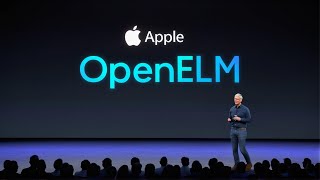
Apple released OpenELM, an open-source language model that's 2.36% more accurate than its predecessor while using half the training data. The model runs efficiently on Apple hardware like the M2 Max, and Apple published the full weights, training logs, and setup details, a rare move for the company.
Questions this video answers
April 25, 2024.
2.36% more accurate.
Reported to use half as many pre-training tokens as Olmo.
Layer Wise Scaling.
GitHub, Wikipedia, and Stack Exchange (among others).
Chapters
In an unexpected move from Apple, a company known for keeping its projects under wraps, it has introduced its latest venture in AI, OpenELM. This new generative AI model represents a big change in Apple's approach, showing a new willingness to be open and work with others in AI development. OpenELM is not just notable for being open, but also for its technical achievements. It is reported to be 2.36% more accurate than its earlier model Olmo, and it achieves this while using only half as many pre training tokens. This boost in efficiency and accuracy indicates that Apple is making significant progress in AI aiming to really make a mark on the industry at its core. OpenELM is a state of the art language model developed by Apple's team of researchers. It leverages a method called Layer Wise Scaling which optimizes how parameters are used across the model's architecture, allowing for more efficient data processing and improved accuracy. This is a big change from older models that spread their settings evenly across all sections, which makes OpenELM smarter and more flexible. The model has been trained using a wide range of public sources like text from GitHub, Wikipedia, Stack Exchange and others, totaling billions of data points. Thanks to this thorough training, this model can understand and create human level text based on the input it gets. It also comes with a complete set of tools and frameworks for further training and testing, which makes it very useful for developers and researchers. Now what makes this model stand out is that Apple has chosen to make it an open source framework that you can use for both training and evaluating the model. Usually companies just give out the model weights and the codes needed to run them. OpenELM goes further by including training logs, several checkpoints and detailed setups for pre training. This openness lets users really see and copy how the model was trained, which helps everyone do more open and shared research. When it comes to training the model, OpenELM uses some smart strategies to make the most out of the computer power it has. For example, even though it uses fewer pre training tokens than other models like Olmo, it still manages to be more accurate. It does this by using clever methods such as rmsnorm for keeping things balanced and grouped Query Attention, which both improve how the computing works and boost the model's performance in benchmark tests, OpenELM has shown that it's more accurate than other language models. For instance, it's 2.36% more accurate than Olmo even though it uses half the pre training tokens. This success is due to a special technique called Layer Wise Scaling which adjusts the settings in each layer of the model to improve its performance. The effectiveness of the model is also clear in various standard, zero shot and few shot tasks where OpenELM consistently does better than other models. These tasks check how well the model can understand and respond to new situations it hasn't been specifically trained for, which is really important for how it's used in the real world. Understanding how well AI models like this work in the real world is critical, and that's why benchmarking is so important. Apple did a thorough performance analysis to see how it stacks up against other top models. This kind of testing helps us see how fast and accurate the model is, and it provides developers and researchers with important information to make the model even better. Apple has made OpenELM work well on both the usual computer setups using CUDA on Linux and on Apple's own type of chips, showing that the model can be used in different ways. Tests have found that this model is more accurate than similar models like Olmo, but it's a bit slower because it uses complex methods like RMS norm to check its calculations. This balance between being right and being fast is important for Jobs, where you really need to trust the results more than you need quick answers. The model has been tried on various hardware setups to make sure it works well in different situations. For example, OpenELM's performance on Apple's M2 Max chip is a good example of how Apple makes sure its software works well with its latest technology. The use of bfloat 16 precision and lazy evaluation techniques on this chip make sure the system handles data efficiently, showing that Apple's hardware is used well. OpenELM's design lets it manage its parts very finely. Each part of the model can be adjusted separately, which makes the best use of the computing power available. This approach not only makes the model more accurate, but but also lets it handle different kinds of AI tasks better. During tests, it was clear that while this model's special use of RMSnorm helps it be very accurate, it also slows it down. Because of this, Apple's team is planning to make changes to speed it up without losing accuracy. They want to make the model faster so it can be useful for more kinds of jobs. Apple thoroughly tested OpenELM by having it complete a variety of tasks, from simple ones that it could handle right away to more complex ones that involved deep thinking. It went through tough tests where it had to understand and answer different questions, just like how we use AI in real life for things like digital assistants, analyzing data and helping customers. The tests Also looked at how well Open ELM worked with Apple's own MLX framework. This framework lets you run machine learning programs directly on Apple devices. By doing this, the need for cloud based services goes down. Which is better for keeping user information private and secure? The detailed evaluation of the model showed that it's a strong part of the AI toolbox, giving clear information about what it can do and where it could get better. Apple made sure to test it in many ways and settings to confirm that OpenELM is not only advanced, but also dependable and safe for different AI uses. Apple also made it easy to add the model into current systems that developers use. They released code that lets developers adapt openelm models to work with the MLX library, which is part of Apple's machine learning setup for their own chips. This makes it possible to use the model on Apple devices for tasks like inference and fine tuning, taking full advantage of Apple's strong AI capabilities without always needing to be connected to the Internet. Running AI models right on devices like phones and IoT gadgets is a big deal. It's really useful for when it's too much hassle to keep checking in with the server. By processing data locally, devices respond quicker and keep your personal information safe, which is super important these days. OpenELM is great for this kind of stuff because it's smart about using the limited space and power these smaller devices have. For developers making AI powered apps for Apple products, this local processing is key. It lets them put powerful AI capabilities into everyday gadgets, from phones to home tech, making them smarter and faster at making decisions. OpenEl M was put through its paces in real life settings, tackling everything from simple Q and A setups to more complex thinking and talking tasks. It wasn't just compared to other language models, but also check to see how well it works for what typical Apple users need. Continued efforts to benchmark OpenELM show where it excels and where it could be improved. Apple's open sharing of benchmarking results is really helpful for developers and researchers. It gives them the information they need to make the most of the model's strong points and fix its weaknesses. The detailed process of benchmarking, which tested different setups and conditions, has helped us understand how the model performs under different pressures and workloads. This information is especially important for those who want to use this model in critical settings where it needs to be both strong and reliable. So we can say that Apple's new AI model is a big advancement in the AI field, providing an innovative, efficient language model that is more accurate and flexible than many older models. By openly sharing its training and evaluation methods, Apple is helping to make AI research more accessible to everyone. This can lead to more advancements in the field. So while OpenELM is already performing well and is very adaptable, the company is working to make it even faster and more efficient for developers, researchers and businesses. The new model is a powerful tool for using AI on the devices that millions of people use every day. Alright, don't forget to hit that subscribe button for more updates. Subscribe thanks for tuning in and we'll catch you in the next one.










