B-Team Jiu Jitsu: Craig Jones, Nicky Rod, and Nicky Ryan | Lex Fridman Podcast #363
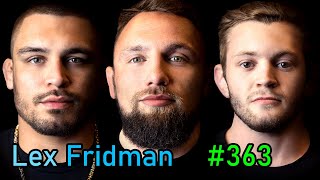
Craig Jones, Nicky Rodriguez, and Nicky Ryan of B Team Jiu Jitsu talk competitive grappling, injuries, and their split from the Danaher Death Squad. Nicky Ryan left school at 15 to train full-time. They discuss ADCC wins, an EBI match against Gordon Ryan, and a spiral fibula fracture that nearly ended a career.
Questions this video answers
Two (two-time ADCC silver medalist).
Brown belt (no stripes).
Spiral fracture of the fibula (from a heel hook).
Around 15 (dropped out after freshman year of high school).
Chapters
How would a kangaroo attack a human?
Knock them down and then they choke him?
The kangaroos, do they choke each other? Yeah. They don't choke each other.
You don't believe me? You want to watch a video? They check each other out.
I've seen this. Yeah.
I mean, probably the most annoying one was obviously the one where I had Gordon Armbar. I was like, tap, bro. And he wouldn't tap, so I let him out.
I didn't get surgery. I didn't do essentially any rehab. I just have no ACL in my left leg.
So what's it like having no surgery?
Guys, you've got two options. Surgery, rehab, Nikki goes, I'll do nothing. Yeah. I mean, what could possibly go wrong if you're the world's best grappler, hates you and you're gently provoking him behind the scenes every day? Well, I mean, in Texas, and you've stolen his brother, held him for ransom.
It is like a story of a shitty western.
The last part of a difficult weight cut for me is I try to find a sad movie and at least cry about a pound out. That really gets me over the line.
What are the rules in the streets?
Do you think you're on steroids? He would have finished the choke.
I, I mean, for sure.
Who knew that the cure to the Dagistani wrestling were the Aussies?
The following is a conversation with Craig Jones, Nikki Rod and Nikki Ryan, who together with Ethan Kinston and others make up the B team, a legendary Jiu Jitsu team here in Austin, Texas. It was formed after the so called Danaher Death Squad, the team headed by John Danaher split up into New Wave Jiu Jitsu and B Team Jiu Jitsu, both located here in Austin, Texas. There has been a lot of trash talk back and forth including accusations of greasing and steroid use. And I, as a practitioner and fan of grappling Jiu Jitsu and martial arts in general, am here for it to see the best grapplers in history go at it both on the mat and on Instagram. I like the people on both teams and train with both and am really happy to see the exciting rapid evolution of the sport that these athletes and coaches are catalyzing. This is the Lex Friedman podcast to support it. Please check out our sponsors in the description. And now dear friends, here, here's Craig Jones, Nikki Rod and Nikki Ryan. Craig, can you introduce everyone?
Yep. So we got Nikki Rod here, brown belt, two time ADCC silver medalist, Nikki Ryan here. That's it.
Who are you?
And I'M Craig Jones, also two time ADCC silver medalist.
Silver medalist. So the number one loser. Number one loser and maybe a little bit more. Your bio says widely known as the black belt Slayer hails from New Jersey, the land of pizza and biceps.
Ah yes, that's pretty accurate.
Okay.
You also do carry gun on you a lot.
Yeah, I keep, I keep it, keep it loaded, you know. Keep it on me.
Huh. You have one today in the car. That was a mistake. It was your first mistake.
Yeah. I think you're too close.
Very uncomfortable. And you are? Nikki Ryan. What else is there? What else do we know?
Gordon Ryan's brother.
Gordon Ryan's brother.
Waiting for that one. All right, so.
And you're all together part of the leadership of the, the B team here in Austin. Let's just get out some introductory questions. What in general accomplishment of the things you mentioned you're most proud of?
I mean I'm proud just to not have to work a full time job just to get by on the bullshit I've done so far.
Yeah. Honestly just making money of a thing you love.
Exactly. Yeah.
When was the first time you made money on a thing you love?
Probably a jujitsu tournament. I think maybe in Abu Dhabi where I won a thousand dollars. Thought I was rich.
Yeah. Yeah. Would you spend the thousand dollars on.
Probably something bad, probably drugs or something at the time. Maybe blew it at the after party.
That's a good introduction to Craig. So what about you? When's the first time you made money on Jiu jitsu or what? What's actually stepping back like what's the thing you're most proud of? Is it a similar kind of thing?
I think, I think I'm most proud of is, I mean for sure two ADCC silver medals, which hurts because you're so close to getting that gold. But you know, it takes time. I'm understanding that, you know, sport of Jiu Jitsu takes quite a while to be at the tip top, to be the absolute best. So. And I'm just being consistent in my training and my craft and I'll get that number one spot one day.
What failure or loss is the most painful to you?
I don't know. I could have a pretty short term memory. So my losses, I just like I'll just forget about them. Yeah, I mean for sure my loss at, at this past ADCC in the finals, you know that one sung a bit because I definitely thought I, I was going to win. I mean like it takes a while to produce the skills or the reactions more so that you need to, to have to be, you know, to be that number one pound for pound guy. And you know, pre adcc, I was coming off of injury, so it took me a little bit to find the right mentality and physicality that I needed in order to, you know, get the wins that required gold. So yeah, it's just process.
Interesting. You keep saying process. Like it takes a while to build up. So you're not like thinking of a loss like ADCC is like a specific failures. You're not, you haven't gone long enough in a particular process to being a champion.
Well, I mean, for me, I'm coming, I'm closing in on five years of specifically jiu jitsu training. I'm about, about four and a half right now. And yeah, it's just you kind of, you constantly have these ups and downs in training where like, as long as you stay consistent, you'll have a gradual raise. But you know, it's still, you have these peaks and lows and you know, just, just trying to get better every day. I'm, I'm definitely not where I will be in, in a few years, in a few years from now, but I'm striving to get there.
Are you actually a brown belt? Was that a joke?
Brown belt?
Yeah, you're a brown belt. Like how many stripes?
No stripes.
No stripes.
Stripless.
Okay. Is that part of the process that you're working through?
Definitely part of the process. I mean, I think a black belt is just based upon how much knowledge you have. Obviously, like, you know, if you're talking competitive wise, like from when I started, I was able to beat most black belts. That's just kind of how I was gifted from my, my wrestling experience and you know, the time will come when it's right. But I'm not in a rush at all. I'm continuing. I just kind of take every day for what it is and, and try to improve upon that.
I mean, I want to give him the black belt. Nikki Ryan says he's not ready.
What is, are you guys like, there's no geek, folks. Do you take that seriously, like the black belt or like how much does it come into. Play into?
Yeah, I mean, it's like Nikki Rod said, you know, it's based off of knowledge, not just, you know, what you do out on the competition mats because, you know, like you said, he had years of wrestling experience and obviously he's very physically gifted. So we grade based off of the am of knowledge that you have.
Like how do you measure knowledge I.
Think teaching is a good measurement of it, like, how well you're able to show the moves and, you know, really make sure that you have an understanding of what you're doing.
Yeah, it's an interesting rank. It's like, it's something that takes many years to accomplish, and for a lot of people it's truly meaningful. It's like, it represents a particular step in a journey. But for you guys, it's almost like different because you've been so focused on competition that I guess if you take it seriously, it is a big step for you too, like, as martial artists. That, that's bigger than just being like top of the world competitors. Right. So I thought it was a joke. You guys are actually taking it seriously.
Like, that he's a brown belt.
That he's a brown belt and he's. And you're taking seriously the rank of black belt and like, it's part of, it's part of your journey.
I think by the time I get a black belt, I'll be no more. Pound for pound. I think it'd be pretty nice to accomplish that as a brown belt and then maybe toss a black belt on.
Top, maybe get promoted on, on the podium. What do you guys. Do you love winning or hate losing more?
I definitely don't hate losing. If it pays the bills, I don't mind.
Oh, really?
Yeah. But honestly, if I win, I feel more relief than anything rather than like, excitement and stuff. I'm like, oh, fuck, thank God that's over.
You know, I hate losing for sure, but I understand that it's necessary to get, you know, to get. Get to where you want to be. And then winning is like. I mean, what. I think winning is probably the closest you can think you can get to like, heroin or something. Because, I mean, we're on a. Like, if you do have extreme success in a torment that you've been, you know, adamant about training for and, and competing in for a while, and you end up winning it. I mean, I feel like you're on that high for days at a time afterwards.
Heroin's got to be better.
You think so? I'm. I'm a stick with no, but I'm.
Not going to suck dick to win.
You suck that for heroin.
Okay.
I guess that's a good point.
Yeah.
But, you know, like, because you, you come from a little bit of the wrestling culture, one of the things I really love is at the end of the match when they lose, they just, there's no, they just run off. They're like Almost pissed off. It's like some mixture of anger and frustration at themselves, I think.
I think sometimes that people like freak out on the mat and I think that's just a. To show everybody like they're acting like they cared a lot and really maybe they didn't work enough to, to, you know, get to where they want to where they expected to be. And they lost and then they had this big boost of emotion like after their, after their loss. But yeah, I mean, I think you just cry in the mirror, not to everybody else.
You know.
What?
Have you ever cried watching a movie?
I don't think I've ever cried, period.
Okay. Have you cried watching a movie?
Not yet. Not yet.
The Notebook.
I try to avoid those, actually. I lie, actually.
Titanic.
The last part of a difficult wake up for me is I try to find a sad movie and at least cry about a pound out. That really gets me over the line. Low energy. Cutting the tears.
There's other following liquids I could talk to you about, but let's just, let's just continue on.
Low energy.
What about you, Nikki? Love of winning versus hate of losing.
I'm a very competitive person, so I for sure hate losing more than I like winning. I do think it's something that's kind of held me back over the past few years because it makes it so that I'm not as active as I should be because it's like I really hate that feeling of, you know, after a match that you just lost. So it kind of prevents me from competing. So it's definitely something I need to work past.
So, like, when you think about a competition, the possibility of losing, which is always there in competition, is the thing that like weighs heavy on you in the months and weeks leading up to.
Yeah, my whole life, you know, my financial stability, everything depends on, you know, my ability to go out there and compete and my ability to teach. So, you know, it's, it's a huge hit to the brand if you lose. So, you know, leading up to matches, that's, that's definitely something that's in my mind.
I know. So you guys are like world class athletes, but for me, more like a hobbyist competitor. I compete a lot. The thing I was, because I really wanted to win, the thing I was probably most afraid of is not just losing, but like embarrassing myself.
Yeah, even.
Even actually winning by stalling. That was the thing I hated the most about myself in terms of crying in the mirror. It's like being too afraid to take risks. After I'm up on two Points or something.
I think you got a competition. Sometimes it's good to take the emotion out of it. It's too easy sometimes to like think about all my girls and in the crowd, my family's watching, like I want to win because they're there. Uh, but at the highest level, if you're emotional at all, no, that's affecting you.
Yeah. That's tough though. That's tough. Especially like leading up to when you're on the map maybe, but leading up.
To it, I think it's okay to be emotional prior. Like, you know, if we know ADCC or is coming up and we have a big match, like definitely I'll go out in, in practice and I'll, I'll visualize, I'll put myself in that competition. That way when it's game time, it's like I've been there a thousand times already.
So not the actual competition, but even leading up to it, like stepping on the mat, like all the walk, the walk towards it, all that, all that stuff.
Like I'll do the same exact warm up for weeks on end until my competition day comes. That's way that way. You know, when I compete, I'm just like, oh, it's another Tuesday at practice.
What about you, Craig? How do you prepare mentally for a tournament like adcc?
I push it completely out of my mind. Don't even think about it. Try to avoid any visualization, any rituals, warmups, anything like that. Block it out until the last second. Yeah, Try not to think about it. I just go to training to have fun, learn a bit. So I try to approach competition the exact same way. I don't warm up at training. Do very little warmup for competition.
Uhhuh. And you just step on the mat.
Step on the mats. My philosophy is there's no warmups on the street.
We're so vastly different.
All right, so you like legit don't warm up?
No, I probably should now I'm 31, but I would just like in the gym, take it easy the first round, you know, like if I look around the room and Nikki Ryan's down, I might go. All right, we'll have an easier first round today.
So even for like the most high stakes matches, you try to push it out.
Yeah, I didn't even think about it.
What about like all the social, like Instagram posts you have to do about that match? You just make a joke out of it and kind of.
Yeah, I mean, kind of pretty silly, you know, we're just wrestling each other, you know. Yeah, we Put the meaning into it. But to someone that doesn't follow the sport, it looks stupid.
Well, all of human existence is pretty silly. Like, what are we doing? None of us really know what's going on. We kind of have sex to reproduce. We get hungry, we eat, and then we're all chasing money and cars and whatever the hell in a capitalist society. Or we worship a dictator in a authoritarian regime. Yeah. And then we'll get off on. We let power abuse us, and then we just murder others because we get off on it. Yeah. And then eventually all of us will die because the sun will run out of energy because colonizing other planets is very difficult. So none of it matters. It's a good, good philosophy. It's pretty. Pretty good.
That's exactly what it is.
How does the sun run out of energy? You caught me there.
It's burnout. It's like it's a nuclear fusion engine that eventually burns out.
Like, when you get tired of training.
Yeah.
It's never happened. I try to get tired. I was like, dude, it's not working.
All right, cool.
So you legit don't care about losing? It doesn't weigh heavy on you?
I try not to list. Like, if I win, I try to block out all the compliments, all the niceties and stuff. So I try to do the same with losing. It's happened. Move on to the next one. You know, don't dwell on it too much.
And sometimes make a joke out of it.
Yeah, exactly. Winning or losing, with the right joke, we can make money off of the event that's just transpired. That's what's most important.
Excellent. Thank you. I have a bunch of your merch.
Oh, nice. This one's the Jordan Burrows ripoff.
All I see is silver. The way pronounced Burrows is very, very sexy. Okay.
I throw lines at people, and I try to gauge their action. Like, sometimes I'll say something, Nikki, and I'll be like, all right, that's probably crossing the line. You know what I mean? We'll tone it down to the public.
So. Yeah. Yeah. So it's not just right. You have to think is. It's crossing the line.
Yeah, yeah. I get as close to it as possible.
Yeah.
I feel like you can't really.
And then cross it. Just. Just a little bit.
Just a little bit. Yeah.
Okay. Speaking of which, you said that I'm Switzerland in World War II. Since I'm friends with both you and Gordon and John.
Very rich country.
Are you a Hitler or Stalin, by the way? In this analogy, would you like to be Hitler or Stalin and should you make a T shirt out of it.
Or I mean a Nazi T shirt? I don't know how well that sells.
I think it would, you know, I think. Let's brainstorm on this one. Offline. I think since Hitler lost, so he got second place in World War II.
That's true, that's true.
I think that makes you Hitler. Anyway, to the degree that you can, can you tell the story of how the time you've had with the Danaher Death Squad and why you split up?
I competed against Gordon for ADCC and EBI in 2017. And I remember I competed against him at ADCC and then we had the EBI event and then I had a Kasai. I used to compete all the time, every week. I wouldn't even do the preparation or anything. I'd just be like trying to do seminars, make money and then jump in and compete. I remember I showed up to Kasai after I faced him twice and there were like four locker rooms and they put me with all the DDS guys. It was just me and all of dds and I think we competed the week, weekend before. So I thought it was going to be super awkward, but it was actually, it was actually pretty chill. And the Kasai was in New York and they suggested to come train that week. So I came, trained, hung out with them a bit. Ultimately the goal was to move to America and join a bigger team. Just because that flight to Australia is death. Australia is so far away from everywhere. It's kind of like not realistic to base yourself in Australia when all the tournaments are in America. And then I went and trained with the guys and they just had a massive, massively deep talent pool in that room. Like show up to like a meant to be 7am Actual 8am Class on Brazilian time. And there'd be like a 100 people in there, maybe I don't know how many black belts, but a ton of elite guys. And I was coming from Australia training with Lachlan Giles, but really that room was pretty shallow and like most people had serious jobs and stuff. So it was like basically me just training with Lachlan, maybe a couple of other guys and then to go to New York and have access to a. A wide array of training partners and guys that are training twice each day. I feel like that's what you really need. You need people that can train as much as you are.
Yeah, humbled. Humbled in that room at first for sure.
Because my style at the time was basically a rip off version of what they were doing. Yeah, leg locks came in. I remember just watching Eddie Cummings nonstop and just seeing this guy rip people's legs off and I was like, you know what? That's probably a good move. You know, that looks like an easier path to victory than trying to beat these guys at what they. What they're good at already. You know, my philosophy at the time was if it's bothering old Brazilians, yeah. It's bothering them for a reason. It's probably effective. And that's the path I took to sort of try to rip off their moves and then obviously to go into that room, try to do them to them. It's going to be a bit more difficult.
All right, so that's how it started. How did you end up here?
How do we end up here?
We're in Austin, Texas.
I mean, I like to think of Puerto Rico as Apocalypse Now. John Danaher as Colonel Kurtz. Things got very weird in the jungle and the teams went into different directions. But honestly, I mean, it's not really my story to tell. I had some issues with some of those people at the time of the split. I got along very well with John. I feel like me and him connected very well. I don't know why that was. Maybe it was just because of the. He missed home. He missed a familiar accent. Australian, New Zealand accent. But I mean, I basically followed Nikki, left with Nikki, sort of that core group of guys left with Nikki. And I mean I just back there was personal problems and I just backed Nikki basically.
Got it. Just sticking on you for a bit. Is there a part of you that, you know, finds it heartbreaking that DDS split up? This part of you miss working with John and everybody. Now can you steel man the case for that?
I mean, I miss certain aspects of it, but I also do prefer the freedom of being apart from it. It's obviously a very strict regime under John Danaher. You know, obviously there's parts of it I miss. The parts the. The public doesn't see of John. The behind the scenes banter. I feel like he's very conscious of the image he portrays to the world, but basically a closed doors. He's always making jokes, always finding, I guess more in line with the Australian Kiwi sort of culture. But you don't really see that in the public eye. So that perspective. I do miss that relationship with John in terms of setting aside personal differences. Gordon was a good training partner, definitely a good training partner to train with. But obviously the negative things we can't really talk about outweighed all of those things. And we obviously had to make a decision to leave.
Things that happen in the jungle.
The things that happen in the jungle.
Shall never be spoken of.
That I personally cannot speak of. Yeah, but obviously I do miss certain aspects. Like, I mean, not. Nothing's all bad, nothing's all good, you know?
Yeah, this goes back to your. Like, everything we're doing is silly.
Yeah, exactly. That's why I don't get. People take it so serious. Martial arts. So serious. It's just. It's just pretty stupid, really. Especially in the gi. It looks just. It looks bad.
And then, I mean, it's pretty silly with. With and without the gi, it's just a bunch of apes.
What's silly about no gi? And what's silly about the gi and just mixed and matched bottoms there, you know what I mean?
Wait, which one? Sam, I see what you're doing, brother. You come to my house and offend my people.
All right.
This is. We're gonna go to every dark place, apparently. Nick, how did you get with dds? Like, what was that journey like? Is there. Try to see if there's things that you remember fondly that. That you've gotten from the experience. All right?
So the way I started training with dds, initially, I was training for, like. Well, initially I was. I was a bouncer, right? I would. I dropped out of college to pursue this fitness modeling career. I ended up signing with a Wilhelmina Models up in New York. And I was, like, trying to get in better shape. While I was bouncing, kind of the talk of, like, you know, who's tougher came up between the wrestlers and a few of the bouncers that trained jiu jitsu, and, you know, they convinced me to go to a practice and. And I went my first practice over there, and I, for the most part, I just controlled everybody, got on top of them, was able to avoid, like, kind of like, you know, shitty submissions because I had. I had an awareness of the sport, and, you know, I'm a fan of fighting and whatnot. So, you know, I kind of understood it pretty well. And then soon after that, I joined a school, and my second week of Jiu jitsu, I started competing. Had pretty good success. You know, I was, like, subbing a few black belts and beating everybody, like, you know, pretty decisively with points and stuff. And about three months into training locally, I got connected with Gordon, Gordon Ryan and John Danaher up in New York, and I started. I committed to, you know, make the drive up there as many days As I could at the, at the time I lived in South Jersey and it was about two and a half hour, three hour drive without traffic to New York.
Where in South Jersey?
Gloucester County. Clayton, New Jersey specifically. But Gloucester County. Yeah, so it's about, is about, about 130 miles and without traffic, you know, about two, two and a half hours or so. But on the way back, man, we, it'd be three plus sometimes, you know, catching that R shower.
What year was this? Do you remember?
This was 2018 for a bit.
I forget how young you are. Yeah, I was there before, before all that. All right, cool. Anyway, you're doing the long drive and then. And then. And then what?
Yeah, doing the long drive and then, you know, once I won ADCC trials, I was able to make a couple bucks and then, you know, I got my silver medal at ADCC and I was able to afford to live up there in New York and North Jersey area. So I lived up there, trained there full time every day and you know, just kind of sucked with the team throughout, throughout the turbulent times and found.
Ourselves in Austin in the jungle. In the jungle with the things we shall not speak of. What, what are there things that you remember that you've learned from John Donahue, from your time you spent with him?
Yeah, I mean I definitely learned a ton from, from John and the team as a whole. Like, you know, it's, you have to be the guy that asks questions in, in that type of environment. Right. Because there's not, it's not, you're not going to get singled out to be that star or the, the best guy in the room when you have all these other, you know, stud athletes. So I really had to seek out and, and figure out the kind of questions that I needed to ask. And once I became a bit more verbal with my training and you know, I, I'm showing, I'm, I'm expressing all my curiosities about grappling to these guys. Definitely help boost my, boost my technique and my career as a whole.
Yeah. Did you understand what kind of stuff? Like technically you want to get good at what fits your body. What, like what would be good for you, what are your weaknesses and all that.
So initially when I started grappling, I had an innate ability to just get to opponent's back. So I was like, all right, I'm good at getting to the back. Let me get, let me perfect controlling the back and then submitting opponent via rear naked choke. And then besides that, I really focused on leg lock defense. And then eventually Came the Roddy Lock pass where, you know, I'm really good at body lock passing my opponents now and then. And yeah, it just takes a quite a long time because you have to find different sequences and then there's always these. An abundance of opportunities that your opponent gets from these specific sequences. So. Takes a while.
Is there part of you that finds the fact that dgs split up heartbreaking?
I definitely, you know, having one person to go to that runs practice every day that's, you know, consistent. It was definitely, it was definitely, definitely a gift. But now I'm also gifted with many, many other partners. I have Nikki Ryan, you know, Craig Jo, Jonesy.
Jones.
Yeah, yeah. We have Ethan Krellisi and Damian Anderson. So a full team of knowledgeable athletes that I can continue to go to with multiple questions. But yeah, definitely, definitely it took me some time to adjust to, to training or to learning from, you know, specifically my team and not just one person.
We should mention for people just listening because you can't visually see that Nikki Ryan is currently terrified and Craig Jo currently enjoying the practice. Anyway. Can you talk about your Nikki, can you talk about your time with DDS?
I started training when I was like around 13. You know, my brother Gordon had started prior to me, and I really just went into training just as like a means to exercise and lose weight at the beginning because I was pretty fat as a kid. So I went to the first class, loved it. And then just started training every day at Gary's Gym, Brunswick. And then during the summer when I'd get off from school, they would take me up to New York to, to train under John. And, you know, I just absolutely loved it. I knew what I wanted to do with my life at a young age. So I ended up dropping out of school actually after my, my freshman year in high school. So, yeah, 15, I ended up dropping out and just pursuing Jiu jitsu full time. You know, training every day up in the, the blue basement.
Like what aspects of jiu jitsu was made, you know, that this is the thing for you.
It was just something I just enjoyed being, you know, like on the mats every day. I love that there's, you know, a problem solving aspect to it. So it's, you know, it's mentally challenging, it's physically challenging. Helps me get in shape. So I just, yeah, right off the bat I knew I loved it.
Okay, so then we'll go to the jungle. What happened in the jungle? Yeah, and in general, like.
I like this.
I like this. This is like this, like shroud of mystery that shall never be penetrated, that should never be.
Like, we've got a book deal, it's coming once, obviously he left high school, he's not riding it.
Okay, I'll do the Russian translation.
Okay.
So what are, what are things that you enjoy that you remember from working with John Donaghar?
Yeah, I mean, you know, obviously he's considered one of the best coaches in the world. You know, very charismatic guy when you see him in person. You know, I pretty much was, you know, kind of raised in the dds. You know, that's where I spent the, the majority of my time every day. So I obviously had very deep connections, you know, with John, my brother Gary, you know, even Eddie Cummings and stuff back then. So obviously I miss interacting with those guys every day. And you know, it's like they said, it's, it's good to have somebody to kind of crack the whip at you every day. And John, John was very good at that.
When you're like younger in your teenage years, you can kind of, you like have to get humbled, right? There's like a process to that.
Yeah, for sure. And it's a pretty good room to.
Get humbled in, I guess.
Yeah, exactly. I mean, I, I was, I started training with them just when like everybody started to break out. Gary was like the biggest name at the time just because he had won 80cc trials already and he had a crazy match with Kron at Cron, Gracie at adcc. But Eddie was just starting to break out. Gordon just started winning ebi. So I started training under John, you know, right when, when everything was exploding.
What are the good things about life, about Jiu Jitsu, you learn from your brother?
Both me and my brother never really wanted to, you know, work a full time job doing something that we hate. And he was always, you know, a very confident person. So he just went, you know, full fully started pursuing Jiu Jitsu. So I'm very happy that, you know, he did that and I ended up following in his footsteps because you can ask these guys, I'm a lazy sack of shit out of, outside of the, the, the mat. So that's, that's definitely one thing that I'm very grateful for, that he paved.
The way like you can, you can make money doing stuff you love.
Yeah, exactly. And he was, he was a big reason, you know, why my parents eventually let me drop out of school because, you know, when, when they were coming up, there was, there's no money in the sport. It was very hard to make a full living. Like, if you wanted to actually make a living, you'd eventually have to transfer to mma. And I feel like Gordon and Gary and those guys were, you know, some of the first people to make a very good living off of just jiu.
Jitsu at this party. You find it heartbreaking that you've split up from dds, but also from your brother in terms of spending time on the mat every day.
Yeah, for sure. You know, I mean, growing up, you know, obviously, he's my big brother. I looked up to him a lot. So I definitely, like I said, I miss interacting with those guys. I was pretty much raised, you know, in that blue basement. You know, the John was like, you know, a father figure to me, so I definitely miss seeing those guys every day.
Do you have animosity towards Gordon and does he have animosity toward you, and what is the source of that? And do you think you'll ever be able to forgive each other?
Definitely. Initially, during the initial split, we definitely hated each other at the beginning, but it's definitely started to calm down. Actually, just prior to all this social media drama that's going on currently, he had reached out to me, and that was literally, like, the first time that we have actually talked since. Since the split happened. So we didn't talk to each other for, was it now, like, almost two years. And that was the first time that, you know, we interacted again. And overall, you know, he wasn't, you know, aggressive towards me. I wasn't aggressive towards him. You were cracking some jokes. So hopefully the animosity is going down.
There's this Godfather quote that I wrote down. I recently rewatched it from the Don. From Don Carleon Vito Corleone. The strength of a family, like the strength of an army, lies in its loyalty to each other. Is there some aspect of family that you miss, of the blood that kind of connects you that you can count on?
Yeah, my parents, you know, they both raised us that, you know, like, family is everything. You never, you know, betray your family or anything like that. So I definitely, you know, miss him from time to time.
Okay. Imagine you're, like, 40 years from now sitting on a porch with a shotgun, drinking whiskey, looking over, like, all the land you've conquered. Looking back to this moment. Is the reason you split up a reason, or is it a good reason? From the perspective of the king who has now conquered the lands, have proven himself, have done everything, I think it.
Was definitely, like, a justifiable reason for the team splitting. Like, it just with the way things were going it just was not going to work with, you know, all of us in the same room together. It started, you know, affecting training, people didn't feel comfortable and things. So I definitely think that it was a justifiable reason to split.
The things that happen in the jungle to be told about in the book. Is it gonna be an audiobook or is it just gonna be now? Who's gonna voice it might be a play, a musical. Yeah, on Broadway. How's your singing voice?
Mine's not so good, but Nikki has a beautiful voice.
Does he? Of an angel, I bet. Okay, speaking of the social media drama, I should mention that I've talked recently to Gordon a bunch. I've talked to him about talking to you guys, and he's had nothing but really nice things to say about you, Nick Ryan, and he has had nothing but bad things.
What was some of the things?
Well, let's just go to the social media first, because the social media stuff that he said publicly is just like a warm up. It's like foreplay, I guess. So Gordon sent you Nicky Rod flowers for Valentine's Day? Posting on Instagram, quote, I've been him in every round and competition since we met in 2018. The least I can do is buy him flowers.
We didn't get the flowers.
Yeah, that was the question.
He sent it to the wrong address.
He did?
Yeah.
Where do you think he sent it?
It was close, but it was wrong.
Did you appreciate the romantic gesture?
I did.
I was looking forward to the flowers and potentially chocolates in there, but, you know, it was a bit of a letdown.
Can you describe your recent match against Gordon? The EBI match.
Okay, so EBI match on UFC fight balance. It was a 20 minute match and immediately no match starts. I pull guard and then I stand up. He pulls guard and we have this kind of like back and forth where he's trying to. For under hooks, trying to get on top of me, and he can't really find success. And out. And. And then in the midst of me trying to work my body lock pass, Gordon is able to underhook a leg and we end up in a leg entanglement. And then I'm. I'm able to transfer that leg entanglement to a 50, 50 position. Still, like, still in the leg entanglement. From that 50, 50 position, I'm able to separate his feet and. And actually get a few pops. And. And he actually said I broke his foot in that exchange with a toehold. The toehold, Yep. And you know, after. After that, we had A.
A bit more.
I was. I was just being. Working on top positions, trying to get my body lock. Time runs out, and we go to overtime. In overtime.
Can you hold on a second? Actually, what does it mean to break a leg? I was very confused about. Okay, so is this, like, a expression or. What do you mean? What do you mean broke? Which part breaks? In a toehold.
Okay, so in a toehold, there's a few different grades of it. Like, you could get a few pops and have some. Have some, you know, walking issues, and people consider that a break. And then you could fooling. Have your foot be like a limp noodle. You know, I think what goes Achilles? What is the front of the Achilles or something?
I mean, probably the ligaments. I mean, it's funny, like, a lot of people say they broke something, but, like, to me, you break bones, you tear ligaments, so I would imagine you probably had a grade three tear.
Grade three.
How hard do you think is it to. I always wondered that with, like, a straight foot lock. How hard is it to break the shin or, like, the actual bones versus the terast stuff?
Depends how many steroids they're on and obviously how much you're on.
You're one of the few guys that have actually broken bones in competition.
Yeah, have I?
Oh, yeah.
Couple. Yeah.
Which bone did you break?
Spiral fracture of the fibula.
Is it like a twisting. How did you break it?
Oh, it was a heel hook. Vinnie always used to say, heel hooks don't work, leg locks don't work. But unfortunately, age gets the best of all of us. I think he had some mileage on those ligaments.
Yeah.
And the bone, I guess. Yeah.
So it's actually what, the. The bone?
Yeah, his ankle, like, disconnected from the tibia and the fibula. But the fibula definitely snaps pretty bad, though.
That's fascinating, the dynamics of that. Okay, anyway, it went to overtime. What happened in overtime?
Okay, what happened overtime? Let's see. Trying to hang. Oh, okay. I go defense first whistle blows. I'm able to escape in, like, 17 seconds. And then immediately after I go on his back and he gets out in exactly 17 seconds, I'm like, all right, I thought I had a good start. And then he gets on my back right after that. And he's able to ride me out for pretty much the entire round. After that, he. I go back on his back. He escapes in maybe, like, a minute and some change. I think where I went wrong in the overtime is I should have went. I should have been less adamant about chasing the submission and more aware of collecting time. If I kind of diverted my attention towards acquiring, you know, time on the clock, it would have been, you know, more in my favor. But yeah, at the end of my overtime round, I'm able to lock up a rear naked choke over the face, but there just wasn't enough time to fully finish. You know, I got a few seconds of squeezed in there. I didn't have enough time to adjust and go ahead.
Do you think if you're on steroids you would have finished the choke?
I. Yeah, I mean, for sure, for sure.
That's what I thought.
If you're on gear it, you're, you're changing the biology of your body, right? You're adjusting your DNA. For sure. If I adjust in my DNA, I mean, it's a finish.
So you're implying you're a natural athlete is what you.
Oh, I'm definitely natural athlete, yeah. Heavy implication.
Okay, so for people who don't know the EBI rules, it's an interesting rule structure where the over time you put yourself in like the worst possible position and the task is to escape and then the other person gets the same thing. What do you guys think about that rule set?
I like it just because first of all, I don't like the idea of having to put somebody on my back, but I do like the definitive answer in the match. Like either you escaped in time or you got written out. So the. Absolutely. You get to final winner. That's great. I'd much rather have that than a close decision and it kind of goes the other way.
What about you?
I mean, honestly, there's all the different rules. When I look at the rule sets, I just try to think of what rule set I could beat that individual in and I sort of gear myself towards that. That's really the strategy there. I think there's some guys that like that stall a lot that you would love to have EBI overtime with at the end. You know, they're stalling until they have to give us a good position. But then there's some guys that are so good in those positions. I'm like, oh, maybe we just do a regular match, you know.
What are the rules in the streets?
The streets? No time limit.
Yeah, that's one of it. There's also like concrete and cars biting. Biting, yeah. Poking? Yeah. So you don't like that rule set? Are there some people you would prefer in the street as a rule set?
Me?
Probably not. I don't know the ebi. I mean, it's tricky, you know, it Depends on the opponent, which rule set I'd want to do.
What about you, Nick? What do you think about the rule set of ebi?
Yeah, so I think EBI is, is very good from a spectator point of view. You know, people find it very entertaining to watch, you know, because you're. People want to see submissions and you're putting people, you're putting the athletes in a. In a position where, you know, you have, like, the highest percentage submission in the sport. So obviously you're going to get a lot of submissions. My issue with it is it is a rule set that allows somebody that's overall worse at Jiu Jitsu to win a match. You know, a guy can go out there and just stall and just get completely dominated for the entirety of regulation, and then he gets to start on the guy's back. So that's, that's one my, My one issue with it.
But also, I mean, it's interesting to see, like, the best people in the world have to be put in a really bad position and to see how good their escapes are, for example. Yeah, it's interesting. Yeah, but, but it doesn't feel like realistic. It's, It's a fun thing to watch, but it doesn't feel like the real fight. Yeah, it feels weird.
I'll claim it. If I start an overtime on someone, I finish them, I'll claim it, but if they submit me in overtime, I'm lost.
You're good to know. Yeah, it's good.
The issue is people like stalling to just win the overtime. So where you got this guy that his whole training camp is just, just not get subbed and, and win the overtime. It's a bit boring.
By the way, I have a rose behind you. Somebody gave me a Valentine's flower, so if you, if you missed the one from Gordon, I got one for you.
Well, I'd appreciate that. Thank you. It's good to feel loved.
Yeah.
All right. So what did you learn from that match? Like a takeaway is, technically speaking, like, what. What do you need to work on?
Well, I learned that I am pretty good. Yeah, pretty good. I got a, you know, a few. I know exactly what my weakness is. You know, it's the, the leg lock department. And I'm doing, I'm doing a lot to, to, you know, get better in that specific aspect.
And Defense.
Attack, I would say. Yeah, attack, defense, re. Attacks. Even if I wanted to offensively enter a leg, you know, I could use some work there as well. But I feel like once I solidify, like, my like, if I come in, I'll become a black belt, specifically in the leg lock department. I feel like I'd be unstoppable.
If you, Nicky Rod, definitively beat Gordon Ryan, how would you do it?
Buggy choke.
Bucky choke.
Buggy choke for the listener. I don't even know how to describe buggy joke. What's. What's the definitive, like, conclusion on. On that joke? Does it work? It's a. It's a joke that you do when you're in a. What's the opposite of a dominant. It's not submissive. In a non dominant position of bottom side control.
Yeah. Just an embarrassing submission to get caught with. Really?
Yeah. But does it work?
It works on certain people.
For the listener, he glassed over at Nicki Randall. It's embarrassing, but it's also what. It's a way to frustrate the opponent for sure.
Yeah. It's a new part of the sport. I feel like the Rotolos brought it back into fashion. And even if you don't get it because it's one of those moves that's so embarrassing, at the first sign of danger, the top guy abandoned ship, and you can basically retain guard by attempting a very embarrassing submission.
So the threat of embarrassment.
Yeah, people pull out very quick to avoid suffering the consequences.
I think some people underestimate how good of a submission it is. I mean, like, once you're locked in there, there's not too many defenses for a buggy choke.
I did. Are you. Is there an instructional on the way from you on the J Rod?
Actually, my little brother has one.
Oh, yeah, for real? You actually legit have. Oh, wow, that's awesome. We'll check it out. So, I mean, there is. I mean, you're making a joke out of it, but it is a real. Like, there's a system to it.
I mean. Yeah, I don't know if we call it a system. It's a good move.
I mean, you take an opponent that was just winning in a. In a. In a greatly dominant position, and then boom, in that same position, they're pretty much. They're losing. You know, it's. It's an interesting move.
What's the name of the. What's the name of it?
It's called the Buggy Pediatric.
Okay. The. The Buggy Pedia. I thought there'd be something like, very Craig Jonesy about it. Okay, awesome. I know you don't want to sort of reveal the secrets of what you're working on, but in general, do you. What does it Take to beat Gordon, I guess.
Okay. So it would have to be some kind of a choke. I think any joint lock or anything like that, he's just gonna let it break and. And stay in the match. So I. I don't even think he'd tap from, like, a. A renegade choke. I think I would have to put him to sleep. So putting him to sleep is how it went.
So Gordon is somebody who really hates losing. Yeah.
Like, he won't even tap in the. In the practice room. I remember, like, I had a toehold a couple times in practice room, and he was just comfortable, like, working there. I'm, like, I'm not really putting much on it. I think he just, you know, maybe because of situations like that in practice, he kind of didn't respect my toehold's ability in. In competition.
You've done that to me in the practice.
I.
Yes, I have.
Yeah.
Yeah. I gave you a little, you know.
Give me a little pop, and then he let go.
That was just. That was only 10% right there.
Hey, don't get into math.
Okay. Is there some part of that you think is necessary to be a champion is to, like, this almost unwillingness and competition to tap?
I think there's definitely something to be said for people that are just, like, you know, willing to go that extra mile or to take that damage to secure their. Their victory.
Is there part of you that, like, would hate to tap or hate to tap?
Yeah. I mean, all of me. They would hate that.
Yeah.
The whole part of me.
Isn't there a John Legend song like that? All of you and all of me.
Very romantic.
Yeah. We're sticking on that theme. Okay.
I'm sorry.
Oh, one of the things. Things Gordon asked. I forget how you put it, because I think there's a lot of words that would need to be censored involved. But he said, ask them.
How it.
Feels to have a.05 record against me with four submissions combined.
I mean, first of all, I wasn't sure he could count to five.
Yeah.
That's an impressive thing. Oh, and five. I mean, I will say one thing. Nobody beats me four times.
I love you so much.
I did have a question. I did have a question for you. There was some controversy on your Twitter.
Yeah.
About a list of books.
Yeah.
And I was wondering why Gordon's book wasn't featured amongst that literature.
Well, it was only the first 30 books or, like, the first 20 books. And it would, of course, be in the.
Something interesting about Gordon. He's the first author that's Written more books than he's read. Pretty good.
If you face him and beat him, what's your take on what it takes to be Gordon? I mean, you guys kind of joke, and they go pretty hard recently on each other. But as a fan of jiu jitsu, I'm all in on this rivalry. It's just fun to watch.
I mean, first of all, I don't think I go really hard with him. I think think Gordon is. He's pretty sensitive. You know what I mean? He's looking for a large insult in a small insult. And for me, like Australians, we just attack each other all day, every day. And for me, like, if I see someone that takes himself very seriously, that's like blood in the water. That's funny to me. To me, if I can just gently provoke and get a strong reaction, that's hilarious. Like, Aussies, we will just attack each other, and the first person that gets upset, he kind of loses the exchange. So I think that is very, very entertaining.
Like, if you were to beat Gordon, would the mental game off the map be part of it?
I think it would be a factor for sure. But, I mean, I'm never gonna come out too crazy direct with him, you know? Like, I don't. I. I find that, like, if you get too upset online and you're going crazy, I find that I'd be embarrassed to do that myself. Obviously, each. Everyone's different. Everyone has a different style, you know, but, like, yeah, I think mental. The mental aspect would play a big factor. I mean, mainly because if I were to beat him, I would send him a message every day until I died.
Yeah.
Just to gently remind him that I got the last one. The last one is all that matters. We're not giving. Yeah, we're not giving score.
So, like, once you beat him, you're going to run for the rest of your life.
I mean, run, but look back.
Yeah. With messages. Ride your horse into the sunset. Okay. Oh, by the way, you've talked very lightly, talked very lightly against Alexander Volkanovsky's opponent. Very lightly. Have you received death threats or how's. How are you still alive?
Like Gordon? I would say people from Dagestan of. Take a joke very well, you know?
Really? Do they really?
No, I like Gordon.
Oh, sorry, I'm slow now. Aggressive mode in my head now.
Honestly, listening to you, Islam was pretty cool. I wanted to stir it up a bit, you know, because, like, I felt like that was a massive fight and it probably should have had more attention than it was receiving. So I wanted to just gently stir it up.










