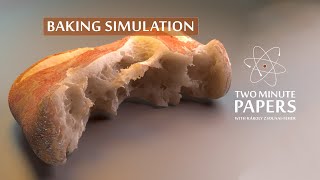
A new paper simulates baking and chocolate melting by modeling how heat moves through solids, water, and gas. The simulation shows cookies changing shape, chocolate melting, and crusts forming. Lead author Meng Yuan Ding's work was accepted to Siggraph Asia.
Questions this video answers
January 10, 2020.
Meng Yuan Ding.
SIGGRAPH Asia (accepted to the Siggraph Asia Conference).
2014.
Chapters
Dear fellow scholars, this is two minute papers with. This is one of those simulation papers where you can look at it for three seconds and immediately know what it's about. Let's try that. Clearly expansion and baking is happening. And now let's look inside. Mmm. Yep, this is done. Clearly this is a paper on simulating the process of baking. Loving the idea. So how comprehensive is it? Well, for a proper baking procedure, the simulator also has to be able to deal with melting, solidification, dehydration, coloring and much, much more. This requires developing a proper thermomechanical model where these materials are modeled as a collection of solids, water and gas. Lets have a look at some more results. And we have to stop right here because I'd like to tell you that the information density on this deceivingly simple scene is just stunning. In the x axis from the left to right, we have a decreasing temperature in the oven, left being the hottest. And the chocolate chip cookies above are simulated with an earlier work from 2014. The ones in the bottom row are made with the new technique. You can see a different kind of shape change as we increase the temperature. If we crank the oven up even more. And look there, even the chocolate chips are melting. Oh my goodness, what a paper. Talking about information density. You can also see here how these simulated pieces of dough of different viscosities react to different amounts of stress. Viscosity means the amount of resistance against deformation. Therefore, as we go up, you can witness this kind of resistance increasing. Here you can see a cross section of the bread which shows the amount of heat everywhere. This not only teaches us why crust forms on the outside layer, but you can see how the amount of heat diffuses slowly into the inside. This is a maxed out paper. By this I mean the execution quality is through the roof and the paper is considered done the not when it looks alright, but when the idea is being pushed to the limit and the work is as good as it can be without trivial ways to improve it. And the results are absolute witchcraft. Huge congratulations to the authors. In fact, double congratulations. Because it seems to me that this is only the second paper of Meng Yuan Ding, the lead author, and it has been accepted to the Siggraph Asia Conference which is one of the greatest achievements a computer graphics researcher can dream of. A paper of such quality for the second try. Wow. This episode has been supported by Weights and Biases. Weights and Biases provides tools to track your experiments in your deep learning projects. It can save you a ton of time and money in these projects and is being used by OpenAI, Toyota Research, Stanford and Berkeley. They have excellent tutorial videos. In this one, the CEO himself teaches you how to build your own neural network and more. Make sure to Visit them through wandb.com papers wandb.com papers or just click the link in the video description and you can get a free demo today. Our thanks to Weights and Biases for helping us make better videos for you. Thanks for watching and for your generous support and I'll see you next time.