A new simulation technique makes fluid-solid interactions faster and more realistic, handling everything from floppy bunny ears to water-filled spheres and wet sand. The method finds fluid-solid boundaries and lets simulations use larger time steps while plugging into different material models.
Chapters
Dear fellow scholars, this is two minute papers with Dr. Zsolnai. It is time for some fluids. As many of you know, in this series we often talk about fluid simulations. And sometimes the examples showcase a fluid splash, but not much else. However, in real production environments, these simulations often involve complex scenes with many objects that interact with each other. And therein lies the problem. Computing these interactions is called coupling, and it is very difficult to get right, but is necessary for many of the beautiful scenes you will see throughout this video. Getting this right is of utmost importance if we wish to create a realistic simulation where fluids and solids interact. So the first question would be as many of these techniques build upon the material point method or npm. In short, why not just use that? Well, let's do exactly that and see how it does on this scene. Let's drop the liquid ball on the bunny and oh, a lot of it is now stuck to the bunny. This is not supposed to happen. So what about the improved version of npm? Yup, still too sticky. And now let's have a look at how this new technique handles this situation. I want to see dry and floppy bunny ears. Yes, now that's what I'm talking about. Now then, that's great. But what else can this do? A lot more. For instance, we can engage in the favorite pastimes of the computer graphics researcher, which is of course destroying objects in a spectacular manner. This is going to be a very challenging scene.
Ouch.
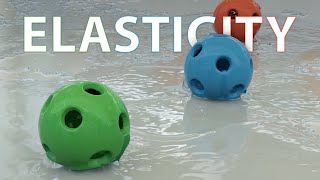
And now let physics take care of the rest. This was a harrowing but beautiful simulation and we can try to challenge the algorithm even more. Here we have three elastic spheres filled with water. And now watch how they deform as they hit the ground and how the water gushes out exactly as it should. And now hold on to your papers because there is a great deal to be seen in this animation, but the most important part remains invisible. Get this. All three spheres use a different hyper elasticity model to demonstrate that this new technique can be plugged into many existing techniques. And it works so seamlessly that I don't think anyone would be able to tell the difference. And it can do even more. For instance, it can also simulate wet sand. Wow. And I say wow. Not only because of this beautiful result, but there is more behind it.
If you are one of our hardcore.
Long time fellow scholars, you may remember that three years ago we needed an entire paper to pull this off. This algorithm is more general and can simulate this kind of interaction between liquids and granular media. As an additional side effect, we can also simulate dropping this creature into a piece of fluid and as we increase the density of the creature, it sinks in in a realistic manner. While we are lifting frogs and help an elastic bear take a bath, let's look at why this technique works so well. The key to achieving these amazing results in a reasonable amount of time is that this new method is able to find these interfaces where the fluids and solids meet and handles their interactions in a way that we can advance the time in our simulation in larger steps than previous methods. This leads to not only these amazingly general and realistic simulations, but they also run faster. Furthermore, I am very happy about the fact that now we can not only simulate these difficult phenomena, but we don't even have to implement a technique for each of them. We can take this one and simulate a wide variety of fluid solid interactions What a time to be alive. This episode has been supported by Weights and Biases. In this post they show you how.
To use their system to train a deep reinforcement learner to become adept at.
The cart pole balancing problem.
This is the algorithm that was able to master Atari Breakout that we often.
Talk about in this series.
Weights and Biases provides tools to track your experiments in your deep learning projects. Their system is designed to save you a ton of time and money and it is actively used in projects at prestigious labs such as OpenAI, Toyota Research, GitHub and more. And the best part is that if you have an open source, academic or personal project, you can use their tools for free. It really is as good as it gets. Make sure to Visit them through wnb.com papers or click the link in the video description to start tracking your experiments in five minutes. Our thanks to Weights and Biases for their long standing support and for helping us make better videos for you.
Thanks for watching and for your generous support and I'll see you next time.