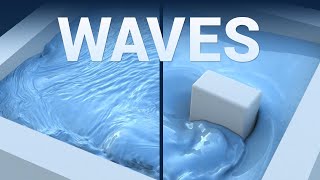
A short YouTube episode by Dr. Zsolnai (Two Minute Papers) describing a new computer-graphics method that enriches coarse fluid simulations by adding curve-shaped "wave curves" instead of particles. The method is applied as a post-processing step to add high-frequency surface detail without rerunning the core simulation. Execution time scales linearly with the number of curve points (examples: 100k→~10s, 200k→~20s, 400k→~40s, 800k→~80s). The video also notes limits (cannot introduce large intrusive changes) and includes a sponsorship mention for Weights and Biases.
Questions this video answers
May 29, 2021
Dr. Zsolnai
Curve-shaped "wave curves" (wave packets)
As a post-processing step to enrich an existing simulation
Dear fellow scholars, this is two minute papers with Dr. Zsolnai. Through the power of computer graphics research works today, it is possible to simulate honey coiling water flow with debris, or to even get a neural network to look at these simulations and learn how to continue them. Now if we look under the hood, we see that not all but many of these simulations contain particles. And our task is to simulate the pressure, velocity and other physical quantities for these particles and create a surface where we can watch the evolution of their movement. Once again, the simulations are typically based on particles, but not this new technique. Look, it takes a course simulation. Well, this one is not too exciting. So why are we looking at this? Well, look. Whoa. The new method can add these crispy high frequency details to it. And the result is an absolutely beautiful simulation. And it does not use millions and millions of particles to get this done. In fact, it does not use any particles at all. Instead it uses wave curves. These are curve shaped wave packets that that can enrich a course simulation and improve it a great deal to create a really detailed, crisp output. And it gets even better because these wave curves can be applied as a simple post processing step. What this means is that the workflow that you saw here really works like that. When we have a core simulation that is already done and we are not happy with it, with many other existing methods, it it is time to simulate the whole thing again from scratch. But not here with this one. We can just add all this detail to an already existing simulation. Wow. Loving it. Note that the surface of the fluid is made opaque so that we can get a better view of the waves. Of course, the final simulation that we get for production use are transparent like the one you see here. Now another interesting detail is that the execution time is linear with respect to the curve points. So what does that mean? Well, let's have a look together. In the first scenario, we get a low quality underlying simulation and we add 100,000 wave curves. This takes approximately 10 seconds and looks like this. This already greatly enhanced the quality of the results. But. But we can decide to add more. So first case, 100k wave curves in tennis seconds. Now comes the linear part. If we decide that we are yearning for a little more, we can run 200k wave curves and the execution time will be 20ish seconds. It looks like this better. We are getting there. And for 400k wave curves, 40 seconds. And for 800k curves. Yes, you guessed it right. 80 seconds. Double the number of curves, double the execution time. This is what the linear scaling part means. Now, of course, not even this technique is perfect. The post processing nature of the method means that it can enrich the underlying simulation a great deal, but it cannot add changes that are too intrusive to it. It can only add small waves relative to the size of the fluid domain. But even with these, the value proposition of this paper is just out of this world. So from now on, if we have a relatively poor quality fluid simulation that we abandoned years ago, we don't need to despair. What we need is to harness the power of wave curves. This episode has been supported by Weights and Biases. In this post they show you how to monitor and optimize your GPU consumption during model training in real time with one line of code. During my PhD studies I trained a ton of neural networks which were used in our experiments. However, over time there was just too much data in our repositories and what I am looking for is not data but insight. And that's exactly how Weights and Biases helps you when by organizing your experiments. It is used by more than 200 companies and research institutions including OpenAI, Toyota Research, GitHub and more. And get this Weights and Biases is free for all individuals, academics and open source projects. Make sure to Visit them through wnb.com papers or just click the link in the video description and you can get a free demo today. Our thanks to Weights and Biases for their long standing support and for helping us make better videos for you. Thanks for watching and for your generous support and I'll see you next time.