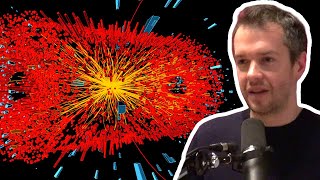
Interview clip with physicist Harry Cliff describing the LHCb experiment and how it complements larger LHC detectors (ATLAS, CMS). Cliff explains that LHCb specializes in studying b (beauty/bottom) quarks — they are produced abundantly and can be measured precisely. He contrasts LHCb’s forward, cone-shaped detector with the general-purpose, barrel-shaped ATLAS/CMS, outlines detector subsystems (silicon tracking near the beam, calorimeters, muon chambers), explains identifying B hadrons via displaced decays (they travel a few centimeters before decaying; LHCb’s vertex detector sits ~7 mm from the beam), and describes using B oscillations/decays to probe matter–antimatter (CP) asymmetries and search for indirect signs of new physics.
Chapters
So I work on a detector called lhcb, which is one of these four big detectors that are spaced around the ring. And we do slightly different stuff to the big guys. There's two big experiments called ATLAS and CMS. 3000 physicists and scientists and computer scientists on them each. They are the ones that discovered the Higgs, and they look for supersymmetry and dark matter and so on. What we look at are standard model particles called be quarks, which, depending on your preference, is either bottom or beauty. We tend to say beauty because it sounds sexier. Yeah, for sure. But these particles are interesting because we can make lots of them. We make billions or hundreds of billions of these things. You can therefore measure their properties very precisely. So you can make these really lovely precision measurements. And what we are doing really, is a sort of complementary thing to the other big experiments, which is they. If you think the sort of analogy they often use is if you imagine you're looking in. You're in a jungle and you're looking for an elephant, say, and you are a hunter, and you're kind of like, let's say there's the relent is very rare. You don't know where in the jungle. The jungle's big. So there's two ways you go about this. Either you can go wandering around the jungle and try and find the elephant. The problem is, if the elephant. If there's only one elephant and the jungle's big, the chances of running into it are very small. Or you could look on the ground and see if you see footprints left by the elephant. And if the elephant's moving around, got a chance that you're a better chance maybe of seeing the elephant's footprints. If you see the footprints, you go, okay, there's an elephant. I maybe don't know what kind of elephant it is, but I got a sense there's something out there. So that's sort of what we do. We are the footprint people. We're looking for the footprints, the impressions that quantum fields that we haven't managed to directly create, the particle of the effects these quantum fields have on the ordinary standard model fields that we already know about. So these. I see these B particles, the way they behave can be influenced by the presence of, say, superfields or dark matter fields or whatever you like. And the way they decay and behave can be altered slightly from what our theory tells us they ought to behave.
Gotcha. And it's easier to collect huge amounts of data on B quarks.
We get billions and billions of these things. You can make very precise measurements. And the only place really at the LHC or really in high energy physics at the moment where there's fairly compelling evidence that there might something beyond the standard model is in these b. These beauty quarks decays.
Just to clarify, which is the difference between the different, the four experiments for example that you mentioned? Is it the kind of particles that are being collided? Is it the energies which they're collided? What's the fundamental difference between the different experiments?
The collisions are the same. What's different is the design of the detectors. So ATLAS and CMS are called, they're called what are called general purpose detectors. And they are basically barrel shaped machines. And the collisions happen in the middle of the barrel. And the barrel captures all the particles that go flying out in every direction. So in a sphere effectively that come flying out and it can record all of those particles. And what's the.
Sorry to be interrupting, but what's, what's the mechanism of the recording?
Oh, these detectors, if you've seen pictures of them, they're huge. Like Atlas is 25 meters high and 45 meters long. They're vast machines, instruments I guess you should call them really. They're kind of like onions. So they have layers, concentric layers of detective detectors, different sorts of detectors. So close into the beam pipe you have what are called usually made of silicon. They're tracking detectors. So they're little made of strips of silicon or pixels of silicon. And when a particle goes through the silicon it gives a little electrical signal and you get these dots, you know, electrical dots through your detector which allows you to reconstruct the trajectory of the particle. So that's the middle and then the outsides of these detectors you have things called calorimeters which measure the energies of the particles. Particles. And on rare edge you have things called muon chambers which basically these muon particles which are the heavy version of the electron, they are, they're like high velocity bullets and they can get right to the edge of the detector. So if you see something at the edge, that's a muon. So that's broadly how they work.
And all of that is being recorded.
That's all being fed out to, you know, computers.
That data must be awesome.
Okay, so LHCB is different. So we, because we're looking for these bee quarks. Yes. Be quarks tend to be produced along the beam line. So in a collision the be quarks tend to fly sort of close to the beam pipe. So we built a detector that sort of pyramid cone shaped, basically that just looks in one direction. So we ignore, if you have your collision stuff goes everywhere. We ignore all the stuff over here and going off sideways. We're just looking in this little region close to the beam pipe where most of these be quarks are made.
So is there a different aspect of the sensors involved in the collection of the B quark trajectories?
There are some differences. So one of the differences is that one of the ways, you know, you've seen a bee quark is that B quarks are actually quite long lived by particle standards. So they live for 1.5 trillionths of a second, which is, if you're, if you're a fundamental particle, is a very long time because, you know, the Higgs boson I think, lives for about a trillionth of a trillionth of a second or maybe even less than that. So these are quite long lived things and they will actually fly a little distance before they decay. So they will fly, you know, a few centimeters maybe, if you're lucky, then they'll decay into other stuff. So what we need to do in the middle of the detector, you want to be able to see, you have your place where the protons crash into each other. And that produces loads of particles that come flying out. So you have loads of lines, loads of tracks that point back to that proton collision. And then you're looking for a couple of other tracks, maybe two or three, that point back to a different place that's maybe a few centimeters away from the proton collision. And that's the sign that a little B particle has flown a few centimeters and decayed somewhere else. So we need to be able to very accurately resolve the proton collision from the B particle decay. So we are, the middle of our detector is very sensitive and it gets very close to the collision. So you have this really beautiful delicate silicon detector that sits, I think it's 7 millimeters from the beam. And the LHC beam has as much energy as a jumbo jet at takeoff. So it's enough to melt a ton of copper. So you have this furiously powerful thing sitting next to this tiny, delicate, you know, silicon sensor. So there's aspects of our detector that are specialized to, to, to measure these particular be quarks that we're interested in.
And is there, I mean, I remember seeing somewhere that there's some mention of matter and antimatter connected to the, be the, these beautiful quarks. Is that, what, what's the connection? Yeah, what, what's the connection there?
Yeah. So There is a connection, which is that when you produce these B particles, these particles, because you don't see the B quark, you see the thing that be quark is inside. So they're bound up inside what we call beauty particles, where the B quark is joined together with another quark or two, maybe two other quarks, depending on what it is. There are a particular set of these B particles that exhibit this property called oscillations. So if you make, for the sake of argument, a matter version of one of these B particles, as it travels, because of the magic of quantum mechanics, it oscillates backwards and forwards between its matter and antimatter versions. So it does this weird flipping about backwards and forwards. And what we can use this for is a laboratory for testing the symmetry between matter and antimatter. So if the symmetry between antimatter is precise, it's exact, then we should see these B particles decaying as often as matter as they do as antimatter. Because this oscillation should be even. It should spend as much time in each state. But what we actually see is that one of the states it spends more time in, it's more likely to decay in one state than the other. So this gives us a way of testing this fundamental symmetry between matter and antimatter.