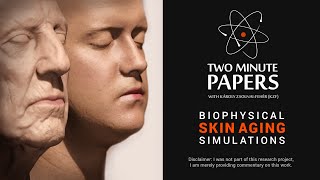
Researchers at the University of Zaragoza built a simulation that predicts how skin ages: thinner epidermis, less melanin and water, more uneven pigment. You input age and skin type, run the heavy simulation once to get diffusion profiles, then render photorealistic skin in real time.
Chapters
Dear fellow scholars, this is two minute papers with the faithful. Simulation of human skin is incredibly important both in computer games, the movie industry and also in medical sciences. The appearance of our face is strongly determined by the underlying structure of our skin. Human skin changes significantly with age. It becomes thinner and more dry, while the concentration of chromophores, the main skin pigments, diminishes and becomes more irregular. Those pigment concentrations are determined by our age, gender, skin type and even external factors like for example exposition to UV radiation or our smoking habits. As we age the outermost layer of our skin, the epidermis thins, the melanin, hemoglobin and water concentration levels drop over time. As you could imagine, having a plausible simulation considering all the involved actors, is fraught with difficulties. Scientists at the University of Zaragoza came up with a really cool, fully fledged biophysically based model that opens up the possibility of simply specifying intuitive parameters like age, gender, skin type and get, after some processing, a much lighter skin representation ready to generate photorealistic rendered results in real time. Luckily, one can record diffusion profiles, also called scattering profiles, that tell us the color of light that is reflected by our skin. In this image above, you can see a rendered image and a diffusion profile of a 30 and an 80 year old person. The idea is the you specify intuitive inputs like age and skin, then run a detailed simulation once that creates these diffusion profiles that you can use forever in your rendering program. And all this is done in a way that is biophysically impeccable. I was sure that there was some potential in this topic, but when I first saw these results, they completely crushed my expectations. Excellent piece of work. Thanks for watching and for your generous support and I'll see you next time.