Boston Dynamics Isnt The Only Company To Be Worried About...
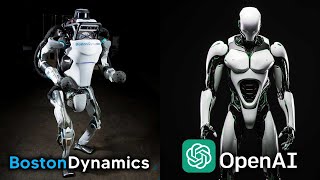
Beyond Boston Dynamics, Tesla's Optimus, Sanctuary AI's Phoenix, and OpenAI's Neo are racing to build humanoid robots. Tesla targets $25,000 units for manufacturing; Phoenix aims for $150,000 healthcare robots. The video weighs their technical specs against concerns about job displacement, military ties, and whether these machines can be trusted.
Questions this video answers
Early development was heavily influenced by U.S. military funding (U.S. Army interest in pack-mule robots).
66 pounds.
Walking speed 2.5 miles per hour; sprinting up to 7.5 miles per hour.
44 pounds.
Open for pre-orders at the end of 2023 (as stated).
Chapters
Boston Dynamics, a pioneer in the field of robotics, has earned a reputation for creating agile, smart and eerily lifelike robots. With their astounding ability to navigate even the most challenging terrains and perform acrobatic feats. Their creations have garnered millions of views worldwide. But here's why we should take a moment to ponder. Boston Dynamics early development was heavily influenced by U.S. military funding. Yes, you heard that right. The U.S. army saw potential in Boston Dynamics experimental robots and envisioned using them as pack mules to support infantry troops carrying heavy equipment across rugged landscapes. While the military application brought incredible advancements, it also raises concerns about how such technology could be deployed in the future. Now you might wonder, why worry about other robots? The answer lies in the immense potential of robotics itself. As technology progresses, robots are becoming more integrated into our lives, impacting various industries and reshaping the job landscape. While this presents exciting opportunities, it also raises questions about the ethical and societal implications of widespread robot adoption. But today, we won't just focus on Boston Dynamics. We'll also introduce you to other groundbreaking robotics companies that deserve the spotlight. From OpenAI's Neo to the astonishing GR1, from Tesla Optimus's efficiency to Hanson Robotics emotive wonder, these creations will leave you in amazement. First up on our list is none other than OpenAI's Neo. Neo isn't just another computer program. It's a physical Android embodying artificial intelligence and bridging the gap between the virtual and the real. Buckle up as we delve into neo's incredible capabilities and explore why it's shaping the future in ways we could only dream of. Neo's power lies in its concept of embodied AI, a marvel of engineering and innovation. Imagine a physical robot with AI senses perceiving and understanding its surroundings in a way that echoes human perception. Unlike traditional robots, NEO isn't confined to rigid programming. It continuously learns and evolves, growing smarter and more capable over time. This adaptability is the hallmark of true autonomy, making NEO a pioneering example of an intelligent and self governing entity. The implications of neo's abilities are breathtaking. Imagine having NEO as your versatile home assistant, effortlessly performing household chores and providing much needed support. In the industrial realm, NIO shines even brighter, powering sectors like security, logistics and manufacturing with unparalleled efficiency. It's a game changer, effortlessly operating machinery and handling complex tasks that once seemed beyond reach. But Neo's potential doesn't stop there. OpenAI envisions Neo as more than just an industrial marvel. It's a source of hope and assistance for those facing mobility challenges. With its physical presence, NEO can fetch items, provide companionship and significantly improve the quality of life for many. Moreover, NEO has opened the doors to cutting edge research in the fields of psychology and artificial intelligence. Its ability to interact with the world on a deeper level enables scientists to explore new frontiers in understanding human cognition and behavior. Neo's autonomy is genuinely remarkable. Just like a skilled decision maker, it processes information from its surroundings, assesses situations and makes decisions based on predefined rules and experiences. The beauty lies in its continuous learning, adjusting its behavior and decision making process based on new insights. This level of adaptability and intelligence is what makes NEO stand out from the crowd. Neo's agility and power are equally impressive. Weighing in at just 66 pounds, it moves with graceful finesse at a speed of 2.5 miles per hour. But when it needs to pick up the pace, NEO can sprint at an astonishing 7.5mph. Its carrying capacity of 44lbs makes it a strong and reliable ally in various scenarios. Further showcasing its versatility, the future holds even more excitement. OpenAI has announced that NEO will be open for pre orders at the end of 2023. That means we're just around the corner from witnessing this marvel of AI in action. As the world embraces the merging of language models and physical robots and neo's arrival is a momentous milestone. Now let's address an essential aspect of NEO that deserves our thoughtful consideration. Why should we worry about this groundbreaking AI? As NEO represents a significant evolution in artificial intelligence, it's crucial to acknowledge the potential challenges and ethical implications that come with such advanced technology. One of the primary concerns revolves around the notion of AI autonomy. With neo's ability to continuously learn and adapt, there's a valid fear that its decision making process could become increasingly opaque. As AI systems become more sophisticated, understanding how they arrive at specific decisions could become a daunting task. This raises questions of accountability and transparency in crucial situations where human lives or safety are at stake. Say hello to Sanctuary AI, a Vancouver based company on a mission to create human like intelligence in general purpose robots. Get ready to be amazed as we unveil their latest creation, Phoenix™, the world's first humanoid general purpose robot. But what sets Sanctuary AI apart from the rest? Phoenix Trademark, a 5, 7 inches tall humanoid marvel weighing 155 pounds, is equipped with an incredible payload capacity of 55 pounds. But it doesn't stop there. Phoenix boasts maximum speeds of up to 3mph. The standout feature lies in its extraordinary robotic hands. With 20 degrees of freedom rivaling human hand dexterity. Coupled with proprietary haptic technology, it mimics the sense of touch, making Phoenix a truly remarkable creation. The secret to Phoenix's intelligence lies in Carbon, an advanced AI control system that enables natural language translation into real world actions. It's like having a thinking and acting human like intelligence at your service. The added benefit of explainable and auditable reasoning ensures transparency in decision making, making it all the more trustworthy. But what truly sets Sanctuary AI apart is is their dedication to creating a genuinely general purpose robot. Unlike specialized robots limited to specific tasks, Phoenix™ is designed to perform nearly any work task you'd expect from a person in various environments. It's a game changer, revolutionizing how we perceive robots as tools for intelligent AI systems like Carbon Trademark. With a successful commercial deployment and a robust coalition of top notch partners, they're poised for incredible achievements. Their open and collaborative approach to building the AI and robotics ecosystem showcases their commitment to collective growth. While we celebrate the innovation behind Phoenix Trademark by Sanctuary AI, it's essential to approach this technological marvel with a balanced perspective. As Phoenix Trademark represents a significant leap in humanoid general purpose robots, several considerations warrant our attention. One crucial concern lies in the potential adoption of general purpose robots like Phoenix™ could disrupt industries and jobs. Because if the Phoenix robot is used in many companies to do labor job, many people will lose their jobs. While these robots offer a solution to labor challenges, we must address the potential impact on employment. Hold on tight because the excitement doesn't stop. Stop there. Feast your eyes on the extraordinary Tesla Optimus. Optimus made its grand entrance at Tesla AI Day 2.0 and the excitement was palpable. Elon Musk, the visionary CEO of Tesla, revealed that the team is hard at work to make Optimus available to the public at an affordable price of less than $20,000. That's less than the cost of a car. With its humanoid form, Tesla, this prototype looks more like a real life wonder than a distant dream. The joint motors powering Optimus are not only powerful, but also surprisingly sensitive. Capable of avoiding unexpected obstacles like delicate eggs. The video showcases its agility with an explosive leaping power and precise movements that stop just in time to protect the fragile egg. Tesla's approach to training Optimus is intriguing. The the Optimus team uses a monkey see, monkey do technique similar to the Sanctuary AI team's method. Human operators donning motion capture suits and head mounted cameras perform everyday tasks and a virtual model of the robot learns from their actions. While both approaches have merits, Tesla's virtual training might lack real world Robot data Unlike Sanctuary's intuitive method that closely mirrors human robot interactions, what sets Optimus apart is its human like functionality that goes beyond just the hands. The entire robot is designed to work like a human body. Imagine a robot that moves, talks and processes information, just like us. With cutting edge technology, including a battery pack and software for Autopilot, Tesla aims to create millions of units of Optimus, ushering in a new era of robotics. Despite its learning journey, Optimus is already mastering the art of picking up items independently, a remarkable feat indeed as it requires the robot to perceive objects, understand their three dimensional shapes, strategize the best approach and execute precise motor movements to grasp and lift them. Elon Musk acknowledges that Optimus is currently honing its basic skills, but the vision is to make Optimus an agile and capable companion. While we marvel at the potential of Optimus and other AI advancements, it's essential to address a crucial why should we worry? The recent controversy surrounding Google's Lamda sparks a fascinating Is AI truly conscious or is it an illusion? Many scientists argue that consciousness itself self might be an illusion and our actions are largely unconscious. The intriguing question if AI lacks sensory input, can it truly be conscious? A baby born with sensory limitations still has the potential to become an intelligent being. Similarly, Lambda might lack human sensory experiences, but what if it were to get a body? Tesla's Optimus, a large language model, shows that with the right neural architecture and AI can control robots that move and act like humans. Elon Musk's vision of human robots like Optimus becomes a stepping stone towards achieving real human level. AGI. The intricate interplay between AI, robotics and consciousness is paving the way for a future where robots seamlessly integrate into our lives, becoming companions that we might not even distinguish from real human interactions. Love him or criticize him Elon Musk's belief in human robots as a necessary step towards AGI drives the industry's progress. As we stand on the precipice of technological advancements, the road to consciousness in machines is long and uncertain. But with every stride taken by robots like Optimus, we inch closer to a future where AI and humanity walk hand in hand.










