Boston Dynamics New ATLAS UPGRADE Surprises EVERYONE (Boston Dynamics Atlas)
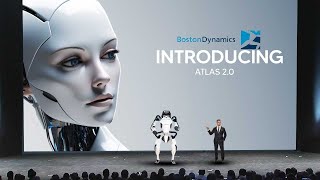
YouTube commentary (LARRUZ) analyzing a Boston Dynamics short that showcases an Atlas humanoid upgrade focused on manipulation for “real work.” The speaker highlights a new two-pronged gripper, Atlas lifting and handling a car strut (possibly using pre-baked 3D model alignment with LIDAR), recovery after a trip, comparisons and mild skepticism about staged elements, references to cost estimates for humanoid robots, and a discussion of likely near-term applications versus consumer availability.
Chapters
So Boston Dynamics's very famous robot just got a major upgrade and many people did miss this. So I'm going to be informing you all on how crazy this upgrade really is. So you can see right here, Boston Dynamics actually posted this short. And in this short, it's a very, very informative short about the Atlas platform and what this robot is capable of doing. What you're seeing Atlas do is I'm not entirely sure what it is loading for, but it is clearly loading some items into some sort of carrier and then placing them out of the carrier and loading them into something else. Now, essentially what we saw here with the caption that Boston Dynamics added to this was they said that this is ATLAS getting ready for real work. And I think that this was something many people miss because they just thought it was a really cool demo. But this demo actually had many different small things that many people didn't realize, including myself when I watched it the first time. But after watching it back one more time, I realized just how impressive this demo really was. Now, most of you guys do know about Boston Dynamics from their very, very famous videos in which they've done the parkour videos, where they showcase just how crazy good this is in terms of the agility of the platform of the humanoid robot. But this video actually focuses on something rather impressive. The reason that this video is so impressive is because Boston Dynamics actually made a very small change to this robot that many people didn't realize. You can see that one of the first changes that Boston Dynamics has made. If I pause the video right here, you guys are going to see that they've actually made a small change to the hand. If we compare that to a video that we saw prior where Boston Dynamics was doing some other work, you can see that in this video it used a different style of gripper. Now this style of gripper is a two pronged gripper. The this is similar to the style of many other robots and I'm guessing the new one is a bit more innovative. The point here is that you can see that this kind of gripper that they did use was very, very non gentle. This was a kind of grip that was very, very, I guess you could say harsh on whatever item it might be bringing. And this is something that doesn't have as much applications as a gripper that isn't as tight. So, so that was something that I did notice. And what that does mean is that if Boston Dynamics have upgraded their Atlas platform and if they've said in the description of the video that look this Thing is going to be getting ready for real work soon. That means that they are clearly experimenting with some new style of hands for Boston Dynamics that is going to be using in order to be doing some real work. Now, another thing that was really, really, really impressive about this Boston Dynamics demo was the fact that the robot actually tripped up and then somehow managed to regain its footing. Now you can see right here that the robot actually trips. And what was funnily enough was that this was actually like a real person. You can see how a real person kind of tripped and they kind of regain their footing and then they look right back at the item. And then something that you do see right here is that you do see in the back. You do see someone's reaction. Like, whoa, he actually didn't just drop, he actually managed to stay upright. You can see people's reactions right there. Like, wow. Okay, this thing is pretty crazy. I'm not sure if they're like, wow, it nearly fell, or wow, it stayed up. But I'm going to show you later on in the video how good Boston Dynamics is because this is a truly, truly advanced humanoid robot. Now, there was also something from an article that I did see about this demo in which they stated that, you know, some parts of this were pretty pan. So they said the one limitation here is that some of the smarts in the video are pre calculated. At one point, we see what looks like Atlas's vision processing and it has a perfect 3D scan of the car strut ready to go. So essentially, they're talking about this point right here. You can see that as the video starts off, you can see that the car strut right here is a perfect 3D scan. Essentially what they mean is that they mean in order to get a perfect 3D scan of a similar object, you're going to need to scan it in a different kind of system, which, which means that they kind of planned this out because of course, if you're running around, you're not going to get like a perfect 3D scan of an object using lidar and some vision sensors. So clearly this was planned out in some sense, but nonetheless, it's still pretty cool. You can see. So it says this is either attempt number 5000 or it has already seen the strut from all angles. Or ATLAS was pre programmed with topographical data for this exact model car strut. It says either way, for all lifts in the video, ATLAS is saved from trying to figure out the shape of the object in real time. And ATLAS has LIDAR sensors on its face and can generate a point cloud of what it's looking at. So it just needs to line up the pre baked model with the point cloud and it has perfect knowledge of the strut topography. A harder level of difficulty would be picking up an object ATLAS has never seen before. But you've got to break down the challenges into smaller parts and start somewhere. And that is pretty true. A common gripe in robotics is to try and get objects that have never been seen by the robot before to be picked up by that said robot. And this is something that is hard, but I don't think that something like this is pretty bad. Because if this Boston Dynamics robot is going to be working within certain fields, I'm sure that certain items are going to be, you know, very, very normal to this robot. I mean, if you're a person who's working in a kind of environment, I'm sure there are certain items that you do see pretty, pretty often. So this is not going to be that big of a deal in the future. And I'm sure that whatever Boston Dynamics are cooking up here, and it does mean that in the future we're likely to see these in some kind of places. Now, one question that I've always had is, you know, when is the full robot automation thing going to be coming? One thing that I always did realize is that this thing is very, very expensive. I would estimate that this is probably a quarter of a million dollars. Maybe that is, you know, a little bit of an exaggeration in terms of the price. But if we take a look at some other figures, you can see that the estimate, if true, is a huge feat, considering robots usually take years to complete and cost far more. Spot, the four legged robot, actually sells at $74,000. And according to experts, humanoid robots like ATLAS cost at least within the $100,000 rate. And I'm not surprised that this is true because I do remember that a similar project called Eve from 1X, if I remember correctly, it actually cost around 250,000 and it wasn't as agile and could move as much as this. So I'm guessing that maybe this could even be more expensive. But, but then again, we have no idea what Boston Dynamics is offering because we haven't really seen Spot do, I mean, ATLAS do any kind of work just yet. So it will be interesting to see how ATLAS does get on in certain environments because now that they've actually upgraded this robot to be able to do this, and previously, like I said, it was just a robot platform that was just pushing the bounds of what is capable and this agile. Atlas was really, really good at doing these runs and jumps. But now the fact that they've added these prongs to this robot and now the fact that it's able to load things and move things with these grippers, it does mean that in the future we're going to be getting this humanoid doing some really cool stuff. Now, something that I did really see that I do want to add here was that they said something and I mean, you can infer many different things from it. And I did infer something from it, and I don't want to start any drama, but the chief strategy officer at Boston Dynamics said, we considered making coffee or picking up an egg, but decided to focus on real world manipulation challenges instead. Smiley face. And then he said, lift heavy things, recognize irregular objects, recover gracefully after tripping. And Atlas has what the real world requires. So the Castrat is actually really heavy, so the robot's able to lift that, which is a huge, huge milestone. A lot of the times the robots that we're seeing, they don't really lift stuff that's really heavy. Recognizing irregular objects. I'm guessing that, you know, considering that someone's the vice president of marketing and communications at Boston Dynamics, stating that it's recognizing an irregular object, but maybe it's recognizing the object for the first time or something that's irregular that it hasn't seen that many times. And of course, recovering gracefully after tripping is something that is really, really crazy because it's able to deal with the dynamic nature of the environment. Now, something that you might not know is that this statement here, picking up an egg and making coffee are two very big things if you're someone who pays attention to the robotics area. That's because recently there were two demos in which robots actually picked up an egg and made coffee. And the first demo in which robots picked up an egg was this demo here. And this, of course, was the Tesla Optimus demo, which was the Gen 2 demo. Now, this thing is a lot faster now, but essentially the bit that they're talking about is this. Now, I don't know if this was just a dig at Tesla. I'm not sure what the relationship is between Boston Dynamics and some of these other top companies, but I did find it funny. That said, we're not going to be picking up an egg or making coffee. We're actually going to use this for the real world. So I know that statement can be quite funny, but I do think that being able to with a robot is Important because it shows at how delicate the movements are from this robot and how great it is as dealing with delicate objects. Because there are so many objects that are very, very fragile that you need to be able to deal with. And if you have something that just has, you know, it's kind of two pronged nature that's really, really powerful. I mean it's going to be good in some industries, but isn't going to be good overall. And this was the second company that it probably took a dig at. And you can see that this is figures humanoid robot which coffee with a coffee machine. And of course the chief strategy officer at Boston Dynamics saying we considered making coffee but decided to focus on something in the real world. I'm not sure if that's hilarious or just taking a dig at these other humanoid companies, but one thing I would say that these other humanoid companies do have against Boston Dynamics is that they've been in the game a lot less. And what they've achieved in their short time scale shows us that they are moving very, very rapidly compared to Boston Dynamics. Now I do want to say that Boston Dynamics is far ahead of these companies, but it will be interesting to see how they co evolve and how the competition does so in the future. Now as for the future, they've talked about Atlas and they've said, well, what's next for Atlas? We've shown that we can pick up, carry and throw objects while walking, running and jumping. NPC lets us combine the robot's perception of the world with high level tasks like mobility and manipulation. Making smart decisions about how to move world and how to move the world to will soon be essential for turning Atlas into a robot that can do meaningful work outside of the lab. So do you think these robots are going to be in our home soon? I mean these robots are very, very expensive. They cost the price of like a Ferrari or something like that. And I'm sure not the average person has one of those. So that means that we are looking at potentially quite some time before these things come down in price. I mean with economies of scale maybe that does happen, but you definitely have a long way away. But before I think we're seeing wild scale robots that can run like these Boston Dynamics ones can. So with that being said, which industry do you think Boston's Dynamics ATLAS is going to be jumping into next?










