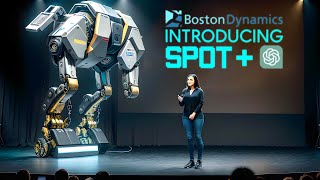
Boston Dynamics' robot dog SPOT can now understand natural-language commands through ChatGPT integration. The system lets SPOT respond to spoken requests and could be used for reporting, eldercare, and security, though concerns about job displacement and police surveillance loom large.
Questions this video answers
April 30, 2023
Santiago Valderrama
Lovatus
Google's Text-to-Speech
New York Police Department (NYPD)
Chapters
If you've ever seen Boston Dynamics Robot Dog Spot in action, you're likely already familiar with how impressive the machine can be. After all, the robot is capable of moving in ways that closely resemble a real dog, and its agility and mobility have made it a popular subject of conversation among tech enthusiasts. But as of late, SPOT has become even more interesting thanks to the addition of OpenAI's ChatGPT. With this new feature, the robot dog can now understand and respond to natural language commands, opening up a whole new realm of possibilities for what the machine is capable of. So what exactly does this development mean for the future of robotics and AI? In this video, we'll take a closer look at the integration of ChatGPT into Spot, exploring the potential applications of this technology and considering what it might mean for the future of human robot interaction. Before we start Talking about how ChatGPT was added to Spot, let's take a second to understand what it is. ChatGPT is a language model developed by OpenAI, which uses machine learning algorithms to generate human like responses to natural language prompts. Since its initial release, ChatGPT has become increasingly popular as a tool for natural language processing and conversational AI. In fact, the model has been used to create everything from virtual chatbots to interactive fiction games, and its ability to generate responses that closely resemble human speech has made it a valuable tool for a wide range of applications. But while ChatGPT has proven to be useful in a number of contexts, its integration into SPOT represents a particularly exciting development. By allowing the robot dog to understand and respond to natural language commands, engineers are essentially creating a more intuitive interface for human robot interaction. So how exactly does the integration of ChatGPT into Spotwork? According to Machine learning engineer Santiago Valderrama, who helped develop the technology, the process involves training the machine to recognize and respond to specific prompts. Valderrama and his team at Lovatus used Google's text to speech feature to ask SPOT questions about past and upcoming tasks, which the machine was then able to respond to in real time. By interpreting the question, parsing relevant data files, and formulating an answer, SPOT was able to carry on a conversation with its human handlers. The integration of ChatGPT into Spot brings a significant change in how robots can be controlled and interacted with SPOT performs automated tasks every day and collects data as a result of these tasks. However, it is not always easy to report these data, as the configuration files are miles long and can be hard to understand for non engineers. That's where ChatGPT comes in. It can interpret questions parse the files and formulate an answer in real time. This simplifies the whole process of robot interaction and control, making it much easier for non engineers to understand what the robot is doing and what data it is collecting. With ChatGPT, Spot can now respond to questions about past and upcoming tasks, making the reporting of robots and their work much simpler. This feature is not only helpful in commercial settings, but it could also prove useful in security and law enforcement applications. Moreover, adding productive AI like ChatGPT to robots is just the start of a change in the way we build robotic systems. Microsoft, which signed a multi billion dollar deal with OpenAI, released a paper in February outlining design principles for ChatGPT integration into robotics. The company hopes to inspire other researchers to jump into this exciting field and develop new ways to integrate AI into robots. As we continue to age as a population, we're going to need more assistance and support. One way to meet this need is by using robots. By integrating ChatGPT into these machines, we could create robots that are more intuitive and human like. They could provide companionship, answer questions, and even perform other tasks. This technology has the potential to be especially helpful for elderly individuals who need a little extra help. While the integration of ChatGPT into Spot is undoubtedly impressive, it also raises concerns and implications for the future of robotics and AI. With the ability to understand and respond to natural language commands, robots like SPOT could potentially replace human workers in a variety of industries, leading to job loss and economic disruption. CHAT GPT enabled robots can be applied in the security field. A great example of this is the New York Police Department deploying SPOT robots for crowd monitoring and identifying potential threats. By integrating ChatGPT into these machines, it is possible to create a more efficient and responsive system of surveillance. The robots can understand natural language commands and provide real time feedback to their human operators. This could be helpful in situations where quick decision making is critical. However, the use of AI and robotics in law enforcement raises concerns about privacy, civil liberties and the potential for abuse. As we've seen with the recent controversies surrounding facial recognition technology, the use of advanced technologies in law enforcement must be approached with caution. It is essential to consider these implications and ensure that we are using this technology in an ethical and responsible manner. For instance, in 2018, a study was conducted by researchers from the Georgetown Law center on Privacy and Technology which found that police were using facial recognition technology without oversight, accountability or transparency. The study also found that facial recognition technology was often inaccurate and disproportionately affected communities of color. This highlights the importance of considering the potential consequences of implementing new technologies in law enforcement. To sum up, adding ChatGPT to Boston Dynamics Robot Dog SPOT is a big deal for the world of robotics and AI. Now, SPOT can understand and respond to natural language commands just like humans, which makes interacting with it a lot easier. This development has immense potential for improving efficiency, productivity, and pushing the boundaries of what is possible with robots. However, we must be aware of the potential impact on society and make sure that we are using this technology in a responsible and ethical way. Thanks for watching guys. If you enjoyed this video, please consider giving it a like and subscribing to our channel for more content like this. We appreciate your support.