Break into AI: I took an online course, what's next?
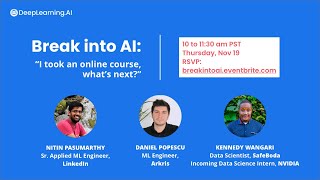
Three ML engineers share how they went from online courses to industry jobs. They built portfolios on Kaggle and GitHub, landed internships, and prepped for interviews by reading papers and doing mock interviews. Nitin works at LinkedIn, Daniel at Arcris, and Kennedy is joining NVIDIA.
Chapters
Sam.
Hi everyone and welcome. My name is Sandhya Simhan and I'm the Director of Marketing and communications at DeepLearning AI. We appreciate you taking some time out to join us for this event at DeepLearning AI. Our mission is to make world class AI education accessible to everyone. We aim to empower our community of aspiring and current machine learning practitioners to be a part of the AI transformation that is happening across so many industries. Besides building new courses, part of that work is to help our learners sort out the steps after finishing our courses, including how to land your first machine learning job. Last month we assembled a panel of technical recruiters to share their tips with you. If you missed that event, scroll down to the event description for a link to the YouTube recording. Today we have panelists who have successfully made the transition from online courses to now working in AI for a few years. They'll be sharing their firsthand suggestions on potential career paths, as well as tips and best practices for interview prep. You can find the list of topics we'll be covering in the first half in the event description. Afterwards, we'll be taking questions from the community via Slido. Only the people who have signed up for the Slido ticket will be able to access the page. Please to post and upvote questions. And now, without further ado, I'd like to welcome our panel speakers. They are Nitin Pasumarthy, senior applied Machine learning engineer at LinkedIn.
Hi everyone. It's my pleasure. Thanks for having me.
Daniel Popescu, a machine learning engineer at arcris.
Hello.
And Kennedy Wangari, data scientist at Safeboda and an incoming data science intern at Nvidia.
Hi.
Thank you for having me for this session.
Very excited to have all you here with us. For the next 40 minutes or so, I'll be asking some questions to our panelists while I'll direct questions to a specific person. I'd also like to encourage any of you on the panel to jump in, offer your input in the conversation. So let's start off with a brief introduction from everyone. Nitin, do you want to go first?
Yeah, sure. Hi everyone, I'm Nitin Pasmorti from LinkedIn and I've been working at LinkedIn for almost three years and right now I am working on applied machine learning problems for performance at LinkedIn.
Daniel.
Hello, I'm Daniel. I've been working as a machine learning engineer for about two years. Before that I worked as a web developer for almost seven, eight years. Yeah.
And Kennedy.
Thank you. I'm Kennedy Wangari, currently working with Safe border as a data scientist and currently just working on trying to improve our machine learning workflows to be able to help us improve in terms of understanding our customer journey. And thank you.
Awesome. So obviously we know a little bit about what each of you guys do right now, but I'd love to kind of go back to the beginning. So can each of you tell us what is your background? What were you doing before you even heard of the word machine learning? And then how did you first get started in AI?
Daniel yeah, my story is quite funny in a way because so I was working as a web developer for a lot of years up till then and at some point I kind of had a middle life crisis but earlier and decided I kind of want to see more do more and actually took a sabbatical in which I just went and started learning other other technologies, other stuff. I ended up starting the deep learning AI specialization. After the first course I was actually pretty hooked and already in love with machine learning. After that it was just uphill thing where I started doing courses and slowly building up my knowledge in the area.
Very cool. Nitin, I saw you nodding a lot as Daniel was talking. Do you want to share your story?
Yeah, sure. I shared a very similar experience. Like Daniel, I was also a software engineer web developer for a long time before joining LinkedIn around four years back at Apple I was a data analysis tool designer where kind of used my web designing and software engineering skills to make robust big data analysis tools and with a slight focus in distributed databases which was my thesis during masters. So I had a typical computer science background and like many of you I wanted to solve real world challenging problems using like smart algorithms. So for example, instead of building a medicines catalog app which can catalog all the medicines, I wanted to make it more useful if it like make some initial diagnosis. And that's where after talking to a lot of friends and doing a lot of blog reading I realized maybe machine learning is the way to solve such problems. So I set myself becoming an applied machine learning engineer since then as the next career path. Since 2017ish.
Very cool.
And then Kennedy Chris My background is in information technology. That's the undergraduate degree that I pursued and currently I'm preparing myself to pursue a master's degree program at the University of Michigan. And looking at how I started in AI, I could say this was way from when I secured a business intelligence analyst internship role with a local bank here in Kenya. And during that time period working with the various data teams, it made me realize my passion Working with data and also trying to solve various customer problems with data. And this really sparked interest and fueled me to in terms of any activities, in terms of all other work that came after my BI internship role at that bank and looking at how the bank was applying AI applications to try and solve various customer problems and also looking at the various ways that AI was providing new techniques to solve problems in the bank made me feel more excited. And I could say that's how I started my journey into the data science field. And having a strong background in software engineering and bi, it was quite easy now to take up the deeplearning AI courses. And long story short, here we are joining Nvidia next year.
Yes. And congratulations on the Nvidia position.
Thank you.
I'd love for you guys to share a little bit about how did you choose to even apply for the current positions you're in? Daniel?
Okay. For me, at some point I started specializing in NLP and while I was working on small projects on my own, I actually got presented with a job. So I didn't really apply, I was just around on LinkedIn and things like that and they saw my interest in NLP and that was very similar with the projects that the startup was working on. We are working on a chatbot that interviews people and helps HR with different processes. And yeah, so for me it was a bit different because I was actually approached, I didn't start looking for a job from the start, but that's actually quite a nice thing because you know, I, I did a lot of courses and I didn't have to start looking for something. I kind of was approached already by someone else based on the credentials that I was getting from. Course.
Got it. Well, that's a pretty wonderful scenario. Kennedy and Nitin, did you guys have a similar experience?
I could say after completing my first BA internship role in 2018 and then going back again in 2019 to the same bank now as a data science intern, I could say at that point, now after my internship my main question was what next? And while still thinking of how I could now be able to maybe get a role to help me now be able to grow in the industry and gain more skills at the same time also working at that point, that's when I was reached out by a certain firm and that's how I was able to start my first full time data sales role. But because of the culture there, I did not, I didn't stay for long. And that's how I was also reached out by the team at Safe Border And I could say that the skills that I gained from the DeepLearning AI courses really helped me in terms of being able to structure various projects, being able to confidently work on various data science and machine learning projects. And I can say at Safe Board majorly my work has been all around predictive marketing analytics. For the last six months that I've been there, I've worked on a couple of projects helping the sales and marketing team on optimizing marketing campaigns, working on targeting of our various products to various customers and understanding their behaviors. And I can say currently what I'm doing right now is working with the various data teams that are there to like I did mention earlier, to see how can we improve how our pipelines, that is the data science and machine learning pipelines, to be able to ingest more data, to be able to streamline our processes so that we're able to get more customer engagement data to help us with the sales team in terms of being able to understand more to the customer journey and all that. So that's what I'm doing currently and also how I was able to get to the current position.
Fair enough.
And Nitin, so my story is a little different than Daniel and Kennedy. So I was a web developer and for a long time I was only building websites and doing some little bit of databases, but I wanted to use ML knowledge that I gained from the deep learning AI courses to eventually reach where I wanted to reach. So I started doing a lot of pet projects but I was unable to scale given the amount of work at office and immediately after the office work doing these pet projects. So I started applying for roles which are close to web designing but also have a scope for doing more optimization and performance work, not directly ML but kind of closer in that direction. So which I felt was a little good middle ground. So because I have some skills that I can showcase in the interview and prove to them that okay, I am good at these things and also those optimization and performance kind of tasks can let me apply ML knowledge is what I thought initially that was the plan. And with that plan I just updated my LinkedIn profile and updated the title and stuff and I was approached by a LinkedIn recruiter funnily very soon.
Apparently LinkedIn recruiters use their own product.
Yeah, it looks like. Yeah, immediately. I mean that was instantaneous.
Okay, can I ask what sort when you were identifying? I'm currently a web developer. I'm looking for X role that has both a little bit of web development but also a little bit of optimization stuff. Where I can start using ML vs full on machine learning engineering. What were the sort of role titles that you were looking at as sort of that middle ground?
So I don't know if it was a standard then or it is now, but like it's more of a standard now is what I feel. But that time I felt machine learning is a little too direct and I may not be able to crack such kind of roles. So I started phrasing myself as Applied Machine Learning in web. So something in between. So applying machine learning knowledge with my web designing skills.
Got it. Like in your domain expertise.
Yeah, exactly. Right.
Okay, very cool. Yeah, the lack of standardization of titles is something we hear from our learners a lot. Like, you know, a data scientist at one place is not a data scientist at another place, you know, it's a machine learning researcher instead. And so that, that can get confusing. One of our sister companies, Work Era, is trying to resolve that as best as they can by creating more industry wide assessments. But it's definitely still a work in progress and it's very nascent, so I appreciate that. It's hard to explain this is how much I can do in the, what is it, hundred characters that you have in a LinkedIn title. So I know that all of you guys obviously have done more than just take courses as part of your progress towards, you know, becoming machine learning engineers and data scientists. So I was wondering if you could, if any of you could chat a little bit about, you know, what did you do to build your portfolio to actually show a recruiter that reached out. Hey, I actually have, you know, like relevant skill sets that are, that I've applied.
Okay, I'll try to go first. After, after I did a bit of the deep learning specializations and some other specializations actually also from Coursera, I started applying them in a way in Kaggle competitions which I guess most of the users watching right now know about. That was really a great thing because after Delta, up till that point, you know, in the courses you, you get theoretical information and you kind of do something practical but really with your hand hold it. And in the Kaggle competition you actually get to work with big data, very big data in a way, but also just are free to test and do whatever level you feel comfortable with, you know. And also a great tool is the community there because you get a lot of other solutions from other people during the competition, you know, so you learn quite a lot in that time. I can say that at my first competition, I mean I didn't do any good, but I Learned so much like applying the knowledge I had. And also it was one of the first times that I was like, okay, so I don't need to look at stack overflow for this. I kind of know what to do. I just need to test it. That was quite interesting.
That's a pretty awesome feeling that first time that you're like, hey, I did this from my brain.
Yeah. And that's after seven years of web development. And granted there you have to search a lot of other things because it's quite picky, but yeah, it's pretty cool.
And so what were you, what platform were you using?
What do you mean?
What platform were you using for competitions? Like, was it Kaggle? Was it something else?
Oh, it was Kaggle. It was Kaggle. The main, the main Kaggle competitions. Yeah, whatever. I found at that moment to be that I liked the competition that I liked, I went for it. After a while I started liking just NLP competitions. I only tried those.
But are the competitions how you decided that, hey, NLP is the area that I want to focus in on?
Kind of, yeah, actually, yeah, yeah. I really can't remember right now. What was the competition? It was something from Google, I think. And at some point I just started working in, at this project of the competition. But at some point during that I actually started liking something that I read in a paper that was supposed to help me with the competition, you know, but it was so interesting that I kind of left the competition and just started working on that thing because it was more interesting at the moment. And that's from, from that moment on I kind of went to NLP and made a whole plan for me to start gathering knowledge in that area and specialize myself in a way. Then after that, after like three, four months of that, I got approached by the current company that I'm working with.
Got it. And Kennedy, I know you've done a lot besides just courses as part of building out your professional network and such. Would you mind chatting with us a little bit about that?
Great. I could say for me, I've explored different ways that really helped me to be able to build a good portfolio. One way is that I was able to be able to take up two BI and data science related internships that provided a great foundation. I've also been involved in taking up real world projects with various companies such as Omdena and also Google AI for social good. And also I've also been able to take part and participate in a couple of data science hackathons and competitions and more to that I'm one person who is quite passionate when it comes to AI communities, have been involved with learning at the same time, also working with AI communities, collaborating and doing a couple of projects. And I could say more to that. I also have a group of my friends, we have a paper reading club, so we always get to do deep learning literature. We're able to summarize machine learning papers. And above all, I could say I'm actively involved in open source work. I believe most of us have in one way or the other come across maybe my data science posts or opinions or basic, basically getting to share more to either my projects or sharing more to various topics in data science, machine learning practice and all that. And I can say all that in lump sum have really helped me to be able to build a good portfolio and also be able to introduce me to other professionals in the field and get to engage more.
Awesome. And I think something that Kennedy is being very humble about is the fact that he's one of our most active event ambassadors as part of the PI and AI community meetups that Deep Learning hosts and has been a key part of what makes the Kenyan chapters so successful as well. And Nitin, I know that. Did you approach competitions as sort of a way to help you showcase and pick up, you know, the skills that you wanted? Was there something else that you did?
So, yeah, like just like Daniel, I tried attending some competitions but I was not, not good at it initially.
So.
So I started doing my own stuff, learning more about the machine learning concepts. But slowly I picked up the momentum and understand it, understood what actually that is the core concept that was missing. So went back to the course and did and I started doing much better. But then at that time around I was approached by LinkedIn and there I got a chance to really work on some real projects and apply the knowledge that I gained from all these sources in that project and build quick prototypes and that really helped revise and apply, revise and apply. That cycle really helped me get better at it.
That makes sense. It seems like for all of you, nothing really quite beats actually doing the work. You know, getting in there, actually trying it out, getting practicing and practicing with it in various, you know, incarnations until you feel more secure in your skills. That's a really great takeaway for our audience. I would love to now ask. Well, I think one of the questions we get from our learners very frequently is how do I know that I'm ready to work in the machine learning industry? And it seems like all of you approached it through Less of a, you know, binary system of like, oh, I'm in, and then, nope, I'm all the way in. Instead, you found a more incremental approach. What would you recommend for people as like, sort of, you know, okay, hey, I've completed a specialization. I've completed, you know, dls, for example. Like, what do I do now?
From my point of view, I actually get this question quite a lot. In the past year, I've got this question quite a lot. And what's interesting is that I got it from persons in very various stages. Like one person was with eight courses already done. One was only with one. One was already a senior engineer at some big firm and so on. So it really varies. And I would say that when you, when you start doing a bit of applied work and see that you can handle building a project, like doing all the steps, you know, gathering the data, selecting the features, training and redoing all those steps till it gets better. At that point you already are kind of ready. It just depends on how high you want to aim. Like, you know, there are very various levels of jobs out there. So it really depends on how much time you have left to learn. Like if you, if you are like me, like I took a sabbatical, which I know I knew was for a bit over six months, then I, I allowed myself all those six months to learn more and more and more. You know, I felt like I was ready around the three months mark. But if you have time, I guess just learn as much as you can and then I think you're pretty ready already. In most cases it really depends on what level you want to work on.
That's a really fair point. Nitin, you look like you had something to say.
Yeah, I just want to add to that saying it all depends. Like if you feel that you are able to perform all the different stages of the pipeline, the work era report that you are referring to has a very nice way to describe your role succinctly based on the skill sets that you have gained while doing these courses. So I think some data scientists expect maybe modeling and feature engineering. So maybe if those are the things that you feel confident about doing, say in a real project, in a company, then I think trying to going deep in that particular stack also helps to get a job faster and you can at least start there immediately by applying in those roles as well.
That's very fair. To play devil's advocate here. Would you say that there is a base level of multiple things that a machine learning engineer or data scientist needs to learn first and then before you specialize, or do you think that, you know, the specialization is beneficial in and of itself, especially when you know you're applying for larger companies that tend to have more specialized roles?
That's. Go ahead, Daniel.
No, go ahead.
So that's a very good question. So whether we want to go broad or whether you want to go deeper, it totally depends on the interest because all the skills that are required for an ML project are very different. I had a database systems background, so feature processing was kind of an easy thing to tackle first for me and go deep. But at the same time I was spending enough amount of time on modeling as well. So that was the thing that I kind of tried to focus on in my early projects in ML and also work with other teammates in the company to learn the other aspects. So my journey was like deep and as well go broad, but it can work the other way for others as well.
Yeah, related to this, to the question. I mean I really think that the basics in this area in machine learning are much more important than in other jobs. You know, like for example, as I said, I was a web developer. The basics there was, were also important, but not as much. Not like you could start learning a framework without knowing everything that's going behind it, you know, but in, in machine learning you can't really. I mean you can use Keras for example, without knowing too much, but it won't help you go very far with. Without knowing the basics and actually what's going underneath that. So this much more than in other jobs really needs the basics to be, to be known. Well, you know, I, I'm kind of a perfectionist. So I, for example, for me I did the like three courses of the basics. I did the deep learning specialization, then I did the machine learning from Andrew Ng. Then I did another thing that was going through papers of the basic things. So. But that's because I'm a bit crazy with really putting them clearly in my mind. But still, I mean, I think the basics are very important for this job, especially.
Kennedy. You look like you had something to say.
I would also get to just build up to what Daniel has said, that once you've been able to build your foundational skills with the deeplearning AI specialization and you could opt maybe to take up either go in depth or cover breathworks. And as you continue to build up your competencies while taking up the projects, it gets to point. One thing is you never get at any point where you will feel that you are ready to apply for any role, you have to take that courage and be confident that with the skills that you've gained, you're able to build solutions and you're able to take up roles. And that's why I always prefer the mode of once you've, like Nitin said, once you've been able to learn the basics of almost each and every part of the workflows and you can be able to build a simple model the best. I think what would work best for me is if you're able to build a real world application, whether it's a simple project and you continue growing on that, you get to a point where you feel you're confident and you can be able to even take up complex projects and you can be able to apply for any role that excites you either to maybe in a specific niche area or maybe depending if you just want to cover breadthwise of the various topics that are there. And again, I would say you never get to any point that you feel that you're ready to apply for any specific role, but go ahead, apply for that role and showcase to them that you can be able to solve problems, you are an innovator and you can build end to end solutions.
Got it? Very solid advice, very bold advice too. It's like take that first step, make that leap. I know we've been talking a lot about sort of, you know, getting ready to apply for that first machine learning job, but one of the biggest, maybe scariest aspects of actually landing a job is the interview process. And so I was wondering if you guys would be willing to share a little bit about how, you know, although all three of you were approached in various capacities by the recruiters, you know, when we were going through the interview, what was the most, you know, I guess like what was the most apprehensive part and how did you prepare for it?
Maybe I could go first briefly, maybe sharing more to my interview experience with Nvidia and I could say it was one quite intensive and thorough rounds of interview. There were three rounds of interview and they started by one being reached out by Nvidia recruiter and we had just a quick initial phone screen call that was more of basically getting to understand more to my personality and compatibility and also taking me through the opportunities that were there at Nvidia. And then after that I was invited now for the first round of interview. And coming into this interview we already an understanding of what the role was all about. It was heavy, it had heavy product components and the questions were all majorly around statistics and a B testing more of designing and analyzing experiments. And also during that time I was also able to have a technical discussion on my previous experiences and the projects that I'd done. And then moved on now to the second round of interview. And during this interview process it was also heavily technical, but it was more involved now on the specific role with engaging more on a use case project scenario where we engaged. And then I was also able to make a submission and also an according interview. And lastly, I was having achieved satisfactory results, I was now invited to the third round. The third round was very brief and this road I was interviewing with the team lead for the Data Rapids team at Nvidia and the session was very brief, but also technical. And lastly after that, after maybe a week, I was able to receive the offer. And then now building up to the second part of your question, how I was able to prepare for this role, I could really say that one way that really helped me was I was able to research intensively both from the internal teams and also from what is already out there in the Internet, to be able to understand the kind of projects Nvidia was working on, the challenges that they were going through, their goals and all that. And this really helped me to have insights to understand more to the company. I was also able to do more research around the specific role, what is expected and all that. And also before coming to all these rounds of interviews, I spent a great time to understand more to the profiles of the interviewing team, to be able to understand what is the existing work that is out there, what is their opinions, what have they shared out there, and maybe going to look at various sources to understand more to them. And this helped me to be able to build a couple of questions to at least have a good conversation and all that with them. And also another thing that really helped me was with the internal teams at Nvidia, through the engagements with them, I was able to understand more to the ongoing projects and what they were aiming to do. So this really helped me to form also a good baseline when having the conversation with him. And another thing that really helped me being the fact that this was a product based role, I tried to interact with some of their products and during the sessions I was able to share with them some of the feedback based on how I was able to interact with these products. And also all these intensive research engagements really helped me to be able to come up with valuable questions to ask the teams. Because one thing that I know is that if you able to ask insightful questions to the business. It means that you understand the problems and you can be able to have a good conversation with them. And also lastly, I was able to use some of the resources out there like the crack the coding interview for the coding questions. And also I looked at, I practiced a good number of mock up data science interviews, SQL statistics encoding and all these collectively really helped me to be able to confidently go through the three rounds and finally land an offer. So that is briefly of my whole interview process and what greatly helped me to be able to secure the role of where I'll be joining Nvidia next year.
That is a fantastically thorough review of what you did to prep. Thank you. I'm sure our learners will really appreciate that. Daniel or Nitin, is there anything that additional that you guys felt was helpful when you were preparing for your respective interviews?
I don't think additionally we could add to that. It was pretty comprehensive already.
Fair enough. I do have a little bit of a curveball question and perhaps Daniel or Nathan, you'd be able to answer this. When you were preparing, when you were trying to figure out what exactly will this role entail, what are exactly responsibilities and what sort of, you know, specific domain expertise do I need to pick up in order to be successful at this role, were you able to use, you know, the job listing as a source of that or did you feel that it was the conversations with the recruiters that were, you know, really allows you to really understand what the role required.
I can start. So in my opinion talking to the recruiter, especially given like I said before, AI landscape was quite broad. Engineer, applied scientist, applied machine learning engineers. So many varieties are exist today. While that is still getting standardized. I think if you can share your skill and interests and intent of what you want to work on very clearly on your resume and Also on your LinkedIn profile or wherever it really helps. I mean they can help you connect with the right teams and they can also help you connect to the right kind of interviews. Like if I may not be great at data processing or distributed systems, but that is an expected thing for a machine learning engineer. So if I set that out straight in the beginning, they will have maybe a lighter version of that particular round and a more aggressive version of the other rounds which I am confident on. It is certainly possible to fine tune the rounds based on the skill set. It's just we need to share it upright and clearly.
Yeah, I agree. Like I think you do get a lot of information from just the job description. In a way you know what to prepare. But again I would go to the basics in a way, like Kennedy and Nitin were kind of now at the more senior level in a way. I would explain a bit more for juniors in a way maybe because, for example, for my company, we're preparing to extend the team in a way a bit. And that will be kind of my role. And what I started preparing and what I know I want to look for most is that the candidate can really go confidently and on its own, mostly through those, through those important steps, like, you know, understanding the data correctly, being able to research. Because in machine learning, a big part of it is research. Even if you don't go on a research, you know, you still, you still need a lot of research capabilities. In a way.
You mean. Of course, something else. Sorry, when you say like research capabilities, do you mean research papers or.
Yeah, yeah, I mean, I mean the research papers that come from the conferences. Well, for the specific task, like. Yeah, for the specific task. It's very specific. That is quite important. Like, I know for sure Nitin and Kennedy can maybe attest to that, that they had to read a lot since they got the job and started working.
Yeah.
And I guess that that would be a huge, huge plus in a way. And of course being able to understand the models and you know, go. Go a bit beyond the basics of them. Like, it's not really enough to know the basic. That you see on every tutorial out there online. It's good if you are able to tell me more specific things like. Yeah, but if you remove this layer and add something else, you get something completely different. And why, you know, the why is very important in this case.
Okay, no, that's a really valid point. I know that one of the things that we hear is, you know, I take these courses, I learn the basics of the information, but the really only way to keep up with the latest knowledge is to. Is to be in there and reading the research papers and really digesting them. I know Kennedy mentioned a paper reading circle or group that he has to help sort of, you know, help people, you know, get a better handle on research papers that are coming out now. I obviously have to tout the batch, which is, you know, where we summarize research papers for subscribers. But is there, are there any resources or tactics that you use, Daniel and Mithin, in terms of, you know, helping. Sure. That you're keeping up to date with the latest research that's relevant to your work?
For me, at some point, I think around the beginning of this year, I made the challenge for myself. Like, read One paper a day, which wasn't easy because a paper is pretty big. To really understand it you need to like a lot of time. But that was with great, great effects. Like it was hard, it took a lot of time. But I did it for about two months and a half. Then I slowed down because I work and other things, you know, you don't really get to do it forever. But I learned like so much because of the, because of it. And I still try to do it like to read at least one paper a week or something like that. And mostly I'm using at the start of course you need some kind of roadmap or something like that. But after you start I'm pretty sure that this goes for everybody. After you start you'll kind of know what you want to read next because it links together, you know, it's. You find the specialization in a way and then you know that oh this, this. You see some newsletters and you know, okay, this one is really interesting for me. I'll put it in the, in the reading list, kind of, you know.
Got it. That makes sense. Nitin, was there something you wanted to add?
Yeah, like one, One slight thing I would like to add is. So there are a lot of websites like Paper storage with code or I think probably I forget the name exactly but they kind of digest just like batch does. They kind of digest the most important aspects of papers and put them in easy to understand manner. If I found some papers quite relevant to my job and math can be very daunting and I think it might scare at least it scares me away when I see a lot of math in paper. So the way I do it is look at the code that they published on GitHub and try to like break it down, play it on Jupyter notebook, try to delete some lines and like execute some functions. So some core math topics which I'm not able to follow immediately. I try to understand them as black boxes, a small unit of, of work. What does it do? Slowly I think I understand the entire landscape of the paper, what they're trying to do like that.
I would like to say something regarding this, regarding the math thing. Like when I after I did the first specialization I started reading some papers and like Nitin I was very scared about because I realized okay, so I understand just the first chapter and that's about it. And because I wasn't good at math, I'm a good programmer but not good at math. But because of, actually because of the love for the field I decided to get good at it in a way. And actually, I took a specialization, I think it was called mathematics from 4mL or something like that, also from Coursera, and can't say that now. I'm okay, an expert or something, but I do understand the papers a lot better. You know.
Our founder, Andrew Ng, is very famous for saying, you know, don't worry about the math. But it seems, you know, what you guys are saying is, you know, at first you may not need to worry about it, but it does help help the more advanced you get to have that grounding.
Yeah, in a way, it's true. Don't worry about the math. Because, look, I wasn't good at math at all, but I really managed to get ahead of it just by pushing through.










