Bret Weinstein: Truth, Science, and Censorship in the Time of a Pandemic | Lex Fridman Podcast #194
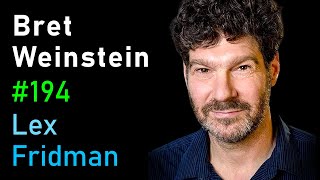
Bret Weinstein argues SARS-CoV-2 likely came from a lab with over 95% probability, points to genomic anomalies, and discusses ivermectin's claimed 86% prophylactic effectiveness. He critiques censorship of these topics on platforms like YouTube and raises concerns about vaccine risks including antibody-dependent enhancement and VAERS underreporting.
Questions this video answers
June 25, 2021.
He stated the likelihood the virus came from a lab is well above 95% (his personal estimate).
Approximately 86% effectiveness as a prophylactic (as reported in the discussed meta‑analysis).
He cited 'above 5,000' unexpected deaths in the US and referenced estimates up to ~25,000 (as discussed).
Chapters
The following is a conversation with Bret Weinstein, evolutionary biologist, author, co host of the Dark Horse podcast and, as he says, reluctant radical. Even though we've never met or spoken before this, we both felt like we've been friends for a long time. I don't agree on everything with Brett, but I'm sure as hell happy he exists in this weird and wonderful world of ours. Quick mention of our sponsors, the Jordan Harbinger Show, ExpressVPN, Magic Spoon, and Four Sigmatic. Check them out in the Description to support this podcast. As a side note, let me say a few words about COVID 19 and about science broadly. I think science is beautiful and powerful. It is the striving of the human mind to understand and to solve the problems of the world. But as an institution it is susceptible to the flaws of human nature, to fear, to greed, power and ego. 2020 is a story of all of these that has both scientific triumph and tragedy. We needed great leaders and we didn't get them. What we needed is leaders who communicate in an honest, transparent and authentic way about the uncertainty of what we know and the large scale scientific efforts to reduce that uncertainty and to develop solutions. I believe there are several candidates for solutions that could have all saved hundreds of billions of dollars and lessened or eliminated the suffering of millions of people. Let me mention five of the categories of masks at home testing, anonymized contact tracing, antiviral drugs and vaccines. Within each of these categories, institutional leaders should have constantly asked and answered publicly, Honestly the following three 1. What data do we have on the solution and what studies are we running to get more and better data? 2. Given the current data and uncertainty, how effective and how safe is the solution? 3. What is the timeline and cost involved with mass manufacturing distribution of the solution? In the service of these questions, no voices should have been silenced, no ideas left off the table. Open data, open science, open honest scientific communication and debate was the way, not censorship. There are a lot of ideas out there that are bad, wrong, dangerous. But the moment we have the hubris to say we know which ideas those are is the moment we'll lose our ability to find the truth, to find solutions, the very things that make science beautiful and powerful in the face of all the dangers that threaten the well being and the existence of humans on Earth. This conversation with Brett is less about the ideas we talk about. We agree on some, disagree on others. It is much more about the very freedom to talk, to think, to share ideas. This freedom is our only hope. Brett should never have been censored I asked Brett to do this podcast to show solidarity and to show that I have hope for science and for humanity. This is the Lex Friedman podcast, and here's my conversation with Brett Weinstein. What to you is beautiful about the study of biology, the science, the engineering, the philosophy of it.
It's a very interesting question, I must say. At one level, it's not a conscious thing. I can say a lot about why as an adult, I find biology compelling. But as a kid, I was completely fascinated with animals. I loved to watch them and think about why they did what they did. And that developed into a very conscious passion as an adult. But I think in the same way that one is drawn to a person, I was drawn to the never ending series of near miracles that exists across biological nature.
When you see a living organism, do you see it from an evolutionary biology perspective of like this entire thing that moves around in this world? Or do you see like from an engineering perspective that, like first principles almost down to the physics, like the little components that build up hierarchies. You have cells first, proteins and cells and organs and all that kind of stuff. So do you see low level or do you see high level?
Well, the human mind is a strange thing, and I think it's probably a bit like a time sharing machine in which I have different modules. We don't know enough about biology for them to connect, right? So they exist in isolation, and I'm always aware that they do connect, but I basically have to step into a module in order to see the evolutionary dyn of the creature and the lineage that it belongs to. I have to step into a different module to think of that lineage over a very long time scale. A different module still, to understand what the mechanisms inside would have to look like to account for what we can see from the outside. And I think that probably sounds really complicated, but one of the things about being involved in a topic like biology and doing so for one, you know, really not even just my adult life for my whole life, is that it becomes second nature. And, you know, when we see somebody do an amazing parkour routine or something like that, we think about what they must be doing in order to accomplish that. But of course, what they are doing is tapping into some kind of zone, right? They are in a zone in which they are in such command of their center of gravity, for example, that they know how to hurl it around a landscape so that they always land on their feet. And I would just say for anyone who hasn't found a topic on which they can develop that kind of facility. It is absolutely worthwhile. It's really something that human beings are capable of doing across a wide range of topics, Many things our ancestors didn't even have access to. And that flexibility of humans, that ability to repurpose our machinery for topics that are novel, means really the world is your oyster. You can figure out what your passion is and then figure out all of the angles that one would have to pursue to really deeply understand it. And. And it is well worth having at least one topic like that.
You mean embracing the full adaptability of both the body and the mind. So, like. Cause I don't know what to attribute the parkour to, like, biomechanics of how our bodies can move, or is it the mind? Like, how much percent wise? Is it the entirety of the hierarchies of biology that we've been talking about, or is it just all the mind?
The way to think about creatures is that every creature is two things simultaneously. A creature is a machine of sorts, right? It's not a machine in, in the, you know, it's. It's. I call it an aqueous machine, right? And it's run by an aqueous computer, right? So it's not identical to our. Our technological machines. But every creature is both a machine that does things in the world sufficient to accumulate enough resources to continue surviving, to reproduce. It is also a potential. So each creature is potentially, for example, the most recent common ancestor of some future clade of creatures that will look very different from it. And if a creature is very, very good at being a creature, but not very good in terms of the potential it has going forward, then that lineage will not last very long into the future because change will throw at challenges that its descendants will not be able to meet. So the thing about humans is we are a generalist platform and we have the ability to swap out our software to exist in many, many different niches. And I was once watching an interview with this British group of parkour experts who were being, you know, just. They were discussing what it is they do and how it works. And what they essentially said is, look, you're tapping into deep monkey stuff, right? And I thought, yeah, that's about right. And, you know, anybody who is proficient at something like skiing or skateboarding, you know, has the experience of flying down the hill on skis, for example, bouncing from the top of one mogul to the next. And if you really pay attention, you will discover that your conscious mind is actually a spectator. It's there, it's involved in the Experience, but it's not driving. Some part of you knows how to ski and it's not the part of you that knows how to think. And I would just say that what accounts for this flexibility in humans is the ability to bootstrap a new software program and then drive it into the unconscious layer where it can be applied very rapidly. And you know, I will be shocked if the exact thing doesn't exist in robotics. You know, if you, if you programmed a robot to deal with circumstances that were novel to it, how would you do it? It would have to look something like this.
There's a certain kind of magic, you're right. With the consciousness being an observer. When you play guitar, for example, or piano for me, music, when you get truly lost in it, I don't know what the heck is responsible for the flow of the music. The kind of the loudness of the music going up and down, the timing, the intricate like even the mistakes. All those things that doesn't seem to be the conscious mind. It is just observing and yet it's somehow intricately involved. More like, because you mentioned parkour, dance is like that too. When you start, I've been tango dancing. If when you truly lose yourself in it, then it's just like you're an observer. And how the hell is the body able to do that? And not only that, it's the physical motion is also creating the emotion. The like that damn was good to be alive feeling. So but, but then that's also intricately connected to the full biology stack that we're operating in. I don't know how difficult it is to replicate that. We're talking offline about Boston Dynamics robots. They've recently been. They did both parkour, they did flips, they've also done some dancing. And it's something I think a lot about because what most people don't realize because they don't look deep enough is those robots are hard coded to do those things. The robots didn't figure it out by themselves. And yet the fundamental aspect of what it means to be human is that process of figuring out, of making mistakes. And then there's something about overcoming those challenges and the mistakes and like figuring out how to lose yourself in the magic of the dancing or just movement is what it means to be human, that learning process. So that's what I want to do with the, with the. Almost as a fun side thing with the Boston Dynamics robots is to have them learn and see what they figure out. Even if they make mistakes, I want to let Spot make mistakes. And in so doing, discover what it means to be alive. Discover beauty, because I think that's the essential aspect of mistakes. Boston Dynamics folks want Spot to be perfect because they don't want Spot to ever make mistakes, because it wants to operate in the factories, it wants to be, you know, very safe and so on. For me, if you construct the environment, if you construct a safe space for robots and allow them to make mistakes, something beautiful might be discovered.
But.
But that requires a lot of brain power. So Spot is currently very dumb, and I'm going to give it a brain. So first, make it see. Currently, it can't see, meaning computer vision. It has to understand its environment, has to see all the humans, but then also has to be able to learn. Learn about its movement, learn how to use its body to communicate with others. All those kinds of things that dogs know how to do well, humans know how to do somewhat well. I think that's a beautiful challenge. But first you have to allow the robot to make mistakes.
Well, I think your objective is laudable, but you're going to realize that the Boston Dynamics folks are right the first time Spot poops on your rug.
I hear the same thing about kids and so on, but I still want to have kids.
No, you should. It's a great experience. So let me step back into what you said in a couple of different places. One, I have always believed that the missing element in robotics and artificial intelligence is a proper development, right? It is no accident, it is no mere coincidence that human beings are the most dominant species on planet Earth, and that we have the longest childhoods of any creature on Earth, by far. Right? Development is the key to the flexibility. And so the capability of a human at adulthood is the mirror image. It's the flip side of our helplessness at birth. So I'll be very interested to see what happens in your robot project if you do not end up reinventing childhood for robots, which, of course, is foreshadowed in 2001 quite brilliantly. But I also want to point out you can see this issue of your conscious mind becoming a spectator very well. If you compare tennis to table tennis, right? If you watch a tennis game, you could imagine that the players are highly conscious as they play. You cannot imagine that if you've ever played ping pong decently, a volley in ping pong is so fast that your conscious mind, if your reactions had to go through your conscious mind, you wouldn't be able to play. So you can detect that your conscious mind, while very much present, isn't there. And you can also detect where consciousness does usefully intrude. If you go up against an opponent in table tennis that knows a trick that you don't know how to respond to, you will suddenly detect that something about your game is not effective, and you will start thinking about what might be. How do you position yourself so that move that puts the ball just in that corner of the table or something like that doesn't catch you off guard? And this, I believe, is we highly conscious folks, those of us who try to think through things very deliberately and carefully, mistake consciousness for, like, the highest kind of thinking. And I really think that this is an error. Consciousness is an intermediate level of thinking. What it does is it allows you. It's basically like uncompiled code, and it doesn't run very fast. It is capable of being adapted to new circumstances. But once the code is roughed in, right, it gets driven into the unconscious layer and you become highly effective at whatever it is. And that from that point, your conscious mind basically remains there to detect things that aren't anticipated by the code you've already written. And so I don't exactly know how one would establish this, how one would demonstrate it, but it must be the case that the human mind contains sandboxes in which things are tested, right? Maybe you can build a piece of code and run it in parallel next to your active code so you can see how it would have done comparatively. But there's got to be some way of writing new code and then swapping it in. And frankly, I think this has a lot to do with things like sleep cycles. Very often, you know, when I get good at something, I often don't get better at it while I'm doing it. I get better at it when I'm not doing it, especially if there's time to sleep and think on it. So there's some sort of, you know, new program swapping in for old program phenomenon, which, you know, will be a lot easier to see in machines. It's going to be hard with the wetwear I like.
I mean, it is true because somebody that played, I played tennis for many years. I do still think the highest form of excellence in tennis is when the conscious mind is a spectator. So the compiled code is the highest form of being human. And then consciousness is just some specific compiler. You have to have Borland C compiler. You could just have different kind of compilers. Ultimately, the thing by which we measure the power of life, the intelligence of life, is the compiled code. And you can probably do that compilation all kinds of ways.
Yep. I'm not saying that tennis is played consciously and table tennis isn't. I'm saying that because tennis is slowed down by just the space on the court, you could imagine that it was your conscious mind playing. But when you shrink the court down, it becomes obvious. It becomes obvious that your conscious mind is just present rather than knowing where to put the paddle. And weirdly for me, I would say this probably isn't true in a podcast situation, but if I have to give a presentation, especially if I have not overly prepared, I often find the same phenomenon. When I'm giving the presentation, my conscious mind is there watching some other part of me present, which is a little jarring, I have to say.
Well, that means you, you've gotten good at it. Not let the conscious mind get in the way of the flow of words.
Yeah, that's, that's the sensation, to be sure.
And that's the highest form of podcasting too. I mean, that's why I have that. That's what it looks like when a podcaster is really in the pocket, like, like Joe Rogan, just having fun and just losing themselves. And that's, that's something I aspire to as well. Just losing yourself in the conversation. Somebody that has a lot of anxiety with people. Like, I'm such an introvert. I'm scared. I was scared before you showed up. I'm scared. There's just anxiety, there's just. It's a giant mess. It's hard to lose yourself. It's hard to just get out of the way of your own mind.
Yeah. Actually trust is a big component of that. Your conscious mind retains control if you are very uncertain. But when you do get into that zone when you're speaking, I realize it's different for you with English as a second language, although maybe you present in Russian and you know, and it happens. But do you ever hear yourself say something and you think, oh, that's really good. Right? Like, like you didn't come up with it. Some other part of you that you don't exactly know came up with it.
I don't think I've ever heard myself in that way because I have a much louder voice that's constantly yelling in my head at, why the hell did you say that? There's a very self critical voice that's much louder. So I'm very. Maybe I need to deal with that voice. But it's been like, what is it called? Like a megaphone just screaming so I can't hear the voice that says, good job. You Said that thing really nicely. So I'm kind of focused right now on the megaphone person in the audience versus the positive. But that's definitely something to think about. It's been productive. But you know, the place where I find gratitude and beauty and appreciation of life is in the quiet moments when I don't talk, when I listen to the world around me, when I listen to others, when I talk. I'm extremely self critical in my mind. When I produce anything out into the world that originated with me. Like any kind of creation, extremely self critical. It's good for productivity, for always striving to improve and so on. It might be bad for just appreciating the things you've created. I'm a little bit with Marvin Minsky on this where he says the key to a productive life is to hate everything you've ever done in the past.
I didn't know he said that. I must say I resonate with it a bit. And unfortunately my life currently has me putting a lot of stuff into the world and I effectively watch almost none of it. I can't stand it.
Yeah, what do you make of that? I don't know. I just recently, just yesterday read Metamorphosis by Kafka. Reread Metamorphosis by Kafka where he turns into a giant bug because of the stress that the world puts on him, his parents put on him to succeed. And you know, I think that you have to find the balance because if you allow the self critical voice to become too heavy, the burden of the world, the pressure that the world puts on you to be the best version of yourself and so on, to strive, then you become a bug. And that's a big problem. And then the world turns against you because you're a bug. You become some kind of caricature of yourself, I don't know, become the worst version of yourself and then thereby end up destroying yourself and then the world moves on. That's the story.
That's a lovely story. I do think this is one of these places. And frankly you could map this onto all of modern human experience. But this is one of these places where our ancestral programming does not serve our modern selves. So I used to talk to students about the question of dwelling on things. You know, dwelling on things is famously understood to be bad. And it can't possibly be bad. It wouldn't exist. The tendency toward it wouldn't exist if it was bad. So what is bad is dwelling on things past the point of utility. And you know, that's Obviously easier to say than to operationalize. But if you realize that your dwelling is the key in fact to upgrading your program for future well being and that there's a point presumably from diminishing returns, if not counterproductivity, there is a point at which you should stop because that is what is in your best interest, then knowing that you're looking for that point is useful, right? This is the point at which it is no longer useful for me to dwell on this error I have made. That's what you're looking for and it also gives you license. If some part of you feels like is punishing you rather than searching, then that also has a point at which it's no longer valuable. And there's some liberty in realizing, yep, even the part of me that was punishing me knows it's time to stop.
So if we map that onto compiled code discussion as a computer science person, I find that very compelling. You know, there's a. When you compile code, you get warnings sometimes. And usually if you're a good software engineer, you're going to make sure there's no, you know, you treat warnings as errors, so you make sure that the compilation produces no warnings, but at a certain point when you have a large enough system, you just let the warnings go. It's fine. Like I don't know where that warning came from, but you know, just ultimately you need to compile the code and run with it and hope nothing terrible happens.
Well, I think what you will find, and believe me, I think what you're talking about with respect to robots unlearning is going to end up having to go to a deep developmental state and a helplessness that evolves into hyper competence and all of that. But I noticed that I live by something that I, for lack of a better descriptor, call the theory of close calls. And the theory of close calls says that people typically miscategorize the events in their life where something almost went wrong. And you know, for example, if you. I have a friend who I was walking down the street with my college friends and one of my friends stepped into the street thinking it was clear and was nearly hit by a car going 45 miles an hour would have been absolute disaster, might have killed her, certainly would have permanently injured her, but she didn't, you know, car didn't touch her, right? Now you could walk away from that and think nothing of it because, well, what is there to think? Nothing happened. Or you could think, well, what is the difference between what did happen and my death the difference is luck. I never want that to be true. Right. I never want the difference between what did happen and my death to be lucky. Therefore, I should count this as very close to death and I should prioritize coding so it doesn't happen again at a very high level. So anyway, my, my basic point is the accidents and disasters and misfortune describe a distribution that tells you what's really likely to get you in the end. And so personally, you can use them to figure out where the dangers are so that you can afford to take great risks because you have a really good sense of how they're going to go wrong. But I would also point out civilization has this problem. Civilization is now producing these events that are major disasters, but they're not existential scale yet. Right. They're very serious errors that we can see. And I would argue that the pattern is you discover that we are involved in some industrial process at the point it has gone wrong. Right. So I'm now always asking the question, okay, in light of the Fukushima triple meltdown, the financial collapse of 2008, the Deepwater Horizon blowout COVID 19 and its probable origins in the Wuhan Lab, what processes do I not know the name of yet that I will discover at the point that some gigantic accident has happened? And can we talk about the wisdom, or lack thereof of engaging in that process and before the accident? Right. That's what a wise civilization would be doing. And yet we don't.
I just want to mention something that happened a couple of days ago. I don't know if you know who JB Straubel is. He's the co founder of Tesla, CTO of Tesla for many, many years. His wife just died. She was riding a bicycle. And in the same, in the same thin line between death and life that many of us have been in, where you walk into the intersection and there's this close call every once in a.
While.
It you get the short straw. I wonder how much of our own individual lives and the entirety of the human civilization rests on this little roll of the dice.
Well, this is sort of my point about the close calls is that there's a level at which we can't control it, right? The gigantic asteroid that comes from deep space that you don't have time to do anything about. There's not a lot we can do to hedge that out, or at least not short term. But there are lots of other things. You know, obviously the financial collapse of 2008 didn't break down the entire world economy. It Threatened to. But a Herculean effort managed to pull us back from the brink. The triple meltdown at Fukushima was awful, but every one of the seven fuel pools held. There wasn't a major fire that made it impossible to manage the disaster going forward. We got lucky. You know, we could say the same thing about the. The blowout at the Deepwater Horizon, where a hole in the ocean floor large enough that we couldn't have plugged it could have opened up. All of these things could have been much, much worse. Right. And I think we can say the same thing about COVID as terrible as it is. And, you know, we cannot say for sure that it came from the Wuhan Lab, but there's a strong likelihood that it did, and it also could be much, much worse. So in each of these cases, something is telling us we have a process that is unfolding, that keeps creating risks. Where it is luck that is the difference between us and some scale of disaster that is unimaginable. And that wisdom, you know, you can be highly intelligent and cause these disasters to be wise is to stop causing them. Right. And that would require a process of restraint, a process that I don't see a lot of evidence of yet. So I think we have to generate it. And somehow we. You know, at the moment, we don't have a political structure that would be capable of taking a protective algorithm and actually deploying it. Right. Because it would have important economic consequences, and so it would almost certainly be shot down. But we can obviously also say, you know, we paid a huge price for all of the disasters that I've mentioned, and we have to factor that into the equation. Something can be very productive short term and very destructive long term.
Also, the question is how many disasters we avoided because of the ingenuity of humans or just the integrity and character of humans. That's sort of an open question. We may be more intelligent than lucky. That's the hope. Because the optimistic message here that you're getting at is maybe the process that we should be, that maybe we can overcome luck with ingenuity. Meaning, I guess you're suggesting the process is we should be listing all the ways a human civilization can destroy itself, assigning likelihood to it, and thinking through how can we avoid that, and being very honest with the data out there about the close calls and using those close calls to then create sort of mechanism by which we minimize the probability of those close calls and just being honest and transparent with the data that's out there.
Well, I think we need to do a couple things for it to work. So I've been an advocate for the idea that sustainability is actually. It's difficult to operationalize, but it is an objective that we have to meet if we're to be around long term. And I realized that we also need to have reversibility of all of our processes, because processes very frequently, when they start, do not appear dangerous, and then they, when they scale, they become very dangerous. So, for example, if you imagine the first internal combustion engine in a vehicle driving down the street, and you imagine somebody running after them, saying, hey, if you do enough of that, you're going to alter the atmosphere and it's going to change the temperature of the planet. It's preposterous, right? Why would you stop the person who's invented this marvelous new contraption? But of course, eventually you do get to the place where you're doing enough of this that you do start changing the temperature of the planet. So if we built the capacity, if we basically said, look, you can't involve yourself in any process that you couldn't reverse if you had to, then progress would be slowed, but our safety would go up dramatically. And I think in some sense, if we are to be around long term, we have to begin thinking that way. We're just involved in too many very dangerous processes.
So let's talk about one of the things that, if not threatened human civilization, certainly hurt it at a deep level, which is COVID 19. What percent probability would you currently place on the hypothesis that COVID 19 leaked from the Wuhan Institute of Virology?
So I maintain a flowchart of all the possible explanations, and it doesn't break down exactly that way. The likelihood that it emerged from a lab is very, very high. If it emerged from a lab, the likelihood that the lab was the Wuhan Institute is very, very high. There are multiple different kinds of evidence that point to the lab, and there is literally no evidence that points to nature. Either the evidence points nowhere or it points to the lab. And the lab could mean any lab. But geographically, obviously, the labs in Wuhan are the most likely. And the lab that was most directly involved with research on viruses that look like Covid, that look like SARS, COV2 is obviously the place that one would start. But I would say the likelihood that this virus came from a lab is well above 95%. We can talk about the question of could a virus have been brought into the lab and escaped from there without being modified? That's also possible, but it doesn't explain any of the anomalies in the genome of SARS CoV2. Could it have been delivered from another lab? Could Wuhan be a distraction in order that we would connect the dots in the wrong way? That's conceivable. I currently have that below 1% on my flowchart.
But I think very dark thought that somebody would do that almost as a political attack on China.
Well, it depends. I don't even think that's one possibility. Sometimes when Eric and I talk about these issues, we will generate a scenario just to prove that something could, could live in that space. Right. It's a placeholder for whatever may actually have happened. And so it doesn't have to have been an attack on China. That's certainly one possibility. But I would point out if you can predict the future in some unusual way better than others, you can print money, right? That's what markets that allow you to bet for or against virtually any sector allow you to do. So you can imagine a simply amoral person or entity generating a pandemic, attempting to cover their tracks because it would allow them to bet against things like, you know, cruise ships, air travel, whatever it is, and bet in favor of, I don't know, sanitizing gel and whatever else you would do. So am I saying that I think somebody did that? No, I really don't think it happened. We've seen zero evidence that this was intentionally released. However, were it to have been intentionally released by somebody who did not know, did not want it known where it had come from, releasing it into Wuhan would be one way to cover their tracks. So we have to leave the possibility formally open, but acknowledge there's no evidence.
So, and the probability therefore is low. I tend to believe maybe this is the optimistic nature that I have, that people who are competent enough to do the kind of thing we just described are not going to do that because it requires a certain kind of. I don't want to use the word evil, but whatever word you want to use to describe the kind of disregard for human life required to do that, you're just that that's just not going to be coupled with competence. I feel like there's a trade off chart where competence on one axis and evil is on the other. And the more evil you become, the crappier you are at doing great engineering, scientific work required to deliver weapons of different kinds, whether it's bioweapons or nuclear weapons, all those kinds of things. That seems to be the lessons I take from history. But that doesn't necessarily mean that's what's going to be happening in the future. But to stick on the lab leak idea because the flowchart is probably huge here because there's a lot of fascinating possibilities. One question I want to ask is what would evidence for natural origins look like? So one piece of evidence for natural origins is that it's happened in the past that, that viruses have jumped.
Oh, they do jump. They.
So, like that's one, like that's possible to have happened, you know, so that, that's a sort of like a historical evidence. Like, okay, well, it's possible that it happened.
It's possible. It's not evidence of the kind you think it is. It's a justification for a presumption. Right, right. So the presumption upon discovering a new virus circulating is certainly that it came from nature. Right. The problem is the presumption evaporates in the face of evidence, or at least it logically should, and it didn't in this case. It was maintained by people who privately in their emails acknowledged that they had grave doubts about the natural origin of this virus.
Is there some other piece of evidence that we could look for and see that would say this increases the probability that it's natural origins?
Yeah, in fact, there is evidence. You know, I always worry that somebody is going to make up some evidence in order to reverse the flow.
Boy.
Well, let's say I am.
There's a lot of incentive for that.
Actually, there's a huge amount of incentive. On the other hand, why didn't the powers that be, the powers that lied to us about weapons of mass destruction in Iraq, why didn't they ever fake weapons of mass destruction interact? Whatever force it is, I hope that force is here, too. And so whatever evidence we find is real.
It's the competence thing I'm talking about. But. Okay, go ahead. Sorry.
Well, we can get back to that. But I would say, yeah, that the, the giant piece of evidence that will shift the probabilities in the other direction is the discovery of either a human population in which the virus circulated prior to showing up in Wuhan. That would explain where the virus learned all of the tricks that it knew instantly upon spreading from Wuhan. So that would do it. Or an animal population in which an ancestor epidemic can be found in which the virus learned this before jumping to humans. But I'd point out in that second case, you would certainly expect to see a great deal of evolution in the early epidemic, which we don't see. So there almost has to be a human population somewhere else that had the virus circulating or an Ancestor of the virus that we first saw in Wuhan circulating. And it has to have gotten very sophisticated in epidemic before hitting Wuhan in order to explain the total lack of evolution and extremely effective virus that emerged at the end of 2019.
So you don't believe in the magic of evolution to spring up with all the tricks already there. Like everybody who doesn't have the tricks, they die quickly. And then you just have this beautiful virus that comes in with a spike protein and through mutation and selection, just like the ones that succeed and succeed big are the ones that are going to just spring into life with the Trix.
Well, no, that's called a hopeful monster. And hopeful monsters don't work. The job of becoming a new pandemic virus is too difficult. It involves two very difficult steps and they both have to work. One is the ability to infect a person and spread in their tissues sufficient to make an infection. And the other is to jump between individuals at a sufficient rate that it doesn't go extinct for one reason or another. Those are both very difficult jobs. They require, as you describe, selection. And the point is, selection would leave a mark. We would see evidence that it would.
In animals or humans. We would see both.
Right.
You would see this evolutionary trace of, of the virus gathering the tricks up.
Yeah, you would see the virus, you would see the clumsy virus get better and better. And yes, I am a full believer in the power of process. In fact, I believe it. What I know from studying the process is that it is much more powerful than most people imagine that what we teach in the evolution 101 textbook is too clumsy a process to do what we see it doing. And that actually people should increase their expectation of the rapidity with which that process can produce just jaw dropping adaptations. That said, we just don't see evidence that it happened here, which doesn't mean it doesn't exist. But it means in spite of immense pressure to find it somewhere, there's been no hint, which probably means it took place inside of a laboratory.
So inside the laboratory, gain of function, research on viruses, and I believe most of that kind of research is doing this exact thing that you're referring to, which is accelerated evolution. And just watching evolution do its thing on a bunch of viruses and seeing what kind of tricks get developed. The other method is engineering viruses. So manually adding on the tricks. Which do you think we should be thinking about here?
So mind you, I learned what I know in the aftermath of this pandemic emerging. I started studying the question and I would say based on the Content of the genome and other evidence in publications from the various labs that were involved in generating this technology. A couple of things seem likely. This SARS COV2 does not appear to be entirely the result of either a splicing process or serial passaging. It appears to have both things in its past, or it's at least highly likely that it does so. For example, the furin cleavage site looks very much like it was added in to the virus. And it was known that that would increase its infectivity in humans and increase its tropism. The virus appears to be excellent at spreading in humans and minks and ferrets. Now, minks and ferrets are very closely related to each other. And ferrets are very likely to have been used in a serial passage experiment. The reason being that they have an ACE2 receptor that looks very much like the human ACE2 receptor. And so were you going to passage the virus or its ancestor through an animal in order to increase its infectivity in humans, which would have been necessary? Ferrets would have been very likely. It is also quite likely that humanized mice were utilized. And it is possible that human airway tissue was utilized. I think it is vital that we find out what the protocols were. If this came from the Wuhan Institute, we need to know it. And we need to know what the protocols were exactly, because they will actually give us some tools that would be useful in fighting SARS Cov2 and hopefully driving it to extinction, which ought to be our priority. It's a priority that does not. It is not apparent from our behavior, but it really is. It should be our objective. If we understood where our interests lie, we would be much more focused on it. But those protocols would tell us a great deal. If it wasn't the Wuhan Institute, we need to know that. If it was nature, we need to know that. And if it was some other laboratory, we need to figure out who, what and where so that we can determine what we can determine about. About what was done.
You're opening up my mind about why we should investigate, why we should know the truth of the origins of this virus. So for me personally, let me just tell the story of my own kind of journey. When I first started looking into the lab leak hypothesis, what became terrifying to me and important to understand was and obvious is the sort of like Sam Harris way of thinking, which is it's obvious that a lab leak of a deadly virus will eventually happen. My mind was it doesn't even matter if it happened. In this case, it's obvious that it's going to happen in the future, so why the hell are we not freaking out about this? And COVID 19 is not even that deadly relative to the possible future viruses. It's this the way. I disagree with Sam on this, but he thinks about this way, about AGI as well, about artificial intelligence. It's a different discussion, I think. But with viruses, it seems like something that could happen on the scale of years, maybe a few decades. AGI is a little bit farther out for me. But it seemed the terrifying thing. It seemed obvious that this will happen very soon for a much deadlier virus as we get better and better at both engineering viruses and doing this kind of evolutionary driven research. Gain of function research. Okay, but then you started speaking out about this as well, but also started to say, no, no, we should hurry up and figure out the origins now because it will help us figure out how to actually respond to this particular virus, how to treat this particular virus. What is in terms of vaccines, in terms of antiviral drugs, in terms of just. And all the number of responses we should have. Okay, I still am much more freaking out about the future. Maybe you can break that apart a little bit. Which are you most focused on now? Which are you most freaking out about now in terms of the importance of figuring out the origins of this virus?
I am most freaking out about both of them because they're both really important. And, you know, we can put bounds on this. Let me say first that this is a perfect test case for the theory of close calls. Because as much as Covid is a disaster, it is also a close call from which we can learn much. You are absolutely right. If we keep playing this game in the lab, if we are not. If we are, especially if we do it under pressure, and when we are told that a virus is going to leap from nature any day and that the more we know, the better we'll be able to fight it. We're going to create the disaster all the sooner. So, yes, that should be an absolute focus. The fact that there were people saying that this was dangerous back in 2015 ought to tell us something. The fact that the system bypassed a ban and offshored the work to China ought to tell us this is not a Chinese failure. This is a failure of something larger and harder to see. But I also think that there's a clock ticking with respect to SARS, COV2 and Covid, the disease that it creates, and that has to do with whether or not we are stuck with it permanently. So if you Think about the cost to humanity of being stuck with influenza. It's an immense cost year after year, and we just stop thinking about it because it's there. Some years you get the flu, most years you don't. Maybe you get the vaccine to prevent it. Maybe the vaccine isn't particularly well targeted. But imagine just simply doubling that cost. Imagine we get stuck with SARS cov2 and its descendants going forward and that it just settles in and becomes a fact of modern human life. That would be a disaster. Right? The number of people we will ultimately lose is incalculable. The amount of suffering that will be caused is incalculable. The loss of well being and wealth incalculable. So that ought to be a very high priority driving this extinct before it becomes permanent and the ability to drive it extinct goes down. The longer we delay effective responses, to the extent that we let it have this very large canvas, large numbers of people who have the disease in which mutation and selection can result in adaptation that we will not be able to counter, the greater its ability to figure out features of our immune system and use them to its advantage. So I'm feeling the pressure of driving it extinct. I believe we could have driven it extinct six months ago and we didn't do it because of very mundane concerns among a small number of people. And I'm not alleging that they were brazen about or that they were callous about deaths that would be caused. I have the sense that they were working from a kind of autopilot in which you, let's say you're in some kind of a corporation, a pharmaceutical corporation, you have a portfolio of therapies that in the context of a pandemic might be very lucrative. Those therapies have competitors. You of course, want to position your product so that it succeeds and the competitors don't. And lo and behold, at some point through means that I think those of us on the outside can't really intuit, you end up saying things about competing therapies that work better and much more safely than the ones you're selling that aren't true and do cause people to die in large numbers. But you know, it's some kind of autopilot. At least part of it is.
So the. There's a complicated coupling of the autopilot of institutions, companies, governments. And then there's also the geopolitical game theory thing going on where you want to keep secrets. It's the Chernobyl thing where if you messed up, there's a big incentive, I think, to hide the fact that you messed up. So how do we fix this? And what's more important to fix the autopilot, which is the response that we often criticize about our institutions, especially the leaders in those institutions, Anthony Fauci and so on, some of the members of the scientific community. And the second part is the game with China of hiding the information in terms of on the fight between nations.
Well, in our live streams on Dark Horse, Heather and I have been talking from the beginning about the fact that although yes, what happens began in China, it very much looks like a failure of the international scientific community. That's frightening. But it's also hopeful in the sense that actually if we did the right thing now we're not navigating a puzzle about Chinese responsibility, we're navigating a question of collective responsibility for something that has been terribly costly to all of us. So that's not a very happy process. But as you point out, what's at stake is in large measure, at the very least, the strong possibility this will happen again and that at some point it will be far worse. So, you know, just as a person that does not learn the lessons of their own errors, doesn't get smarter and they remain in danger, we collectively humanity has to say, well, there sure is a lot of evidence that suggests that this is a self inflicted wound. When you have done something that has caused a massive self inflicted wound, self inflicted wound, it makes sense to dwell on it. Exactly to the point that you have learned the lesson that makes it very, very unlikely that something similar will happen again.
I think this is a good place that kind of asks you to do almost like a thought experiment or to steel man the argument against the lab leak hypothesis. So if you were to argue, you know, you said 95% chance that the virus leave from a lab, there's a bunch of ways I think you can argue that even talking about it is bad for the world. So I, if I just to put something on the table is to say that for one it would be racism versus Chinese people. That talking about that a leak from a lab, there's a kind of immediate kind of blame and it can spiral down into this idea that somehow the people are responsible for, for the virus and this kind of thing. Is it possible for you to come up with other steel man arguments against talking or against the possibility of the lab leak hypothesis?
Well, so I think steel manning is a tool that is extremely valuable, but it's also possible to abuse it. I think that you can only steel man a good faith argument and the problem is we now know that we have not been engaged in opponents who were wielding good faith arguments because privately their emails reflect their own doubts. And what they were doing publicly was actually a punishment, a public punishment for those of us who spoke up with, I think, the purpose of either backing us down or more likely warning others not to engage in the same kind of behavior. And obviously for people like you and me who regard science as our likely best hope for navigating difficult waters, shutting down people who are using those tools honorably is itself dishonorable. So I, I don't really, I don't feel that it is. I don't feel that there's anything to steel man. And I also think that, you know, immediately at the point that the world suddenly, with no new evidence on the table, switched gears with respect to the lab leak, you know, at the point that Nicholas Wade had published his article and suddenly the world was going to admit that this was at least a possibility, if not a likelihood. We got to see something of the rationalization process that had taken place inside the institutional world. And it very definitely involved the claim that what was being avoided was the targeting of Chinese scientists. And my point would be I don't want to see the targeting of anyone. I don't want to see racism of any kind. On the other hand, once you create license to lie in order to protect individuals, when the world has a stake in knowing what happened, then it is inevitable that that process, that license to lie, will be used by the thing that captures institutions for its own purposes. So my sense is it may be very unfortunate if the story of what happened here can be used against Chinese people. That would be very unfortunate. And as I think I mentioned, Heather and I have taken great pains to point out that this doesn't look like a Chinese failure. It looks like a failure of the international scientific community. So I think it is important to broadcast that message along with the analysis of the evidence. But no matter what happened, we have a right to know. And I frankly do not take the institutional layer at its word, that its motivations are honorable and that it was protecting good hearted scientists at the expense of the world. That explanation does not add up.
Well, this is a very interesting question about whether it's ever okay to lie at the institutional layer to protect the populace. I think both you and I are probably on the same, have the same sense that it's a slippery slope. Even if it's an effective mechanism in the short term, in the long term it's going to be destructive. This happened with masks, this happened with other things. If you look at just history, pandemics, there's an idea that panic is destructive amongst the populace. So you want to construct a narrative whether it's a lie or not, to minimize panic. But you're suggesting that almost in all cases, and I think that was the lesson from the pandemic in the early 20th century, that lying creates distrust and distrust in the institutions is ultimately destructive. That's your sense that lying is not.
Okay, well, okay, you know, there are obviously places where complete transparency is not a good idea. Right. To the extent that you broadcast a technology that allows one individual to hold the world hostage. Right. Obviously you've got to something to be navigated, but in general, I don't believe that the scientific system should be lying to us. In the case of this particular lie, the idea that the well being of Chinese scientists outweighs the well being of the world is preposterous. Yeah, right. As you, as you point out, one thing that rests on this question is whether we continue to do this kind of research going forward. And the scientists in question, all of them, American, Chinese, all of them were pushing the idea that the risk of a zoonotic spillover event causing a major and highly destructive pandemic was so great that we had to risk this. Now, if they themselves have caused it, and if they are wrong, as I believe they are, about the likelihood of a major world pandemic spilling out of nature in the way that they wrote into their grant applications, then the danger is, you know, the call is coming from inside the house and we have to look at that. And yes, whatever we have to do to protect scientists from retribution, we should do, but we cannot protecting them by lying to the world. And even worse, by demonizing people like me, like Josh Rogan, like Yuri Dagan, the entire drastic group on Twitter, by demonizing us for simply following the evidence is to set a terrible precedent. Right. You're demonizing people for using the scientific method to evaluate evidence that is available to us in the world. What a terrible crime it is to teach that lesson. Right? Thou shalt not use scientific tools. No, I'm sorry, whatever your license to lie is, it doesn't extend to that.
Yeah, I've seen the, the attacks on you, the pressure on you has a very important effect on thousands of world class biologists. Actually at mit, colleagues of mine, people I know there's a slight pressure to not be allowed to one, speak publicly and two, actually think, like to even think about these ideas. It sounds kind of Ridiculous, but just in the privacy of your own home to read things, to think. It's many people, many world class biologists that I know will just avoid looking at the data. There's not even that many people that are publicly opposing gain of function research. They're also like, it's not worth it, it's not worth the battle. And there's many people that kind of argue that those battles should be fought.
In private.
With colleagues, in the privacy of the scientific community, that the public is somehow not maybe intelligent enough to be able to deal with the complexities of this kind of discussion. I don't know. But the final result is combined with the bullying of you and all the different pressures in the academic institutions is that it's just people are self censoring and silencing themselves and silencing the most important thing, which is the power of their brains. Like these people are brilliant. And the fact that they're not utilizing their brain to come up with solutions outside of the conformist line of thinking is tragic.
Well, it is. I also think that we have to look at it and understand it for what it is. For one thing, it's kind of a cryptic totalitarianism. Somehow people's sense of what they're allowed to think about, talk about, discussion is causing them to self censor. And I can tell you, it's causing many of them to rationalize, which is even worse. They are blinding themselves to what they can see. But it is also the case, I believe, that what you're describing about what people said, and a great many people understood that the lab leak hypothesis could not be taken off the table, but they didn't say so publicly. And I think that their discussions with each other about why they did not say what they understood, that's what capture sounds like on the inside. I don't know exactly what force captured the institutions. I don't think anybody knows for sure out here in public. I don't even know that it wasn't just simply a process. But you have these institutions, they are behaving towards a kind of somatic obligation. They have lost sight of what they were built to accomplish. And, and on the inside, the way they avoid going back to their original mission is to say things to themselves, like the public can't have this discussion, it can't be trusted with it. Yes, we need to be able to talk about this, but it has to be private. Whatever it is they say to themselves, that is what capture sounds like on the inside. It's a institutional rationalization mechanism. And it's very, very deadly. And at the point you go from lab leak to, to repurposed drugs, you can see that it's very deadly in a very direct way.
Yeah, I see this in my field of, with things like autonomous weapon systems. People in AI do not talk about the use of AI in weapon systems. They, they kind of avoid the idea that AI is used in the military. It's kind of funny there, there's this like, kind of discomfort and they're like, they all hurry like, you know, like something scary happens and a bunch of sheep kind of like run, run away. That's what it looks like. And it, I don't even know what to do about it because. And then I feel this natural pull every time I bring up autonomous weapon systems to go along with the sheep. There's a natural kind of pull towards that direction because it's like, what can I do as one person now? There's currently nothing destructive happening with autonomous weapon systems. So we're in the early days of this race that in 10, 20 years might become a real problem now where the discussion we're having now, we're now facing the result of that in the space of viruses, like for many years, avoiding the conversations here. I don't know what to do that in the early days, but I think we have to, I guess create institutions where people can stand out. People can stand out and like basically be individual thinkers and break out into all kinds of spaces of ideas that allow us to think freely, freedom of thought. And maybe that requires the decentralization of institutions.
Well, years ago I came up with a concept called cultivated insecurity. And the idea is, let's just take the example of the average Joe. The average Joe has a job somewhere and their mortgage, their medical insurance, their retirement, their connection with the economy is to one degree or another dependent on their relationship with the employer. That means that there is a strong incentive. Especially in any industry where it's not easy to move from one employer to the next, there's a strong incentive to stay in your employer's good graces. Right. So it creates a very top down dynamic, not only in terms of who gets to tell other people what to do, but it really comes down to who gets to tell other people how to think. So that's extremely dangerous. The way out of it is to cultivate security. To the extent that somebody is in a position to go against the grain and have it not be a catastrophe for their family and their ability to earn, you will see that behavior a lot more. So I would argue that some of what you're talking about is just a simple predictable consequence of the concentration of the sources of well being and that this is a solvable problem.
You got a chance to talk with Joe Rogan yesterday?
Yes, I did.
And I just saw the episode was released and Ivermectin is trending on Twitter. Joe told me it was an incredible conversation. I look forward to listening today. Many people have probably by the time this is released, I've already listened to it. I think it would be interesting to discuss a postmortem. How do you feel how that conversation went and maybe broadly, how do you see the story as it's unfolding of Ivermectin from the origins from before COVID 19 through 2020 to today?
I very much enjoyed talking to Joe and I'm indescribably grateful that he would take the risk of such a discussion, that he would, as he described it, do an emergency podcast on the subject, which I think that was not an exaggeration. This needed to happen for various reasons that he took us down the road of talking about the censorship campaign against Ivermectin, which I find utterly shocking, and talking about the drug itself. And I should say we talked. We had Pierre Cory available. He came on the podcast as well. He is of course the face of the FLCCC, the Frontline COVID 19 Critical Care Alliance. These are doctors who have innovated ways of treating COVID patients and they happened on Ivermectin and have been using it. And I hesitate to use the word advocating for it, because that's not really the role of doctors or scientists. But they are advocating for it in the sense that there is this pressure not to talk about its effectiveness for reasons that we can go into.
So maybe step back and say what is Ivermectin and how much studies have been done to show its effectiveness?
So Ivermectin is an interesting drug. It was discovered in the 70s by a Japanese scientist named Satoshi Ohmura, and he found it in soil near a Japanese golf course. So I would just point out in passing that if we were to stop self silencing over the possibility that Asians will be demonized over the possible lab leak in Wuhan and to recognize that actually the natural course of the story has a likely lab leak in China, it has a unlikely hero in Japan. The story is naturally not a simple one. But in any case, Amura discovered this molecule. He sent it to a friend who was at Merck, a scientist named Campbell they won a Nobel Prize for the discovery of the ivermectin molecule in 2015. Its initial use was in treating parasitic infections. It's very effective in treating the worm that causes river blindness, the pathogen that causes elephantitis, scabies. It's a very effective anti parasite drug. It's extremely safe. It's on the WHO's list of essential medications, it's safe for children. It has been administered something like 4 billion times in the last four decades. It has been given away in the millions of doses by Merck in Africa. People have been on it for long periods of time. And in fact, one of the reasons that Africa may have had less severe impacts from COVID 19 is that ivermectin is widely used there to prevent parasites. And the drug appears to have a long lasting impact. So it's an interesting molecule. It was discovered some time ago apparently that it has antiviral properties. And so it was tested early in the COVID 19 pandemic to see if it might work to treat humans with COVID It turned out to have very promising evidence that it did treat humans. It was tested in tissues, it was tested at a very high dosage, which confuses people. They think that those of us who believe that Ivermectin might be useful in confronting this disease are advocating those high doses, which is not the case. But in any case, there have been quite a number of studies. A wonderful meta analysis was finally released. We had seen it in pre print version, but it was finally peer reviewed and published this last week. It reveals that the drug, as clinicians have been telling us, those who've been using it, it's highly effective at treating people with the disease, especially if you get to them early. And it showed an 86% effectiveness as a prophylactic to prevent people from contracting Covid. And that number 86% is high enough to drive SARS CoV2 to extinction if we wished to deploy it.
First of all, the meta analysis, is this the ivermectin for COVID 19 real time meta analysis of 60 studies or there's a bunch of meta analysis there Because I was really impressed by the real time meta analysis. That keeps getting updated. I don't know, it's the same kind.
Of the1@ivmmeta.com well, I saw it, it's c19evermeta.com no, this is not that meta analysis. So that is, as you say, a living meta analysis where you can watch as evidence, which is super cool by the way. It's really Cool. And they've got some really nice graphics that allow you to understand, well, what is the evidence? You know, it's concentrated around this level of effectiveness, et cetera. So anyway, it's great site, well worth paying attention to. No, this is a meta analysis. I don't know any of the authors, but one second author is Tess Laurie of the Byrd Group. Byrd being a group of analysts and doctors in Britain that is playing a role similar to the FLCCC here in the US So anyway, this is a meta analysis that Tess Laurie and others did of all of the available evidence and it's quite compelling. If people can look for it on my Twitter, I will put it up and people can find it there.
So what about dose here in terms of safety? What do we understand about the kind of dose required to have that level of effectiveness and what do we understand about its safety, the safety of that kind of dose?
So let me just say I'm not a medical doctor, I'm a biologist. I am on ivermectin in lieu of vaccination. In terms of dosage, there is one reason for concern, which is that the most effective dose for prophylaxis involves something like weekly administration and that that is because that is not a historical pattern of use for the drug. It is possible that there is some long term implication of being on it, for being on it weekly for a long period of time. There's not a strong indication of that. The safety signal that we have over people using the drug over many years and using it in high doses. In fact, Dr. Corey told me yesterday that there are cases in which people have made calculation errors and taken a massive overdose of the drug and had no ill effect. So anyway, there's lots of reasons to think the drug is comparatively safe, but no drug is perfectly safe. And I do worry about the long term implications of taking it. I also think it's very likely because the drug is administered in a dose something like, let's say 15 milligrams for somebody my size once a week after you've gone through the initial, the initial double dose that you take 48 hours apart, it is apparent that if the amount of drug in your system is sufficient to be protective at the end of the week, then it was probably far too high at the beginning of the week. So there's a question about whether or not you could flatten out the intake so that the amount of ivermectin goes down, but the protection remains. I have little doubt that that would be discovered if we looked for it. But. But that said, it does seem to be quite safe, highly effective at preventing Covid. The 86% number is plenty high enough for us to drive SARS COV2 to extinction in light of its r naught number of slightly more than two. And so why we are not using it is a bit of a mystery.
So even if everything you said now turns out to be not correct.
It.
Is nevertheless obvious that it's sufficiently promising. It always has been, in order to merit rigorous scientific exploration, investigation, doing a lot of studies, and certainly not censoring the science or the discussion of it. So before we talk about the various vaccines for COVID 19, I'd like to talk to you about censorship. So given everything you're saying, why did YouTube and other places censor discussion of Ivermectin?
Well, there's a question about why they say they did it, and there's a question about why they actually did it. Now it is worth mentioning that YouTube is part of a consortium. It is partnered with Twitter, Facebook, Reuters, AP Financial Times, Washington Post, some other notable organizations, and that this group has appointed itself the arbiter of truth. In effect, they have decided to control discussion ostensibly to prevent the distribution of misinformation. Now how have they chosen to do that? In this case, they have chosen to simply utilize the recommendations of the WHO and the CDC and apply them as if they are synonymous with scientific truth problem. Even at their best, the WHO and CDC are not scientific entities. They are entities that are about public health. And public health has this whether it's right or not, and I believe I disagree with it, but it has this self assigned right to lie that comes from the fact that there is game theory that works against, for example, a successful vaccination campaign that if everybody else takes a vaccine and therefore the herd becomes immune through vaccination and you decide not to take a vaccine, then you benefit from the immunity of the herd without having taken the risk. So people who do best are the people who opt out. That's a hazard. And the WHO and CDC as public health entities effectively oversimplify stories in order that that game theory does not cause a predictable tragedy of the commons. With that said, once that right to lie exists, then it turns out to serve the interests of, for example, pharmaceutical companies which have emergency use authorizations that require that there not be a safe and effective treatment and have immunity from liability for harms caused by their product. So that's a recipe for disaster, right? You don't need to be a sophisticated thinker about complex systems to see the hazard of immunizing a company from the harm of its own product at the same time that that product can only exist in the market if some other product that works better somehow fails to be noticed. So somehow YouTube is doing the bidding of Merck and others. Whether it knows that that's what it's doing, I have no idea. I think this may be another case of an autopilot that thinks it's doing the right thing because it's parroting the corrupt wisdom of the WHO and the cdc. But the WHO and the CDC have been wrong again and again in this pandemic. And the irony here is that with YouTube coming after me, well, my channel has been right where the WHO and CDC have been wrong consistently over the whole pandemic. So how is it that YouTube is censoring us because the WHO and CDC disagree with us, when in fact, in past disagreements, we've been right and they've been wrong.
There's so much to talk about here. So I've heard this many times, actually, on the inside of YouTube and with colleagues that I've talked about, talked with, is they kind of, in a very casual way, say their job is simply to slow or prevent the spread of misinformation. And they say, like, that's an easy thing to do. Like, to know what is true or not is an easy thing to do. And so from the YouTube perspective, I think they basically outsource of. Of the. The task of knowing what is true or not to public institutions that, on a basic Google search, claim to be the arbiters of truth. So if you were YouTube, who are exceptionally profitable and exceptionally powerful in terms of controlling what people get to see or not, what would you do? Would you take a stand, a public stand, against the who, who cdc? Or would you instead say, you know what? Let's. Let's open the dam and let any video on anything fly. What do you. What do you do here? If you say you were put. If Brett Weinstein was put in charge of YouTube for a month, in this most critical of times where YouTube actually has incredible amounts of power to educate the populace, to give power of knowledge to the populace, such that they can reform institutions, what would you do? How would you run YouTube?
Well, unfortunately, or fortunately, this is actually quite simple. The founders, the American founders, settled on a counterintuitive formulation that people should be free to say anything. They should be free from the government blocking them from doing so. They did not imagine that in formulating that right, that most of what was said would be of high quality, nor did they imagine it would be free of harmful things. What they correctly reasoned was that the benefit of leaving everything so it can be said exceeds the cost which everyone understands to be substantial. What I would say is they could not have anticipated the impact the centrality of platforms like YouTube, Facebook, Twitter, et cetera. If they had, they would not have limited the first amendment as they did. They clearly understood that the power of the federal government was so great that it needed to be limited by granting explicitly the right of citizens to say anything. In fact, YouTube, Twitter, Facebook may be more powerful in this moment than the federal government of their worst nightmares could have been. The power that these entities have to control thought and to shift civilization is so great that we need to have those same protections. It doesn't mean that harmful things won't be said, but it means that nothing has changed about the cost benefit analysis of building the right to censor. So if I were running YouTube, the limit of what should be allowed is the limit of the law, right? If what you are doing is legal, then it should not be YouTube's place to limit what gets said or who gets to hear it. That is between speakers and audience. Will harm come from that? Of course it will. But will net harm come from it? No, I don't believe it will. I believe that allowing everything to be said does allow a process in which better ideas do come to the fore and win out.
So you believe that in the end, when there's complete freedom to share ideas, that truth will win out. So what I've noticed, just as a brief side comment, that certain things become viral irregardless of their truth. I've noticed that things that are dramatic and or funny, like things that become memes, don't have to be grounded in truth. And so that what worries me there is that we basically maximize for drama versus maximize for truth in a system where everything is free. And that's worrying in the time of emergency?
Well, yes, it's all worrying in time of emergency, to be sure. But I want you to notice that what you've happened on is actually an analog for a much deeper and older problem. Human beings are the. We are not a blank slate, but we are the blankest slate that nature has ever devised. And there's a reason for that, right? It's where our flexibility comes from. We have, effectively, we are robots in which the. A large fraction of the cognitive capacity has been or of the behavioral capacity has been offloaded to the software layer which gets written and rewritten over evolutionary Time. That means effectively that much of what we are, in fact the important part of what we are is housed in the. In the cultural layer and the conscious layer and not in the hardware hard coding layer. That layer is prone to make errors. Right. And anybody who's watched a child grow up knows that children make absurd errors all the time.
Right.
That's part of the process. As we were discussing earlier, it is also true that as you look across a field of people discussing things, a lot of what is said is pure nonsense. It's garbage. But the tendency of garbage to emerge and even to spread on the short term does not say that over the long term, what sticks is not the valuable ideas. So there is a high tendency for novelty to be created in the cultural space, but there's also a high tendency for it to go extinct. And you have to keep that in mind. It's not like the genome, right? Everything is happening at a much higher rate. Things are being created, they're being destroyed. And I can't say that, you know, I mean, obviously we've seen totalitarianism arise many times and it's very destructive each time it does. So it's not like, hey, freedom to come up with any idea you want hasn't produced a whole lot of carnage. But the question is, over time, does it produce more open, fairer, more decent societies? And I believe that it does. I can't prove it, but that does seem to be the pattern.
I believe so as well. The thing is, in the short term, freedom of speech, absolute freedom of speech, can be quite destructive, but you nevertheless have to hold on to that, because in the long term, I think you and I, I guess, are optimistic in the sense that good ideas will win out.
I don't know how strongly I believe that it will work, but I will say I haven't heard a better idea.
Yeah.
I would also point out that there's something very significant in this question of the hubris involved in imagining that you're going to improve the discussion by censoring, which is the majority of concepts at the fringe are nonsense. That's automatic. But the heterodoxy at the fringe, which is indistinguishable at the beginning from the nonsense ideas, is the key to progress. So if you decide, hey, the fringe is 99% garbage, let's just get rid of it, right? Hey, that's a strong win. We're getting rid of 99% garbage for 1% something or other. And the point is, yeah, but that 1% something or other is the key you're throwing out the key. And so that's what YouTube is doing. Frankly, I think at the point that it started censoring my channel, you know, in the immediate aftermath of this major reversal for lab leak, it should have looked at itself and said, well, what the hell are we doing? Who are we censoring? We're censoring somebody who was just. Right. Right. In a conflict with the very same people on whose behalf we are now censoring. Right. That should have caused them to wake up.
So you said one approach if you're on YouTube, is just basically let all videos go that do not violate the law.
Well, I should fix that. Okay. I believe that that is the basic principle. Eric makes an excellent point about the distinction between ideas and personal attacks, doxxing, these other things. So I agree. There's no value in allowing people to destroy each other's lives, even if there' technical legal defense for it. Now, how you draw that line, I don't know. But what I'm talking about is, yes, people should be free to traffic in bad ideas, and they should be free to expose that the ideas are bad. And hopefully that process results in better ideas winning out.
Yeah, there's an interesting line between ideas like the earth is flat, which I believe you should not censor. And then, like, you start to encroach on, like, personal attacks. So not. Not, you know, doxxing. Yes. But like, not even getting to that. Like, there's a certain point where it's like, that's no longer ideas. That's more. That's somehow not productive. Even if it's. It feels like believing the earth is flat is somehow productive because maybe there's tiny percent chance it is, you know, like, it just feels like personal attacks. It doesn't. Well, you know, it's. I'm torn on this because there's. In this world, there's fraudulent people in this world. So sometimes personal attacks are useful to reveal that. But there's a line you can cross. Like, there's a comedy where people make fun of others. I think that's amazing. That's very powerful and that's very useful, even if it's painful. But then there's like, once it gets to be. Yeah, there's a certain line. It's a gray area where you cross where it's no longer in any possible world productive. And that's a really weird gray area for YouTube to operate in. And it feels like should be a crowdsourced thing where people vote on it. But then again, do you trust the majority to vote on what is crossing the line and not. I mean this is where this is really interesting on this particular like the scientific aspect of this. Do you think YouTube should take more of a stance, not censoring, but to actually have scientists within YouTube having these kinds of discussions and then be able to almost speak out in a transparent way. This is what we're going to let this video stand. But here's all these other opinions almost like take a more active role in its recommendation system in trying to present a full picture to you. Right now they're not. The recommender systems are not human fine tuned. They're all based on how you click and there's this clustering algorithms. They're not taking an active role on giving you the full spectrum of ideas in the space of science. They just censor or not.
Well, at the moment it's going to be pretty hard to compel me that these people should be trusted with any sort of curation or comment on matters of evidence because they have demonstrated that they are incapable of doing it. Well, you could make such an argument and I guess I'm open to the idea of institutions that would look something like YouTube that would be capable of offering something valuable. I mean and you know, even just the fact of the them literally curating things and putting some videos next to others, you know, implies something. So yeah, there's a question to be answered. But at the moment, no, at the moment what it is doing is quite literally putting not only individual humans in tremendous jeopardy by censoring discussion of useful tools and making tools that are more hazardous than has been acknowledged seem safe. But it is also placing humanity in danger of a permanent relationship with this pathogen. I cannot emphasize enough how expensive that is. It's effectively incalculable if the relationship becomes permanent. The number of people who will ultimately suffer and die from it is indefinitely large.
Yeah, currently the algorithm is very rabbit hole driven, meaning if you click on the flat earth videos, that's all you're going to be presented with and you're not going to be nicely presented with arguments against the flat earth. And the flip side of that.
If.
You watch like quantum mechanics videos or no general relativity videos, it's very rare you're going to get in a recommendation. Have you considered the earth is flat? And I think you should have both. Same with vaccine videos that present the power and incredible like biology, genetics, virology about the vaccine. You're rarely going to get videos from well respected scientific minds presenting possible dangers of the vaccine and the vice Versa is true as well, which is if you're looking at the dangers of the vaccine on YouTube, you're not going to get the highest quality of videos recommended to you. And I'm not talking about like manually inserted CDC videos that are like the most untrustworthy things you can possibly watch about how everybody should take the vaccine. It's the safest thing ever. No, it's about incredible again, MIT colleagues of mine, incredible biologists, virologists that talk about the details of how the MRNA vaccines work and all those kinds of things. I think maybe this is me with the AI hat on is I think the algorithm can fix a lot of this and YouTube should build better algorithms and trust that to and coupled with complete freedom of speech to expand what people are able to think about. Present always varied views, not balance in some artificial way, hard coded way, but balanced in a way that's crowdsourced. I think that's an algorithm problem that could be solved because then you can delegate it to the algorithm as opposed to this hard code censorship of basically creating artificial boundaries on what can and can't be discussed. Instead creating a full spectrum of exploration that can be done and trusting the intelligence of people to do the exploration.
Well, there's, there's a lot there I would say we have to keep in mind that we're talking about a, a publicly held company with shareholders and obligations to them and that that may make it impossible. And I remember many years ago, back in the early days of Google, I remember a sense of terror at the loss of general search. Right. It used to be that the, that Google, if you searched, came up with the same thing for everyone. And then it got personalized. And for a while it was possible to turn off the personalization, which was still not great because if everybody else is looking at a personalized search and you can tune into one that isn't personalized, what are you know, that doesn't tell you why the world is sounding the way it is, but nonetheless it was at least an option and then that vanished. And the problem is, I think this is literally deranging us that in effect, I mean, what you're describing is unthinkable. It is unthinkable that in the face of a campaign to vaccinate people in order to reach herd immunity, that YouTube would give you videos on hazards of vaccines. When this is, you know, how hazardous the vaccines are is an unsettled question.
Why is it unthinkable? That doesn't make any sense from a company perspective. If intelligent people in large amounts, are open minded and are thinking through the hazards and the benefits of vaccine. A company should find the best videos to present what people are thinking about.
Well, let's come up with a hypothetical. Let's come up with a very deadly disease for which there's a vaccine that is very safe, though not perfectly safe. And we are then faced with YouTube trying to figure out what to do for somebody searching on vaccine safety. Suppose it is necessary in order to drive the pathogen to extinction, something like smallpox, that people get on board with the vaccine. But there's a tiny fringe of people who thinks that the vaccine is a mind control agent. Right. So should YouTube direct people to the only claims against this vaccine, which is that it's a mind control agent, when in fact the vaccine is very safe, whatever that means. If that were the actual configuration of the puzzle, then YouTube would be doing active harm pointing you to this other video potentially. Now, yes, I would love to live in a world where people are up to the challenge of sorting that out. But my basic point would be if it's an evidentiary question and there is essentially no evidence that the vaccine is a mind control agent and there's plenty of evidence that the vaccine is safe, then, well, you look for this video we're going to give you, this one puts it on a par, right? So for the mind that's tracking how much thought is there behind its safe versus how much thought is there behind it's a mind control agent will result in artificially elevating this. Now, in the current case, what we've seen is not this at all. We have seen evidence obscured in order to create a false story about safety. And we saw the inverse with Ivermectin. We saw a campaign to portray the drug as more dangerous and less effective than the evidence clearly suggested it was. So we're not talking about a comparable thing. But I guess my point is the algorithmic solution that you point to creates a problem of its own, which is that it means that the way to get exposure is to generate something fringy. If you're the only thing on some fringe, then suddenly YouTube would be recommending those things. And that's obviously a gameable system at best.
Yeah, but the solution to that, I know you're, you're creating a thought experiment, maybe playing a little bit of a devil's advocate. I think the solution to that is not to limit the algorithm. In the case of the super deadly virus, it's for the scientists to step up and become better communicators. More charismatic is fight the battle of ideas. So to create better videos, you know, like, if the virus is truly deadly, you have a lot more ammunition, a lot more data, a lot more material to work with in terms of communicating with the public. So be better at communicating and stop being. You have to start trusting the intelligence of people and also being transparent and playing the game of the Internet, which is like, what is the Internet hungry for? I believe authenticity. Stop looking like you're full of shit. The scientific community, if there's any flaw that I currently see, especially the people that are in public office that like Anthony Fauci, they look like they're full of. And I know they're brilliant, why don't they look more authentic? So they're losing that game. And I think a lot of people observing this entire system now, younger scientists are seeing this and saying, okay, if I want to continue being a scientist in the public eye and I want to be effective at my job, I'm going to have to be a lot more authentic. So they're learning the lesson. This evolutionary system is working. So there's just a younger generation of minds coming up that I think will do a much better job in this battle of ideas that when the much more dangerous virus comes along, they'll be able to be better communicators. At least that's the hope. The using the algorithm to control that is, I feel like, is a big problem. So you're going to have the same problem with a deadly virus as with the current virus if you let YouTube draw hard lines by the PR and the marketing people versus the broad community of scientists.
Well, in some sense, you're suggesting something that's close kin to what I was saying about, you know, freedom of expression ultimately provides an advantage to better ideas. So I'm in agreement, broadly speaking. But I would also say there's probably some sort of, you know, let's imagine the world that you propose where YouTube shows you the alternative point of view that has the problem that I suggest. But one thing you could do is you could give us the tools to understand what we're looking at. Right? You could give us. So, first of all, there's something, I think myopic, solipsistic, narcissistic about an algorithm that serves shareholders by showing you what you want to see rather than what you need to know. Right? That's. The distinction is flattering you, you know, playing to your blind spot is something that algorithm will figure out, but it's not healthy for us all to have Google playing to Our blind spot. It's very, very dangerous. So what I really want is analytics that allow me or maybe options and analytics. The options should allow me to see what alternative perspectives are being explored. Right. So here's the thing. I'm searching and it leads me down this road. Right. Let's say it's Ivermectin, okay. I find all of this evidence that Ivermectin works. I find all of these discussions and people talk about various protocols and this and that. And then I could say, all right, what is the other side? And I could see who is searching not as individuals, but what demographics are searching alternatives. And maybe you could even combine it with something Reddit like where effectively, let's say that there was a position that I don't know that a vaccine is a mind control device and you could have a steel man this argument competition effectively and the better answers that steel man and as well as possible would rise to the top. And so you could read the top three or four explanations about why this really credibly is a mind control product. And you could say, well, that doesn't really add up. I can check these three things myself and they can't possibly be right. Right. And you could dismiss it. And then as an argument that was credible, let's say plate tectonics, before that was an accepted concept, you'd say, wait a minute, there is evidence for plate tectonic, as crazy as it sounds, that the continents are floating around on liquid. Actually that's not so implausible. You know, we've got these subduction zones, we've got geology that is compatible. We've got puzzle piece continents that seem to fit together. Wow, that's a surprising amount of evidence for that position. So I'm going to file some Bayesian probability with it that's updated for the fact that actually the steel man argument's better than I was expecting. Right. So I could imagine something like that where a. I would love the search to be indifferent to who's searching. Right. The. The solipsistic thing is too dangerous. So the search could be general so we would all get a sense for what everybody else was seeing too. And then some layer that didn't have anything to do with what YouTube points you to or not, but allowed you to see, you know, the general pattern of adherence to searching for information. And again, a layer in which those things could be defended so you could hear what a good argument sounded like rather than just hear a caricatured argument.
Yeah. And also reward people creators that have Demonstrated like a track record of open mindedness and correctness. Correctness as much as it could be measured over a long term and sort of, I mean a lot of this maps to incentivizing good long term behavior, not immediate kind of dopamine rush kind of signals. I think ultimately the algorithm on the individual level should optimize for personal growth, long term happiness, just growth intellectually, growth in terms of lifestyle personally and so on as opposed to immediate. I think that's going to build a better society. Not even just like truth, because I think truth is a complicated thing. It's more just you growing as a person, exploring the space of ideas, changing your mind, often increasing the level to which you're open minded, the knowledge base you're operating from, the willingness to empathize with others, all those kinds of things the algorithm should optimize for like creating a better human at the individual level that you're alt. I think that's a great business model because the person that's using this tool will then be happier with themselves for having used it and will be a lifelong quote unquote customer. I think it's a great business model to make a happy, open minded, knowledgeable, better human being.
It's a terrible business model under the current system. What you want is to build the system in which it is a great business model.
Why is a terrible model?
Because it will be decimated by those who play to the short term.
I don't think so.
I mean, I think we're living it. We're living it.
Well, no, because if, if you have the alternative that presents itself, it, it points out the emperor, Emperor has no clothes. I mean it points out that YouTube is operating in this way, Twitter operating in this way, Facebook is operating in this way.
How long term would you like the wisdom to prove out?
Well, even a week is better, what's currently happening, right?
But the problem is if a week loses out to an hour, right?
I don't think it loses out, it loses out in the short term.
That's my point.
If you're a great communicator and you basically say, look, here's the metrics and a lot of it is like how people actually feel like this, this is what people experience with social media. They look back at the previous month and say I felt shitty on a lot of days because of social media, right? Like if you look back at the previous few weeks and say, wow, I'm a better person because of that month happened. That's they immediately choose the product that's going to lead to that. That's what love for products looks like. If you, if you love like a lot of people love their Tesla car, like that's or iPhone or like beautiful design. That's what love looks like. You look back, I'm a better person for having used this thing.
Well, you got to ask yourself the question though, if this is such a great business model, why isn't it devolving?
Why don't we see it honestly is competence. It's like people are just. It's not, it's not easy to build new. It's not easy to build products, tools, systems on new ideas. It's kind of a new idea. We've gone through this. Everything we're seeing now comes from the ideas of the initial birth of the Internet. There just needs to be new sets of tools that are incentivizing long term personal growth and happiness.
That's it. Right. But what we have is a market that doesn't favor this. Right. I mean, for one thing, we had an alternative to Facebook that looked, you owned your own data, it wasn't exploitative and Facebook bought a huge interest in it and it died. I mean, who do you know who's on Diaspora?
The execution there was not good.
Right. But it could have gotten better. Right.
I don't think that the argument that why hasn't somebody done it? A good argument for it's not going to completely destroy all of Twitter and Facebook when somebody does it or Twitter will catch up and pivot to the algorithm.
This is not what I'm saying. There's obviously great ideas that remain unexplored because nobody has gotten to the foothill that would allow you to explore them. That's true. But you know, an Internet that was non predatory is an obvious idea and many of us know that we want it and many of us have seen prototypes of it. And we don't move because there's no audience there. So the network effects cause you to stay with the predatory Internet. But let me just. I wasn't kidding about build the system in which your idea is a great business plan. So in our upcoming book, Heather and I in our last chapter, explore something called the fourth frontier. And fourth frontier has to do with sort of a 2.0 version of civilization, which we freely admit we can't tell you very much about. It's something that would have to be. We would have to prototype our way there, we would have to effectively navigate our way there, but the result would be very much like what you're describing. It would be something that effectively liberates humans meaningfully. And most importantly, it has to feel like growth without depending on growth. In other words, human beings are creatures that like every other creature, is effectively looking for growth. Right. We are looking for underexploited or unexploited opportunities. And when we find them, our ancestors, for example, if they happened into a new valley that was unexplored by people, their population would grow until it hit carrying capacity. So there would be this great feeling of there's abundance until you hit carrying capacity, which is inevitable. And then zero sum dynamics would set in. So in order for human beings to flourish long term, the way to get there is to satisfy the desire for growth without hooking it to actual growth, which only moves in fits and starts. And this is actually, I believe, the key to avoiding these spasms of human tragedy. When in the absence of growth, people do something that causes their population to experience growth, which is they go and make war on or commit genocide against some other population, which is something we obviously have to stop.
By the way, this is a Hunter Gatherer's Guide to the 21st Century, co authored.
That's right.
With your wife Heather being released this September. I believe you said you're going to do a little bit of a preview videos on each chapter leading up to the release. So I'm looking forward to the last chapter as well as all the previous ones. I have a few questions on that. So you generally have faith to clarify that technology could be the thing that empowers this kind of future?
Well, if you just let technology evolve, it's going to be our undoing. Right. One of the things that I fault my libertarian friends for is this faith that the market is going to find solutions without destroying us. And my sense is I'm a very strong believer in markets, right. I believe in their power, even above some market fundamentalists. But what I don't believe is that they should be allowed to plot our course. Right? Markets are very good at figuring out how to do things. They are not good at all about figuring out what we should do. Right. What we should want. We have to tell markets what we want and then they can tell us how to do it best. And if we adopted that kind of pro market, but in a context where it's not steering, where human well being is actually the driver, we can do remarkable things. And the technology that emerges would naturally be enhancing of human well being. Perfectly so. No, but overwhelmingly so. But at the moment, markets are finding our every defect of character and exploiting them. And making huge profits and making us worse to each other in the process.
Before we leave COVID 19, let me ask you about a very difficult topic, which is the vaccines. So I took the Pfizer vaccine. The two shots you did not. You have been taking Ivermectin.
Yep.
So one of the arguments against the discussion of ivermectin is that it prevents people from being fully willing to get the vaccine. How would you compare ivermectin and the vaccine for COVID 19?
All right, that's a good question. I would say, first of all, there are some hazards with the vaccine that people need to be aware of. There are some things that we cannot rule out and for which there is some evidence. The two that I think people should be tracking is the possibility, some would say a likelihood, that a vaccine of this nature, that is to say, very narrowly focused on a single antigen, is an evolutionary pressure that will drive the emergence of variants that will escape the protection that comes from the vaccine. So this is a hazard. It is a particular hazard in light of the fact that these vaccines have a substantial number of breakthrough cases. So one danger is that a person who has been vaccinated will shed viruses that are specifically less visible or invisible to the immunity created by the vaccines. So we may be creating the next pandemic by applying the pressure of vaccines at a point that it doesn't make sense to. The other danger has to do with something called antibody dependent enhancement, which is something that we see in certain diseases like dengue fever. You may know that dengue one gets a case and then their second case is much more devastating. So breakbone fever is when you get your second case of dengue. And dengue effectively utilizes the immune response that is produced by prior exposure to attack the body in ways that it is incapable of doing before exposure. So this is apparently. This pattern has apparently blocked past efforts to make vaccines against coronaviruses. Whether it will happen here or not, it is still too early to say. But before we even get to the question of harm done to individuals by these vaccines, we have to ask about what the overall impact is going to be. And it's not clear in the way people think. It is that if we vaccinate enough people, the pandemic will end up. It could be that we vaccinate people and make the pandemic worse. And while nobody can say for sure that that's where we're headed, it is at least something to be aware of.
So don't vaccines usually create that kind of evolutionary pressure to Create deadlier different strains of the virus. So is there something particular with these MRNA vaccines that's uniquely dangerous in this regard?
Well, it's not even just the MRNA vaccines. The MRNA vaccines and the adenovector DNA vaccine all share the same vulnerability, which is they are very narrowly focused on one subunit of the spike protein. So that is a very concentrated evolutionary signal. We are also deploying it in mid pandemic and it takes time for immunity to develop. So part of the problem here, if you inoculated a population before encounter with a pathogen, then there might be substantially enough immunity to prevent this phenomenon from happening. But in this case, we are inoculating people as they are encountering those who are sick with the disease. And what that means is the disease is now faced with a lot of opportunities to effectively evolutionarily practice escape strategies. So one thing is the timing, the other thing is the narrow focus. Now, in a traditional vaccine, you would typically not have one antigen, right? You would have basically a virus full of antigens. And the immune system would therefore produce a broader response. So that is the case for people who have had Covid, right? They have an immunity that is broader because it wasn't so focused on one part of the spike protein. So anyway, there is something unique here. So these platforms create that special hazard. They also have components that we haven't used before in people. So for example, the lipid nanoparticles that coat the RNAs are distributing themselves around the body in a way that will have unknown consequences. So anyway, there's reason for concern.
Is it possible for you to steel man the argument that everybody should get vaccinated?
Of course the argument that everybody should get vaccinated is that nothing is perfectly safe. Phase three trials showed good safety for the vaccines. Now that may or may not be actually true, but what we saw suggested high degree of efficacy and a high degree of safety for the vaccines that inoculating people quickly and therefore dropping the landscape of available victims for the pathogen to a very low number. So that herd immunity drives it to extinction, requires us all to take our share of the risk. And that because driving it to extinction should be our highest priority, that really people shouldn't think too much about the various nuances because overwhelmingly we fewer people will die if the population is vaccinated from the vaccine than will die from COVID if they're not vaccinated.
And with the vaccine as it currently is being deployed, that is a quite a likely scenario that everything, you know, the virus will fade away in the following sense, that the probability that a more dangerous strain will be created is non zero. But it's not 50%, it's something smaller. And so the most like. Well, I don't know, maybe you disagree with that. But the scenario we're most likely to see now that the vaccine is here is that the effects of the virus will fade away.
First of all, I don't believe that the probability of creating a worse pandemic is low enough to discount. I think the probability is fairly high. And frankly, we are seeing a wave of variants that we will have to do a careful analysis to figure out what exactly that has to do with campaigns of vaccination, where they have been, where they haven't been, where the variants emerged from. But I believe that what we are seeing is a disturbing pattern that reflects that those who were advising caution may well have been right.
The data here, by the way, and a small tangent, is terrible.
Terrible. Right. And why is it terrible is another question. Right.
This is where I started getting angry.
Yes.
It's like there's an obvious opportunity for exceptionally good data, for exceptionally rigorous, like even the self, like the website for self reporting side effects for not side effects, but negative effects.
Adverse events.
Adverse events. Sorry for the vaccine. Like there's many things I could say from both the study perspective, but. But mostly, let me just put on my hat of like HTML and like web design. Like it's like the worst website. It makes it so unpleasant to report. It makes it so unclear what you're reporting. If somebody actually has serious effects, like if you have very mild effects, what are the incentives for you to even use that crappy website with many pages and forms that don't make any sense? If you have adverse effects, what are the incentives for you to use that website? What is the trust that you have that this information will be used? Well, all those kinds of things. And the data about who's getting vaccinated, anonymized data about who's getting vaccinated, where, when, with what vaccine, coupled with the adverse effects, all of that we should be collecting. Instead, we're completely not. We're doing it in a crappy way and using that crappy data to make conclusions that you then twist. You're basically collecting in a way that can arrive at whatever conclusions you want. And the data is being collected by the institutions, by governments, and so therefore it's obviously they're going to try to construct any kind of narratives they want based on this crappy data. Reminds me of much of psychology, the field that I love, but is Flawed in many fundamental ways. So rent over. But coupled with the dangers that you're speaking to, we don't have even the data to understand the dangers.
Yeah, I'm going to pick up on your rant and say estimates of the degree of underreporting in VAERS are that it is 10% of the real to 100% for reporting. Yeah, the VAERS system is the system for reporting adverse events. So in the US we have above 5,000 unexpected deaths that seem in time to be associated with vaccination. That is an undercount, almost certainly, and by a large factor. We don't know how large. I've seen estimates 25,000 dead in the US alone. Now you can make the argument that, okay, that's a large number, but the necessity of immunizing the population to drive SARS CoV2 to extinction is such that it's an acceptable number. But I would point out that that actually does not make any sense. And the reason it doesn't make any sense is actually there are several reasons. One, if that was really your point that yes, many, many people are going to die, but many more will die if we don't do this. Were that your approach, you would not be inoculating people who had had COVID 19, which is a large population. There is no reason to expose those people to danger. Their risk of adverse events in the case that they have them is greater. So there's no reason that we would be allowing those people to face a risk of death if this was really about an acceptable number of deaths arising out of the set of vaccines. I would also point out there's something incredibly bizarre and I struggle to find language that is strong enough for the horror of vaccinating children in this case, because children suffer a greater risk of long term effects because they are going to live longer and because this is earlier in their development, therefore it impacts systems that are still forming. They tolerate Covid well, and so the benefit to them is very small. And so the only argument for doing this is that they may cryptically be carrying more Covid than we think and therefore they may be integral to the way the virus spreads to the population. But if that's the reason that we are inoculating children, and there has been some revision in the last day or two about the recommendation on this because of the adverse events that have shown up in children. But to the extent that we were vaccinating children, we were doing it to protect old infirm people who are the most likely to succumb to COVID 19 what society puts children in danger, robs children of life to save old infirm people. That's upside down. So there's something about the way we are going about vaccinating who we are vaccinating, what dangers we are pretending don't exist that suggests that to some set of people vaccinating people is a good in and of itself, that that is the objective of the exercise, not herd immunity. And the last thing, and I'm sorry, I don't want to prevent you from jumping in here, but the second reason, in addition to the fact that we're exposing people to danger that we should not be exposing them to.
By the way, as a tiny tangent, another huge part of this soup that should have been part of it, that's an incredible solution, is large scale testing. But that might be another couple hour conversation. But there's these solutions that are obvious that were available from the very beginning. So you could argue that ivermectin is not that obvious. But maybe the whole point is you have aggressive, very fast research that leads to meta analysis and then large scale production and deployment. Okay, at least that possibility should be seriously considered, coupled with a serious consideration of large scale deployment, of testing at home, testing that could have accelerated the speed at which we reach that herd immunity. But I don't even want to.
Well, let me just say I am also completely shocked that we did not get on high quality testing early and that we are still suffering from this even now, because just the simple ability to track where the virus moves between people would tell us a lot about its mode of transmission, which would allow us to protect ourselves better. Instead, that information was hard won and for no good reason. So I also find this mysterious.
You've spoken with Eric Weinstein, your brother, on his podcast the Portal, about the ideas that eventually led to the paper you published titled the Reserved Capacity Hypothesis. I think first, can you explain this paper and the ideas that led up to it?
Sure. Easier to explain the conclusion of the paper. There's a question about why a creature that can replace its cells with new cells grows feeble and inefficient with age. We call that process, which is otherwise called aging. We call it senescence. And senescence in this paper, it is hypothesized, is the unavoidable downside of a cancer prevention feature of our bodies, that each cell has a limit on the number of times it can divide. There are a few cells in the body that are exceptional, but most of our cells can only divide a Limited number of times. That's called the Hayflick limit. And the Hayflick limit reduces the ability of the organism to replace tissues. It therefore results in a failure over time of maintenance. And that explains why we become decrepit as we grow old. The question was, why would that be? Especially in light of the fact that the mechanism that seems to limit the ability of cells to reproduce is something called a telomere. Telomere is not a gene, but it's a DNA sequence at the ends of our chromosomes that is just simply repetitive. And the number of repeats and functions like a counter. So there's a number of repeats that you have after development is finished. And then each time the cell divides, a little bit of telomere is lost. And at the point that the telomere becomes critically short, the cell stops dividing, Even though it still has the capacity to do so, it stops dividing, and it starts transcribing different genes than it did when it had more telomere. So what my work did was it looked at the fact that the telomeric shortening was being studied by two different groups. It was being studied by people who were interested in counteracting the aging process, and it was being studied in exactly the opposite fashion by people who were interested in tumorigenesis and cancer. The thought being, because it was true, that when one looked into tumors, they always had telomerase active. That's the enzyme that lengthens our telomeres. So those folks were interested in. In bringing about a halt to the lengthening of telomeres in order to counteract cancer. And the folks who were studying the senescence process were interested in lengthening telomeres in order to generate greater repair capacity. And my point was, evolutionarily speaking, this looks like a pleiotropic effect, that the genes which create the tendency of the cells to be limited in their capacity to replace themselves are providing a benefit in youth, which is that we are largely free of tumors and cancer at the inevitable late life cost that we grow feeble and inefficient and eventually die. And that matches.










