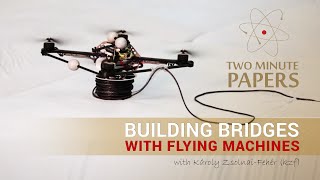
Károly Zsolnai-Fehér covers ETH Zurich research on flying machines that build rope bridges by working together. Each drone carries rope and follows precise timing and force profiles to tie complex knots, creating resilient structures that demonstrate advances in collaborative control.
Chapters
Dear fellow scholars, this is two minute papers with anyone who has tried building bridges over a huge chasm realized that it is possibly one of the most difficult and dangerous things you could do on a family vacation. The basic construction elements for such a bridge can be ropes, cables and wires. And this kind of task is fundamentally different from classical architectural building problems. Here you don't need to have any kind of scaffolding or to carry building blocks that weigh a lot. However, you have to know how to tie knots. Therefore, this is the kind of problem you'll need flying machines for. They can fly anywhere, they are nimble. And their disadvantage that they have a very limited payload does not play a big role here in this piece of work at the ETH Zurich. These machines can create some crazy knots from single to multi. Round turn hitches, knobs, elbows, round turns and multiple rope knobs. And these you have to be able to create in a collaborative manner. Because. Because each individual flying machine will hold one rope. Therefore they have to pass through given control points at a strictly given time and a target velocity. These little guys also have to know the exact amount of force they need to exert on the structure to move into a desirable target position. Even deploying the rope is not that trivial. The machine is equipped with a roller to do so. But the friction of this roller can be changed at any time according to the rope releasing direction. To unroll it properly, you also have to face the correct direction as well. And these structures are not just toys. The resulting bridges are resilient enough for humans to use. This work is a great example to show that the technology of today is improving at an incredible pace. If we can solve difficult collaborative control problems such as this one, just think about the possibilities. What an exciting time it is to be alive. We have gotten lots of shares for the series on social media. I am trying to send a short thank you message for every single one of you. I am trying, trying my best. And don't forget, every single share helps spreading the word for the series immensely. Thanks for watching and I'll see you next time.