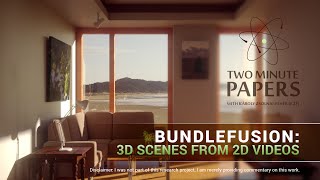
BundleFusion builds complete 3D models from regular video in near real-time, refining the scene as the camera moves. It works on consumer hardware like an Nvidia Titan X and handles architectural visualization, animation, and furniture scanning, though fine details often need manual cleanup afterward.
Chapters
Dear fellow scholars, this is two minute papers with this piece of work enables us to walk around in a room with a camera and create a complete 3D computer model from the video footage. The technique has a really cool effect where the 3D model is continuously refined as we obtain more and more data by walking around with our camera. This is a very difficult problem and a good solution to this offers a set of cool potential applications. If we have a 3D model of a scene, what can we do with it? Well, of course assign different materials to them and run a light simulation program for architectural visualization applications, animation, movies and so on. We can also easily scan a lot of different furnitures and create a useful database out of them. There are tons of more applications, but I think these should do for starters. Normally, if one has to create a 3D model of a room or a building, the bottom line is that it requires several days weeks of labor. Fortunately, with this technique, we'll obtain a 3D model in real time and we won't have to go through these tribulations. However, I'd like to note that the models are still by far not perfect. If we are interested in the many small, intricate details, we have to add them back by hand. Previous methods were able to achieve similar results, but they suffer from a number of different drawbacks. For instance, most of them don't support traditional consumer cameras or take minutes to hours to perform the reconstruction. To produce the results presented in the paper, an Nvidia Titan X video card was used, which is currently one of the pricier pieces of equipment for consumers, but not so much for companies who are typically interested in these applications. If we take into consideration the rate at which graphical hardware is improving, anyone will be able to run this at home in real time in a few years time. The comparisons to previous works reveal that this technique is not only real time, but the quality of the results is mostly comparable and in some cases it surpasses previous methods. Thanks for watching and for your generous support, and I'll see you next time.