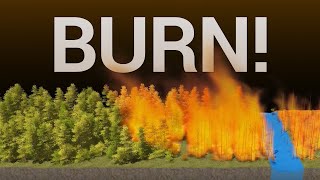
Dr. Zsolnai reviews a forest fire simulation that models 120,000 trees, wind, moisture, and the clouds that form above flames. The largest run processes each step in 95 milliseconds. Researchers use it to test firebreaks and suppression tactics.
Questions this video answers
Dr. Zsolnai
June 22, 2021
120,000 trees
95 milliseconds per simulation step
Weights & Biases; podcast: Gradient Descent
Chapters
Dear fellow scholars, this is two minute papers with Dr. Zsolnai. In a previous episode, not so long ago, we burned down a virtual tree. This was possible through an amazing simulation paper from four years ago, where each leaf has its own individual mass and area. They burn individually, transfer heat to their surroundings, and finally branches bend and luck can eventually even break in this process. How quickly did this run? Of course, in real time? Well, there is quite a paper. So if this was so good, how does anyone improve that? Burn down another virtual tree? No, no, that would be too easy. You know what? Instead, let's set on fire an entire virtual forest. Oh yeah. Here you see a simulation of a devastating fire from a lightning strike in Yosemite National Park. The simulations this time around are typically sped up a great deal to be able to give us a better view of how it spreads. So if you see some flickering, that is the reason for that. But wait, is that really that much harder? Why not just put a bunch of trees next to each other and start the simulation? Would that work? The answer is a resounding no. Let's have a look why. And with that, hold on to your papers because here comes the best part. It also simulates not only the fire, but cloud dynamics as well. Here you see how the wildfire creates lots of hot and dark smoke closer to the ground. And wait for it. Yes, there we go. Higher up, the condensation of water creates this lighter cloudy region. Yes, this is key to the simulation, not because of the aesthetic effects, but this wildfire can indeed create a cloud type that goes by the name flamingitis. So is that good or bad news? Well, both. Lets start with the good news. It often produces rainfall which helps putting out the fire. Well, that is wonderful news. So then what is so bad about it? Well, flammagenitis clouds may also trigger a thunderstorm and thus create another huge fire. That's bad news number one. And bad news number two. It also occludes the fire, thereby making it harder to locate and extinguish it. So, got it. Add cloud dynamics to the tree fire simulator and we are done, right? No, not even close. In a forest fire simulation, not just clouds, everything matters. For instance, we first need to take into consideration the wind intensity and direction. This can mean the difference between a manageable or a devastating forest fire. Second, it takes into consideration the density and moisture intensity of different tree types. For instance, you see that the darker trees here are burning down really slowly. Why is that? That is because these trees are denser. Birches and oak trees Third, the distribution of the trees also matter. Of course, the more area is covered by trees, the more degrees of freedom there are for the fire to spread. And fourth, fire can not only spread horizontally from tree to tree, but vertically too. Look. When a small tree catches fire, this can happen. So, as we established from the previous paper, one tree catching fire can be simulated in real time. So what about an entire forest? Let's take the simulation with the most number of trees. My goodness, they simulated 120k trees here. And the computation time for one simulation step was 95, so. 95 what? 95 milliseconds. Wow. So this thing runs interactively, which means that all of these phenomena can be simulated in close to real time. With that, we can now model how a fire would spread in real forests around the world and test different kinds of fire barriers and their advantages. And we can even simulate how to effectively put out the fire. And don't forget, we went from simulating one burning tree to 120,000 in just one more paper down the line. What a time to be alive. This video has been supported by weights and biases. They have an amazing podcast by the name Gradient Descent, which is where they interview machine learning experts who discuss how they use learning based algorithms to solve real world problems. They've discussed biology, teaching robots, machine learning in outer space, and a whole lot more. Perfect for a fellow scholar with an open mind. Make sure to visit them through WNB MEGD or just click the link in the video description. Our thanks to WeightsAndBiases for their long standing support and for helping us make better videos for you. Thanks for watching and for your generous support and I'll see you next time.