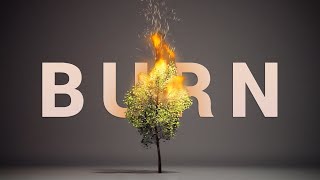
Dr. Zsolnai covers a SIGGRAPH Asia 2017 paper that simulates burning trees in real time using particle physics. The simulation tracks temperature, water content, and leaf mass to create realistic flames, and the original paper got fewer than 1,000 views and about 10 citations in four years despite the impressive results.
Questions this video answers
SIGGRAPH Asia 2017
May 4, 2021
About 10 times
Less than 1,000 views
Chapters
Dear fellow scholars, this is Two Minute Papers with Dr. Zsolnai. Today we are going to burn some virtual trees. This is a fantastic computer graphics paper from four years ago. I ask you to hold on to your papers immediately and do not get surprised if it spontaneously lights on fire. Yes, this work is about simulating wood combustion and it is one of my favorite kinds of papers. That takes an extremely narrow task and absolutely nails it. Everything we can possibly ask for from such a simulation is there. Each leaf has its own individual mass and area. They burn individually, transfer heat to their surroundings and finally branches bend and look can eventually even break. In this process, if we look under the hood, we see that these trees are defined as a system of connected particles embedded within a physics simulator. These particles have their own properties. For instance, you see the temperature changes here at different regions of the tree as the fire gradually consumes it. Now if you have been holding onto your papers, squeeze that paper and look. What do you think? Is this fire movement pre programmed? It doesn't seem like it. This seems more like some real time mouse movement, which is great news indeed. And yes, that means that this simulation and all the interactions we can do with it runs in real time. Here is a list of the many quantities it can simulate. Oh my goodness, there's so much yummy physics here, I don't even know where to start. Let's pick the water content here and see how changing it would look. This is a tree with a lower water content. It catches fire rather easily. And now let's pour some rain on it. Then afterwards, look, it becomes much more difficult to light on fire and emits huge plumes of dense, dense smoke. And we can even play with these parameters in real time. We can also have a ton of fun by choosing non physical parameters for the breaking coefficient, which of course can lead to the tree suddenly falling apart in a non physical way. The cool thing here is that we can either set these parameters to physically plausible values or and get a really realistic simulation. Or we can choose to bend reality in directions that are in line with our artistic vision. How cool is that? I could play with this all day. So as an experienced scholar you ask, ok, this looks great, but how good are these simulations really? Are they just good enough to fool the untrained eye or are they indeed close to close to reality? I hope you know what's coming, because what is coming is my favorite part in all simulation research. And that is when we let reality be our judge and compare the simulation to that. This is a piece of real Footage of a piece of burning wood. And this is the simulation. Well, we see that the resolution of the fire simulation was a little limited. It was four years ago, after all. However, it runs very similarly to the real life footage. Bravo. And all this was done in 2017. What a time to be alive. But we are not even close to be done yet. This paper teaches us one more important lesson. After publishing such an incredible work, it was accepted to The SIGGRAPH Asia 2017 conference that is one of the most prestigious conferences in this research field. Getting a paper accepted here is equivalent to winning the Olympic gold medal of computer graphics research. So with that, we would expect that the authors now revel in eternal glory, right? Well, let's see. What is this serious? The original video was seen by less than a thousand people online. How can that be? And the paper was referred to only 10 times by other works in these four years. Now you see, that is not so bad in computer graphics at all. It is an order, maybe even orders of magnitude smaller field than machine learning. But I think this is an excellent demonstration of why I started this series. And it is because I get so excited by these incredible human achievements and I feel that they deserve a little more love than they are given. And of course these are so amazing, everybody has to know about them. Happy to have you fellow scholars watching this and celebrating these papers with me for more than 500 episodes now. Thank you so much. It is a true honor to have such an amazing and receptive audience. This episode has been supported by Weights and Biases. In this post they show you how to use their tool to fool a neural network to look at a pig and be really sure that it is an airliner. If you work with learning algorithms on a regular basis, make sure to check out weights and biases. Their system is designed to help you organize your experiments and it is so good it could shave off weeks or even months of work from your projects and is completely free for all individuals, academics and open source projects. This really is as good as it gets. And it is hardly a surprise that they are now used by over 200 companies and research institutions. Make sure to Visit them through wnb.com papers or just click the link in the video description and you can get a free demo today. Our thanks to Weights and Biases for their long standing support and for helping us make better videos for you. Thanks for watching and for your generous support and I'll see you next time.