6:39
Andrew Ng explains 1x1 convolutions, which apply fully connected operations across channels at each location. They add nonlinearity, change channel count for dimensionality reduction, and cut computation in networks like Inception.
Andrew Ng explains 1x1 convolutions, which apply fully connected operations across channels at each location. They add nonlinearity, change channel count for dimensionality reduction, and cut computation in networks like Inception.
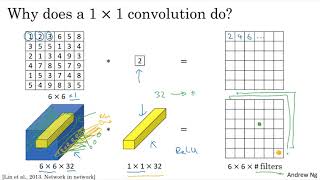
In terms of designing confluent architectures, one of the ideas that really helps is using a one by one convolution. Now you might be wondering, what does a one by one convolution do? Isn't that just multiplying by a number? That seems like a funny thing to do. Turns out it's not quite like that. Let's take a look. Here's a one by one filter. I put a number two there, and if you take this six by six image, 6x6x1 and convolve it with this one by one by one filter, you end up just taking the image and multiplying by two. So 1, 2, 3 ends up being 2, 4, 6 and so on. And so a convolution by a one by one filter doesn't seem particularly useful. You just multiply it by some number. But that's the case of 6 by 6 by 1 channel images. If you have a 6 x 6 x 32 instead of by 1, then a convolution with a one by one filter can do something that makes much more sense. And in particular, what a one by one convolution will do is it will look at each of the 36 different positions here, and it will take the element wise product between 32 numbers on the left and the 32 numbers in the filter, and then apply a relu nonlinearity to it after that. So to look at one of the 36 positions, maybe one slice through this volume, you take these 36 numbers, multiply it by, you know, one by one slice through the volume like that, and you end up with a single real number which then gets plotted in one of the outputs like that. And in fact, one way to think about the 32 numbers you have in this one by one by 32 filter is that it's as if you have one neuron that is taking as input 32 numbers, multiplying each of these 32 numbers in one slice in the same position, height and width. But these 32 different channels, multiplying them by 32 weights and then applying a relu nonlinearity to it, and then outputting the corresponding thing over there. And more generally, if you have not just one filter, but if you have multiple filters, then it's as if you have not just one unit, but multiple units that are taken as input all the numbers in one slice and then building them up into an output that is six by six by number of filters. So one way to think about a one by one convolution is that it is basically having a fully connected neural network that applies to each of the 62 different positions. And what this fully connected neural network does is it inputs 32 numbers and outputs, you know, number of filters outputs. So I guess depending on notation, this is really a NC of L plus one, if that's the next layer. And by doing this at each of the 36 positions, each of the six by six positions, you end up with an output that is six by six by the number of filters. And this can carry out a pretty non trivial computation on your input volume. And this idea is often called a one by one convolution, but it's sometimes also called network in network and is described in this paper by Min Lin Tiangchen and Xue Chen Yang. And even though the details of the architecture in this paper are aren't used widely, this idea of a one by one convolution, or this sometimes called network and network idea has been very influential, has influenced many other neural network architectures, including the inception network, which we'll see in the next video. But to give you an example of where one by one convolution is useful, here's something you could do with it. Let's say you have a 28 by 28 by 192 volume. If you want to shrink the height and width, you can use a pooling layer. So we know how to do that. But what if the number of channels has gotten too big and you want to shrink that? How do you shrink it to a 28 by 28 by 32 dimensional volume? Well, what you can do is use 32 filters that are one by one. And technically each filter would be of dimension one one by one by one hundred and ninety two. Because the number of channels in your filter has to match the number of channels in your input volume. But you use 32 filters and the output of this process will be a 28 by 28 by 32 volume. So this is a way to let you shrink NC as well. Whereas pooling layers are used just to shrink NH and NW the height and width of these volumes. And we'll see later how this idea of one by one convolutions allows you to shrink the number of channels and therefore save on computation in some networks. But of course if you want to keep the number of channels at 192, that's fine too. And the effect of a one by one convolution is it just adds non linearity. It allows you to learn a more complex function of your network by adding another layer the input is 28 by 28 by 192 and outputs 28 by 28 by 192. So that's how a one by one convolutional layer is actually doing something pretty non trivial and it adds non linearity to your neural network and allow you to decrease or keep the same or if you want, increase the number of channels in your volumes. Next you see that this is actually very useful for building the inception network. Let's go on to that in the next video. So you've now seen how a one by one convolution operation is actually doing a pretty non trivial operation and it allows you to shrink the number of channels in your volumes, or keep it the same, or even increase it if you want. In the next video you see that this can be used to help build up to the inception network. Let's go on to the next video.










