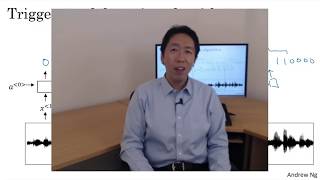
Andrew Ng explains how voice assistants like Alexa detect wake words using spectrograms and RNNs. The training trick: label zeros before the trigger word and ones right after it, optionally extending the ones across a short window to handle class imbalance.
Chapters
You've now learned so much about deep learning and sequence models that we can actually describe a trigger word system quite simply just on one slide, as you see in this video. But with the rise of speech recognition, there have been more and more devices you can wake up with your voice, and those are sometimes called trigger word detection systems. So let's see how you can build a trigger word system. Examples of trigger word systems include Amazon Echo, which is one woken up with the word Alexa, the Baidu Duros Pod devices woken up with the phrase Xiao Du Nihao, Apple, Siri woken up with hey Siri and Google Home woken up with OK Google. So thanks to trigger word detection that if you have say an Amazon Echo in your living room, you can walk to your living room and just say Alexa, what time is it? And have it wake up or be triggered by the word Alexa and answer your voice query. So if you can build a trigger word detection system, maybe you can make your computer do something by telling it computeractivate. One of my friends also worked on turning on and off a particular lamp using a trigger word kind of as a fun project. But what I want to show you is how you can build a trigger word detection system. The literature on trigger word detection algorithm is still evolving, so there isn't wide consensus yet on what's the best algorithm for trigger word detection. So I'm just going to show you one example of an algorithm you can use. Now, you've seen RNNs like this and what we really do is take an audio clip, maybe compute spectrogram features and that generates features x1, x2, x3 audio features x1 x2, x3 that you pass through an RNN. And so all that remains to be done is to define the target labels Y. So if this point in the audio clip is when someone just finished saying the trigger word, such as Alexa or Xiao Liu Nihao or hey Siri or ok, Google, then in the training sets you can set the target labels to be zero for everything before that point and right after that to set a target label of 1. And then if a little bit later on, you know, the trigger word was set again and the trigger word was set at this point, then you can again set the target label to be one right after that. Now this type of labeling scheme for an rnn, you know, could work actually. This will actually work reasonably well. One slight disadvantage of this is it creates a very imbalanced training set with a lot more zeros than ones. So one other thing you could do that's again, a little bit of a hack, but could make the model a little bit easier to train is instead of setting only a single time step to output one, you could actually make it output a few ones for several times or for a fixed period of time before reverting back to zero. So and that slightly evens out the ratio of ones to zeros. But this is a little bit of a hack. But if this is when in the audio clip a trigger word is said, then right after that you can set the Target label to 1. And if this is the trigger word set again, then right after that is when you want the RNN to output one. So you get to play more of this as well in the programming exercise. But I think you should feel quite proud of yourself that you've learned enough about deep learning that it just takes one picture and one slide to describe something as complicated as trigger word detection. And based on this, I hope you'll be able to implement something that works and allows you to detect trigger words. But you see more of this in the program exercise. So that's it for trigger words. And I hope you feel quite proud of yourself for how much you've learned about deep learning, that we can now describe trigger words in just one slide in a few minutes, and that you could hopefully implement it and get it to work, maybe even make it do something fun in your house, like a light turn on or turn off, or make it do something on your computer when you or when someone else says a trigger word. This is the last technical video of this course. And to wrap up in this course on sequence models, you learned about RNNs, including both GRUs and LSTMs. And then in the second week you learned a lot about word embeddings and how to learn representations of words. And then in this week you learned about the attention model, as well as how to use it to process audio data. And I hope you have fun implementing all of these ideas in this week's programming exercise. Let's go on to the last video.