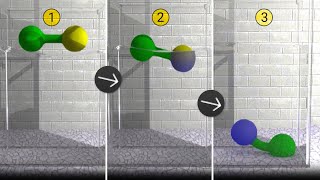
Dr. Zsolnai demonstrates simulations of how virtual sponges absorb fluid, using a quarter-million fluid particles and 250k solid particles. Four experiments show different absorption behaviors, from spongy dumbbells to selective absorption of mixture components, all running on a consumer GPU.
Questions this video answers
November 25, 2021.
About a quarter of a million particles (≈250,000).
Approximately another quarter-million particles (≈250,000).
Approximately one second per frame (interactive speed) on a consumer graphics card.
Dr. Zsolnai (Two Minute Papers).
Chapters
Dear fellow scholars, this is Two Minute Papers with Dr. Zsolnai. Today we are going to not only simulate fluids, but even better, we are going to absorb them with sponge like porous materials too. This paper does not have the usual super high resolution results that you see with many other simulation papers. However, I really wanted to show you what it can do through four lovely experiments. And at the end of the video you will see how slowly or quickly it runs. Experiment number one, Spongy dumbbells. One side is made of a spongy material and as it starts absorbing the water, let's see if it sinks. Well, it slowly starts to descend as it gets heavier, and then it gets so heavy that eventually it sinks the other half too. That is a good start. Now, experiment number two. Absorption. Here the green liquid is hard to absorb, therefore we expect it to pass through, while the red liquid is easier to absorb and should get stuck in this perforated material. Let's see if that is indeed what happens. The green is coming through. And where is all the red goo? Well, most of it is getting absorbed here. But wait. The paper promises to ensure that mass and momentum still gets transferred through the interactions properly. So if the fluid volumes are simulated correctly, we expect a lot more green down there than red. And did we get it? Oh yes. Checkmark. And if you think this was a great absorption simulation, wait until you see this. Experiment number three. Absorption on steroids. This is a liquid mixture, and these are porous materials, each of which will absorb exactly one component of the liquid and let through the rest. Let's see. The first obstacle absorbs the blue component quickly, the second retains all the green component and the red flows through. And look at how gracefully the red fluid fills the last sponge. Lovely. Onwards to experiment number four, Artistic control. Since we are building our own little virtual world, we make all the rules. So let's see the first absorption case. Nothing too crazy here, but if this is not in line with our artistic vision, do not despair, because this is our world. So we can play with these physical parameters. For instance, let's increase the absorption rate so the fluid enters the solid faster. Or we can increase the permeability. This is the ease of passage of the fluid through the material. Does it transfer quicker into the sponge? Yes, it does. And finally we can speed up both how quickly the fluid enters the solid, how quickly it travels within. And we have also increased the amount of absorption. Let's see if we end up with the smaller remaining volume. Indeed we do. The beauty of building these virtual worlds is that we can have these simulations under our artistic control. So. So how long do we have to wait for the sponges? Well, hold on to your papers because we not only don't have to sit down and watch an episode of Spongebob to get these done, but get this. The Crazy3 sponge experiment used about a quarter of a million particles for the fluid and another quarter ish million particles for the solids and runs at approximately a second per frame. Yes, it runs interactively and all this can be done on a consumer graphics card. And yes, that's why the resolution of the simulations is not that high. The authors could have posted a much higher resolution simulation and kept the execution time in the minutes per frame domain. But no, they wanted to show us what this can do interactively. And in this case it is important that you apply the first law of papers, which says that research is a process. Do not look at where we are, look at where we will be. Two more papers down the line. So there we go. I really wanted to show you this paper because unfortunately, if we don't talk about it, almost no one will see it. And this is why two minute papers exist. And if you wish to discuss this paper, make sure to drop by on our Discord server. The link is available in the video description. This video has been supported by weights and biases. Look at this. They have a great community forum that aims to make you the best machine learning engineer you can be. You see, I always get messages from you fellow scholars telling me that you have been inspired by the series but don't really know where to start. And here it is. In this forum you can share your projects, ask for advice, look for collaborators and more. Make sure to visit WNB me Paperforum and say hi or just click the link in the video description. Our thanks to Weights and Biases for their long standing support and for helping us make better videos for you. Thanks for watching and for your generous support and I'll see you next time.