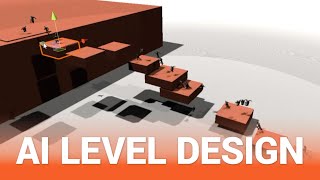
A short YouTube lecture by Dr. Zsolnai (2 Minute Papers) explaining a research approach where two learning algorithms jointly solve game levels: one AI builds levels (tuning block distances, heights, angles, sizes) while another AI learns to play them. The speaker demonstrates the builder/player pair generating increasingly difficult platforming levels (including shortcuts) and generalizing to racing-track generation; quantitative comparisons show the new method outperforms a fixed-track-trained agent (easy: fixed ≈75% vs new ≈100%; hard: fixed ≈20% vs new ≈60%). The video also notes the baseline is not state-of-the-art and contains a promotional segment for the experiment-tracking tool Weights & Biases.
Questions this video answers
About 75%.
Nearly 100%.
About 20% (2 out of 10).
About 60% (6 out of 10).
Chapters
Dear fellow scholars, this is 2 Minute Papers with Dr. Zsolnai. Testing modern computer games by using an AI is getting more and more popular these days. This earlier work showcased how we can use an automated agent to test the integrity of the game by finding spots where we can get stuck. And when we fix the problem, we could easily ask the agent to check who whether the fix really worked. In this case, it did. And this new work also uses learning algorithms to test our levels. Now this chap has been trained on a fixed level, mastered it, and let's see if it has managed to obtain general knowledge from it how well by testing how it performs on a different level. It is very confident. Good. But oh, as you see, it is confidently incorrect. So is it possible to train an agent to be able to beat these levels more reliably? Well, how about creating a more elaborate curriculum for them to learn on? Yes, let's do that. But with a twist. In this work, the authors chose not to feed the AI a fixed set of levels. No, no. They created another AI that builds the levels for the player AI. So both the builder and the player are learning algorithms who are tasked to succeed together in getting the agent to the finish line. They have to collaborate to succeed. Building the level means choosing the appropriate distance, height, angle and size for these blocks. Let's see them playing together on an easy level. Ok, so far so good. But let's not let them build a little cartel where only easy levels are being generated so they get a higher score. I want to see a challenge to do that. Let's force the builder AI to use a larger average distance between the blocks, thereby creating levels of a prescribed difficulty. And with that, let's ramp up the difficulty a little. Things get a little more interesting here because. Whoa. Do you see what I see here? Look, it even found a shortcut to the end of the level. And let's see the harder levels together. While many of these chaps failed, some of them are still able to succeed. Very cool. Let's compare the performance of the new technique with the previous fixed track agent. This is the chap that learned by mastering only a fixed track. And this one learned in the wilderness. Neither of them have seen these levels before. So who is going to be scrappier? Of course, the wilderness guy described in the new technique. Excellent. So all this sounds great, but I hear you asking the key question, what do we use this for? Well one, the player AI can test the levels that we are building for our game and give us feedback on whether it is possible to finish. Is it too hard or too easy? And more this can be a godsend when updating some levels because the agent will almost immediately tell us whether it has gotten easier or harder or if we have broken the level. No human testing is required. Now hold on to your papers because the thing runs so quickly that we can even refine a level in real time. Loving it. Or two. The builder can also be given to a human player who might enjoy a level being built in real time in front of them. And here comes the best part. The whole concept generalizes well for other kinds of games too. Look, the builder can build race tracks and the player can try to drive through them. So do these great results also generalize to the racing game? Let's see what the numbers say. The agent that trained on a fixed track can succeed on an easy level about 75% of the time, while the newly proposed agent can do it nearly with a 100% chance. A bit of an improvement OK, now look at this. The fixed track agent can only beat a hard level about 2 times out of 10, while the new agent can do it about 6 times out of 10. That is quite a bit of an improvement. Now note that in a research paper choosing a proper baseline to compare to is always a crucial question. I would like to note that the baseline here is not the state of the art, and with that it is a little easier to make the new solution pop. No matter, the solutions are still good. But I think this is worth a note. So from now on, whenever we create a new level in a computer game, we can have hundreds of competent AI players testing it in real time. So good. What a time to be alive. This episode has been supported by weights and biases. In this post they show you how.
To use their tool to interpret the.
Results of your neural networks. For instance, they tell you how to.
Look if your neural network has even.
Looked at the dog in an image.
Before classifying it to be a dog. If you work with learning algorithms on a regular basis, make sure to check.
Out weights and biases.
Their system is designed to help you organize your experiments and it is so.
Good it could shave off weeks or.
Even months of work from your projects and is completely free for all individuals, academics and open source projects.
This really is as good as it.
Gets and it is hardly a surprise that they are now used by over 200 companies and research institutions. Make sure to Visit them through wnb.com papers or just click the link in the video description and you can get.
A free demo today.
Our thanks to weights and biases for their long standing support and for helping.
Us make better videos for you. Thanks for watching and for your generous support and I'll see you next time.