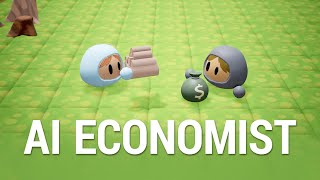
Károly Zsolnai-Fehér explains a simulation where an AI designs tax policy for virtual economies. The AI system improved the equality-productivity trade-off by 16% compared to the 2018 US federal tax formula, partly by better supporting middle-class and low-skill workers.
Chapters
Dear fellow scholars, this is two minute papers with Dr. We hear many opinions every day on how tax policy should change, what we should do and how it would affect us. But of course, whenever we change something, we have to be mindful of its ramifications. Experimenting with tax policies willy nilly is of course ill advised in the real world. But we are researchers, so we can create our little virtual world, populate them with virtual character AIs and we can experiment all we want. Here. Just imagine a future where a politician comes and says, I will lift up the middle class by creating policy X. Well, let's simulate that policy X in a virtual world and see if it actually works as they promised. That would be glorious. But of course. I know, I know. Wishful thinking, right? But maybe with this paper, not so much. Look, these workers are reinforcement learning agents. Which means that they observe their environment, inquire what the tax rates and other parameters are, and decide how to proceed. They start working, they pay their taxes, and over time they learn to maximize their own well being given a tax system. This is the inner loop of the simulation. Now comes the even cooler part, the outer loop. This means that we have not only simulated worker AIs, but simulated policymaker AIs tool. And they look at inequality, wealth distribution and other market dynamics and adjust the tax policy to maximize something that we find important. And herein lies the key of the experiment. Let's start with the goal of the simulation. We seek a tax policy that maximizes equality and productivity at the same time. This is of course immensely difficult. Every decision comes with its own trade offs. We'll talk about the results in a moment, but first let's marvel at the fact that it simulates agents with higher and lower skills. And not only that, but with these specialization starts appearing. For instance, the lower skill agents started gathering and selling materials, where the higher skill agents started buying up the materials to build houses. The goal of the policymaker AI is to maximize the equality and productivity of all of these agents. As a comparison, it also simulated the 2018 US federal tax rate. An analytical tax formula where the marginal tax rate decreases with income. A free market model, and also proposed its own tax policies. So how well did it do? Let's have a look at the results together. The free market model excels in maximizing productivity, which sounds great until we find out that it does this at the cost of equality. Look, the top agent owns almost everything, leaving nearly nothing for everyone else. The US Federal tax and analytical models strike a better balance between the two. But neither seems Optimal. So where is the AI economist's model on this curve? Well, hold on to your papers because it is here. It improved the trade off between equality and productivity by 16% by proposing a system that is harder to game, that gives a bigger piece of the pie for the middle class and subsidizes lower skill AI workers. And do not forget that the key here is that it not only proposes things, but but it can prove that these policies serve everyone, at least within the constraints of this simulation. Now that's what I call a great paper. And there is so much more useful knowledge in this paper. I really urge you to have a look. It is a fantastic read and needless to say, I'd love to see more research in this area. For instance, I'd love to know what happens if we start optimizing for sustainability as well. These objectives can be specified in this little virtual world and we can experiment with what happens if we are guided by these requirements. And now onwards to more transparent tax policies. What a time to be alive. Perceptilabs is a Visual API for TensorFlow, carefully designed to make machine learning as intuitive as possible. This gives you a faster way to build out models with more transparency into how your model is architected, how it performs and how to debug it. Look, it lets you toggle between the visual modeler and the code editor. It even generates visualizations for all the model variables and gives you recommendations both during modeling and training, and does all this automatically. I only wish I had a tool like this when I was working on my neural networks during my PhD years. Visit perceptilabs.com papers to easily install the free local version of their system today. Our thanks to Perceptilabs for their support and for helping us make better videos for you. Thanks for watching and for your generous support and I'll see you next time.