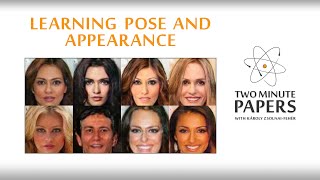
LARRUZ explains how GANs can learn to separate pose from appearance in images using 3D transforms. The technique generates faces and objects with independent control over viewpoint and identity, though flickering still occurs when changing angles.
Chapters
This episode has been supported by lamda. Dear fellow scholars, this is two minute papers with I apologize for my voice today. I am trapped in this frail human body and sometimes it falters. But you remember from the previous episode, the papers must go on. In the last few years we have seen a bunch of new AI based techniques that were specialized in generating new and novel images. This is mainly done through learning based techniques to typically a generative adversarial network, a gan, in short, which is an architecture where a generator neural network creates new images and passes it to a discriminator network which learns to distinguish real photos from these fake generated images. The two networks learn and improve together, so much so that many of these techniques have become so realistic that we sometimes can't even tell they are synthetic images unless we look really closely. You see some examples here from Biggan, a previous technique that is based on this architecture. Now normally if we are looking to generate a specific human face, we have to generate hundreds and hundreds of these images. And our best bet is to hope that sooner or later we'll find something that we were looking for. So of course, scientists were interested in trying to exert control over the outputs. And with follow up works we can kind of control the appearance. But in return we have to accept the pose in which they are given. And this new project is about teaching a learning algorithm to separate pose from identity. Now that sounds kind of possible with proper supervision. What does this mean exactly? Well, we have to train these GANs on a large number of images so they can learn what a human face looks like, what landmarks to expect and how to form them properly when generating new images. However, when the input images are given with different poses, we will normally need to add additional information to the discriminator that describes the rotations of these people and objects. Well, hold on to your papers because that is exactly what is not happening in this new work. This paper proposes an architecture that contains a 3D transform and a projection unit. You see them here with red and blue. And these help us in separating pose and identity. As a result, we have much finer artistic control over these during image generation. That is amazing. So as you see here, it enables a really nice workflow where we can also set up the poses. Don't like the camera position for this generated bedroom? No problem. Need to rotate the chairs? No problem. And we are not even finished yet because when we set up the pose correctly, we are not stuck with these images. We can also choose from several different appearances. And all this comes from the fact that this technique was able to learn the intricacies of these objects. Love it. Now it is abundantly clear that as we rotate these cars or change the camera viewpoint for the bedroom, a flickering effect is still present. And this is how research works. We try to solve a new problem one step at a time. Then we find flaws in the solution and improve upon that as a result. We always say two more papers down the line and we'll likely have smooth and creamy transitions between the images. The Lambda sponsorship spot is coming in a moment and I don't know if you have noticed at the start, but they were also part of this research project as well. I think that is as relevant of a sponsor as it gets. If you are a researcher or startup looking for cheap GPU compute to run these algorithms, check out Lambda GPU Cloud I've talked about Lambda's GPU workstations in other videos and I'm happy to tell you that they are offering GPU cloud services as well. The Lambda GPU Cloud can train ImageNet to 93% accuracy for less than $19. Lambda's web based IDE lets you easily access your instance right in your browser and finally, hold on to your papers. Because the Lambda GPU Cloud costs less than half of AWS and Azure. Make sure to go to lambdalabs.compapers and sign up for their amazing GPU instances today. Thanks for watching and for your generous support and I'll see you next time.