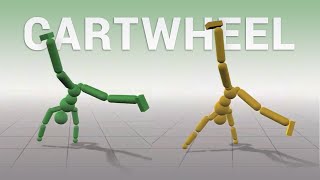
Dr. Zsolnai explains how AI learns to perform cartwheels by copying reference motions while maintaining each character's individual style. The technique uses constraints on the body's center of mass and energy to make the movements physically realistic and transferable between different simulated characters.
Chapters
Dear fellow scholars, this is two minute papers with Dr. Zsolnai.
Today we will see how this AI based technique can help our virtual characters not only learn new movements, but they will even perform them with style. Now, here you see a piece of reference motion.
This is what we would like our.
Virtual character to learn. The task is to then enter a physics simulation where we try to find the correct joint angles and movements to perform that. Of course, this is already a challenge, because even a small difference in joint positions can make a great deal of difference in the output. Then the second, more difficult task is to do this with style. No two people perform cartwheels exactly the same way. So would it be possible to have our virtual characters imbued with style so that they, much like people, would have their own kinds of movement? Is that possible somehow? Well, let's have a look at the simulated characters. Nice. So this chap surely learned to, at the very least, reproduce the reference motion. But let's stop the footage here and there and look for differences. Oh yes, this is indeed different. This virtual character indeed has its own style, but at the same time, it is still faithful to the original reference motion. This is a magnificent solution to a very difficult task, and the authors made it look deceptively easy. But you will see in a moment that this is really challenging. So how does all this magic happen? How do we imbue these virtual characters with style? Well, let's define style as creative deviation from the reference motion, so it can be different, but not too different, or else this happens.
So what are we seeing here?
Here with green, you see the algorithm's estimation of the center of mass for this character, and our goal would be to reproduce that as faithfully as possible. That would be the copying machine solution. Here comes the key for style, and that key is using spacetime bounds. This means that the center of mass of the character can deviate from the original, but only as long as it remains strictly within these boundaries. And that is where the style emerges. If we wish to add a little style to the equation, we can set relatively loose spacetime bounds around it, leaving room for the AI to explore. If we wish to strictly reproduce the reference motion, we can set the bounds to be really tight instead. This is a great technique to learn running, jumping, rolling behaviors, and it can even perform a stylish cartwheel and backflips. Oh yeah. Loving it. These spacetime bounds also help us retarget the motion to different virtual body types. It also helps us salvage really bad quality reference motions and make something useful out of them. So are we done here? Is that all? No, not in the slightest. Now hold on to your papers because here comes the best part. With these novel spacetime bounds, we can specify additional stylistic choices to the character moves. For instance, we can encourage the character to use more energy for a more intense dancing sequence. Or we can make it sleepier by asking it to decrease its energy use. And I wonder if we can put bounds on the energy used. Can we do more? For instance, do the same with body volume use? Oh yeah, this really opens up new kinds of motions that I haven't seen virtual characters perform yet. For instance, this chap was encouraged to use its entire body volume for a walk and thus looks like someone who is clearly looking for trouble. And this poor thing just finished their paper for a conference deadline and is barely alive. We can even mix multiple motions together. For instance, what could be a combination of a regular running sequence and a bent walk? Well, this. And if we have a standard running sequence and a happy walk, we can fuse them into a happy running sequence. How cool is that? So with this technique, we can finally not only teach virtual characters to perform nearly any kind of reference motion, but we can even ask them to do this with style. What an incredible idea. Loving it. Now before we go, I would like.
To show you a short message that.
We got that melted my heart. This I got from Nathan who has been inspired by these incredible works and he decided to turn his life around and go back to study more. I love my job and reading messages like this is one of the absolute best parts of it.
Congratulations Nathan.
Thank you so much and good luck. If you feel that you have a similar story with this video series, make sure to let us know in the comments.
This episode has been supported by Lambda GPU Cloud. If you're looking for inexpensive cloud GPUs for age AI, check out Lamda GPU Cloud. They've recently launched Quadro RTX 6000, RTX 8000 and V100 instances and hold on to your papers because Lambda GPU Cloud can cost less than half of AWS and Azure. Plus, they are the only cloud service with 48 gigabyte RTX 8000. Join researchers at organizations like Apple, MIT and Caltech in using Lambda Cloud instances, workstations or servers. Make sure to go to lambdalabs.compapers to sign up for one of their amazing GPU instances today. Our thanks to Lamda for their long standing support and for helping us make.