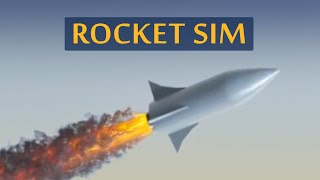
Dr. Zsolnai reviews a SIGGRAPH paper on simulating smoke and rigid objects pushing against each other, using lattice Boltzmann methods. A rocket plume now actually propels the rocket instead of passing through it. Simulations match real experiments, though they cost 2 to 3 times more memory and take up to 16 hours to render.
Chapters
Dear fellow scholars, this is two minute papers with Dr. Zsolnai. In this series, we often talk about smoke and fluid simulations. And sometimes the examples showcase a beautiful smoke plume, but not much else. However, in real production environments, these simulations often involve complex scenes with many objects that interact with each other. And therein lies the problem. Computing these interactions is called coupling, and it is very difficult to get right, but is necessary for many of the scenes you will see throughout this video. This new graphics paper builds on a technique called the lattice Boltzmann method and promises a better way to compute this two way coupling. For instance, in this simulation, two way coupling is required to compute how this fiery smoke trail propels the rocket upward. So coupling means interaction between different kinds of objects. But what about the two way part? What does that mean exactly? Well, first let's have a look at one way coupling. As the box moves here, it has an effect on the smoke plume around it. This example also showcases one way coupling where the falling plate stirs up the smoke around it. The parts with the higher Reynolds numbers showcase more turbulent flows. Typically that's the real good stuff if you ask me. And now onto two way coupling. In this case, similarly to previous ones, the boxes are allowed to move the smoke, but the added two way coupling part means that now the smoke is also allowed to blow away the boxes. What's more, the vortices here on the right were even able to suspend the red box in the air for a few seconds. An excellent demonstration of a beautiful phenomenon. Now let's look at the previous example with the dropping plate and see what happens. Yes, indeed. As the plate drops, it moves the smoke, and as the smoke moves, it also blows away the boxes. Woohoo. Due to improvements in the coupling computation, it also simulates these kinds of vortices much more realistically than previous works. Just look at all this magnificent progress in just two years. So what else can we do with all this? What are the typical scenarios that require accurate two way coupling? Well, for instance, it can perform an incredible tornado simulation that you see here. And there's an alternative view where we only see the objects moving about. So all this looks good, but really, how do we know how accurate this technique is? And now comes my favorite part, and this is when we let reality be our judge and compare the simulation results with real world experiments. Hold onto your papers while you observe the real experiment here on the left. And now the algorithmic reproduction of the same scene here. How close are they? Goodness. Very, very close. I will stop the footage at different times so we can both evaluate it better. Love it. The technique can also undergo the wind tunnel test. Here is the real footage and here is the simulation, and it is truly remarkable how close this is able to match it. And I was wondering that even though as someone who has been doing fluids for a while now, if someone cropped this part of the image and told me that it is real world footage, I would have believed it in a second. Absolute insanity. So how much do we have to wait to compute a simulation like this? Well, great news. It uses your graphics card, which is typically the case for the more rudimentary fluid simulation algorithms out there, but the more elaborate ones typically don't support it, or at least not without a fair amount of additional effort. The quickest example was this as it was simulated in less than six seconds, which I find to be mind blowing a smoke simulation with box movements in a few seconds. I am truly out of words. The rocket launch scene took the longest with 16 hours, while the falling plate example with the strong draft that threw the boxes around with about four and a half hours of computation time. The results depend greatly on Delta T, which is the size of the time steps, or in other words, in how small increments we can advance time when creating these simulations to make sure we don't miss any important interactions. You see here that in the rocket example we have to simulate roughly a hundred thousand steps for every second of video footage. No wonder it takes so long. We have an easier time with this scene where these time steps can be 50 times larger without losing any detail, and hence it goes much faster. The grid resolution also matters a great deal, which specifies how many spatial points the simulation has to take place in. The higher the resolution of the grid, the larger the region we can cover and the more details we can simulate. As most research works, this technique doesn't come without limitations. However, it is less accurate if we have simulations involving thin rods and shells, and typically uses two to three times more memory than a typical simulator program. If these are the only trade offs to create all this marvelous footage, sign me up this very second. Overall, this paper is extraordinarily well written and of course it has been accepted to the Siggraph Conference, one of the most prestigious scientific venues in computer graphics research. Huge congratulations to the authors, and if you wish to see something beautiful today, make sure to have a look at the paper itself in the video description. Truly stunning work. What a time to be alive. This episode has been supported by Lambda GPU Cloud. If you're looking for inexpensive cloud GPUs for AI. Check out Lamda GPU Cloud. They've recently launched Quadro RTX 6000, RTX 8000 and V100 instances and hold on to your papers because Lambda GPU Cloud can cost less than half of AWS and Azure. Plus they are the only cloud service with 48gb RTX 8000. Join researchers at organizations like Apple, MIT and Caltech in using Lambda Cloud instances, workstations or servers. Make sure to go to lambdalabs.compapers to sign up for one of their amazing GPU instances today. Our thanks to Lambda for their long standing support and for helping us make better videos for you. Thanks for watching and for your generous support and I'll see you next time.