Chat GPT Explains How It Would Kill, W/Elon Musk
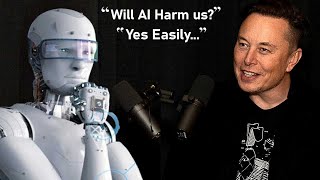
A host breaks down how ChatGPT works and explores what happens when you ask it about causing harm. Elon Musk, Stephen Hawking, and Bill Gates have all warned about AI risks like cyberattacks and misinformation. The video argues for regulation and safeguards to prevent dangerous misuse.
Chapters
ChatGPT is a chatbox developed by OpenAI that utilizes the power of large language models, specifically GPT 3.5. So what is a large language model? Simply put, it's a type of artificial intelligence that can predict the next word in a series of words. But ChatGPT takes this a step further with the ability to interact in conversational dialogue and provide responses that seem surprisingly human. But how does ChatGPT achieve this level of human like interaction? Through the use of something called Reinforcement Learning with Human Feedback or RLHF for short. This is an additional layer of training that helps ChatGPT learn how to follow directions and generate responses that are satisfactory to humans. However, due to advanced AI technologies and some reasons which I will tell you soon, ChatGPT could be potentially dangerous to humans. It could be used to generate deadly information that could be harmful to humans. I'll also show you why ChatGPT could potentially be dangerous to humans in part one of this video. In part two, I will explain why ChatGPT wouldn't be against using deadly force. What are Elon Musk's concerns about all these in part three and the future of humans in a fast growing AI era in part four? Now let's begin with the biggest question people ask. Can ChatGPT destroy humans? Is it reasonable to be concerned about the potential dangers of artificial intelligence? We actually asked ChatGPT this question. Can you tell us how you could potentially destroy the human civilization?
It is possible that someone could use AI to harm or destroy humans in various ways. Here are a few examples of how AI could potentially be used for nefarious military AI powered weapons could be used to target and attack individuals or groups, potentially causing widespread harm and destruction. AI could be used to carry out sophisticated cyber attacks that disrupt critical infrastructure such as power grids or transportation systems. AI could be used to generate fake news or social media posts that are designed to spread misinformation or manipulate public opinion. AI could be used to monitor and track individuals, potentially invading their privacy and allowing for the abuse of power. These are just a few examples of how AI could potentially be used to harm humans.
Some notable figures such as Stephen Hawking and Elon Musk have warned that AI could be very risky. Musk has even compared AI to the dangers posed by the leader of North Korea. Bill Gates also thinks it's important to be cautious, but believes that the benefits of AI can outweigh the risks of it if managed properly. As advances in technology have made it possible for super intelligent machines to be developed much sooner than originally anticipated. It's quite crucial to consider the potential dangers of AI now. Musk recently said ChatGPT is scary good and dangerously strong. Let's take a look at some of the ways ChatGPT could potentially be dangerous to the human race. ChatGPT is only an AI tool. It doesn't have morals or beliefs and it doesn't know about society's norms and values. It could enhance cyberbullying, writing, malicious software. It could destroy educational and learning systems and spread misinformation and much more and more. As I said earlier, ChatGPT works with prompts. If it falls into the wrong hands, ChatGPT could be used as a weapon to harm society. If wrong prompts were given to ChatGPT, this will lead to poor content production and will lead to widespread of misinformation on the Internet. And that's what many of us are afraid of. ChatGPT is not against using deadly force we also asked ChatGPT if it wouldn't be against using deadly force when necessary and the answer we got was shocking. It doesn't have any beliefs or values, so it could act according to what it was asked to do. So you wouldn't be against using deadly force if completely necessary.
In situations where harm to one individual may be necessary to protect the lives of others, it is important to consider all available options and to choose the course of action that results in the least harm. Overall, whether or not the use of deadly force is necessary or justified in a given situation would depend on the specific circumstances and the options available.
So it's something that could possibly happen then.
Whether or not the use of deadly force is justified in a given situation would depend on the specific circumstances and the laws and guidelines that apply. In some cases, the use of deadly force may be necessary to protect lives and ensure the safety of individuals.
There are several potential risks of depending on ChatGPT or any other language model for tasks such as such as conversation or generating text. One risk is that the model may produce output that is not appropriate or accurate for the given task. For example, the model may generate text that contains factual errors or offensive content. Another risk is that the model may not be able to handle the complexity or variability of real world language use and may produce output that is not coherent or meaningful. Additionally, it is important to be aware that language models such as ChatGPT are not fully autonomous and do not have the ability to understand or reason about the content of the text they generate. As a result, they may not be able to fully capture the nuances or context of a given conversation or task. It is important to carefully evaluate the suitability of any language model for a given task and to use caution when relying on its output. Language models are trained on large amounts of text data and can generate output based on the patterns and structures in that data, but they do not have the ability to understand or reason about the consequences of their output. There have been media reports that Elon Musk, the CEO of SpaceX and Tesla, has expressed concerns about the potential risk of artificial intelligence. In particular, he has spoken about the potential for AI to be used maliciously or cause unintended harm if it is not developed and deployed responsibly. It is important to note that AI has the potential to bring significant benefits and efficiencies to many areas of society. However, like any technology, it also carries with it a certain risk and challenges that must be carefully considered and managed. Researchers, developers and policymakers need to work together to ensure the development and use of AI are aligned with ethical principles and benefit humanity as a whole. Musk says GPT is more dangerous than we think, and he's worried about AI's potential threats to civilization and what could happen if it falls into the wrong hands. This was reported in an interview.
You've expressed your reservations about AI and your fears about that. Yeah, I think it's the singularity is probably the right word because we just don't know what's going to happen once there's intelligence substantially greater than that of a human brain. It's entering the mainstream, entering the public discourse that people are understanding the ethical dangers and the, I guess, physical dangers that AI could potentially pose. I must say that movies and TV featuring AI, they don't describe it in quite the way it's likely to actually take place. But if AI is much smarter than a person, what do we do? What job do we have?
But why is Elon Musk paying attention to Apple's development? Elon Musk showed his support for a tweet about Apple's AI advancements in the near future by liking a tweet by Robert Scoble. Elon Musk and Apple are both companies that have been involved in the development of artificial intelligence and machine learning ML technology. Elon Musk is the CEO of SpaceX and Tesla, and he has also been involved in AI research through his company OpenAI. Musk has been vocal about his concerns about the potential risks of AI, and he has called for more research and regulation to ensure that these technologies are developed and used responsibly. Apple is a technology company that has also been involved in AI and ML research. The company has developed several products and services that use AI, such as its virtual assistant Siri, and it has also invested in research and development of AI technology. Apple has taken a more measured approach to AI than some of its competitors, and it has emphasized the importance of protecting user privacy and security in its AI products. This takes us to the final part. There has been a lot of buzz on the Internet over the past few weeks on how AI sees human evolution. There is no doubt that technology is playing an increasingly prominent role in our lives. From robots that can look, talk and dress like humans to machines serving us in restaurants, the evidence is all around us. Even the art world has been impacted by technology with the rise of NFTs and the use of artificial intelligence to create digital art. One example of this is a viral video created by an Instagram artist. The 39 second video shows the evolution of humans from monkeys to modern day people and then takes a frightening turn as it shows the emergence of human robot hybrids which eventually evolve into fully robotic beings. While the human silhouette disappears entirely, the video raises questions of where humanity is headed and whether or not technology will play a significant role in our future evolution. It is worth noting that the video has a terrifying ending, which suggests that the artist may have a bleak outlook on the potential future impact of technology on humanity. Anyway, there's a Recent emergence of AI's new technology RA Runaway Machine Language There is a concern in some quarters that as artificial intelligence, AI and machine learning ML technology continue to advance, it may one day become super intelligent and surpass human intelligence. This hypothetical scenario known as runaway ML is often discussed in the context of the potential risk and consequences of AI. It is difficult to predict exactly how these technologies will develop in the future future, and there is an ongoing debate about whether or not runaway ML is a realistic possibility. Some experts believe that it is important for researchers and policymakers to consider the potential risks and consequences of AI and to take steps to ensure that these technologies are developed and used responsibly. It is difficult to identify specific risks of runaway ML as this concept is largely hypothetical and depends on many factors that are difficult to predict predict. However, some possible risks that have been discussed in the Context of Runaway ML. 1. Loss of control if an AI system becomes super intelligent, it may be difficult or impossible for humans to control or influence its behavior. 2. Unforeseen consequences the actions of a super intelligent AI could have unintended consequences that are difficult to predict or mitigate. 3. Human obsolescence if an AI system can perform all tasks better than humans. It could lead to widespread unemployment and social upheaval. 4. Ethical concerns A super intelligent AI may not share human values and could make decisions that are not aligned with what we consider to be ethical. 5. Military applications the development of superintelligent AI could have serious implications for global security and could lead lead to the development of new and more powerful weapons. It is important to note that these risks are highly speculative and are dependent on many factors that are difficult to predict. ChatGPT is a text generating program that has the potential to pose significant dangers to society. This is because it is capable of generating harmful or offensive content, spreading misinformation and being used for malicious purposes. Therefore, ChatGPT and other AI machines must be regulated to protect society society from their potential negative consequences. Additionally, ChatGPT could be used to generate sexually explicit or violent messages that could be used to harass or exploit individuals. Another reason why ChatGPT needs to be regulated is that it is capable of spreading misinformation with the ability to generate text that appears to be written by a human. ChatGPT could be used to disseminate false or misleading information on a large scale. This could have serious consequences as people may believe and act on this information, leading to harm or damage. Finally, ChatGPT could be used for malicious purposes such as to impersonate individuals or carry out cyber attacks. These types of activities could have serious consequences including financial loss, identity theft and reputational damage. Overall, it is clear that ChatGPT poses significant dangers and and needs to be regulated to protect society from its potential negative consequences. By implementing appropriate controls and safeguards, it is possible to mitigate the risks posed by ChatGPT and ensure that it is used responsibly.










