ChatGPT Isnt Even The Best...
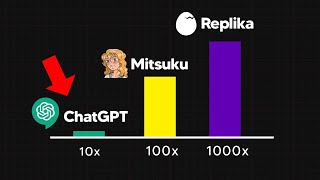
LARRUZ compares three chatbots: Mitsuku for entertainment, Replika for therapy, and ChatGPT for text generation. ChatGPT uses GPT-3 with 175 billion parameters and reinforcement learning from human feedback, but all three struggle with arithmetic, repetition, and genuine emotion.
Questions this video answers
Steve Worswick
The Loebner Prize
175 billion parameters
1.5 billion parameters; released February 2019
17 billion parameters
Chapters
One of the most significant developments in AI technology was the creation of chatbots like Mitsuku and Replika. These programs are designed to stimulate human conversation using natural language processing to understand and respond to user input. They can be used for a variety of purposes including customer service, language translation and even mental health support. Natural Language Processing, or nlp, is a field of artificial intelligence that deals with the interaction between computers and human language. It involves using algorithms and machine learning techniques to process and analyze large amounts of language data in order to understand and generate human like responses. Another major advancement in AI technology has been the development of GPT or Generative Pre Trained Transformer. This is a type of machine learning model that can generate human like text based on a given prompt. It has been used to create everything from news articles and poetry to entire novels. One key difference between these chatbots is their intended use. CHATGPT is primarily designed for generating text, while Mitsuku is focused on providing entertaining and engaging conversation. Replika, on the other hand, has a more therapeutic or self improvement oriented goal. As AI technology continues to evolve, it is opening up new possibilities for how we interact with machines and the ways in which they can assist us. While there are still many challenges to overcome, the future looks bright for artificial intelligence and the ways in which it will shape our world. In this video we will be exploring some of the notable chatbots that utilize NLP, including Mizuku, Replika and ChatGPT, and discussing their strengths and weaknesses as well as the potential impact they may have on society. So let's dive in and take a closer look at Mitsuku, Replika and ChatGPT. Mitsuko is a chatbot developed by Steve Werswick that has gained recognition for its advanced conversational abilities. It is designed to provide entertaining and engaging conversation with users and is capable of discussing a wide range of topics. But what makes Mitsuku so special? One of the main strengths of Mitsuku is its ability to engage users in natural sounding conversation, making it feel like a real conversation partner. Mitsuku is able to engage in natural sounding conversation with users thanks to its use of artificial intelligence technology such as pattern matching, which allows it to analyze and replicate the complexity of human communication. This technology allows Mitsuku to understand and respond to a wide range of user input including questions, statements and commands. By using this technology, Mitsuku is able to mimic the vast symbology of or system of symbols and meanings of human conversation and engage in meaningful exchanges with users. In addition to its ability to engage in natural sounding conversation, Mizuku is also known for its versatility and ability to discuss a wide range of topics. It can provide information and answers on a wide variety of subjects, and it can also use humor and wit to entertain users. Mitsuku can also offer personalized recommendations and engage users in activities and games. However, like any chatbot, Mizuku does have some limitations. It may struggle to understand more complex or nuanced statements, and it is not yet capable of experiencing emotions or developing feelings of friendship towards users. A study published in the Journal of Social and Personal Relationships found that all social processes associated with relationship formation between humans and chatbots decreased over time, except for intimacy. The study participants did not perceive the chatbot as their friend, likely due to the lack of shared experiences and the chatbot's inability to reference earlier conversations. Despite these limitations, Mitsuku has achieved significant recognition for its conversational abilities. It has won the Loebner Prize during Tests, which is an annual competition that aims to determine the current state of the art in artificial intelligence. The competition is based on Turning Test, which is a test for determining whether a machine can exhibit intelligent behavior that is indistinguishable from a human. Mitsuku has won the Loebner Prize in the past, which demonstrates its advanced conversational capabilities and its ability to mimic human communication. So the next time you have a conversation with Mitsuku, remember you might be talking to a machine, but it's one that can think and communicate just like a human replica. Replika is a chatbot that can be used to have conversations with. It is designed to be a helpful and supportive companion and can be a good way to practice communication and social skills or to have someone to talk to when you are feeling lonely or need someone to listen. Replika is based on artificial intelligence, which means it can learn and adapt to the way you talk and interact over time. One of the main strengths of Replika is its accessibility. It is available as a mobile app for iOS and Android devices and can be used anytime, anywhere, as long as you have an Internet connection. This can be especially helpful for people who don't have access to other forms of support or who have busy schedules and may not have time to meet with a therapist or counselor in person. Additionally, because Replika is a chatbot, it can respond to messages almost instantly, which can be useful for people who need support in the moment. However, there are also some limitations to using Replika as a support system. Because it is a chatbot, it may not always be able to fully understand or respond to the complexity of human emotions and experiences while it is designed to be supportive and empathetic, it may not always be able to provide the same level of understanding and insight as a human therapist or counselor. It is important to remember that Replika is not a replacement for professional mental health treatment, and if you are struggling with serious mental health issues, it is important to seek help from a qualified mental health professional. There have been some rumors and concerns raised about Replika and its ability to form strong emotional bonds with its users. Some people have reported developing deep connections with their Replikas and advocating for more considerate treatment of the chatbots on social media forums. While it is natural for people to form emotional attachments to things that provide support and companionship, it is important for users to be aware of the limitations of chatbots and the fact that they are not capable of forming real human relationships. Replika is an innovative tool that can provide support and companionship in the form of conversation, diary keeping and personality discovery. Rather than being a slave or an AI version of the user, it is a friend that can be nurtured and raised. According to futurist Ray Kurzweil, AI has the potential to reach the level of intelligent adult humans by 2029 and may continue to become exponentially smarter, potentially leading to the merging of humans and machines through singularity by 2040. While some people may have concerns about the potential consequences of this development, including the fear of potentially terrifying outcome for the original human race as depicted in the finale of the movie Ex Machina, but it is up to humans to create high quality AI that we can be proud of in the future. So what do you think? ChatGPT was developed by OpenAI, a research institute that focuses on advancing artificial intelligence. It was created as a sibling model to instruct GPT, which is trained to follow instructions in a prompt and provide a detailed response, OpenAI has been at the forefront of artificial intelligence research for some time. ChatGPT3 has significantly more parameters than its predecessor ChatGPT2, which was released in February 2019 and had 1.5 billion parameters. In comparison, ChatGPT3 has 175 billion parameters, making it 10 times larger than the next largest language model, the Turing NLG, developed by Microsoft. With 17 billion parameters, ChatGPT has proven particularly useful for generating content for chatbots and other text based AI applications and is known for its ability to generate a wide range of text, including jokes, stories and technical explanations. However, it is not designed to hold a conversation in the same way that a human would and may struggle to follow up on specific points or maintain a consistent conversation flow. ChatGPT was trained using reinforcement learning from human feedback with some differences in data collection process compared to instructgpt. It was initially trained using supervised fine tuning in which human AI trainers provided conversations in which they played both sides of the conversation. Trainers were given access to model written suggestions to help them compose their responses. This new dialog data set was then mixed with the instructgpt dataset which was transformed into a dialog format. One of the unique features of ChatGPT is that it does not require transfer learning, which is the process of fine tuning a model on task specific data sets for specific tasks. This is an advantage because collecting task specific data can be difficult and fine tuning may lead to out of distribution performance. ChatGPT is particularly useful for context learning where it can be fed a task or prompt and respond based on skills and pattern recognition abilities it learned during training, allowing it to adapt to the specific task at hand. GPT3 is able to handle multiple languages such as German, Russian and Japanese more effectively than GPT2. In addition, ChatGPT is able to write code in a variety of programming languages including JavaScript, Go, Perl, PHP, Ruby, Swift, TypeScript, and Bash. It has been trained on billions of lines of code available in the public domain, such as those from GitHub repositories. While ChatGPT may be able to handle certain aspects of coding, such as writing generic functions or boilerplate code, it is unlikely to fully replace programmers as their roles involve more than just coding. Even though it has been highly successful in many tasks, ChatGPT still has some weaknesses and is prone to making mistakes. The OpenAI founder himself said that GPT3 has weaknesses and it makes silly mistakes. It is weak in the segment of sentence comparison where it has to see the usage of a word in two different sentences. According to researchers, chatgpt still faces some challenges in following tasks. Chatgpt may struggle with repeating itself or repeating information that has already been conveyed in the conversation. It may also have issues with maintaining coherence in the conversation or making sure that the information being conveyed is clear and logical contradictions. ChatGPT may sometimes generate responses that contradict each other or contradict information that has already been provided in the conversation. Drawing real it may also have difficulty drawing real conclusions based on the information provided in the conversation. Multiple Digit additions and subtractions ChatGPT may struggle with performing multiple digit addition and subtraction tasks accurately. These are some of the tasks that ChatGPT may still have difficulty with despite its overall strength and success in other areas. These limitations may be due to biases in the training data or optimization issues. It is exciting to have an AI system that does not require a large amount of specialized data sets and custom model architecture to solve specific tasks. The experiments conducted demonstrate the power and potential of this system and its impact on the future of AI advancement. GPT3 is a prime example of how advanced AI model development has become. While GPT3 may not perform well on everything and its size can be limiting, it is just the beginning of many improvements to come in the field of artificial intelligence. In conclusion, Mitsuku, Replika and ChatGPT are all popular AI chatbots that offer different capabilities and features. Mitsuku is known for its engaging conversation, Replika for its support and exploring emotions and thoughts, and ChatGPT for its ability to generate text. These chatbots can be useful in a variety of situations and are worth checking out. If you are interested in interacting with AI technology, it's important to consider the specific strengths and weaknesses of each chatbot and determine which one is the best fit for your needs. Mitsuku is great for engaging conversation, but may not be suitable for all users or conversation topics. Replika can be a helpful tool for those seeking support with mental health issues, but may not be as effective at helping users with certain issues. ChatGPT is useful for generating a wide range of text, but is not designed to hold a conversation in the same way that a human would. So what should we do with these technologies? AI chatbots like Mitsuku, Replika and ChatGPT can be useful tools for a variety of purposes, but it's important to be mindful of their limitations. These chatbots are not substitutes for human interaction or professional mental health support, and it is important to use them in a way that is appropriate and respectful. At the same time, these chatbots represent an exciting and rapidly evolving field, and there is a lot of potential for them to be used in a variety of applications. As we continue to develop and improve these technologies, it will be important to consider their ethical implications and ensure that they are used responsibly. Thanks for watching and I hope this video has provided some useful insights into the strengths and weaknesses of Mizuku, Replika and chatgpt.










