China Unveils ANOTHER NEW Humanoid ROBOT! (Tiangong) New Humanoid ROBOT
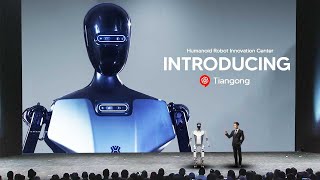
YouTube commentary about a newly released Chinese humanoid robot called Tiangong, presented via a short demo. The speaker highlights that Tiangong is claimed to be a full-size, fully electric anthropomorphic humanoid with notable leg/stability mechanics, ability to traverse slopes and steps (including a ‘blind mode’), and an open-source orientation; the video also lists hardware specs and developer attribution.
Chapters
So it has been an absolutely massive week for China as seemingly not only have they released a new humanoid robot and an advanced AI system, they've now gone ahead and released a fully advanced humanoid robot that they are dubbing Tiangong. It's apparently the world's first fully electric powered, anthropomorphic full size humanoid robot. So essentially they've released a very short new demo in which they showcase this robot's abilities. And we're going to be diving into this and showcasing why this is so fascinating in terms of the world of AI. So let's take a look here at this short demo. So one of the things to note about this demo is that this demo wasn't exactly the longest kind of demo. There was another one released that I'll leave a link to in the description. But, but of course copyright is a big issue. So essentially the reason I think this humanoid robot is rather fascinating is because of how it is powered. They are stating that this is fully electric and that this is capable running solely on electric drive. Now this comes after a slew of announcements from China in terms of many other developments in the nation. And this one actually did come as a surprise, but because I do know that China does have other humanoid robots in there, like the GR1 and many other humanoid robot platforms, but this one was rather surprising. Now you can see here that the way how this robot walks, it does actually look very normal. And one of the capabilities they showcased about this robot was the ability for this to almost get up some steps. And it was pretty weird because one thing I noticed about this demo was the fact that as this robot is going up the steps and it accidentally. Well, I'm not even sure if this is accidentally or not, but I usually don't see this in robotics. But if we highlight this area here, you're going to see that this robot is kind of tripping as it goes up there. I don't know if you guys can see that, but it literally looked as if it was tripping. But I'm guessing that maybe this robot has some kind of advanced system where it's able to self correct as it goes up, which does mean that this robot is very, very stable in terms of the stability mechanics that they've used, which is very, very good. Now, in addition with that, what we do have is we do have a scenario where there are some key features mentioned. So one of the key features mentioned about this robot is of course the fact that it can run through sloped terrain in blind mode. And I'm guessing that this is potentially a mode where they don't actually use the vision sensors because if they're stating in blind mode, I'm guessing that the legs will are pre programmed to pretty much walk over any terrain. So that means that this robot is going to be very, very nimble and agile when it comes to navigating different environments, potentially environments that are foreign to this and environments that it wasn't trained on. And that is very good because there are always going to be unique scenarios in which a robot is going to have to walk up in essentially a zero shot context and be able to clear the path. So this does show us some really, really unique engineering. And I think something that people might miss is that as the robot walks down here, you can see that the level and the angle of the feet actually change. And the reason this is so important is because many of the times in demos that we've seen recently, we see robots and they walk around on the back here. Like for example, we'll see a robot walking around on this flat surface right here, but we won't see robots actually tackling, going up and, and actually going downstairs. We'll see a cool demo with some hands, which is all very good and well, but what we don't see is this right here. And I know this is very subtle, which is why I'm trying to point it out to you, but as the robot goes down, you're going to see that the, the foot of the robot is of course, here. Then as it goes down, it slants its legs just like a human would, which is very, very important for adjusting your stability and ensuring you're stable. So you can see that as the robot, the robot goes down, it then adjusts its legs so that it's very, very stable walking down. And this is something that's rather, rather important. And then we can see this being done here. And this is of course a very unique design and something that we didn't see in many of the other robot designs, which I think is actually very, very important. So this was a key thing that I actually saw that I was like, okay, they definitely worked on these legs for quite some time because they're very, very nimble in being able to handle a majority of different situations. And I think it's really important that we do not underestimate how important that is. Now, there were some additional things that I did find to be completely interesting. One of those things was, of course, the fact that this humanoid robot is a bit lacking in the arm department. I'm guessing that this Humanoid robot, they mainly did focus on, of course, the legs, because once again, the robot is able to run in this mode. And this shows us that this robot has actually a pretty quick step. To be honest with you guys, getting a robot to move this fast without any overhead hanging cable is a huge feat. That is not to be scoffed at because this definitely means that the stability mechanics of this robot are completely incredible. And of course, by the demo, we can see that it does oddly look as if this robot is kind of half developed. Not to take any shots at it, but it does seem that they've been working on the legs quite a lot more than they have the torso. That also almost seems as if it's entirely made up of just a battery. And then of course, the hands look severely underdeveloped. Not in any kind of bad ways, but it just doesn't have anything too crazy on it. I mean, there's no arms. I guessing maybe you can have that in the future. But it definitely is a very interesting humanoid robot. Now, of course, with the cameras, you, it does actually talk about how there are several cameras there that it can be used to of course, navigate certain environments. And this was developed by the Beijing Humanoid robot innovation center company. And it actually stands at a height of 1.63 meters and weighs 43 kilograms. It can also maintain a steady running speed of 6 kilometers per hour. And also the. And also the multiple vision perception sensors that are located here also, or high precision units of 550 trillion operations per second, 3D vision sensors and high precision 6 axis force sensors for accurate force feedback. Now one of the things that I was actually doing some research on when I was looking into this robot was I found out that this robot is actually open source. So this was something that I think is rather fascinating because it's a bit different when you take a look at what robots are capable to do. Now, open source is pretty crazy because open source actually helps out the community in a very, very insane way. We can see here that this demo, they're stating that Tiangong has open source and compatible scalability. Now I do think that that is probably not the most accurate translation, but if this robot is open source and it is developed in that manner, this is going to be pretty crazy because open source projects actually benefit from Kong contributions from a global community of developers and engineers. And this can accelerate innovation as more individuals and teams can experiment with and improve the robot's design and functionality. Now, of course, when they actually do open source, this robot, it also does provide a layer of Transparency, because this allows people to truly understand how this robot works. And this means that you can build trust and reliability as users can verify the safety, the security and and functionality of the robots. Considering the fact that many people are fearful of this technology and what's actually really, really good. And one of the things I think are really important for this, if it actually is open source, is the fact that an open source robot can actually be a valuable resource for educational institutions and research organizations and students and researchers can actually study the robot's design and operation, which can lead to educational advancements and new research projects. And one of the things that I'm truly, truly excited for with this robot is that if it is truly open source, this is going to foster a vast ecosystem of developers and innovators to be building on this platform where they can potentially customize the robot in certain ways that the initial creators may have not realized were useful or utilize it for certain things that could actually show us humanoid robotics moving in a completely new direction. So overall, what we have here was a extremely, extremely interesting humanoid robot. I've got to be honest with you guys, this thing looks absolutely incredible in terms of the design and in terms of the slickness. And I'm wondering if in the future, well, I'm guessing probably so that they may include some hands or some grippers that this robot may have as some functionality. Because right now it does seem a little bit underdeveloped, it's in terms of that area. But maybe this robot is for different things. I guess we will have to see. But so far this is looking very, very good. And I have to say, China have been nonstop with their releases recently in terms of the kinds of technologies they've been developing.










