China's AI Takeover: Get Ready For A Surprise
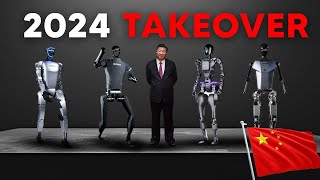
Chinese AI companies are releasing models that rival US systems. Vidu generates videos, SenseTime 5.0 handles images and text, and 01AI's Yi model competes with GPT-4. Humanoid robots like Unitree G1 show China's robotics progress.
Chapters
So China versus USA is a very, very big debate. And I think in artificial intelligence it's arguably one of the most important ones. And I think China on a very, very certain level might actually be winning the AI race if we actually take a look at things. So it's important to know that this video is going to showcase every area of AI and robotics and it's going to give you guys a comprehensive guide on where China is currently in terms of their AI development and their future plans and how they plan to compete with the us. So this video is honestly kind of interesting because when I was making this, I realized that China is certainly further ahead than we may think. So one of the things that I did see from China was of course, their text to video model. Now I didn't make a video on this, but a lot of people didn't actually see this. The model that they made was called Vidu.
Okay.
And this is basically their artificial intelligence system which can create generative videos. Now I'm going to show you guys some of this because it's pretty, pretty incredible. But you can see right here, that video is able to generate videos that are on the level of Sora. I mean, take a look at some of the water consistency. Take a look at the dog that you can see right there. Take a look at some of these characters. I mean, I should just let this play out.
It. Sam.
So there we have the actual demo.
And yeah, you guys can see that that was rather impressive. Now it's like some kind of inception thing going on here because I'm commenting over a video that was like, you know, already done by myself. But the point here is that, you know, from what we've seen, it's shown that, you know, China has caught up.
Pretty much to Sora.
Now, whilst, yes, Sora is probably a little bit more advanced, I do think that the second iteration of this model is probably going to be on the level of Sora. And I think it's rather important to, you know, showcase just how quickly China have moved. And what was interesting was the fact that, you know, a lot of the demos that we saw in video were actually, you know, showcased as a direct comparison to Sora.
So what?
Whilst they may have not caught up directly, I think the most interesting thing was the fact that, you know, maybe they didn't catch up to Sora, but was the fact that they actually beat and are kind of beating a lot of the, I guess you could say, models that are state of the art in the us. Well, not state of the art. Yes, but the ones that you can actually access, like, I'm not sure if you can access video yet. But the point is, is that Runway doesn't have these capabilities. I mean, I guess you could say Pika Labs doesn't have these kind of capabilities. So it really does go to show that China are making some significant breakthroughs here that I genuinely thought that PColabs.
And Runway would have made by now.
Which is genuinely quite surprising. So on the text to video aspect, and I know I probably should have spoke about text to video later, I.
Just, you know, thought that this is.
Pretty crazy because like I said, it's better than what we currently do have because if we compare it to, you know, I guess you could say Runway and Pica Labs, it's very, very fascinating with as to, you know, what is currently available. So that was something that was pretty, pretty crazy. Now in this, you know, video, this is what, you know, probably you really.
Do want to see.
And this is with regards to China's text model. Okay, Now I made another video on this, but like I said before, these videos don't get that much attention, but they are still very, very important. Okay. So basically what they did was they released a model called SenseTime 5.0 or Sense Chat version 5 and they compared.
It to GPT4 Turbo.
And of course GPT4 Turbo, even in its current state, 4O is not the current leader in terms of benchmark capabilities, GPT4 Turbo is. And on the benchmarks pretty much across all of them, bar one or two, there just weren't many areas where this.
Model actually surpassed GPT4.
I mean, there weren't many areas where.
It actually lost to it.
You can see here that Sense Chat version 5 actually surpasses GPT4 Turbo, one of the recent models, in many different areas. And whilst, yes, if you do take a closer look at this, we can see that the discrepancies between Sense Chat version 5 and GPT4 Turbo's performance aren't that wide.
It's still important to note that this.
Is still very, very, very surprising.
And then of course, what they actually do do and this, you know, pay attention here because I'm going to, you know, say some things and I'm going to recall them. So you can see right here that they actually do Compare this to GPT4 Turbo. And that actually is to the eagle eyed viewers that it is the 1106. This isn't actually the most recent one, but it's not also a most outdated one as well. And we can see that the only benchmarks that it surpasses their model sense chat version 5 on is of course the math zero shot benchmark right here. And we can see that it's highlighted in the 61% area and we can see that in this benchmark right here as well. So we can basically see that currently what we're looking at is a situation where across all of the benchmarks compared to GPT4 Turbo, one of the most recent models, I don't know why they didn't do the most recent one. I'm guessing GPT just based on where they are in their testing. And of course we do have a comparison with llama 370 billion parameters instruct. We can see that the differences from GPT4 are honestly, I wouldn't say quite stark, but it doesn't just seem to be Benchmark, which is a state of the art model and it was released by Anthropic. Now I've done this a little bit sloppily, but let me just explain to you what you're currently looking at. So all you're looking at is Claude 3's benchmarks and we can see that it is compared to GPT4 in this tab right here. And essentially across the board completely, Claude 3's Opus model does surpass the benchmarks of GPT4. Now what this does mean here, what I've actually done here is I've actually circled these areas where Claude 3 retains its leadership in terms of how far it is. But I've added X's here because these are areas where Sense Chat V5 actually beats Claude Opus. So in the math benchmarks, which is math problem solving, it does better than Claude Opus. There we can see it's 61.9 and this one is 60.1. So that's where Sense Chat V5 reigned supreme. Then of course we can see here on the common Sense knowledge, the hello Swag, this is 95.4%. And then for here on the Common Sense hello swag, we can see that theirs is actually at 97%. So this is actually a huge improvement. We can see that 95.4% to 97.0.52% is a big improvement. However, Claude actually retains the leadership benchmarks in these areas where we can see the mmlu, the graduate level reasoning, the grade school math.
But something that I do want to.
Add, whilst yes, Claude 3 does have the best on these benchmarks, I would.
Have to be honest and state that.
It isn't far off. Like for example, if we look at the code on the human evaluation at 84.9%. Or for example, if we look at the big bench hard we can see it's currently at 82.98% whereas on the big bench hard it's at 86.8%. So I mean it is pretty interesting.
And the point I'm trying to make here guys, is that overall you can see that basically China has caught up.
To the US standard in terms of GPT4 capability. And you can see that they did a arena battle where they tried to showcase just how good their LLM system was compared to the other AI systems. And I think this stuff is really, really important because it shows us that across the board other countries and other nations are really trying their best to catch up. Now what was crazy as well was this image generation stuff. You can literally see here that this new model that they made, SenseTime 5.0 was able to generate a really, really nice array of images that, that were really, really done well. I mean it was pretty, pretty impressive on how they managed to catch up to midjourney. And you can see that, you know, the quality of this stuff was really nice.
And its ability to generate diverse facial expressions and styles that carry the subtlety and richness of film grade portraits, that description is pretty good. But I've got to be honest, if.
This is their text to image generation.
Model, I have to say whilst yes, Mid Journey might be on this level, this is definitely something that looks really, really good. I mean we can't say that this doesn't look completely realistic. And as for the prompt, I think this is something that does do it really, really well.
Now what was also interesting in this video that I did manage to find was the fact that they also had a 1.8 billion parameter model that actually did a lot better than the 7 billion parameter models that were released I think earlier this year. So it's pretty, pretty crazy that they' just going after the standard LLMs that we do use on, you know, larger tasks. They are pretty much going after every bit of access you can see. Sense chat Lite 1.8B just surpasses all of these other things, surpasses llama 27B and surpasses llama 2.13B and even Google's Gemma 7B. So that is pretty, pretty, pretty crazy. And I think they do have some independent benchmarks here because they don't seem to have any of the industry standard ones. But the point here is that China is definitely, definitely ramping up their efforts in order to catch up or Even perhaps overtake the current capabilities of US AI systems. And it really is interesting because I guess you could say some of this stuff are doing even better than the US counterparts. Now, another area in which China is far, far exceeding what many people thought they were capable of is in that timeframe. Because I think the problem here is that a lot of people were thinking that yes, China of course is good at creating software and stuff like that, but the problem is that with AI you have this time lag to where training a model and of course doing the safety evaluations, all of that stuff does take a decent amount of time. But somehow China have managed to ruthlessly get their models into a position where they're doing very, very well. Recently there was this model called the Yee Large Preview and this was actually at the number two SP until a couple of, you know, updates were there. And Google actually I think they did some post training on their Gemini 1.5 Pro API and then they managed to get their arena ELO even higher. And you can see that it is now above Claude Opus, which is pretty crazy. And you can see that Yee Large is a Chinese model released by a company called Yi. And I'm going to show you guys some of the information in a second. But the Chinese AI company Behind the model Yi Large is 01AI. And this startup was actually founded by Kai Fu Lee, a prominent figure in the AI industry who had previously led Google China and founded Synovation Ventures. 01 AI has quickly risen to prominence in the AI field, actually achieving unicorn status with a valuation of over $1 billion within just eight months of its founding, which is absolutely incredible. And the Yee Large model is a closed sourced large language model with over 100 billion parameters. And apparently this model has been reported to surpass OpenAI's GPT4 in reasoning and in several other benchmarks. And not only is Yi Large Preview their only model, they also have other versions of the yi model, including Yi 1.5 34 billion parameter model, which combines computational efficiency with broad capabilities. They've also introduced APIs optimized for various tasks as well. And here is a short clip of the founder talking about this.
So we are launching today our new model called E Large, which is the model that has API being released throughout the world. We intend to be a global company, so not just for China, but for China we've developed an app on top of E large. So large is to GPT 4 as one is to chat GPT. We now have both. 01, my company was founded only one year ago and when we started we were at least 7, 8 years behind the open air. But now I'm proud to say that our latest model, Large is performing comparably with GPT4 by third party evaluations. And on top of a powerful model is really the only way to support a product with product market fit that that will excite users, bring about the ChatGPT moment. So we are hopeful that our model with its performance will provide a chat bot that will rival ChatGPT for China. But we also think the model will support all kinds of apps throughout the world.
So that is the CEO talking about how they've managed to do eight years of work in just one year. And that is of course a remarkable, remarkable achievement. And hats off because I'm sure that took a level of hard work and dedication that we've honestly never seen before. Now, it's not just AI systems where China is making rapid progress. We have humanoid robots. Take a look at their recent demo of their untree G1. This is their most impressive feat to date yet because not only is this robot very, very flexible and very, very sturdy and very, very strong, this humanoid robot is incredibly cheap. It is only, and I repeat, only $16,000. Which means the research efforts behind this robot are about to exponentially increase due to the affordability of this. And I mean, it's really, really shocking how quickly they've been managing to get these robots and build robots that are humanoid in their form factor that are so effective yet. So I guess you could say creepy in this aspect, but that is something for another day because other robotics companies are doing this as well, but so much stronger than what we initially thought. And I mean, it's a very, very impressive humanoid robot that is probably going to be walking around cities in sometime in the near future, completing a variety of different tasks. So the Unitree G1 is a robot that is founded by the company Unitree and they' previously done robotics demos where they've showcased some very, very impressive capabilities of their robot, including breaking the world record for the fastest running robot. And I can't imagine what this robot is going to look like when it's running, walking around and doing some very impressive tasks. So China's, I guess you could say, infrastructure is very, very, very suited to support the robotics infrastructure. So I wouldn't be surprised if China is arguably the leading manufacturer of robotics in the years to come. Now they've also got other humanoid robots, although I can't show this one because they copyrighted my other video which Means that, you know, the video, I think it did get taken down, but essentially it was a robot that does have a large language model integrated into it, and it's able to give the robot, I guess you could say, advanced capabilities, such as conversing with you and performing more tasks than it usually can. And China have also made this robot recently, which is 100% automated, the Astrobot S1. This is the robot that I wouldn't say it broke the Internet, but genuinely, it is so impressive that I'm still, still dyke, just speechless at this point, but struggling to believe that this is, of course not teleoperated or that this is, of course not some kind of, you know, fake demo. Because it's so impressive that it just surprises me that this is even possible to do. So you can see that they also have a large language model in there. And this is a completely autonomous robot that is able to do a variety of tasks. So, I mean, what do you guys think about this? Completely. Do you think China will surpass the US in the coming years in terms of humanoid robotics and in terms of AI development? Do you think China is not going to ever catch up? And they may never catch up because the US is far ahead with OpenAI and companies like Boston Dynamics? Or do you think this terminal race condition that we've applied to ourselves and the market dynamics are going to force more innovative companies to come out of China, potentially leading to breakthroughs that could shift the balance in terms of who is leading the AI race? Now, I personally believe that the US is probably going to stay ahead, but I don't think that they will stay ahead in terms of robotics developments, because China by far have outlined their master plan for 2027, where they aim to be the leader in terms of robotics. And if you've been paying any attention to what's been going on in the electric vehicle space, we can see that that is having a giant impact on the US car market sales. And I think we're going to see a very similar thing in robotics, too. The point being that, look, China's infrastructure, it supports mass production. And the mass production of humanoid robots has to come from somewhere. And I wouldn't be surprised if that place was China. So with that being said, let me know what you thought about this. China is definitely further ahead than you may think. And it's very interesting to see how this next wave of technology is going to be developed, because I think that now that this giant race has been kicked off, I think that we're truly about to see innovation on a completely different level.










