Chinas New "KEPLERBOT" Surprises Everyone! (Tesla bot Competitor)
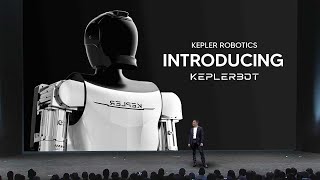
YouTube commentary by LARRUZ reviewing Kepler Robotics' humanoid "Kepler" robots. The narrator summarizes a demo and company materials: Kepler offers multiple variants (S1/K1/D1) aimed at outdoor tasks, hazardous environments and general-purpose applications; hands with 12 degrees of freedom and force sensing; an on-board "Nebula" system paired with a ~100 TOPS compute motherboard supporting visual SLAM and 3D modeling; claimed multimodal interaction (vision, language, audio) and real-time sensing; rumored pricing in the ~$20,000–$30,000 range and an alleged Q3 2024 production target; Kepler exhibited at CES (brief interaction with Satya Nadella). The video mixes observed demo footage with marketing claims and speculation about autonomy vs. teleoperation and industry impact.
Questions this video answers
Three (Kepler S1, Kepler D1, Kepler K1).
12 degrees of freedom.
A "100 TOPS" high-computing motherboard (described as paired with the Nebula system).
Approximately $20,000–$30,000.
Alleged mass production around Q3 2024.
Chapters
So I recently came across a very fascinating new humanoid robot that is gearing up to be one of the Tesla bots main competitors. And this video will showcase the new Kepler bot robot from Kepler Robotics. And it is a fascinating humanoid robot that is much better than I initially realized. So let's take a look at their video demo and then let's look at what makes this robot so effective. So that was the demo of the Kepler bot and I think that that was a fascinating demo for us to look at because my, oh my, the humanoid robot race is heating up. Now, there are several things that I did find captivating from this thing. One of the most things that I did find really fascinating was the fact that they do actually have three versions of the Kepler bot. So they have the Kepler Si or the S1, and you can see that it's the Keplod humanoid robot, which is the outdoor tasks version. Then of course we have the Kepler D1, which is the hazard environmental version. So I'm guessing that that one is going to be for specially specialized scenarios that are probably dealing with toxic and hazardous environments. So this one is probably going to be a lot more armored, a lot more rugged in terms of its capabilities. And then of course we have another outdoor tasks version. So I think it's really fascinating how they've managed to come at the angle because a lot of humanoid robots that are currently being built are, unless we're talking about Boston Dynamics, usually what we are talking about is general purpose robots that aren't really a focus on hazardous environments. The only one that I do know did one that was focused on hazardous environments was of course one that there was a dog or Boston Dynamics, which was built to go into dangerous environments. Now I do think that this is actually a very impressive demo. And something from the video did actually quite shock me because they said that it is an AI embedded humanoid robot with bionic body structure and bipedal walking. Now, bipedal walking is definitely something that is quite difficult to achieve in robotics. And only recently have some companies managed this feat, which is why we don't see many AI robotics companies in terms of them being able to get fully functional humanoid robots. And it's definitely a really, really big task for these companies to overcome, which is why we're seeing only a few take the shot at it. So it does give us a breakdown in the video and there are some more slides that give us some more breakdown. And I think some of the stuff that I do show you guys is going to really surprise you. And so Far while the movement doesn't look particularly striking in terms of its smoothness, it does look pretty decent at a first glance from what we are seeing. So the thing that they have right here, you can see we can take a look at their hands. So it says behaving, perceiving, just like humans. Smart and agile robotics, hands master every task. Mimicking the intricate structure of the human hands. It holds a patented design and boasts a total of 12 degrees of freedom. Capable of precise force sensing for unparalleled hand dexterity. So it's got exceptional precision, robust strength, intelligent control and it's versatile and flexible. Now one thing we didn't see from the demo, I mean the hands do look pretty good because we did see the robot be able to actually pick up a few items. So if we take a look at the demo, you can see that right here the robot is successfully picking up some items. One thing that we didn't get was if this was teleoperated or not. Because as you know, in robotics, teleoperation is something that is is currently done which showcases how robots can be moved. But it is far more impressive when robots are being moved and operated on tasks that are quite autonomous. So this is definitely something that we would like to know, but with the hands, what we've seen so far, and there is something that is quite impressive about the hands in terms of its ability that I will show you now and that is the agility of this robot. So there was a small demo and I'm not sure how many tries they did take to do this or if this was something that was entirely pre recorded. But the agility of this robot to be able to throw a, into a cup and of course they could have done this like a thousand times. But I still think that that is somewhat impressive for you know, a robot to be able to get something and throw it. So I still think that that is pretty cool. Although it is just like a, you know, a 10 second video that they uploaded to their channel, I still think something like this is rather impressive and then it gives us the thumbs up. So there are a few more slides that I do want to show you guys from their website because it is truly fascinating and this was something that I wanted to talk about. So they describe this robot to have a self developed nebula system and it says powered by our self developed nebula system which is paired seamlessly with the 100 tops high computing motherboard visual slam, capable of 3D modeling and visual recognition. Systematically enabling profound perception of surrounding environment. Intelligently linking the interwoven sensors, it seamlessly integrates with the world. So it does have a camera inside the head, it has a microphone, and apparently it can hear you. And of course it can see. So it's got a pull pressure sensor, a speed sensor, and, and an HARS sensor. So this thing is really equipped with some truly serious technology. And by far, what we also did see, which was very fascinating about this Reno robot, is that it actually was at ces. I'm going to show you guys a video from CES where a familiar face was actually taking a look at this rather fascinating robot. See, one of the things we did see was, of course, Satya Nadella at ces. So Kepler Robotics was at the convention CES where there were tons of innovative technology companies showcasing their new and innovative tec. And of course, they had a conversation with Satya Nadella. And it just goes to show that this company is definitely going to be making waves within the tech and robotics industry because they are clearly a company that has a focus on production. And so far it does seem like what we do have, even though it isn't that many videos does seem to be pretty effective. Now, there were some other things that I do want to talk about. One of the craziest things that I've seen floating around was the rumors of the pricing. So apparently the pricing for this actually potentially does start around the $30,000 to $20,000. Now, that, if it actually is going to be something that is very effective, is going to be pretty, pretty crazy, because one of the main issues with humanoid robots and robotics in general is that they are just too expensive to mass produce to a consumer market. And if they've managed to figure out something in terms of the production, and of course, since this is a robot coming out of Shanghai, that means that they do have a competitive massive advantage because they are able to get production costs down. And of course, due to economies of scale, they're going to be able to mass produce these at scale. So I do think that the pricing for humanoid robots is an important aspect, because if robots are priced at, you know, around $250,000, that's the same price as a very expensive supercar or something. And that's not what the average person has anyway. So that doesn't mean that it's going to be robot revolution, but if things start to get lower and lower in price, I think this would really change many different industries. Now, there were some other things additionally that I did want to touch upon. For example, the autonomously explore and execute accurately so they stated that powerful motion planning and control algorithm to achieve precise navigation, movement and task execution. So it's pretty crazy that we can see here that they talk about this being autonomous. So it seems that, you know, these robots, what they're doing and the demos have been completely autonomous. And that's just based on what I've seen on their website. Of course, we don't know that at all because we've seen that there's always teleoperation comb with Autonomy several times in many different demos. But I do think that so far from what we've seen, it's definitely quite a demo. So there was also this. So it does say, comprehend the world and embrace limitless possibilities, achieve seamless multimodal interaction, including language, vision, human computer collaboration and more. So I'm guessing that potentially this robot, in the future you may be able to converse with it because they said achieve seamless multimodal interaction. So if this is a robot that you can actually talk to within real time, that would be something that isn't that hard to achieve because recently we've seen technology be able to do this. With the Rabbit's recent demo, we saw them get real time latency with a decent voice achieved. And if this robot is able to do that, that is going to be a neat feature as well. So they talk about, you know, language, vision, human controlled collaboration and more. And of course, I'm guessing that the human collaboration is probably a sneaky word for teleoperation, but like I said, I'm not sure. Now, there was also another slide that I wanted to show you guys was of course, the precise coordination, formulating the next move. So it said, by integrating visual perception and force sensing, the system captures the position and information of external moving objects, enabling real time responsive operations in tandem with moving elements. Now, the thing about robotics, and a reason why robotics is pretty slow to do, is because the thing with this is that it's really hard to process things real time. Like, while ChatGPT and all these AI systems are good, it isn't actually real time because you give chat TP an image, you know, it, you know, calls the server and it, you know, whatever. Like it takes a minute, not an actual minute, but it takes like a couple of seconds in order to process the image and then generate a response. But when things are happening in real time, you need like, you know, like under 100 milliseconds in order to act. Like if you want to dodge something, if someone's like throwing something at your head, you've got like maybe 2 to 3, 2, 300 milliseconds before it hits you. So in order to like, be fast, be quick to react, to be able to actually do things in real time, that is a big challenge in terms of robotics because it means that whatever you're developing has to be quick and very, very accurate. So I'm not sure what kind of proprietary system that they did use, but there was actually an interview in which they did talk about how the system was and they did actually say that everything that they built was from the ground up. So maybe they have a bunch of different things. And previously in the other slide they did also mention that they have a few patented designs as well. And I'm pretty sure that that is something that is normal within this industry, but it just goes to show that they are innovating themselves in a different way now. There was also something as well that I wanted to show you guys. So they talked about uncover the mysteries of the world through enhanced vision and it says real time recognition of surrounding objects, faces and movements for precise target detection and recognition. So again they talk about their, you know, movement system and of course their target recognition system, which seems to be above and beyond what we do currently know. Now there was also this as well, which is visual navigation and autonomous route. Again, like I said, you can see visual navigation and autonomous route planning. It says equipped with visual slam, it achieves, it proficiently achieves 3D modeling, constructs a map in unfamiliar environments and autonomously determines position and movement trajectory. So I'm guessing that this AI system that they do have is more autonomous than they do think, because I didn't really see the teleoperation mentioned anywhere on their website, which I'll show you in a moment. But so far I do think that this company has made a great demo. Now what I'm actually excited for is this is not exactly just this robot, but I'm excited for the competition aspect because a company coming out of China and producing this in, I'm not sure how long they've worked on it, but it doesn't seem that they've done it that long. It seems that they're moving pretty quickly. Goes to show that this actually is a very fast moving industry, more so faster moving one than prior years. So it seems, like I said before, the robot industry is heating up and robots like Kepler are going to be the next wave in terms of what we're going to see where we get that AI merging with our physical world. So I find these companies to be fascinating in terms of how they manage to develop These things in such a quick amount of time with the dexterity and with the polish that Kepler looks like it does have. But what I would like to see is of course the robot being able to move faster than this because this is currently quite slow. Although it is a definitely an achievement. And in terms of being able to balance on one leg and not crack an egg, that is something that is also achievement. But I do think I would like to see more in terms of the demo because whilst we can, you know, look at the demo and I guess you could say gauge certain things, it would be better to have more information to see exactly how certain things are done. For example, if this, you know, walking is completely, you know, autonomous, which it most likely is, and if this right here was not tele operated at all, and it doesn't look like it is, but just some text on the screen during a demo would be really cool. And I guess maybe if this stuff is really completely autonomated and autonomous, I'm guessing that if they've done this, they probably don't want their competitors to figure out how to do that as well. So what I'm going to show you now is of course their esteemed website. So this is the website GotU Kepler. And if you come to it, you are greeted with this of course demo, which we've already seen. And you can see here that they talk about industry application, you know, smart inspection and automated production line. So it seems like this robot is, you know, pretty much going to be an Amazon warehouse robot that does have a few different things. So we've got like industry application, outdoor tasks. So it seems like it's, I think it's, I'm not even sure what it's actually doing here. I thought for a second, for a split second I thought it was doing something crazy, but it isn't. But you can see that in high risk operations we do have a separate one here. And I think that the way that they've, you know, tackled this problem is, you know, rather interesting because other ones are general ones, some ones are just warehouse ones, some ones are just production line ones. But it seems like this one is a truly general robot with small iterations based on each different one. So the Kepler K1 is going to be the front runner. And I got to be honest, guys, it does actually have a similar look to the Tesla bot. But you know, in their defense, I mean, all robots, all humanoid robots definitely do look the same in terms of the entire look because they all are either white or either one color with Like a sleek black head. And it is very, very fascinating to see how they've managed to do this. So production in terms of when these robots are actually going to be available, and it is actually alleged from the interview that I saw online, it's probably going to be in Q3 of 2024, that they may actually be producing these. Now, one thing that does happen with robotics is that sometimes there are slowdowns due to the production of the materials, getting everything to be perfect. But if these do actually go out to mass production in quarter three of 2024 and people are using these, that would be something really, really interesting to see because I would like to see firsthand how they interact in the real world outside of just demos and videos that they've shown us. And then we had this really cool thing on their website where they said, premonition of the unknown, Plan B, anytime, anywhere. And dynamic sensing technology can sense changes in the surrounding environment and make timely adjustments. So what are your thoughts on the Kepler robots? Do you think that these are going to be something that challenges Tesla? Do you think it's going to increase the robot race? Do you think that is something that is just not good at all? Or do you think that is something that does have a real shot at title of the best humanoid robot? I mean, we've got OpenAI, we've got Apptronic, we've got Sanctuary, we've got. Now, something that I did want to touch on before the video did end was the fact that Elon Musk's and his new prediction on the amount of humanoid robots that there are going to be in the future. So from this article we can see that Elon Musk has supported the prediction that there will be about a billion humanoid robots on Earth in two decades. Now, a lot can actually happen in 20 years, because if we do look back at the last 20 years, I mean, right now we're in 2024, and if we look back to 2004 on the amount phones, the amount of technology, we can definitely say that there was a lot less back then and it wasn't as good. Now, with the advent of probably AGI and other AI systems that will be doing a large majority of the work, I think a billion humanoid robots in 2040 is a pretty shocking prediction. But it also does show us exactly where we're heading. And he said, and a hundred billion mostly alien robots throughout the solar system in the 2000 and 60s. So he said probably something like that, provided the foundations of civilization are stable. So of course, provided There isn't any, you know, escalating conflict that does affect any of the production in terms of, you know, what we're going to get, for example, like in AI development. As long as there's anything that does affect TSMC or the company, Nvidia and OpenAI, for example, then that timeline seems to be fast approaching. But let me know your timelines on what you think humanoid robots are. I know there was a recent report that came out that said robots aren't going to take your job, because it did basically mention that in order for a robot to take a job, it needs to be economically viable. And right now, these things are very, very expensive. But like we previously discussed, this thing is only $20,000. So with that being said, with many different humanoid robots on the rise, what are your thoughts about this? Excited. Because like I said, you can just see in the last two years. Well, I mean, I guess you could say not even in the two years, a year and a bit, just how quickly we come in terms of development for the Tesla bot. So I think if Elon Musk, if everything moves at an exponential rate, which it seems to be doing, this is going to be our future. So with that being said, I'll leave you guys with this video and then I'll see you guys in the next one on how good these robots are going to get.










