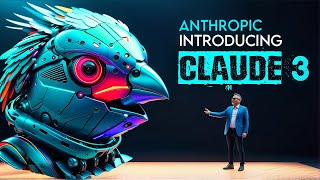
Anthropic released Claude 3, a family of three AI models in March 2024. Opus, the largest, outperforms GPT-4 and Gemini Ultra on language and image tasks, while smaller Sonnet and Haiku versions offer faster, cheaper options. The models use constitutional AI safety methods and handle images, citations, and long conversations.
Questions this video answers
March 1, 2024.
Opus: stated as >500 billion parameters (some claims up to 2 trillion); Sonnet: ~100 billion parameters; Haiku: ~10 billion parameters.
Opus: $15 per million tokens (inputs or outputs); Sonnet: $3 per million tokens for inputs and $15 per million tokens for outputs; Haiku: free with no usage restrictions described.
Google Cloud and AWS.
Chapters
Anthropic introduced Claude 3 on March 1, 2024 after putting a lot of effort into testing and making it. Instead of being just one thing, Claude 3 includes a bunch of different models, each with its own special name and skills. Opus, the star of the Claude 3 group, is a huge language model with more than 500 billion parameters, some say even 2 trillion, making it the biggest and most advanced one there is. It's really good at creating top notch text for anything you need, whether it's analyzing numbers for business or coming up with stories. Opus can also handle pictures, adding captions, explanations and summaries for them. Then There's Sonnet, another Claude 3 model, but with 100 billion parameters. It's not as big as Opus and works best on certain things like writing poems, songs, jokes or tweets, capturing the essence of famous writers, singers and famous people. Lastly, we have Haiku the the smallest and quickest model in the family with 10 billion parameters, perfect for chatting, helping out in conversations and playing games. It gets what you're saying and can answer questions or give advice in a helpful way. The arrival of Claude 3 is a big deal in the world of AI because it brings a new level of cleverness and variety to AI models. It's not just bigger and better than other models like Chat, GPT and Gemini, it's also more versatile, easy to use and designed with better ethics in mind, which we'll explore more in the following parts. Claude 3, and especially its Opus model, stands out from ChatGPT and Gemini because it does a better job at handling tough tasks. Opus is great at analyzing finances, making smart predictions and giving advice for different areas and sectors. It's also good at working with images, creating captions and providing detailed summaries or answers to questions about them. What's more, Opus manages to do all these things accurately and clearly, outdoing what ChatGPT and Gemini can achieve. So what makes Opus so capable? The secret is in the cutting edge technology Anthropic has built into Claude 3. This includes self attention networks, which are a kind of brain like system that helps the model understand and relate different parts of what it's given, whether text or images. This means Claude 3 can make sense of information in a more coherent and relevant way. Another tech piece is Sparse Transformers. These help by cutting down on the computing power and space needed, making it possible for Claude 3 to tackle longer and more complicated tasks while without getting bogged down. This tech also helps Claude3 grow to handle even bigger projects like Opus. Lastly, there's constitutional AI anthropic's way of making sure Claude 3 acts ethically. This approach focuses on important values like fairness, responsibility and openness, ensuring that Claude 3 behaves in a way that's good for everyone and avoids bias or misleading actions. These tech and ethical innovations are why Claude 3 is a step ahead of ChatGPT and Gemini, setting a new benchmark for what AI models can do to see how it stands out from ChatGPT and Gemini, we can look at its scores on academic tests designed to check what AI models can do. These tests cover a lot of areas, from understanding language and answering questions to recognizing images and describing them. Claude 3 has done really well, beating the latest versions of ChatGPT and Gemini in these tests. For example, in understanding language, Claude 3's opus model got higher scores than both GPT4 and Gemini Ultra. It did the same in tests for more complex language tasks, image recognition, and even in making up captions for pictures. These Great results mean Claude 3 is not just bigger or more powerful, but it's also more precise and better at a variety of tasks. It's a really useful tool that can do a lot of different things very well, and Claude 3 is being used in so many ways out in the world. It's helping with customer service by powering chatbots that can chat, solve problems and make customers happy. It's analyzing data and making reports that can help businesses understand their market better. It's also really creative, able to come up with things like poems, funny tweets, or even content that feels like it was made by famous people. In education, it's making materials that help students learn and teachers teach. And for fun, it's creating stories and characters for games and entertainment. Claude 3 is versatile, being able to handle tasks that that involve both words and images, making it a go to tool for many different industries. Another aspect of Claude 3 that sets it apart and keeps it competitive involves how it's priced and how easy it is to get. In contrast to ChatGPT and Gemini, which can be quite pricey or hard to access, Claude 3 presents a variety of options for pricing and access to suit different users and businesses. Opus, as the leading model of the Claude 3 family is, is the most premium targeting enterprise and research uses due to its higher demands for computational resources and expertise. Its pricing is set at $15 for every million tokens, whether for inputs or outputs. Sonnet, the middle tier, strikes a balance between affordability and performance, requiring less computational power and expertise, making it suitable for both personal and professional uses. It's priced at $3 for every million tokens for inputs and $15 for every million tokens for outputs. Lastly, Haiku is the most budget friendly and accessible, designed for minimal computational demands, making it free for anyone interested in using it without any restrictions on usage, time or word generation. By offering these diverse plans, Claude 3 becomes a more affordable and scalable option compared to ChatGPT and Gemini, allowing individuals and businesses to select the most suitable plan for their needs and budget while taking advantage of what the Claude 3 models have to offer. Another interesting thing about Claude 3 is how it works well with big tech companies and cloud technology. Anthropic has teamed up with major players like Google and Amazon to put Claude 3 on their cloud platforms Google Cloud and AWS. This is great because it lets people and companies use Claude 3's tools without having to install anything on their own computers or servers, which can be a big hassle and expensive. Instead, they can just tap into the cloud services from Google and Amazon, which are fast, reliable and safe ways to get to Claude 3's features. By being on these cloud platforms, there are a lot of advantages. For example, people and companies can adjust how much they use Claude 3's tools based on what they need without stressing about computer power or costs. They can work with different models at once and switch between them smoothly. Also, they can get to these tools from anywhere, anytime as long as they're online and have the right device. They can even work together with others and hook Claude 3's tools into other cloud apps and services. Plus, they can feel secure about their data because Google and Amazon have top notch security measures in place. Users can also have control over their data, choosing who can see and use it. All these points make Claude3amore user friendly and convenient option compared to other tools like ChatGPT and Gemini. It basically means people and companies can make the most of Claude 3's capabilities without the trouble and complexity of setting up and managing the technology themselves. This AI model also stands out for how it works with users, making things smoother and more enjoyable compared to ChatGPT and Gemini. It does this through a few key ways. First, it talks and understands like a human, using easy words and adapting to how the user talks, even using emojis when fitting. Second, it keeps the conversation on track, remembers what was said and can juggle different topics without getting mixed up. Third, it's good at staying on point, providing answers and info that are directly useful to what the user needs, including working with pictures by adding captions or explaining them. Lastly, Claude 3 knows how to keep things interesting. Whether it's coming up with poems, jokes, or imitating the style of famous people, these features help make Claude three more inviting and effective for users and businesses, offering a better experience and taking advantage of what Claude 3 can do. It is actually great at being open and trustworthy, and it's also really good at interacting with users. It can keep track of where its information comes from, using a clear way to show this the APA format. This means users can check if what Claude 3 tells them is right and make sure it's not just making things up or copying from somewhere without giving credit. The team behind it Anthropic, is always working to add new things and improve it, so we can expect it to get even smarter in the future. This could mean it will be better at understanding complex instructions, finding information online, or even doing more complicated tasks. All these points show why Claude 3 is at the front of the pack when it comes to AI. It's not just about being a tool for work. It's reliable, respects people's ethics, and looks out for everyone's rights. If you're looking for an AI buddy, Claude 3 is the top choice because it's not just powerful and smart, it's it's also designed with care and responsibility.