Climbing the Corporate AI Ladder -DeepLearning.AI & FourthBrain
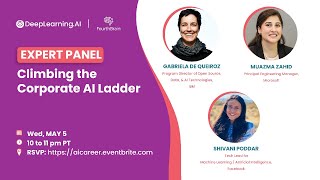
Recorded panel (May 5, 2021) hosted by Sandhya Simhan (DeepLearning.AI) with panelists Gabriela de Queiroz (IBM), Moazma Zahid (Microsoft Azure) and Shivani Podar (Facebook). The discussion covers typical ML/AI org structures and roles (research vs product/applied and IC vs manager ladders), tradeoffs between specialization and breadth, how applicants can stand out (projects, GitHub, community and open-source contributions, communication), transitioning from individual contributor to manager (delegation, emotional intelligence, team enablement), the value of formal degrees versus bootcamps/self-study, challenges in productionizing ML (MLOps skills gap), hiring signals, leadership presence, dealing with bias/toxic cultures, and audience questions about remote hiring and global competition. Practical tips emphasized: hands-on projects, networking/community, continuous learning, transparency about needs, and building allies/sponsors.
Chapters
Sam. Hi everyone and welcome. My name is Sandhya Simhan and I'm the Director of Marketing at DeepLearning AI. Welcome to our expert panel Climbing the Corporate AI Ladder. This event is presented to you by DeepLearning AI and Fourthbrain. Fourthbrain is a company that creates accessible and flexible pathways to AI careers by training candidates with valuable practical and interpersonal skills. You can learn more about their programs on their website, fourthbrain AI. I appreciate thank you all for your patience this morning. We've had some unexpected technical issues and so thank you all for moving over from YouTube to Streamyard. If you have any questions, please don't hesitate to reach out to one of the folks in the chat. So to inspire more people into the growing fields of machine learning and AI and help them level up their careers, today we've assembled a panel of AI leaders to share their firsthand experience and learnings. You can find the list of topics we'll be covering if you scroll down to check out the event description. After the panel discussion, we'll be taking questions from the community via Slido. If you have signed up for the Slido ticket, check your email for the access link to post and upvote questions there. And now, without further ado, let's welcome our panelists. They are Gabriela de Queiroz, Chief data scientist of AI strategy and innovation at IBM. Moazma Zahid, IT.
All right everybody, very nice to meet you. My name is Gabriela de Queiroz. I work at IBM as a chief data scientist working on the AI strategy and Shivani Potter. Oh, we are having some issues. Sandhya, are you back?
I think so.
Okay, so I was introducing myself so let me continue on this. So I work at IBM on AI strategy and innovation. I lead a team of data scientists, developers. I'm also the founder of our ladies and AI inclusive and today we are going to be announcing a scholarship actually with Fourth Brain and I'm going to give more details in the end. So very nice to meet you. I'm looking forward for this discussion.
Hi everyone, my name is Mazuma Zahid. I am a principal engineering manager at Microsoft Azure and a data and AI team. I've been in the tech industry in the data and AI space for over 14 years. Machine learning software that I built many years ago is actually used around the world to detect heart attacks. I'm an advocate of diversity, equity and inclusion at work and outside of work. I'm president of a nonprofit called Pakistani Women in Computing and and also I lead the Seattle community for Anita B. Org. Really excited to be. Excuse me. Really excited to be here today and looking forward to the discussion. Thank you.
Hi everyone, I am Shivani Podar. I am the tech lead for ML and AI at Facebook. I worked in this space for quite some time. I focus on building conversational assistants. So I've worked in Alexa in the past and then on Facebook Assistant for the last few years. I am very passionate about getting women and underrepresented people everywhere out here, giving them opportunities. I have clogged a personal record of helping 100 people last year where I helped them with resumes, connections, networking and all of those things. So very excited to spend some time with everybody here and be a part of this awesome panel. Thank you so much.
Awesome. Thank you guys. And I really appreciate the patience with our technical issues this morning. Not the right time for Wi Fi to be cutting out. So now before we jump into sharing your personal experiences, I was wondering if any of you could give us a high level overview of how machine learning organizations are typically structured and where they might differ from a typical software organization. So we'd love to hear about the various levels that exist in your org. Maybe Gabriella, you could start us off.
Yeah, IBM is huge. So it's more than 300,000 employees. So each small organization inside IBM have a different structure. But we do have like a data science, for example ladder where we have the levels and some kind of certification. But it depends where you are in the organization. So just to give you an example, before my current role I was working on open source, so our ladder was different probably than the other team. Right. So it varies a lot. But we do have like the. It's similar in a way that the soft engineer in terms of like naming and responsibility in a way so you can kind of like match. But it's something that is involving. So every time we talk about how can we structure the levels in a way that people can understand and they can aim to the next level.
Awesome. Mosma, what about you guys?
Yeah, very similar to what Gabriela just mentioned. We have huge Org, so they have different teams, software engineering teams, data scientists, applied scientist teams, and then the program managers or product managers team. Usually they are under one big umbrella so they kind of support one end to end solution or product and that's how we do that. But then if you go to research site or some other sites, they would be different. So yeah, it varies by the role, but in terms of the role itself, like if you, let's say are applied scient you would have the level similar to what a software engineer levels are. So we will start with the level and then you will grow into that like a senior and principal and eventually other levels as well. So yeah, very similar to that.
Very cool. And Shivani.
Sorry, trying to unmute myself here. Yeah, pretty similar. And I would, I would just go out on a limb and say that for a lot of software companies that I do know of, like I've interviewed with previously, this is what Gabriella and Mozma just said is pretty standard to have these pillars where if you're more research focused, you want to go into more research org, where you go in depth, but if you like more breadth in your experience, you want to go in a more product or where you actually apply the work people have already done and actually ship it to product. And then if you like more XFN partnerships with product data science and data scientists are usually people who will make sense of the data that's coming in. It's more product org if you want to go into more academia and look at your self publishing papers and so on, it's more research orgs. So yeah, pretty similar.
Awesome. Very cool. It's interesting to see that even in industry and large companies we sort of have that academia versus industry or product divide. That's especially really interesting to keep in mind as people are thinking about what sort of careers and roles that they want next. Now this is a, I want to say a contentious topic, but definitely one that's top of mind for a lot of people who are starting out. Is it better to focus on a specific topic within the AI space or to develop a broader knowledge in several topics? Say, you know, a little bit of computer vision, a little bit of nlp, some reinforcement learning. Shivani, do you want to kick us off?
Yeah, absolutely. And definitely I think I, I might have a perspective which is very different. But I personally think that it depends, the question really depends on where you see yourself in the sense that if you, if you see yourself getting a breadth of knowledge, I think that's great. But I would also argue that having depth of knowledge in any one area helps because any depth of knowledge that you get in any one area is easily applicable to other areas. To give one example would be say, if you're somebody working in Uber and you're making algorithms to route customers to go to an airport. Really for a place like Uber where you have so much traffic for people just going in and out of airports, there's going to be a separate team which essentially works on Routing people within airports, however. And so one could say that once you do get this depth of knowledge in essentially gathering data, applying it to build algorithms and then routing it or applying it to how consumers are using it, and then back channeling that to improving your algorithms, once you've seen that in depth, it's really easy to apply it to any other application or any other area that you're in. And so it depends, I think it's also, it's also a very personal thing for me personally. I like to get a breadth of knowledge as opposed to really spending a lot of time deep in one area. So, yeah.
Now, Gabriella, you have a slightly different point of view on this.
Yeah, But I also agree that it depends.
Right.
So, but I always think about like, what is the, what is the industry asking us? Right? What is asking for, what they are asking for? What is the amount of time that we spend in our day to day work? So if you are like an individual contributor, for example, you are probably. And if you are working with data, you are probably doing more like, almost like data cleaning, for example, or data exploration. So you spend a lot of time on that first piece where we talk and it's a buzzword. We talk about computer vision and reinforcement learning and all these cool things that are very awesome. But not all the companies are working on that part yet. They are not there yet. Especially if you go to smaller companies, they are still in the very early stages. Even bigger companies I always talk about, at least know what all the industries are using in terms of knowledge. Think about the data cleaning, know the fundamentals, and again, you can always migrate and learn as you go right on the job. So that's my opinion. But it also depends.
No, no, that's a fantastic answer, not the least because next week we have a course coming out on MLOps that really focuses on sort of what we call what Andrew likes to call the data centric approach to AI as opposed to a model centric approach. A lot of the research, a lot of the new buzz or whatever is, oh, look, we trained this model or we made a new model or we trained it on a much larger data set, et cetera, et cetera. But he feels that there's so much, there's an art and craft to how you manage your data. It's almost like a chef. You choosing your ingredients is just as much as, just as important as applying heat. So definitely a really, really solid point that we're hearing from a lot of thought leaders in the space, especially Andrew. So next question is when trying to land their first job, what should someone do to stand out from the crowd? What's something, maybe there's something that made a resume pop in one of your recent hires, Moazma, do you have anything like that that you could share?
Yeah, for sure. Thank you for that question. So I think in terms of resumes, so especially if it's your first job, you have to realize that there is a lot of people applying. Right. So you are, you have to stand out. You have to do stuff out of the kind of ordinary that you do in your college or previous experiences. So one of the things that I look for is what do you do in terms of like, in terms of projects? So hands on learning, where you have developed something from anything that you're passionate about. Let's say you're passionate about sports. So did you look into sports data and did some interesting work with that? And then how do you actually present that? How do you show me that data story and how you can help solve the data problem and whatever that problem is, Maybe you're trying to realize that which area, location, weather impacts the specific sport, something like that, whatever that is. Then I also look at, I make this additional step to actually look at your GitHub as well. If you have a GitHub account, I would go there, I would look at your projects, I would look at your readme as well. How do you describe the project? So those are the things that I definitely look at and I think the resumes that really pop out for me are the ones who have those hands on learning projects that speak to me in terms of like what your passion is about and how you can really solve a data problem using whatever techniques, whatever tools. Because you can always learn the tools and techniques at job. But how you actually, how you actually look at a problem and solve the problem, how you can showcase that in your resume and is a big point for me.
That's awesome. And Gabriela, I know that you have some great thoughts about here as well.
Yeah. And I love what Moesma shared with us because it's exactly what I look at the GitHub, the projects, I love seeing their projects. And I always mention that you don't need to do this as a, like, you don't need to go through Kaggle or anything fancy. Even if it's like, like a project from school. That's good enough. That's all I want to see. It doesn't need to be anything sophisticated. Show me that you can do some coding that you have a story to tell that what you are doing makes sense and me as a reader, it makes sense for me going through the project. The other piece that we don't talk as much is about the community involvement. So are you involved with any type of community? My whole work with communities has been helping me in finding new jobs and creating connections. Another piece is around contributing to open source. Again, you don't need to do anything fancy. Go to our open source project that you use, go through the documentation, find typos, find things that you cannot understand and make it better. So like small things, all this count and makes you differentiate yourself from the crowd. So that's something that we always looking for.
Yeah, really good, solid points. It's actually funny you guys both mentioned that communication, like the way that I've heard an mle, a senior mle, describe it once is that it's not enough that you can speak Python, you have to be able to translate it into English or ideally like product, but you have to be able to make that translation as well. That communication is just as important of a skill as the technical knowledge you receive. I know Fourth Brain does a big emphasis on that, as when they're training in their boot camps, they're like last cohort, you know, really focus on not just being able to do a project and serve up a model in particular Insights. But how do you communicate that in a way that the business can actually take advantage of it from day one as opposed to kind of having to be like, you know, come up with the so what ourselves. So really, really solid point. Especially as someone who's non technical, who interacts with mles, Let me tell you, it's so much easier when they do the translation for me. So next question is, how did you navigate the path of junior MLE to senior MLE to leading teams? Like what was it? Was it through rotations, mentorship, just applying for new ops, you know, and a little bit of looking back, what do you think worked and didn't? Shivani?
Yeah, and I think it's interesting. I didn't really think about this before, but I think what Masma and Gabriela just said ties really well into this question. So I love this question, is that I actually started my career contributing in anything computer science remotely with open source. And so actually starting with a project that's not just coding up and submitting a code somewhere. But you know, the way we do our traditional interviews is typically you write, you have an algorithmic problem to solve, you have a code for it and that's it. But actually going Through a diverse set of projects. So actually getting in your bag of charms, the GitHub profiles and whatnot, a diverse set of projects that actually helps you learn new and broader skill sets that you did not have before. And open source for me used to be a great way to do that, because you essentially communicate with people who are remote all over the world, who have different cultures, who have different contexts, and you do the translation like Sandhya just said. And then also make sure that you communicate in documentation as opposed to communicate verbally because oftentimes your times don't match up. So essentially finding opportunities that help you gather a diverse set of projects and a diverse set of skill sets, that's definitely one way. The second way to grow, which I think is super important, is to, to also get yourself a network. Either find mentorship programs or sponsorship programs that already exist in your community, in your organization, or go ahead and build one. So one fun story was that in one of my jobs I went in, I looked for mentors all around, just couldn't find the right mentorship program. And so I was, for a while I was like, oh my God, what do I do? Like, how do I reach out to people? And then I was like, wait, if I'm feeling this way, I'm sure everybody, a lot of people are. And so let me just go ahead and create a mentorship program. And within two months, around 40 pairs signed up. And it was baffling to me how just like two months of effort got me a mentor and got like 40 other people a mentor. And so really going out and doing these things and basically becoming the champion of your own change and growth is something I think that can really help you grow from where you are to the next level.
No, for sure makes complete sense. At deep learning, we always consider the three pillars of a career path, especially in this field are the technical knowledge, the peer to peer community network that you have, and then your actual practical experience, hands on projects, et cetera. So we've chatted a little bit about the latter two. Maybe we can chat a little bit about the technical knowledge. And this is a contentious question. What do you get out of a Master's or PhD program and is it worth it? And perhaps even more importantly for some of our learners, how do you get that knowledge without a formal program?
Yeah, I have a strong opinion around this. Well, I have two masters, so I cannot like. And if I have a chance, I will do another master's and a boot camp and PhD. I think we are all learners, we like to Learn and keep learning. Yeah, we need, like, this is how the world works these days. It's like you have to keep learning and adding more skills to your toolbox. Right. But I don't think, like, nowadays you need to go through a formal program to get into this area.
Right.
We have so many great bootcamps and let me make a fourth Brain advertisement here. So, like four programs like Fourth Brand and Others and Deep Learning AI, they have so many great materials that are going to get you to your next level or to your next job. So why do you have to go through two years, four years, six years if you don't want to go into research, for example? Right. So I think you have to have this flexible, this flexibility. And companies are changing because a few years ago to be like a statistician or even as a data scientist, you had to have a master's degree or a PhD. Nowadays, that's changing. Right? So I think it's up to you, up to your budget, up to your time, so you can choose for sure.
Shivani?
Yeah, it's funny, I have two masters too, so I'm right in the same boat with Gabriela. I think it, I would say it again, depends. I would want to address. I absolutely agree with what Gabriela says. I think in today's world, if you just wanted to work in industry on some problems pertaining to machine learning AI, you don't need formal. You do need the domain knowledge, but you don't need formal education to get that domain knowledge. There are a lot of more, I guess, affordable, both in terms of time and money, these out there to get you there. But I do want to address the first part of your question, Sandhya, which is what do you get from a master's or a PhD? And in my opinion, I think there's two folds of things that you get in doing these programs. The first one is a very structured way to get the domain knowledge you want to get. And in being structured, I mean that with the courses and with the projects that come with the courses, that is a great opportunity to actually learn the theory and then translate it into practice with your professors or TAs and like people around you. And then that ties into the second thing, which I think is really important if you go to grad school is the network. So typically you'll have an advisor, you'll have a research problem, you'll have peers with whom you collaborate. So it's a great way to also build your network in research or academia. If you were to go get a Ph.D. for example, so I think, yeah, absolutely, with Gabriela on this one that if, if you, if you do see yourself becoming a professor down the line or going into academia, there's no way around it. You have to get a PhD. I don't know of any professor without a PhD. So however, if you are to come into industry, you can always have some background. You can have any background these days. One of my masters is in computational psychology and so go figure. So you can essentially come in and use all of these amazing frameworks, like all of our courses out here. Andrew actually has a great Coursera course which I think kicked most of us off onto machine learning. Right. So you can always use those to get the domain knowledge and use be in a company that actually promotes you acquiring a new skill and applying it and really helps you propel in that direction.
So yeah, awesome. So now shifting a little bit, we've been chatting a lot about how you sort of pick your early part of your career path. But as a manager, as all three of you are managers, can you tell us a little bit more about what you do? What is the proportion of, you know, technical hands on work that you still do when you're in a managerial position? Maybe Masma.
Yeah, I think there's a little bit difference between that and it's a common question I get asked a lot like how do you know that you're ready for that role and how do you kind of make that switch and then what do you do? Right. So the one thing that's the first fundamental thing for any manager if you're thinking about switching to, is that it's not about your individual contributions anymore, it's about your team's contribution. How are you enabling your team to actually do the work that you're supposed to do in terms of your okrs, your object, like whatever your key results, objective, key results that your organization has. The second piece that I think is really important as a manager is that emotional intelligence. Right. So other than understanding of the technical aspects of things like how well do you know your team, how well do you know their strengths and how well you can actually look upon and understand if they're going through something and be there, how do you build trust in your team, how do you build influence around your team and with your stakeholders? So those are some of the key attributes that I think are really important as a manager and to grow into that role and roll beyond that, beyond that level as well. So I would, I would really highly recommend anyone who's thinking about that. If you're Talking to people, understanding people, learning more about them is something that you're not passionate about, then maybe manager is not the right role for you. You can easily in any of these or some of these big orgs or even in startups can go to the highest level as an IC or individual contributor. You don't have to be a manager, but being a manager has this additional step of understanding the strategy, understanding and how do you enable your team. And then the emotional intelligence to me is really important as well.
Awesome.
And Gabriela, yeah, that's a great point. And if you are a good individual contributor, it doesn't mean that you are going to be a great manager. So it's not like one to one because that's also like a mistake that companies do. You are doing awesome, you are a great collaborator, individual contributor. I'm going to promote you to my manager position and then it's a mess, Right? So on top of like what was saying, we do have, we do, we have meetings, a lot of meetings. We are thinking about the strategy, we are thinking about the roadmap, the vision, what are the okrs or the results that we want to see. The outcomes from your team. You have a lot of one on ones with your teammates. You are there to support or enable your team. You are always thinking about what can I do better to support my team. It's not about you anymore, it's about your team. I like to make this analogy which it's similar in a way when you become a parent, right? It's not about you anymore, it's about your children, right? So you are secondary, you are in the background in some ways and you are there supporting your team so they can succeed. If they succeed, awesome. If they fail, usually you take the responsibility. So very different. The other pieces you mentioned about the hands on, the technical, hands on work, I feel that at least myself we do very, very little compared to what I used to do before. Where before was everyday coding. Now it's like if I'm lucky, maybe one day a week. But I still think that we are all very technical even though we are not coding as much as before. But we have more like a broader knowledge of the things that are happening. We have a better overview of the whole ecosystem.
Makes sense. Speaking of what a manager does, are any of you currently hiring on your teams any remote roles? What are the most, let's say the most important characteristics or skills that you look for when you're adding people to your team? I love to hear from all of you guys about this.
1 yeah, I can get started. Not in my immediate team. You're not hiring right now but my bigger org is always hiring so I post a lot of that on my LinkedIn. If you go there you will be. I'd be more than happy to look into your resume and provide that. Some of the latest things that we are looking into is that combination of skills. This whole area is really new So I know MLOps. So when you take machine learning model actually put this into production, those skill sets actually require some of the software engineering skill sets as well there and those folks are really hard to find right now in the industry. So if you have some software engineering background and let's say you're switching to machine learning and you have some of that experience as well, that would be a great place in my bigger org. But other than that we're always hiring to all the roles like data scientists, program managers, product managers and also software engineers. And happy to happy to connect with you on LinkedIn.
I can go next. Same for us. We are always hiring. What I really look for in people is really motivated folks and so I really get a lot of reach outs on LinkedIn and what really distinguishes somebody is how motivated they are. It doesn't really matter the kind of experience they have. It does, but not to the extent where if you're really willing to learn and willing to grow, grow. I would love to like help you get in the pipeline to get interviews and then if you develop that skill set, definitely there's a path for you to come in. And so we are also hiring. Always feel free to connect with me on LinkedIn or any other social media platforms and I can help get you started.
Same here.
Hiri.
I'm not hiring at my team to my new team right now but I'm going to be opening a new hiring in the next few weeks so I'll keep you all posted on all the medias. Usually one of the things that I look for is passion. What is your passion? What are you passionate about other than the technical skills and the communication piece? I really want to hear your story and what you have to offer. So that's how I look in general. It's not about one specific skills but more broader, a more general set of skills makes sense.
Now we talk a lot about how keeping yourself up to date is always important, especially hearing from you guys that you may not necessarily be as involved in the technical side anymore. Now that you're managers, how do you balance keeping your technical skills up to date with your management leadership duties? And sort of, you know, the art of sort of growing that skill. You're kind of, you have two very different skill sets that you have to constantly manage. How do you keep yourself updated on both? Are there any learning resources in particular that you'd love to recommend?
Yeah, I love Twitter. So Twitter, especially around the R language, which is something that I'm, I love. So all the new things coming out of the R language, I go to Twitter and learn about it. Like all the blogs and new stuff. I use Twitter a lot. The conferences, going to conferences. For me to be happy, I have to go to conferences not only because it's a place that I get my knowledge, but it's the place where I connect with people, where I network. Right. So conferences and Twitter and learning resources there has so many. I don't have one specific learning resource that I, that I go to, but you know, we have like all the Coursera classes and different courses that you can take outside. But Twitter a conference. If you, if you have to ask me what are your two things, I would say Twitter and conferences.
Fair enough. Shivani, is there anything you want to add to that?
Yeah, I guess I just kind of want to add that. I was reading in the comments and there was one question that what if a manager wants to switch into a more AI related role? I think this answer really also helps that use case where using conferences and essentially reading papers that are coming out or making yourself have the domain knowledge so you understand the papers that are being published in the conferences, I think is where you want to be at. And so that could mean taking courses which then help you understand what, what's actually written in like this computer vision paper that just came out. Because you want to go lead a computer vision team, I think is very key to understand the domain. So you're able to communicate with the engineers well and essentially have, have the validation that you can lead a team of that technical depth and technical knowledge. So yeah, I absolutely also use papers from good conferences. And Vicky call for papers is Vicky, CFP.com is a website and I can send that resource separately which will basically show you the upcoming conferences and what's the skill level they are, what's the domain. So you have a way to find which conferences you want to latch onto to. And then I also go to these papers and I look at who the authors of these papers are and I follow those people again on Twitter, LinkedIn. And so that's also a way to find the network that you want to follow is basically looking, going and Immersing yourself virtually in this community that you care about and you want to enhance your skills about.
Excellent, excellent resources and yeah, Shivani, we'd love to hear it. We'll try to make sure that it's included in the, the little description box below the video for future watchers. So what are some of the more prominent challenges that you faced as a manager or leader and how are they different from the ones you face as an IC muasma? Can you kick us off?
Yeah, I think as I mentioned in the previous question regarding manager as well, I think technical problems are easy to solve and mostly the problems related to, to human beings or people are really difficult to solve. So understanding your team, as I mentioned, that's the highest, most important thing. So the most important challenge as we all faced this last year with COVID is really the morale and mental health and things that are going up and down. So understanding what your team is really going through, that is one of the biggest challenges. From the perspective of people who report to me, from a perspective of the organization and how the organization is going and where you land. Is your strategy important to be plugged in, into the right kind of stakeholder model to understand how your team can make an impact in this bigger org and the business objectives that you have. So some of the challenges that a lot of managers, especially managers face at this level is the value of your team, right, Is to make sure that they are set up for the right things and then the strategy related stuff, because if you're told by somebody and these are the three things you're supposed to do and you just go do them, then you're not really doing the right thing as a manager because you need to think beyond these six months, one year and think about how do you set up team for success beyond that time frame as well. So those are some of the, I think, the challenges. And of course, as you grow as a team, as you take on these new initiatives, there's always a learning curve, there's always understanding how your team will actually map to those future objectives as well, because you might not be equipped. And as a manager, one of the biggest role that a lot of managers spend a lot of time is hiring, right? So if you have the right folks, you can really get to the things that you want to do. So if you don't do a good job in hiring the right folks, you're set up for failure itself. So that's another challenge. Always looking for great talent, always looking for the right folks in your team and then moving towards that.
Super interesting. Gabriela, you had mentioned something about different types of more time sensitive challenges.
Yes. And also I think adding one particular piece is around how do you delegate? Like delegating. Now you have to delegate where before you would do yourself if there was a new thing to do, a new task you would do and you would deliver. Where now you don't have time, you can't. So you have to say, no, I cannot do this. I have my team that can do that. So I'm going to delegate some of my tasks or all of my tasks to my teammates. So I think that it's a different mindset, it's something that you have to change. And even when we think like, oh, that person is taking more time than I wish that they would take, talk to them. Don't go over and do yourself because you are coaching that person as well. So you have to try to not get frustrated. Try to talk to that person and show and support them to see how they can either do something fast or maybe they are blocker on something. So try to facilitate this communication so next time things will be more smoothly.
One of the best managers I ever had told me that when you become a manager, your job is no longer to fish, it's to teach other people to fish. And that if you don't make that jump, you do both yourself and your team a disservice and then you go.
Too deep into the sea and then you drown.
Yes. And then the entire team drowns. Shivani, I know we chatted a little bit about executive presence and what that means as you get, as, you know, as you go up the ladder. Did you chat a little bit about that? Yeah.
It's very interesting because I feel like we are all learning to that day.
Respect.
Right. All of us are trying to build executive presence, which is basically that, hey, I don't look a certain way, I probably don't fit the mold of who you feel is an executive, but how do I come out to actually present myself in the way wherein I can actually, I can act without really having to say speak up my title every time I say something, I can actually show for it that I really have the experience and the almost the capability to be where I am. And so I think in my experience in more product decision meetings or in more engineering related meetings where I have data to rely on, using data versus intuition, oftentimes meetings helps augment the executive presence that I have. That's one way where I think I, what I've utilized in the past to ensure That I don't have to rely on a role or a title necessarily to essentially make. Make across a point I'm trying to make.
Awesome. We have, we've actually hit our time for the panel, but I have two more questions I'd love to have you guys answer. So we'll do them rapid fire. What are some common habits or attitudes that limit an MLE or data scientist career growth?
Shivani, I can go. Yeah, I think complacency, complacency in the skill set that you've already had or being in a comfort zone, I think has always inhibited any growth for anybody anywhere, I would say. So essentially recognizing when you're not, when the work you're doing is not challenging you enough, and then going and doing something about it and finding something that does challenge you along with this, I think is a great way also leveraging your mentor network. And so this network is somebody who you want to be like, and then you essentially reach out to them and say, I want to be like you. And then finding, relying on this network to help find you these opportunities, which can really push you out of the comfort zone to find new things.
Yep. And the opportunities don't necessarily have to be, you know, new roles. Right. It can also be things like, you know, new projects that you're working on or changing the scope of your current role. So definitely lots of variations to what that word opportunity can mean.
Exactly.
Sure. Moazma or Gabriela. Anything else that you guys would like to add to that?
Yeah, I think I do believe in the growth mindset. So if you have that mindset and because in my career of 14 years, every three to five years there was something new. Right. So if you, if you can pivot and then you can learn and then can grow towards that. And that's true not just as a individual contributor, but also as a manager, because you might be leading a team and an effort today, but tomorrow that might not make sense for the business. So how do you pivot towards that and how do you learn and how do you grow and how do you bring your team along with that, especially for senior levels and higher executive level, Those are the things that are really important. And also how you can, how where people fail is when they have that fixed mindset. Because they said, I've been doing this thing for a long time and this is how things are done and this, how this will work. So you have to, you have to learn and you have to grow and you have to be continuously, as we talked in previous question, always, always Always learning and then making sure everything around you is aligned towards that as well.
For sure. Gabriella, anything you'd add?
Nothing specifically other than like something that can limit your career growth is like someone blocking you. Right. Like maybe a manager is not supportive of your growth or maybe the small organization, it's not supporting you. So which is a shame.
Fair enough. One of the other things that we say here is we have a very low tolerance for what we call brilliant jerks in the deep learning ecosystem. Like it doesn't matter how amazing you are at your craft, how amazing of a technical person you are, if you can't be that team player, you end up being a net negative. And so that's definitely something that we really evaluate when we're bringing people on. And I think it really speaks to the culture that then other people, you know, can survive and thrive in as well. One of the questions that Gabriella, to sort of hit your point a little bit strongly, one of the questions we received from our community was that as a woman in tech, I face discrimination very often and this has seriously affected my career opportunities. I would love to hear suggestions on how to deal with such situations when no one is willing to help.
Yeah, I have, again, I have a strong opinion on this. I would say if you can change companies sometimes I understand that there is no possibility. Like it's not as easy to find a new job, but that could kill your career. So if you can find a new workplace that works for you, there are so many and it took me years to figure out and to find a company that worked for me and would support my growth. And the whole diversity and inclusion was a big thing for them as well. So find a better place. Find a better place. Don't stay there. This is going to make you feel worse and this is going to kill your motivation and your career. So toxic culture should not be tolerable.
Fair enough. A toxic culture can kill your career faster than anything else, has long term impacts even after you leave that role. All right, so we will move on to questions from our slido. So our, I think it's our number one question right now is in an international market with remote working, how do people in high standard of living countries differentiate themselves from the competition in low standard of living countries?
I can take that question. I don't think the difference going back to a previous discussion. So in terms of learning today everybody has the access to Internet and even in low income countries. I'm from Pakistan, originally from Pakistan. Back in the day I had to wait for hours to get onto Internet and it used to be extremely expensive. With the advancements of technology, definitely we all have access. Now of course, the level might be different and it might be expensive in some countries versus others, but it starts with your own kind of learning plan. You have to have a plan for yourself. And how do I see it differentiated is let's say if you don't have access to certain types of projects, then you can pick up any, as I previously discussed, you can pick up any of these open data sets. You can do those projects hands on and again, Showcase on your GitHub and be out there. I know a lot of folks from a lot of these countries whose GitHub profile is way better than the people let's say are in my team right now. And I'm like, can I hire them? So the point I'm trying to make is don't limit yourself by saying or thinking that you don't have the same access. You have the same access to showcase the work that you want to do. In terms of the differentiation, I do want to mention like whichever area, let's say you go depth into like a bit of vision or anything else, try to find the right network around you, right support around you. So all of these communities that Gabriella mentioned earlier on and you have those access, go to the conferences because of the COVID most of these conferences are online these days. Attend events like this, get connected with those folks and then maintain that network. Maintain that network is that just don't talk to them once and then forget about them and then reach out to them when you need a job. Right? That's not how it works. You have to keep that connection warm. You have to stay connected, set up coffee chats with them every three months or six months, understand how they're doing. And that is where I see there's no waters, there's no limits. Anybody can do that. I do a lot of mentoring for a lot of remote areas in Nigeria and Pakistan and Europe and I really, really recommend that you can also do that.
So awesome. I would actually ask for the flip of that as well. Sometimes it can say, it can seem like, hey, like I'm, I'm based in say the US or the UK or a country that has a higher standard of living. How do I show that I am worth my, you know, salary, which is inevitably a little bit higher than those folks who are coming from, you know, who are able to access technical knowledge and community from lower income countries. I was wondering Shivani or Gabriela, maybe you guys have thoughts about that as well.
I actually wanted to really plus one on what Mozma said because I am from India as well. And I think right now, especially one point which is very important to this overarching question of opportunity, equity of opportunity, is that with COVID a lot of these things which were not accessible. I remember not having funds to attend the first ever conference I published a paper at. I didn't have funds and so I couldn't go, which meant that I couldn't connect with anybody in that conference, even though my paper was published in the conference. And now with one blessing in disguise, with all of this madness, is that all of these conferences are now accessible. They're on online. And there's a lot, there is a lot more, there are a lot more ways out there to actually reach out to these people and make sure you're a part of this community. So I really want to plus one to what Muasma said and say that, do use that and do use that to the best of your advantage. And yeah, I'll let Gabriela take the second part of that question now.
Same I'm going to, to take the second but saying yes, the, the opportunities that we all have now. And again this is an international panel. I'm from Brazil originally, so I'm from South America Latina. So the opportunities that we have now because everything's online, it's incredible, right? So you can be in a conference with all your, the people that you admire in the same environment where before was problem because of like visa issues, we all know visa issues. And then funding very expensive to go to conferences where now it's much more accessible. And the second piece of the question is if you are in a more high cost place, like for example California Bay area, which is very, very expensive, the company know that you are in a very expensive. Well, they should know that you want a very expensive area. So your salary is going to be higher than in other places. I know that at least the big companies, they have this is how they calculate the compensation. It's based on like the cost of living. So if you move to a place that is, has a lower cost of living, probably your salary is going to adjust because of that. So that's how you should market yourself as well. Saying hey, I'm in this area, it's impossible to leave it with x, I need x plus 2 or 2x or whatever.
Yeah. And definitely what we've seen with the sort of digital, I want to say like the digital transformation acceleration that's happened because Of COVID It's like we've seen a lot of companies sort of shake off the oh we need to be a Bay Area focused or you know, big tech hub focused company and really shift to that more flexible model. So you know, definitely things to think about as you're planning your career, kind of where you want to, where you want to be geographically speaking, especially in this field. Next question is how important are research skills? As a machine learning engineer and a tech lead.
I can think.
Yeah, okay.
Yeah. So I think it depends on the organization and the team that you're working on. So if you are going in a research org and the project or the work that you do has some impact. But I do want to differentiate there are transferable skills. So if you have like research related skills that you can take a problem, find solutions and present like in a paper or results like that, they are transferable to other industry related roles which are non research related as well. So a simple answer is that, that look at the team, try to connect with somebody on the team and understand what they do on a day to day basis and understand if your existing skill set matches to the team that you are going to be in, if that's the right match, then yeah, go for it and you can reuse those skills. But if you think that the team that you're going in is not aligned with the skill sets that you have, again technical skills and the other skills that you have acquired as a researcher, then that team might not be a good match for you. But I do know that most of these projects, we call this ambiguous problem, most of these projects actually start with ambiguity, where you have to go do some research, figure out what's the latest in the industry, where you stand, where your tool set stands and then you have to do some research. So even if you don't have recent background, you might have to do that in your role and your job as well. So I always look at transferable skills. I always look at folks who can bring these multi dimensional things that they have done in the past and then how they can apply to their current role and, and make think work that they're working on today.
Awesome. Next question comes to us from Sai. It's how does a tech lead within a software company with several AI project experiences transition to a solid AI leader role? Do you suggest starting as an AI practitioner or something else?
If you don't want to change jobs or companies I would suggest for you to maybe team up with a different team or a person or a different project. So you can also get more involved in this with this work and then eventually, if that person, for example, has a new opening, you are going to be the best fit for that position. I get this question around open source.
Almost join the team that you want to join before.
Exactly. I always say that, oh, you want to join that team. See if there is any opportunity for you to collaborate and go take 10% of your time, 20% of your time dedicated to that team.
Very interesting. Shivani or Mosma.
Yeah, I agree. I think also I guess like seeking out. Of course seeking out opportunities in your own org that demonstrate that you're at the level that you want to be at even before you're at the level you want to be at is another skill that I find useful. So almost people who don't know your level should, should presume that you are this level where you want to be at. So basically doing all of the things that an AI leader would do differently from a tech lead and not waiting for that promotion to start doing that I think is one way to showcase.
That you're there for sure. Act for the job you want, not the job you have.
Yeah, I'll just add one point to that. I think this is a quote that I really like. And leadership is not a title but an action. So when you start showing up for things and you go for those stretch assignments, you are already a kind of leader. So most of people wait like I want to be a manager before, before I showcase or I like to wait for titles. That's not the case. So that mindset switch is important for you. And once you start kind of practicing that in your controls. In my career, I've seen that wherever I was most transparent with my manager and say these are the opportunities I want to work on and these are the stretch assignments I can take is where I'm showcasing my leadership. And then that's where I got these opportunities to switch into different type of leadership roles. Whatever it is, it does not apply just for the AI leadership.
It's.
It could be any of those. So wherever you are in your career, if you can be, if you can find opportunities, take those stretch assignments showcasing your work and then as Gabriella and Giovanni mentioned, that kind of work with them teams and figure out what it takes to do those that. That would be a great way to go that route.
Yeah, no, that's a fantastic piece of advice. One thing I've heard advice that we give in marketing as a function is that be vocal about what it is that you want to do next so sometimes you may not hear about a project or an opportunity, you know, internally, but somebody your manager or somebody that you are mentor might. And the more vocal you are about the opportunities that appeal to you, the more that they can find the match and go, oh, hey, these two things seem like they fit. So definitely something that helps make managers lives a lot easier because when we know what our people are motivated by for sure. Next question comes from Jesse. What do you look for in new job opportunities when evaluating whether a company is ready and well positioned to productionize AI? I know we've chatted a little bit about MLOps and sort of the lack of talent, but how do you know that a company is really ready for that stage?
So whenever you're interviewing and looking into the company, again, going back to a couple of things that we mentioned. So networking is important to understand. If you can find somebody who's in that team who is doing that work day to day and ask them what do you do and how do you, how do you make that model ready and how it goes into production? And that's awesome if you can't, right? There are questions that you can prepare during the interview phase and ask those things. One of my favorite questions that people ask me, for example, is like in last six months, what was my kind of rate of my team's rate of moving models or moving work into production and how does that work and who works on that? So you can ask those very like clear questions to the interviewing panel or the manager or anyone and understand what they do and how quickly do they move in terms of the part of the question is about being ready. If you look at this whole area, this is just my personal opinion, I know people would disagree in that the whole area of this whole MLOps or whole moving, there's this Gartner stats that's like 50% more than 50% of machine learning models die in the initial phase. They don't really make it to production. The reason for that is that the skill set to take the people who build the model don't have the right skill set, let's say to take it to the end. And then there is the arc hierarchy that we touched upon in the start of the discussion as well, which is important because models are built in one place and then they're deployed and then the IT team and those are all different places. So you have to align them and make a right strategy for you. So understanding the org structure sometimes could be a good way as well to know if the org is ready and Then I also look at like people's LinkedIn profiles and look at like how what they have in the previous experience and see if they have the right experience and mindset for the team. And the experiences that I'm looking for, let's say I'm applying for a role. So that does apply for anyone who's looking into applying for roles and looking into if the team is ready and asking the right questions again during the interview phase and if you can get connected to somebody in the team, that's awesome as well.
Awesome. That will bring us to our very last question. So usually when you have a panel in tech that is all female, you get the inevitable how do you manage work and life balance question. I personally really, really hate that question. And I think it's really sexist. That is my view, not necessarily deep learning. But what I would love to do is ask how do the people in your life, your friends, your families, your colleagues, support you as you manage and as you manage your career, what are things that the people around you have done and you know, perhaps that you've asked for or perhaps that they've done spontaneously? I'd love to hear a quick example from each of you to round us out today.
Okay, I can go for it. I actually think empowering colleagues, empowering you to ensure that both your work life or essentially who you are can be brought to the company is something that has been really valuable to me. And so in one way in which I feel like people around me have really seen supported me is propping you up when essentially a lot of times women in tech face a larger amount of discrimination than anybody else out there. And so you will hear things like the way you look or the way you sound or any of those things essentially do not are not really doing well for whether you have engineering skills or the domain knowledge you have. And so I feel like having allies in the room where having people who will say, oh no, Shivani made a good point and here's why has been something that has really been valuable to me. And so finding those allies in my workplace or outside people who looked at a post I made or an article I wrote and really took the made the effort to share it or tag more people on it have been ways and in which people have propped me up and really helped offset any of like any of the negativity that would come. So yes, finding those allies has always been important in not just work life, but bringing my whole self to essentially the community.
Awesome. Gabriella.
Yeah, I always say that there's a support system you're born with and then there's a support system that you build over time. Right. So exactly what Shivani said, that the mentors, the allies and sponsors, understanding the difference between the three and then building upon that network is really, really, really key. Especially going back to the topic of today is like climbing the AI ladder is to build that network around you. Technical skills. We all agree that we, most of us have it or we learn towards them. But then having that network around you, the right allies and the support system is really important. And then one other thing I wanted to mention is being transparent. So let's say if I have to pick my kids from, from school, I have this block on my calendar and everybody knows about it and I talk about my struggles at work and my team, that this is what I'm going through. I don't have, let's say childcare today or I have these issues today and I am very vulnerable about it and I am very honest about, about these things because that's my authentic self and that's what I bring to the table when I work, wherever I work. And then of course build the allies and everything else. So those are the two tips or two things that I would mention. Thank you.
Yeah. And to add that as well, like having the ally, a supportive system, having sponsors, advocates. Right, People that are advocating for, for you also being transparent. The transparency can be tricky in a way. Like again, I think for larger companies it's easier to be ourselves where we can be transparent and talk openly about our struggles. In some companies probably they're going to again block you like startups, especially if it's all white male dudes that don't have kids, for example. So they are going to block you if you say, oh, I need to pick up my kid or they will not understand. So like in general bigger companies, you have more flexibility to be who you are. And to say this out loud, I cannot do this because I'm going to pick up my kids or I have to leave work earlier because I have to do my, I don't know, my health thing or I have to do go to the gym. Right. So you can be a whole, your whole self easily than in other companies.
No, for sure. That's definitely an important point of like have choosing that culture. Like you were talking a little bit earlier about leaving toxic cultures, but also about choosing a culture that supports you and wants to bring your whole self. And sometimes that's, you know, your life as a parent, sometimes that's life as you know all your other responsibilities. Sometimes it's just your passion about, you know, a sport that you really love or you know, like you're really into skiing or something. Like doesn't matter what it is that you should be able to bring that self to work. Really solid point.
Yeah. And you as a manager, you are the role model in a sense. So if you say your struggles that you have to, you cannot do this conference or this meeting because you have to pick up your kids, this is going to encourage them to be themselves as well. Right. The other thing that it's, I think we should talk more and more and more about this is like when the school is closed, we should not take PTO or time off for that. Right. Our time off is vacation time. Staying at home with a kid is not vacation. Sorry.
Right.
So like I usually say I'm not taking vacation time if I, if my, my kids school is closed. Right. This is like I'm still working with my kids. It's not a vacation. So it's another thing that we should be talking more and more about.
Sure. Definitely family. Especially as family obligations are, you know, at a peak during this, you know, pandemic right now. Definitely things to remember. Well, thank you all for your insightful discussion. We actually ran over time a little bit today, but it was such a fantastic discussion. Thank you speakers for joining us today. That brings us to the end of today's event. We hope you enjoyed it. We're going to send a follow up email with a survey for all of our attendees today. We'd love to hear about how we can make future events better. We're also giving out a 50% discount code for any of our online courses to up to 200 people who submit qualifying responses. So keep an eye out, make sure to send in your feedback. Thanks again to our co organizer 4th Brain for their support for today's event. We'll be collaborating with them for more future events and so if you don't want to miss them, sign up via the link in the description box below. And don't worry if you can't make a live event. You can always find the recordings on our YouTube channel. Also, a very big thank you to our behind the scenes event team today including Alice Lynn and Mo Rebecca, who have rolled with the punches to make sure we can bring this fantastic panel to our learner community. Really, really appreciate you guys. We also hope that you walk away today feeling inspired about your next career step and we look forward to seeing you next time. And as always, keep learning.
Thank you thank you.










