A short YouTube video transcript (Two Minute Papers, Dr. Zsolnai) describing and demonstrating advanced computer simulations of elastic (soft) bodies. The speaker walks through multiple stress tests—many squishy objects in confined spaces, dramatic deformations, tearing, and interactions—highlighting stability and robustness, and reports the technique can simulate tens of millions of vertices/tetrahedra and run in seconds per frame, claiming up to 100–1000× speedups over prior methods. The video also briefly notes the method’s algorithmic ingredients (domain subdivision, independent subproblems, Gauss–Seidel iterations) and includes an informal sponsor mention at the end.
Chapters
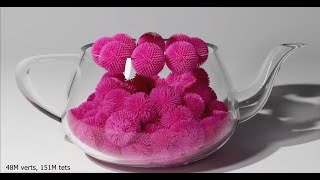
Today we are going to simulate the movement of elastic bodies on a computer. Let's start with a bunch of these really squishy balls in a teapot. Over time they just add more and more and it seems to never end. Look at how beautifully it is simulated, how they bump into each other. Simulating such a thing is a miracle of science because we would have to calculate 1 million collisions in. Imagine an airport with 1 million people, soft bodies bumping into each other. Simulating such a thing would be an absolute nightmare. And yet it is still possible here. Loving it. And at the end of the video I will tell you how incredibly fast this work is. It is going to be something else. Now, next experiment. Octopi and armadillos. This is going to be incredibly tough. Now hold on to your papers fellow scholars and look at how many interactions need to be modeled here. And look at how beautifully they press against the glass enclosure. Loving it. And wait, it gets worse as you drop more objects on the top here. Don't forget these are all elastic materials. So they are all going to weigh on each other, thereby creating this beautiful wave like behavior. This is super difficult because you can't just cheap out on simulating the objects on the bottom. They are still doing a lot here. And there are so many incredible little experiments in this research paper. I don't even know where to start. Dear fellow scholars, this is two minute papers with Dr. Zsolnai. Actually, let's start here. Let's flatten this poor little armadillo. Wow, they really meant it when they said flatten. And when we let go it gets back to its original shape accurately. But that's not the only way of testing the limits of such a simulator. Look at this. Ouch. This is going to hurt. But that is not the point of the experiment. The point of the experiment is to show whether the simulator still remains stable. The despite these crazy conditions is is. My goodness. That was tough. Or so I thought. But that was not even the extreme torture test. It is coming up in a moment. But before that, look at this from a previous paper. This is when the simulator just can't take it anymore and it blows up. I wonder if it happens with the new tests that lets start pulling this little bunny in many directions. I think there is no way the simulator remains stable under these conditions. And look. Yes, we get an additional treat. It is going to be let go. And this is going to be the mother of all stability tests. So does it blow up? What do you think? Let's see. Oh, perfectly stable. Although it is also likely extremely painful. So cool. Yes, before you ask, computer graphics researchers love to do this. It is one of the best perks of the job. And it gets better. It can also simulate different friction coefficients and even topological changes. In other words, tears in the fabric if necessary. This technique feels like it can do absolutely anything. And now let's do a little squishing. Previous technique here is a big cube, which is 2,000 times heavier than the small one. And it goes a bit like the Apple iPad crushing ad that was not very popular with the people and it noobed out after a few seconds. While the new method of. Oh yes. The difference is that the cube is not even supposed to be squished here. It would have to be launched out of the way. In this case, it all happens correctly. Excellent. And while we are looking at these crazy experiments, I tried to explain how much of a miracle of human ingenuity this paper is. Many of these simulations showcase about 50 million vertices and. And 150 million tetrahedra. What does that mean? Well, imagine that we have a million people in a city, each of them in their own little buildings, and the population of that city is almost 50 times the population of San Francisco. So far, so good. Now imagine that all of these people are packed into a tiny teapot. And this is what this simulation does. Wow. So how does all this wizardry work? Well, the key is that this new technique subdivides one big problem into many smaller problems. And one of the keys is that these little problems can now be solved completely independent of each other. It also uses Gauss Seidel iterations, which is a bit like trying to fix a chair while you are sitting on it. Beautiful technique. I wrote a fluid simulator as my master's thesis that uses it. Click the link in the description if you wish to check it out. It comes with a full explanation and source code of how it works. So, as I promised, how quickly does it do all this? Hours? Days? Nope, not even close. All this happens in a few seconds per frame. Wow. Okay, but we are experienced fellow scholars here. We also ask, ok, but how much faster is this technique than the previous ones? Here you see the error receding over time as the simulation runs. And the new one is ok. Hmm. Twice or three times as fast. That would be great. However. Oh my goodness. Holy matter of papers. Look at that. This is not a linear scale. This is a logarithmic scale. What does that mean? It means that this is not just twice as fast. It is potentially up to a hundred to a thousand times faster than previous techniques. I had to double and then triple check to make sure I am seeing correctly. I also talked to the authors about this to make sure that you are getting correct information that is absolutely stunning. And don't forget it is not only fast, but is also more stable than previous techniques. Bravo. Huge congratulations to the authors. Also get this, no AI is used here. This is all handcrafted human ingenuity. How cool is that. And research papers like this is what we celebrate here on two minute papers. What a time to be alive. Experiment tracking, model evaluation and production monitoring for your deep learning projects and LLM apps. This is what weights and biases does and it is the best. Everyone is using it. Try it out now at WNB Me Papers or click the link in the description below.