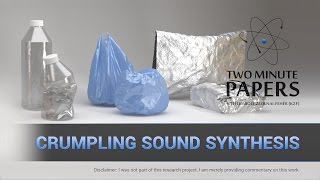
Karoly Zsolnai-Feher explains how researchers synthesize realistic crumpling sounds from physics simulations. A naive approach takes tens of hours to generate seconds of audio, but the team achieves 5 to 10 times speedup by discarding insignificant vibrations and grouping vertices into patches.
Chapters
Dear fellow scholars, this is two minute papers with Today we are going to.
Crush some soda cans.
In the footage that you see here, the animations are performed by an already existing algorithm for thin shell deformations and for a complete sensorial experience. This piece of work aims to synthesize.
Sound for these phenomena. Sounds for crumpling up all kinds of candy wraps, foils and plastic bags.
A lofty, noble goal.
Loving it.
However, this problem is extraordinarily difficult. The reason is that these crumpling simulations are amazingly detailed. And even if we knew all the physical laws for the sound synthesis, which is already pretty crazy, it would still be a fruitless endeavor to take into consideration every single thing that takes place in the simulation. We have to come up with ways to cut corners to decrease the execution.
Time of our algorithm.
Running a naive exhaustive search would take.
Tens of hours for only several seconds of footage.
And the big question is, of course, what can we do about it? And before we proceed, just a quick.
Reminder that the geometry of these models are given by a lot of connected.
Points that people in computer graphics like to call vertices. The sound synthesis takes place by observing the changes in the stiffness of these.
Models, which is the source of the crumpling noise.
Normally, our sound simulation scales with the number of vertices, and it is abundantly clear that there are simply too many.
Of them to go through one by one.
To this end, we should strive to.
Reduce the complexity of this problem. First, we start with identifying and discarding the less significant vibration modes.
Beyond that, if in one of these.
Vertices, we observe that a similar kind.
Of buckling behavior is present in its neighborhood with we group up these vertices into a patch, and we then forget.
About the vertices and run the sound.
Synthesis on these patches. And of course, the number of patches is significantly less than the number of.
Vertices in the original model.
In this footage, you can see some.
Of these patches, and it turns out.
That the execution time can be significantly.
Decreased by these optimizations.
With these techniques, we can expect results in at least five times quicker. But. But if we are willing to introduce slight degradations to the quality of the sounds, we can even go 10 times quicker with barely perceptible changes. To evaluate the quality of the solutions.
There is a user study presented in the paper.
And the pinnacle of all tests is of course, when we let reality be our judge. Everything so far sounds great on paper, but how does it compare to what.
We experience in reality? Wow.
Truly excellent results. Suffice to say, they are absolutely crushing it. And we haven't even talked about stochastic enrichment and how one of these problems.